



Transfer pricing has become a defining issue for companies with cross‑border operations. Canada’s arm’s length principle is at the core of the transfer‑pricing rules that determine whether the pricing between related parties is acceptable for tax purposes. Recent policy changes, notably the Budget 2025 modernization of section 247 of Canada’s Income Tax Act, make understanding the principle even more important.
This guide explains what the arm’s length principle means, how it fits into the Canadian tax framework, how comparable transactions and multiple‑year data should be analysed, and what businesses should do to comply with the latest rules.
What Is the Arm’s Length Principle?
The arm’s length principle requires that transactions between related entities be priced as if the parties were independent. Article 9 of the OECD Model Tax Convention states that when conditions in commercial or financial relations between associated enterprises differ from those that would exist between independent enterprises, profits which would have accrued to one of the enterprises may be taxed accordingly. Canada adopts this principle in section 247 of its Income Tax Act, which allows the Canada Revenue Agency (CRA) to adjust a taxpayer’s transfer prices when non‑arm’s‑length transactions do not reflect market conditions.
Why it matters
- Cross‑border transactions within a multinational enterprise (MNE) can distort where profits are reported. Tax authorities around the world scrutinise transfer pricing to protect their tax base.
- The arm’s length principle ensures fairness by aligning related‑party pricing with prices that would have been negotiated between unrelated parties. Without it, a group could minimise tax by allocating profits to low‑tax jurisdictions, as illustrated in the “Canco” example below.
- In Canada, failure to apply the principle can result in costly reassessments, penalties and double taxation.
Example: How transfer pricing influences tax
A Canadian company (Canco) sells hockey sticks to its Bahamian subsidiary (Foreignco). Canco’s arm’s‑length price to unrelated customers is $3 per stick, but its cost is $2. If Canco charges Foreignco $2 instead of $3, it reports no profit in Canada, while profits shift to the Bahamas, where no tax is paid. By underpricing, the group saves Canadian tax. Transfer‑pricing rules prevent this by ensuring Canco charges its related party the same price it would charge an independent buyer.
Canada’s Transfer Pricing Framework
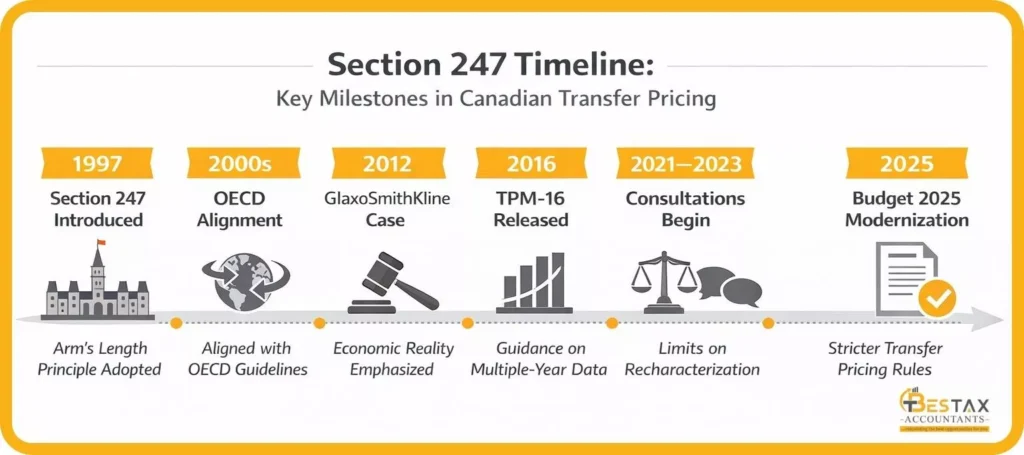
Section 247 of the Income Tax Act
Section 247 is the statutory backbone of Canadian transfer‑pricing rules. Subsection 247(2) allows the CRA to adjust a transaction’s terms when:
- The terms and conditions differ from those that arm’s‑length parties would have agreed to.
- The transaction or series would not have been entered into by persons dealing at arm’s length and can reasonably be considered not to have been undertaken for a bona fide purpose other than to obtain a tax benefit.
The CRA can adjust the quantum and nature of amounts relating to the transaction so they reflect what would have been agreed at arm’s length.
Who is considered non‑arm’s length?
The Tax Act deems parties not to be dealing at arm’s length when there is a common mind directing the bargaining, when parties act in concert without separate interests, or where one party controls the other.
Related persons, corporations under common control, a corporation and its controlling shareholder, and individuals connected by blood, marriage or adoption, are deemed non‑arm’s length.
CRA guidance and OECD alignment
Canada’s rules follow the OECD Transfer Pricing Guidelines. The CRA recognises that the OECD guidance generally supports its interpretation of the arm’s length principle and uses it to interpret section 247. Budget 2025 proposes codifying this by requiring analyses under section 247 to be conducted consistently with the OECD guidelines.
Documentation and reporting requirements
Businesses engaged in cross‑border non‑arm’s‑length transactions must maintain contemporaneous documentation. The CRA requires documentation supporting transfer‑pricing methodologies, functional analyses and choice of comparables, and it must be ready within three months of a CRA request. Budget 2025 would shorten this window to 30 days, increasing the importance of real‑time documentation.
Reporting obligations include filing Form T1134 for foreign affiliates and Form T106 for non‑arm’s‑length transactions with non‑residents. Large multinational enterprise groups (revenue over €750 million) must also file a Country‑by‑Country report.
Penalties and audit period
If transfer prices do not reflect arm’s‑length terms, the CRA can impose a penalty equal to 10 % of certain adjustments. The CRA generally has three years (individuals and Canadian‑controlled private corporations) or four years (other taxpayers) to reassess, with a three‑year extension for transfer‑pricing issues. Budget 2025 proposes increasing the de minimis penalty threshold from CAD 5 million to CAD 10 million, offering limited relief for smaller taxpayers.
Comparability Analysis: The Heart of the Arm’s Length Principle
The arm’s length principle hinges on comparing controlled transactions with uncontrolled ones. The OECD guidelines and CRA memoranda emphasise that a comparability analysis is essential. Two transactions are comparable if:
- Differences do not materially affect the price or profit, or
- Differences can be reasonably adjusted to eliminate the effect.
Key comparability factors
To determine comparability, the following factors must be considered:
- Contractual terms: the rights and obligations of each party.
- Functions performed, assets used and risks assumed: what each party does, what resources are used and who bears the risks.
- Characteristics of property or services: including the nature of goods, services or intangibles.
- Economic circumstances: geographic markets, market size, competition and economic cycles.
- Business strategies: such as expansion plans, market penetration strategies or intangible development.
Functional analysis
A functional analysis examines these factors to understand the economic substance of a transaction. For example, a company that performs manufacturing, owns valuable intangibles and bears significant risk is likely entitled to a higher profit than a distributor that performs routine sales functions and bears little risk. The functional analysis guides the selection of comparables and the most appropriate transfer‑pricing method.
Role of multiple‑year data
The CRA’s Transfer Pricing Memorandum TPM‑16 clarifies how multiple‑year data should be used. It states that the arm’s length price must be established for each individual tax year. Taxpayers should not average results over multiple years when substantiating transfer prices; instead, the results of comparable transactions in the relevant year should be used.
Multiple‑year data may aid the comparability analysis by providing context about business cycles, product life cycles and economic factors, but averaging results across years can obscure important variations and reduce comparability. Statistical tools like ranges or averages can summarise data within a single year, but pooling data across years is not acceptable.
Transfer Pricing Methods in Canada
Canada endorses the OECD’s five primary transfer‑pricing methods. The CRA selects “the most appropriate method” based on the circumstances. The methods fall into two categories: traditional transaction methods and transactional profit methods.
Traditional transaction methods
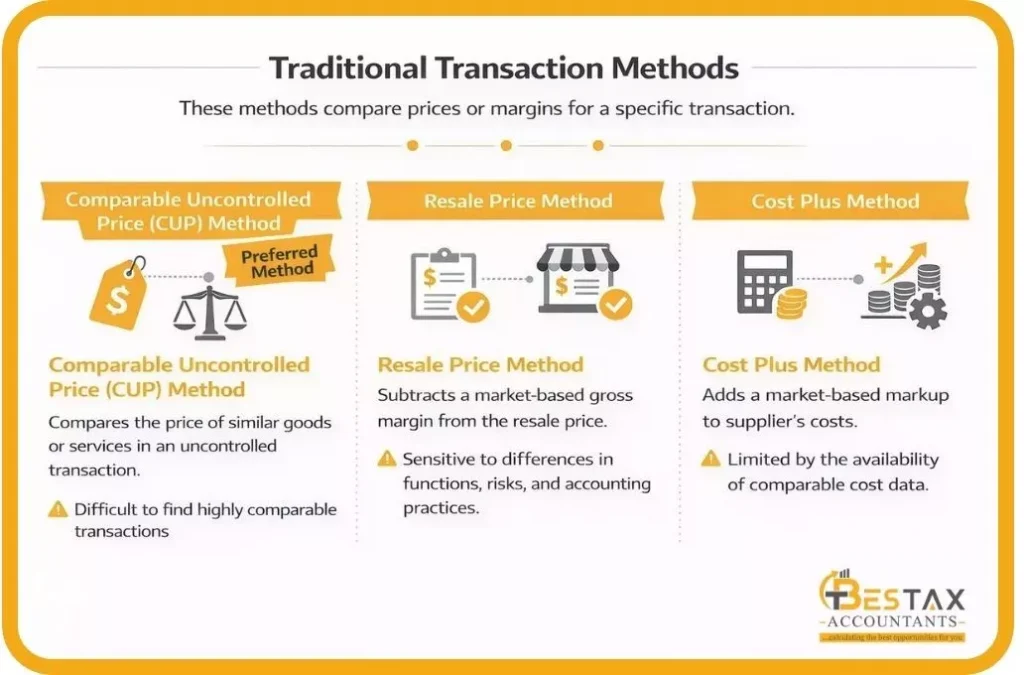
These methods compare prices or margins for a specific transaction.
- Comparable Uncontrolled Price (CUP) Method: The preferred method for both the CRA and OECD. It compares the price of goods or services in a controlled transaction with the price of similar goods or services in an uncontrolled transaction. Drawback: difficult to find truly comparable transactions with identical characteristics.
- Resale Price Method: Starts with the price at which a product is resold to an independent party and subtracts an appropriate gross margin based on comparable uncontrolled transactions. Useful for distributors but sensitive to differences in functions and accounting practices.
- Cost Plus Method: Calculates an arm’s length price by adding a market‑based markup to the supplier’s cost. Common for routine manufacturing or services but limited by the availability of comparable cost data.
Transactional profit methods
These methods evaluate the net profits of a controlled transaction relative to profits from comparable uncontrolled transactions.
- Transactional Net Margin Method (TNMM) / Comparable Profits Method (CPM): Compares the net profit margin relative to an appropriate base (e.g., sales, costs or assets) earned by a related party with that earned by comparable independent companies. Easier to apply because it relies on broader financial data, but may overlook functional differences.
- Profit Split Method: Allocates the combined profits from interrelated controlled transactions according to each party’s contribution. Used when transactions are highly integrated or involve unique intangibles. Because it is subjective, it is often considered a last resort.
Method hierarchy and selection
The CRA and the OECD consider traditional transaction methods, particularly the CUP method, preferable when reliable data exist. However, the method chosen must reflect the functions, assets and risks of the parties.
Summary table of transfer pricing methods
| Method | Type | Key points | When appropriate |
|---|---|---|---|
| Comparable Uncontrolled Price (CUP) | Traditional transaction | Compares price of controlled transaction to comparable uncontrolled transaction | When there are highly similar uncontrolled transactions and reliable price data |
| Resale Price Method | Traditional transaction | Uses resale price minus appropriate gross margin | Distributors that resell products without adding significant value |
| Cost Plus Method | Traditional transaction | Adds market‑based markup to supplier’s costs | Routine manufacturing or service providers where cost data is available |
| TNMM/CPM | Transactional profit | Compares net profit margins to those of comparable companies | When transaction‑level data is scarce but financial data is available |
| Profit Split Method | Transactional profit | Allocates combined profits based on contributions | Highly integrated operations or unique intangibles where other methods fail |
Multiple‑Year Data: Guidance from CRA TPM‑16
Purpose and background
TPM‑16 provides guidance on how to use multiple‑year data in transfer‑pricing analyses. Its purpose is to prevent incorrect transfer‑pricing conclusions caused by averaging outcomes over multiple years. The memorandum emphasises that comparability analysis is the proper context for multiple‑year data.
CRA policy
- The CRA requires arm’s‑length prices to be determined year by year.
- Averaging results over multiple years to substantiate transfer prices is not allowed, except in an Advance Pricing Arrangement (APA) context.
- Multiple‑year data may be used to understand economic characteristics (business cycles, life cycles, market trends) and to decide whether transactions are comparable.
- Statistical tools (ranges, means or medians) are acceptable when applied to results within a single year; pooling data across years reduces comparability and is not acceptable.
Practical takeaway
Use multiple‑year data to inform your comparability analysis (e.g., recognising cyclical trends) but determine your arm’s‑length price using the results of each tax year separately. If you are negotiating an APA, multiple‑year averages may be part of forecasting, but your actual transfer prices will still be tested year by year.
Documentation Requirements and CRA Penalties
Adequate documentation is critical. To be considered to have made “reasonable efforts” to determine arm’s‑length prices, a taxpayer must compile information known as contemporaneous documentation. Key points include:
- Due date: Under current law, contemporaneous transfer-pricing documentation must be prepared by the taxpayer’s filing-due date and, upon a written CRA request, provided within 3 months. Budget 2025/Bill C-15 would shorten the response window to 30 days, applying to taxation years beginning after November 4, 2025.
- Reasonable efforts: Without contemporaneous documentation, the CRA may apply a 10 % penalty on adjustments.
- Forms: File T1134 for foreign affiliates and T106 for non‑arm’s‑length transactions with non‑residents, and comply with Country‑by‑Country reporting for large groups.
- Audit period: The CRA can reassess up to three years (four for non‑CCPCs), with an additional three‑year extension for transfer‑pricing issues.
Practical Considerations and Best Practices
- Conduct a robust functional and comparability analysis: Identify the functions, assets and risks of each party and select appropriate comparables. Consider multiple‑year data to understand industry cycles but derive pricing on a year‑by‑year basis.
- Select the most appropriate transfer‑pricing method: Use the CUP method whenever reliable comparable data exist. If data are scarce, consider TNMM or the profit split method for complex or intangible‑rich transactions.
- Keep contemporaneous documentation: Prepare documentation by your tax return filing deadline and update it regularly. Under the proposed 30‑day response rule, delays could lead to penalties.
- Monitor Budget 2025 developments: Changes such as codifying arm’s‑length conditions and tightening timelines will require updates to policies and systems. Engage tax advisors to ensure your transfer‑pricing practices remain compliant.
- Use advance pricing arrangements (APAs) where appropriate: An APA can provide certainty about future transfer‑pricing methodology and pricing. Multi‑year averages may play a role in APAs, but taxpayers should still prepare annual analyses.
- Prepare for audits: Expect CRA auditors to request transfer‑pricing documentation at the outset of an audit. Keep your documentation accessible and ensure you can demonstrate reasonable efforts.
Conclusion
The Arm’s Length Principle remains the foundation of Canada’s transfer-pricing regime. The core idea has not changed.
If your business operates across borders, now is the time to act. Review your transfer-pricing policies. Refresh your benchmarking studies. Make sure your documentation is audit-ready and accessible within CRA deadlines.
If you want expert help, speak with Bestax Accountants. Our transfer-pricing specialists support Canadian and multinational businesses with compliant policies, defensible documentation, and audit support.
Quick (FAQs)
What does “arm’s length” mean in Canadian transfer pricing?
It means that the terms and conditions of transactions between related parties must match those that would have been agreed by independent parties dealing with each other at arm’s length. Canada follows Article 9 of the OECD Model Tax Convention and Section 247 of the Income Tax Act.
How do I know if parties are not dealing at arm’s length?
Parties are not dealing at arm’s length when a common mind directs their bargaining, they act together without separate interests, or one controls the other. Related persons, such as corporations under common control or individuals connected by blood or marriage, are deemed non‑arm’s length.
What documentation must I keep for transfer pricing?
You need contemporaneous documentation that explains your transfer‑pricing methodology, functional analysis, choice of comparables and calculations. It must be ready by your tax‑return filing date and provided to the CRA within three months, or 30 days under the proposed Budget 2025 rules.
Which transfer‑pricing method should I use?
The CRA applies the most appropriate method for the circumstances. When reliable price data for comparable transactions exist, the CUP method is preferred. For distributors, the resale price method may be suitable. For routine manufacturers or service providers, the cost plus method is common. When transaction‑level data are scarce, TNMM or the profit split method may be used.
Can I average results over multiple years to justify my transfer price?
No. According to the CRA’s TPM‑16, arm’s‑length prices must be established year by year. Multiple‑year data can help analyse economic trends but should not be averaged to determine prices.
What changes in Budget 2025 should I be aware of?
Budget 2025 proposes codifying arm’s‑length conditions, emphasising economic substance, aligning with OECD guidelines, increasing the penalty threshold to CAD 10 million, and shortening the documentation response time to 30 days. It introduces a new analytical rule requiring consideration of the actual conditions of a transaction.
What happens if I don’t comply with Canada’s transfer‑pricing rules?
The CRA may adjust your income and impose penalties equal to 10 % of certain adjustments. Penalties and reassessments can lead to double taxation and interest costs.
Disclaimer: The information provided in this blog is for general informational purposes only. For professional assistance and advice, please contact experts.