


Someone close to you passes away. You are set to receive money or property from their estate. A friend tells you not to worry, Canada has no inheritance tax, so you owe nothing. You relax. Then, a few months later, the estate gets hit with an unexpected tax bill, and suddenly, the amount you expected to receive is much smaller. This situation plays out in Canadian families every single year, and it happens because of one very common misunderstanding.
The phrase “inheritance tax Canada” is searched online constantly, usually by people either planning their estate or trying to understand what they are about to receive. The confusion comes from the fact that Canada genuinely does not have a formal inheritance tax, a law that charges the person who receives money from an estate. But that does not mean death is tax-free in this country. Far from it. The tax just hits differently, and at a different stage, than most people expect.
The difference between inheritance, probate, and estate tax
Three separate things get mixed up in most conversations about this topic: inheritance tax, probate fees, and taxes triggered by death. An inheritance tax would charge the beneficiary, the person receiving the money, a percentage of what they receive. Canada does not have that. Probate is a court process that validates a will and grants the executor legal authority to act. It costs money and takes time, but it is not a tax on the estate’s income. The real tax exposure at death in Canada comes from a concept called deemed disposition, which treats the deceased as though they sold all their assets the day before they died. That triggers capital gains and other income, and those amounts go on the estate’s tax return, not the beneficiary’s.
What this guide will explain for heirs, beneficiaries, and executors
This guide is written for three groups of people: beneficiaries who want to know what they will actually receive, executors who need to understand their legal and tax responsibilities, and families who want to plan ahead and avoid surprises. By the end, you will know exactly who pays what, when they pay it, and what can be done to lower the overall tax cost before and after death.
What Inheritance Tax Means in Canada
Why the Canadian inheritance tax is not a direct tax
Canada does not have a tax law that says, when you receive $200,000 from an estate, you owe the government a portion of it. That type of direct tax on the beneficiary does not exist here. The United States has estate taxes, and some states have inheritance taxes. Canada chose a different approach when it eliminated its federal estate tax back in 1972. Instead of taxing what is received, Canada taxes what is left behind, specifically, the income and capital gains that arise when a person dies, and their assets are treated as sold.
How Canadian tax law treats death, assets, and estate value
Under Canadian tax law, when a person dies, the Canada Revenue Agency treats it as a deemed disposition. That means the deceased is considered to have sold every asset they owned at fair market value on the day before death. If those assets, a vacation property, a stock portfolio, a rental unit, were worth more than what was originally paid for them, the difference is a capital gain. That capital gain is added to the deceased’s final tax return, and the estate is responsible for paying whatever taxes result before anything is passed to heirs.
Why do people confuse inheritance taxes with probate and income tax
The confusion is understandable because all three things, probate fees, income tax on the final return, and the deemed disposition, cost the estate money and reduce what beneficiaries ultimately receive. They look similar from the outside, even though they work through entirely different mechanisms. Probate is a provincial fee based on the estate’s gross value. Income tax on the final return covers employment income, pension income, and RRSP/RRIF amounts. The deemed disposition covers capital gains on assets. None of these is technically an inheritance tax, but together they can add up to a significant reduction in the estate’s net value.
Does Canada Have an Inheritance Tax in 2026?
The direct answer to does canada have an inheritance tax
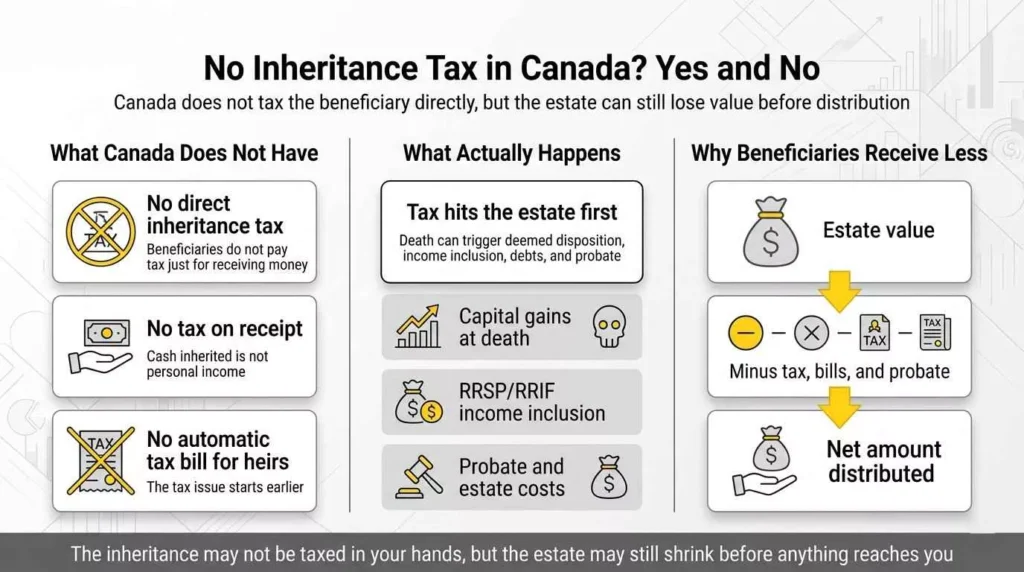
No. Canada did not have an inheritance tax in 2026. There is no law requiring a beneficiary to pay a percentage of what they receive from an estate to the federal or provincial government simply because they inherited it. If you receive $300,000 from your parents’ estate, that $300,000 is not taxable income in your hands under Canadian tax law as it stands today.
Is there an inheritance tax in Canada or not?
There is not, at least not in the traditional sense. What exists instead is a tax framework that applies to the estate itself before assets are transferred. The estate pays taxes on income earned up to the date of death, on RRSP and RRIF amounts that are not rolled to a spouse, and on capital gains from deemed disposition. After those taxes are paid out of the estate’s assets, the remaining amount passes to beneficiaries without them owing additional tax on the receipt itself.
Why the real issue is tax at death, not tax on receipt
The real tax issue is not what the beneficiary receives; it is what happens to the estate before they receive it. Large capital gains, significant RRSP balances, and investment properties with substantial unrealized gains can create tax bills that consume a significant portion of an estate’s value. This is why estate planning matters, and why the statement Canada has no inheritance tax is technically true but financially misleading.
Who Pays Tax After a Person Dies?
When the estate pays tax before beneficiaries receive money
The estate pays taxes first. Think of the estate as a temporary legal entity that handles everything between the date of death and the final distribution to heirs. It files tax returns, pays any outstanding tax balances, settles debts, and handles probate before a single dollar moves to a beneficiary. Only after all of those obligations are cleared does the remaining wealth transfer to the people named in the will.
CRA provides a detailed overview of the entire process in its official guide on doing taxes for someone who died, which walks through the types of returns that may need to be filed, what income gets reported, and how the legal representative carries out their responsibilities during the estate settlement period.
When the executor becomes responsible for filings and payments
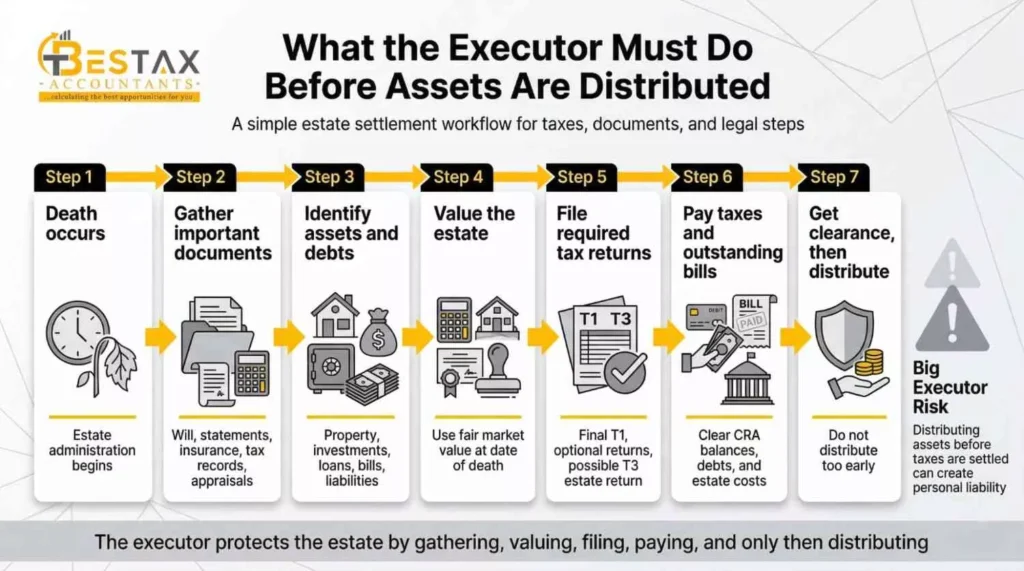
The executor, the person named in the will to manage the estate, takes on real legal responsibility the moment they accept the role. They are required to file the deceased’s final T1 return, an optional rights and things return if applicable, and potentially an estate return for income earned after death. If the executor distributes assets to beneficiaries before paying all tax obligations and before receiving a clearance certificate from CRA, they can be held personally liable for any unpaid amounts. That is not a risk worth taking, regardless of family pressure to move quickly.
Do beneficiaries pay tax on inheritance in Canada?
In most situations, no. Beneficiaries who receive cash or property from a Canadian estate do not report that receipt as income on their personal tax return. The tax was handled at the estate level. The exception comes afterward: if an inherited property earns rental income after it is transferred, or if it is sold and a capital gain results, the beneficiary will owe tax on those future amounts. The act of inheriting itself does not create a personal tax bill.
How the Estate Tax Bill Is Created
Deemed disposition and why assets are taxed at fair value
The deemed disposition rule is the heart of Canada’s estate tax framework. On the day before death, CRA treats every asset as sold at its current fair market value. If a deceased person held shares purchased for $30,000 that were worth $90,000 at death, the $60,000 difference is a capital gain on their final return. The same applies to a cottage, a rental property, or a non-registered investment account. The principal residence is the main exception; a home that qualifies as the principal residence can be sheltered from capital gains on the final return.
How the capital gains tax can apply to property and investments
Capital gains from deemed disposition are included in the deceased’s income for the year of death. In Canada, only a portion of the capital gain is taxable. Currently, one-half of the gain is included in income for individuals in most circumstances, though the rules around inclusion rates have been subject to federal proposals in recent years, and the applicable rate depends on when the gain arose and under which rules the estate is filing. This taxable portion is added to all other income on the final return and taxed at the deceased’s marginal rate, which can be significant if the estate held assets with large unrealized gains.
How RRSPs, RRIFs, and other income trigger tax liability
RRSP and RRIF balances are fully included in the deceased’s income in the year of death unless they are transferred to a surviving spouse or a financially dependent child or grandchild. A $400,000 RRSP balance that is not eligible for a rollover adds $400,000 to the deceased’s taxable income in a single year, potentially pushing the entire amount into the highest marginal tax bracket. This is one of the most significant and most overlooked sources of estate tax in Canada.
Tax on Inherited Property in Canada
Tax on inherited property in Canada explained simply
When you inherit a property, the transfer itself is not taxed in your hands. The estate handles the deemed disposition at the date of death. However, when you inherit the property, you take on a cost base equal to the fair market value at the date of death. From that point forward, any increase in value while you own it becomes your own future capital gain if and when you sell.
Inheritance tax in Canada on property vs capital gains tax
The term inheritance tax Canada on property is commonly searched, but what people are really asking about is capital gains tax, either at the estate level when the deemed disposition occurs, or at the beneficiary level when they eventually sell. These are two separate events with two separate taxpayers. The estate handles the first one. The beneficiary handles the second, but only when a sale actually happens. Holding a property does not trigger a tax bill. Selling it does.
What happens if inherited property is kept, rented, or sold
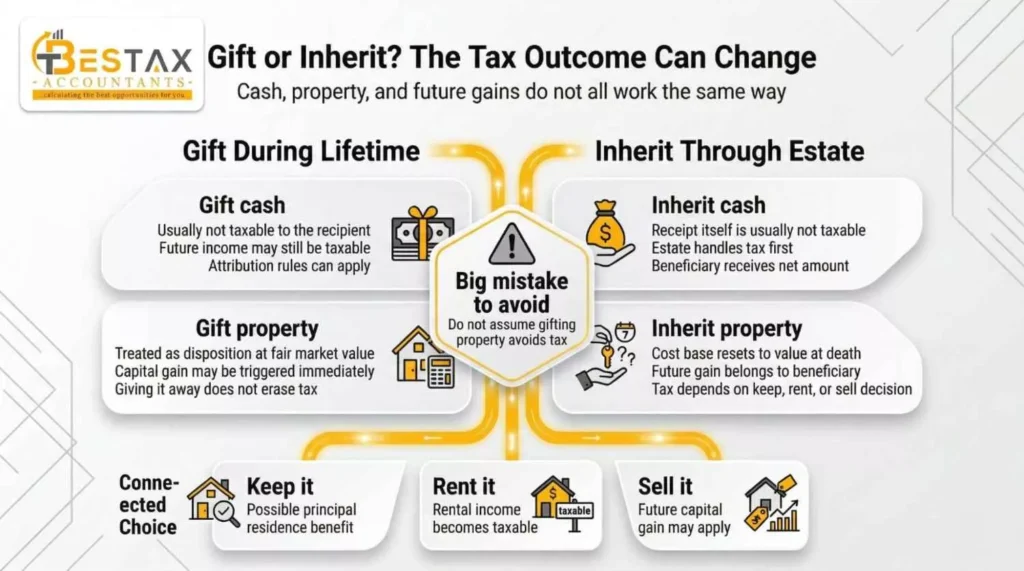
If you keep the property and live in it as your principal residence, future gains may be sheltered when you eventually sell. If you rent it out, the rental income is fully taxable in your hands each year, and the property is no longer eligible for principal residence treatment. If you sell it, any increase in value above the cost base you inherited at death becomes a capital gain. Each of these paths has different tax implications, and the decision about what to do with inherited real estate is worth thinking through carefully before acting.
Probate, Debts, and Estate Administration
What probate is and why it affects time and money
Probate is the court process that confirms a will is valid and gives the executor the legal authority to manage and distribute the estate. Not all assets go through probate; assets with a named beneficiary or held jointly with right of survivorship typically bypass it. But assets held in the deceased’s name alone generally do go through probate, and the fees are based on the gross estate value in most provinces. Ontario charges 1.5 percent of the estate value above $50,000. British Columbia charges 1.4 percent above $50,000. These amounts are not income tax, but they reduce the estate’s net value before distribution.
How outstanding bills are paid before the wealth transfer happens
Before a dollar of inheritance reaches a beneficiary, the executor must settle all of the deceased’s outstanding financial obligations: funeral costs, outstanding credit card balances, mortgage balances on property not passing with the debt, income tax owing from prior years, and any current year tax liability from the final return. Only what remains after all of these are satisfied passes to the beneficiaries named in the will. If the estate does not have enough liquid assets to cover these obligations, the executor may need to sell property to raise the necessary funds.
Which assets may bypass probate through beneficiaries or a trust setup
Assets with a named beneficiary, registered accounts like RRSPs, TFSAs, and life insurance policies, pass directly to the named person without going through probate. Jointly held assets with right of survivorship transfer directly to the surviving owner. Assets held in a trust during the person’s lifetime also bypass the estate and probate entirely. These are common planning tools used to reduce probate fees and speed up wealth transfer after death.
Executor Duties Before Assets Are Distributed
What important documents must the executor gather first?
The executor’s first job is to gather every document needed to establish what the estate owns and what it owes. That means locating the will, collecting account statements for all financial institutions, getting property assessments or appraisals for real estate and other assets, tracking down insurance policies, and finding any prior year tax returns or outstanding CRA correspondence. This document-gathering stage is time-consuming but non-negotiable; you cannot file accurate returns or settle debts without a complete picture of the estate’s assets and liabilities.
Which tax returns may need to be filed for the estate?
The executor may be required to file more than one tax return. The final T1 return covers all income from January 1 of the year of death through the date of death. An optional rights and things return can be filed separately for certain types of income, like uncashed cheques or unpaid salary, and may result in lower overall tax. If the estate earns income after the date of death (rental income, investment income, business income), a T3 estate return may also be required for each year the estate remains open. Each of these has its own deadlines.
Why assets should not be distributed too early
Distributing assets before all tax obligations are settled is one of the most serious mistakes an executor can make. If CRA later determines that additional tax is owed and the estate has already been distributed, the executor may be personally liable for the unpaid amount. The proper protection against this risk is a CRA clearance certificate. You can learn more about what it involves through a Bestax resource on the CRA clearance certificate and how to apply for it. CRA also outlines the formal process in its own instructions on how to apply for a clearance certificate, a step every executor should complete before making any final distributions to beneficiaries.
Estate Planning to Reduce Tax Liability
How a smart estate plan lowers risk and delays
The decisions made while someone is alive have a direct impact on how much tax the estate pays after they are gone. A well-structured estate plan identifies which assets will trigger the largest tax bills at death, considers strategies to reduce those bills in advance, and ensures that the right people and accounts are named as beneficiaries. This kind of advance work does not eliminate all taxes, but it can meaningfully reduce them, and it almost always speeds up the distribution process for heirs.
Where trusts, succession planning, and beneficiaries help
Spousal rollovers allow assets, including RRSPs, RRIFs, and capital property, to transfer to a surviving spouse on a tax-deferred basis, meaning the tax bill is postponed until the spouse either withdraws the funds or passes away. Trusts can hold assets outside of the estate and outside of probate, reducing fees and keeping distribution private. Naming beneficiaries on registered accounts and life insurance policies ensures those assets bypass the estate entirely, reaching their intended recipient faster and without probate costs.
What legal planning can do without chasing fake tax loopholes?
Good estate planning works within the rules, it takes advantage of legitimate provisions in the Income Tax Act like the principal residence exemption, the spousal rollover, the lifetime capital gains exemption for qualifying business and farm property, and proper beneficiary designations. It does not involve offshore arrangements, artificial transactions, or strategies that CRA would view as aggressive tax avoidance. The goal is to use the options that already exist in the law, applied to the specific circumstances of the estate.
Gifting vs Inheriting: Which Is Better?
Is it better to gift money or leave inheritance money?
Gifting cash during your lifetime generally does not trigger a tax bill for the recipient in Canada. The recipient does not report the gift as income. However, the gift does not reduce the donor’s estate for tax purposes in the same dramatic way people often expect. Any income earned on the gifted funds going forward is taxable to the recipient, but attribution rules may bring some of that income back to the donor in certain circumstances, particularly when gifting to a spouse or minor child.
Is it better to gift or inherit property in Canada?
Gifting property during your lifetime is treated as a disposition at fair market value on the date of the gift. If the property has gone up in value since you bought it, gifting it triggers a capital gain, the same as selling it. This surprises many people who assume that giving something away avoids the tax. It does not. The tax treatment is nearly identical whether you gift the property today or it is transferred through your estate at death. The timing changes, but the capital gain calculation follows the same rules.
When gifting creates tax implications instead of tax relief
Gifts of appreciated property, gifts to a spouse that trigger attribution rules, and large cash gifts that affect the donor’s own financial security are all situations where gifting can create more problems than it solves. The most common mistake is assuming that transferring assets out of your name before death eliminates the tax. CRA has clear rules on deemed dispositions that apply to inter-vivos transfers, and the tax can follow the transaction regardless of the label placed on it.
Cross-Border and BC Inheritance Issues
Inheritance tax bc canada and probate cost differences
British Columbia charges probate fees, officially called the Probate Fee under the Probate Fee Act, at 1.4 percent of estate assets over $50,000. This is not an inheritance tax but it does reduce the amount that eventually reaches beneficiaries. BC also has no separate provincial estate or inheritance tax beyond these probate fees. The income tax rules from CRA apply federally across all provinces, including BC, so the deemed disposition, RRSP inclusion, and capital gains treatment are the same as everywhere else in Canada.
How foreign assets can change estate tax exposure
If the deceased owned assets outside Canada, real estate in the United States, investment accounts with a US broker, or other foreign property, the estate may face tax obligations in both countries. The US has its own estate tax rules that apply to non-residents who hold US-situated assets above a certain threshold. Canada taxes the gain on those assets through deemed disposition. These two tax systems can overlap, and while the Canada-US tax treaty provides some relief, the interaction is complex enough to require professional guidance.
Why U.S. property and cross-border wealth need extra planning
A Canadian resident who owns a US vacation property, US stocks in a brokerage account, or a US business interest is in a more complicated position than someone with entirely Canadian assets. The US estate tax threshold for non-residents is significantly lower than for US citizens, which means a relatively modest US asset base can trigger US estate tax liability. Planning for this situation requires coordinating between Canadian and US tax rules well before death, not after.
Common Inheritance Mistakes to Avoid
Confusing probate fees with Canadian inheritance tax
Probate fees feel like a tax, but they are not income tax on the estate. They are an administrative fee charged by the province to validate the will and authorize the executor to act. They are calculated on the gross estate value, not net, which means they apply before debts are paid. Many families make financial decisions based on the assumption that avoiding probate eliminates all costs at death, but probate fees are typically a smaller number than the income tax triggered by deemed disposition, RRSP inclusions, and capital gains.
Ignoring estate valuation, deadlines, and executor risk
Executors who underestimate the fair market value of assets at death, whether intentionally or through poor appraisal, put themselves at risk of CRA reassessment. An estate that includes real property, a private business, artwork, or other non-publicly traded assets needs proper independent valuations. Missing CRA filing deadlines also creates interest and penalties that reduce the estate’s value unnecessarily. The executor’s role carries real legal exposure, and taking shortcuts in valuation or timing is one of the most common ways that exposure becomes personal liability.
Making rushed decisions with inherited property or inheritance money
Grief pushes people toward fast decisions, selling a property quickly to close the estate, moving inherited funds into the wrong account type, or gifting money to other family members before understanding the tax position. Each of these actions can create tax consequences that were avoidable with a short pause and some professional input. The best approach in the weeks following a death is to secure the assets, gather the documents, and wait for a clear picture of the estate’s tax position before making any irreversible financial moves.
What to Do First When You Inherit Money
What is the first thing you should do when you inherit money?
The first thing to do is to do nothing that cannot be undone. Park inherited cash in a simple, accessible account and resists the urge to invest, spend, or gift it until they know the full picture. Find out whether the estate has been fully administered, whether all tax returns have been filed, and all debts have been settled. If you are also the executor, your first priority is gathering documents and engaging a tax professional who handles estate matters.
How to check tax implications before using or moving funds
Ask the executor whether a CRA clearance certificate has been issued. If it has not, the estate’s tax position is not yet finalized, which means the total you are receiving could still change. Confirm whether the inherited assets, particularly any property, carry a cost base that affects your own future tax position. If you inherited investment accounts, find out what the cost base of the individual holdings was at the date of death, since that becomes your starting point for future capital gains calculations.
When to pause, plan, and get estate planning advice
If the inheritance is significant, a large property, a substantial investment portfolio, or business interests, this is exactly the right time to sit down with a tax professional and an estate planner before making any decisions. Inherited wealth often carries tax complexity that is not immediately obvious, and the window between receiving assets and the first tax filing deadline is the best time to understand your position and plan accordingly.
Final Take: No Direct Tax, But Real Costs
The simple answer readers should remember
Canada does not have an inheritance tax. A beneficiary who receives money from a Canadian estate does not owe tax on that receipt. But the estate itself, before anything reaches a beneficiary, can owe significant income tax on capital gains, RRSP and RRIF inclusions, and other income triggered at death. That tax comes out of the estate’s assets before distribution, which is why the amount that actually reaches heirs is often less than expected.
Understanding how taxes on inheritance in Canada actually work, through the estate rather than on the recipient, is the foundation of good estate planning. Knowing this in advance, rather than discovering it during estate administration, is what separates a well-managed wealth transfer from a stressful and costly one.
The hidden costs people miss in estate administration
Beyond income tax, estates also carry probate fees, executor fees, legal and accounting costs, outstanding debts, and potential costs related to selling or managing property during the administration period. None of these is labelled as an inheritance tax, but they all reduce the net amount that beneficiaries receive. According to Statistics Canada, the median value of inheritances received by Canadians has grown substantially over the past decade as housing values increased, which means the tax and fee exposure at death has grown alongside them, making planning more important, not less.
When professional help makes sense for tax and succession planning
If the estate you are dealing with, either as a beneficiary or an executor, involves real property, registered accounts with large balances, a private business, foreign assets, or multiple beneficiaries with competing interests, this is exactly the situation where professional support pays for itself many times over. Bestax Accountants offers Estate and Trust Tax Planning Services in Canada, specifically designed for families working through estate administration and for individuals who want to structure their affairs before death to reduce the tax burden on what they leave behind. Getting that guidance early, while options are still open, is always the better approach than trying to correct decisions made in the middle of an estate crisis.
Quick FAQs
When you inherit money, is it taxable in Canada?
Money received as an inheritance is generally not taxable to the beneficiary in Canada. The estate handled taxes before distribution. However, any income you earn on that money after you receive it, interest, dividends, capital gains, is taxable to you in the normal way.
How much money can be legally given to a family member in Canada?
There is no federal gift tax in Canada and no annual gift limit that applies to cash gifts. You can give any amount of money to a family member without the recipient owing tax on the receipt. However, if you gift income-producing assets to a spouse or minor child, attribution rules may require that the resulting income be reported on your own return rather than theirs.
How is inheritance tax calculated in Canada?
Canada does not calculate an inheritance tax because it does not have one. What gets calculated is the tax owing on the estate’s income, including capital gains from deemed disposition, RRSP and RRIF amounts included as income on the final return, and any other income earned up to the date of death. These amounts are reported on the deceased’s final T1 return, taxed at their marginal rates, and paid out of the estate before beneficiaries receive anything.
Is it better to gift or inherit property in Canada?
Neither approach automatically avoids tax. Gifting property during your lifetime triggers a deemed disposition at fair market value, the same capital gains calculation that would apply at death. The timing differs, but the tax treatment follows the same rules. In some situations, holding the property until death allows for a spousal rollover that defers the tax, which can make inheriting more advantageous than an immediate gift.
Can I gift a house to my son without paying taxes in Canada?
Not entirely. If the house is your principal residence and qualifies for the full principal residence exemption, the capital gain can be sheltered and the transfer may occur without capital gains tax. If it is a secondary property, a rental, a cottage, or an investment property, transferring it to your son is treated as a sale at fair market value, and any gain above your original cost is a taxable capital gain in your hands in the year of the transfer.
How do I avoid inheritance tax in Canada?
Since Canada does not have a direct inheritance tax, the real question is how to reduce the tax the estate owes before assets are distributed. Legitimate strategies include naming beneficiaries on registered accounts and insurance policies to bypass probate, using spousal rollovers to defer income inclusion on RRSPs and capital property, claiming the principal residence exemption on the family home, using trusts to hold assets outside of the estate, and working with a tax professional to plan the structure of the estate well before death.
Is Canada going to have an inheritance tax?
As of 2026, there is no federal legislation introducing an inheritance tax in Canada, and no confirmed proposal from any major political party to create one. The topic comes up periodically in academic and policy discussions, but it has not moved into active legislative development. The current system, with deemed disposition, RRSP inclusion rules, and probate fees, will continue to apply until any future government makes a change through the normal legislative process.
Disclaimer: The information provided in this blog is for general informational purposes only. For professional assistance and advice, please contact experts