



Articles of Incorporation are the legal blueprints for your company. Without them you cannot create a corporation in Canada, because they define the corporation’s structure, purpose, share classes and governance. Many entrepreneurs in Rawalpindi and other parts of the world look to Canada for business opportunities.
Whether you’re a local wanting to do business across provincial borders or an entrepreneur exploring incorporation in Canada, understanding the Articles of Incorporation is critical. This guide breaks down what the documents are, why they matter, how the process works at the federal and provincial levels, and answers common questions like “how many articles of incorporation do I need?”
What Are Articles of Incorporation?
Articles of Incorporation are formal documents filed with either a federal authority (Corporations Canada) or a provincial/territorial registry that legally create a corporation. Section 5 of the Canada Business Corporations Act (CBCA) says one or more individuals or corporate bodies may incorporate a corporation by signing articles of incorporation and following the Act’s procedures. The articles act as the constitution of the company, establishing its legal existence separate from its owners. They outline:
- The corporation’s name and registered office
- The share structure (classes of shares and voting rights)
- The number of directors and any residency requirements
- Restrictions on business activities or share transfers
- Other provisions such as borrowing powers, share issues, and conditions for amendments
Because the corporation is a separate legal entity, articles protect the personal assets of shareholders and directors. They also signal credibility to investors and customers because the business complies with Canada’s corporate laws.
Articles of Incorporation vs. Certificates of Incorporation
People sometimes confuse articles of incorporation with certificates of incorporation or letters patent. The certificate is proof that the government has approved the articles and created the corporation; the articles contain the actual terms of incorporation. Once filed and approved, the government issues the certificate, but the articles remain the governing document.
Federal vs. Provincial/Territorial Incorporation
In Canada, you can incorporate federally or within a province or territory. Each option has advantages and influences the content of your articles.
Federal incorporation (Corporations Canada)
A federal corporation can operate under the same name in all provinces and territories. Corporations Canada outlines a five‑step process: name your corporation, create your articles of incorporation, establish the initial registered office and first board of directors, file individuals with significant control (ISC) information, and submit the application and fee.
When drafting articles, you may choose basic incorporation, a pre‑packaged option with predetermined articles, one or two share classes, a maximum of 10 directors and a numbered corporate name or custom incorporation, which lets you specify your corporate name, share structure, number of directors and other provisions. The articles can be filed in English or French, or be bilingual.
Provincial or territorial incorporation
Each province and territory has its own incorporation statute. Provincial corporations are generally limited to operating within that jurisdiction unless they obtain extra‑provincial registrations. Some provinces have removed director residency requirements, while others still require resident directors.
For example, under the CBCA (which applies to federal corporations), at least 25 % of the directors must be resident Canadians; if there are fewer than four directors, at least one must be resident. Other jurisdictions, such as British Columbia, no longer impose a residency requirement. When incorporating provincially, you must obtain name approval from the provincial registrar and comply with local corporate legislation.
Key Components of Articles of Incorporation
The content of your articles influences how your corporation functions. While there is no fixed number of “articles” (sections) that must be included, the following elements are typically required:
Corporate Name
- Word name vs. numbered name: Corporations Canada allows either a word name or a numbered name. A numbered name is assigned by the registrar and is the simplest option. Word names must be unique and comply with naming rules; they often include legal designators such as “Inc.” or “Ltd.”
- Federal name reservation: For federal corporations, you can reserve your name through the NUANS report (Name Search Report), which must be attached to your articles.
Registered Office Address
Your corporation must state its registered office address. This is where corporate records are kept and legal documents are served. The address should be a place where you reliably receive mail because documents delivered there are deemed received.
Share Structure
The share structure defines classes of shares, rights, and restrictions. You can authorize multiple classes, for example:
- Common shares: Usually carry voting rights and entitlement to dividends.
- Preferred shares: May have priority on dividends or assets and can be voting or non‑voting. Companies may issue preferred shares so investors receive dividends before common shareholders, which can have tax advantages.
- Non‑voting shares: Offer economic rights without voting rights, allowing founders to raise capital while maintaining control.
Your articles must state the maximum number of shares each class can issue, the rights and privileges attached to each class, and any restrictions on issuing, transferring or owning shares.
Number and Qualifications of Directors
Articles should specify the minimum and maximum number of directors. For federal corporations, basic incorporation allows up to 10 directors. The CBCA requires that directors be at least 18 years old, not bankrupt and not incapable. Additionally, at least 25 % of directors must be resident Canadians unless the corporation falls under certain exemptions.
Restrictions on Business Activities
While most corporations have broad powers, some businesses, such as professional corporations (law firms, medical practices) or charities, must limit their activities. Your articles can include a statement restricting or specifying the business activities the corporation may carry on.
Other Provisions
Other clauses commonly included are:
- Share transfer restrictions: To keep a corporation private, the articles can limit share transfers to existing shareholders or require board approval.
- Pre‑emptive rights: To protect against dilution, you may grant existing shareholders the right to purchase new shares before outsiders.
- Borrowing powers: Limits on directors’ ability to mortgage corporate property or incur debt.
- Dividends and distributions: How dividends are declared and allocated among share classes.
How Many Articles of Incorporation Are There?
Unlike a charity by‑law or constitution, there is no set number of “articles” that every incorporation must include. The term “Articles of Incorporation” refers collectively to all the provisions required by statute rather than a specific count of articles. The CBCA and provincial acts simply require that certain information be present, corporate name, share classes, directors, restrictions, etc. You can add additional sections or provisions as needed, but there is no magic number.
For entrepreneurs who file through the basic incorporation option, the government provides a template with pre‑determined articles, one or two share classes and a maximum of 10 directors. You can later file articles of amendment to change or add provisions.
If you choose custom incorporation, you specify the number of share classes, director limits and other details. Thus, “how many articles” depends on how many clauses you include to meet your business objectives.
Step‑by‑Step Process to Draft and File Articles of Incorporation
Drafting articles involves more than completing a form. Follow this structured process to ensure compliance and to position your corporation for growth:
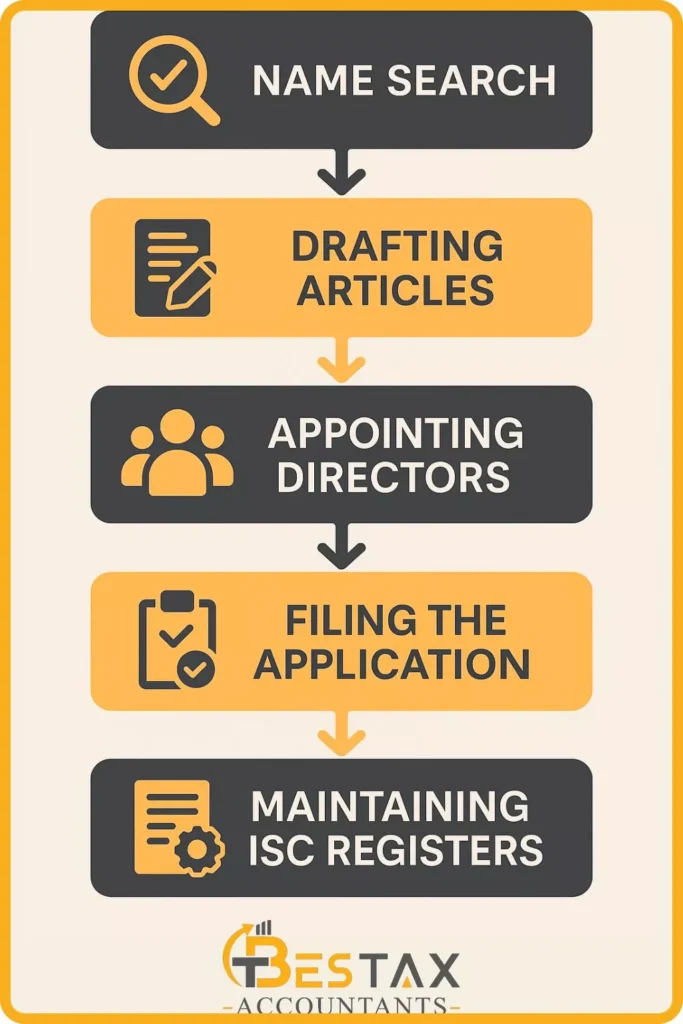
- Decide on federal or provincial incorporation: Federal incorporation gives you the right to operate across Canada; provincial incorporation may cost less but restricts operations to one province. Legal advisers can help you choose.
- Choose and reserve a corporate name: Conduct a name search to ensure your name is distinct and not confusing with existing corporations. For federal corporations, you file a NUANS report; provinces have their own name search systems. Alternatively, use a numbered name if you plan to operate under a trade name.
- Determine share structure: Decide the number of share classes, the rights and restrictions for each class, and whether you will issue voting or non‑voting shares. Structuring shares wisely can reduce taxes and increase financial returns.
- Select directors and officers: Identify qualified individuals who meet statutory requirements. Make sure at least 25 % of directors are resident Canadians. For each director you will need their full name, address and residency status.
- Draft the articles of incorporation: You can use pre‑determined articles (basic incorporation) or draft custom provisions. Include the corporation’s name, share structure, number of directors, restrictions on business, and any other provisions (borrowing powers, share transfer limitations, pre‑emptive rights, etc.). Ensure the language is clear and consistent with the CBCA or provincial act.
- Prepare the initial registered office and first board of directors: You must provide a registered office address where corporate records will be kept. Decide who will serve on the first board, and prepare their consent forms.
- Create an ISC register (federal corporations): Since 22 January 2024, federal corporations must maintain a register of individuals with significant control (ISC), individuals who own or control 25 % or more of voting shares or have de facto control. The register must include each ISC’s name, date of birth, citizenship, residency and description of control. Corporations must update this register annually and within 15 days of changes, and file information with Corporations Canada at the same time as the annual return.
- Submit the articles and pay the fee: Federal incorporations are filed online via Corporations Canada’s Online Filing Centre. Provincial filings often allow online or paper submissions. Once processed, you receive a certificate of incorporation and a corporate number.
- Organize the first meeting and adopt by‑laws: After incorporation, hold the first directors’ meeting to issue shares, appoint officers, and adopt by‑laws and organizational resolutions. These by‑laws govern the internal management of the corporation.
- Maintain annual compliance: File annual returns, update your ISC register, hold annual meetings and maintain corporate records. Consulting a professional helps ensure ongoing compliance.
Filing Articles Yourself vs. Hiring a Professional
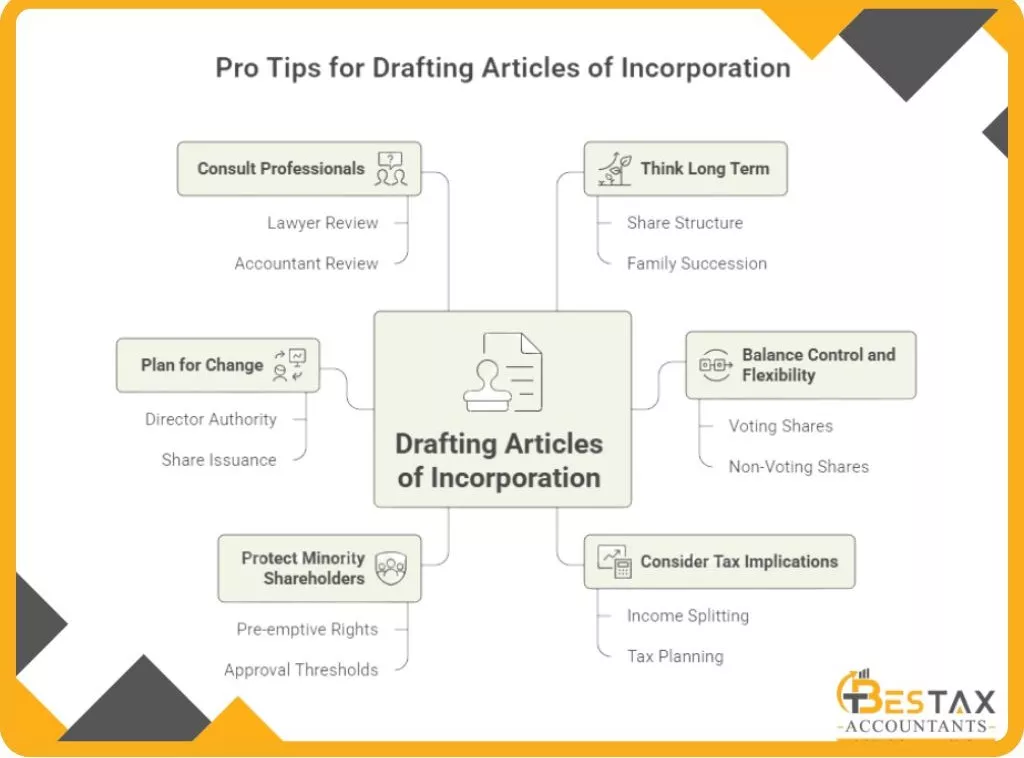
You can prepare your own articles using government templates, but mistakes can be costly, incorrect share structures or missing provisions may require amendments later. Working with a lawyer or accountant ensures your articles align with your tax strategy, shareholder objectives and growth plans.
Tax professionals can walk you through steps such as choosing the right type of incorporation, approving and reserving a business name, drafting the articles, filing them, creating by‑laws and understanding director and shareholder rights.
Benefits of Filing Articles of Incorporation
Incorporation offers significant advantages over operating as a sole proprietorship or partnership:
- Limited liability and asset protection: Incorporation separates your personal assets from business liabilities. If the company incurs debts or faces legal action, shareholders’ liability is limited to their investment.
- Perpetual existence: A corporation continues regardless of changes in ownership or management. This continuity facilitates succession planning and intergenerational transfer of the business.
- Professional credibility: Being formally incorporated can bolster trust among customers, suppliers and investors. A recognized business entity holds more credibility and signals compliance with legal standards.
- Tax planning opportunities: Corporations often benefit from lower tax rates compared to personal income tax rates and can retain earnings for reinvestment. To fully benefit from lower corporate tax rates, your business must generate significant income and may need to consult a tax professional.
- Access to capital: Corporations can issue shares to raise capital and are eligible for certain loans, grants and investment programs not available to unincorporated businesses.
- Ease of transfer and division: Shares can be transferred or divided among family members or investors without transferring underlying assets, making succession planning smoother.
Drawbacks and Responsibilities
Incorporation brings obligations that sole proprietors do not face:
- Complexity and cost: Incorporation involves filing fees, possible name search fees, annual return fees and professional fees if you hire advisors. Ongoing maintenance (annual meetings, updating ISC registers) requires time and resources.
- Public disclosure: Directors’ names and addresses become part of the public record. Federal corporations must also file information about individuals with significant control.
- Administrative obligations:. Corporations must keep records, file annual returns and maintain up‑to‑date registers. Failure to comply can result in penalties or dissolution.
For many entrepreneurs, the benefits outweigh these costs, especially when liability protection and growth potential are key considerations. The decision ultimately depends on your business model, risk tolerance and long‑term goals.
Conclusion
Incorporating a business in Canada is a significant milestone that requires careful planning. Your Articles of Incorporation serve as the foundational document that defines your corporation’s identity, share structure, governance and operational scope.
Whether you choose federal or provincial incorporation, understanding the components, options and obligations will position your business for success.
Ready to create your corporation? Consult a business consultant today to draft your articles of incorporation, choose the right share structure and navigate federal and provincial requirements. Properly prepared articles will protect your interests and set your business on the path to long‑term prosperity.
Frequently Asked Questions (FAQ)
What is the difference between incorporation in Canada and a sole proprietorship?
Incorporation creates a separate legal entity. Sole proprietors are personally liable for all business debts, whereas incorporated businesses provide limited liability and potential tax advantages. Incorporation also allows for easier ownership transfer through shares.
How many articles of incorporation should I have?
There is no fixed number of articles. The term refers to the entire document you file. Basic incorporation includes pre‑determined articles, while custom incorporation lets you include as many provisions as needed.
Do I need a resident Canadian director?
Under the CBCA, at least 25 % of the directors of a corporation must be resident Canadians. If you have fewer than four directors, at least one must be a resident of Canada. Some provinces have removed residency requirements, so check local rules.
Can one person form a corporation?
Yes. Section 5 of the CBCA allows one individual to incorporate by signing articles of incorporation. That individual must be at least 18 years old, capable and not bankrupt.
What languages can I use for the articles?
Federal corporations can file articles in English, French or both languages (bilingual). Provincial rules vary; Ontario and some other provinces accept both official languages, and Quebec requires French articles for provincial incorporations.
What are individuals with significant control?
Individuals with significant control (ISC) are people who own or control 25 % or more of the corporation’s voting shares or have de facto control. Since 22 January 2024, federal corporations must keep an ISC register and file information annually. The register includes each ISC’s name, birthdate, citizenship, addresses and description of control.
What happens if I need to change the articles later?
You can file articles of amendment to change your corporation’s name, share structure, restrictions or other provisions. Amendments require director and sometimes shareholder approval and must be filed with the same authority that issued your original articles.
Do articles of incorporation expire?
No. Once filed and approved, articles exist until amended or until the corporation is dissolved. However, corporations must file annual returns and maintain compliance to remain in good standing.
Disclaimer: The information provided in this blog is for general informational purposes only. For professional assistance and advice, please contact experts.