

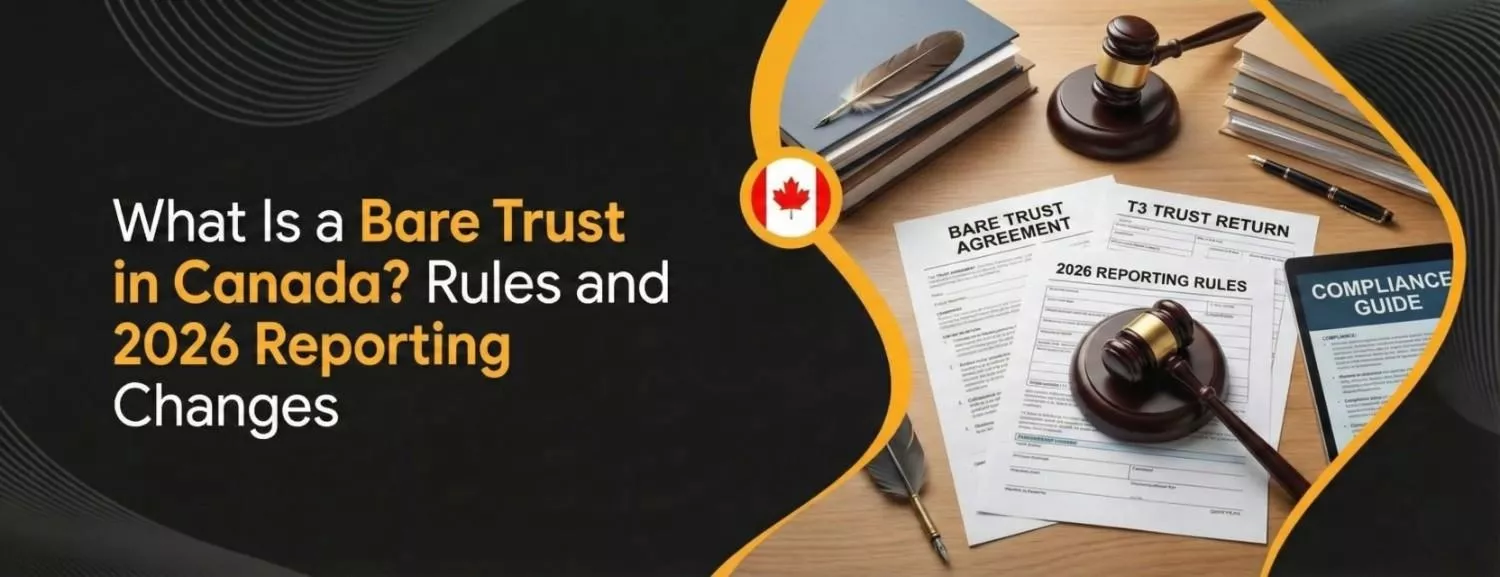
A lot of Canadians are exposed to CRA penalties and do not even know it. The problem is simple: bare trust rules get missed in “normal” life setups.
The 2026 reporting changes matter because the CRA is tightening trust reporting. If you have ever held property or assets for someone else, this may apply to you. In the next few minutes, you will know what a bare trust is, who must report, and how to stay compliant heading into 2026 and beyond.
What Is a Bare Trust in Canada?
Here is the plain definition of a bare trust.
- One person holds legal title to an asset, but someone else is the real owner.
- That “real owner” is called the beneficial owner.
- The person holding the title is often called the bare trustee.
So, the definition of a bare trust comes down to ownership roles:
- Legal ownership is what the paperwork shows.
- Beneficial ownership is who truly owns and controls the asset.
How is this different from a traditional trust?
- In a traditional trust, the trustee usually has real decision-making power.
- In a bare trust, the trustee acts more like an agent and follows instructions.
Here is the misconception that causes most issues:
- Even “informal” arrangements can still count.
- If the facts show split legal vs beneficial ownership, the CRA may treat it as a trust relationship for reporting.
Common Bare Trust Examples Many Canadians Overlook
Most people do not set out to create a trust. They just try to help a family member, simplify banking, or close a deal faster.
Here are common bare trust example situations that trigger questions:
- Parents holding property for a child
The title is in the parents’ name, but the child paid and benefits. - A joint bank account was added “for convenience.”
One person is on the account, but the money is not really theirs. - Nominee arrangements
Someone holds shares or assets as a nominee for the real owner. - Corporate asset holding
A corporation holds an asset for a shareholder, or the reverse, without the corporation truly owning it. - Real estate held for financing reasons
A person goes on title only to help with mortgage approval.
If you want a quick “Ontario lens,” here is a common bare trust Ontario pattern. A parent goes on title for a Toronto condo, but the adult child pays everything. That can look like a bare trust arrangement, even if nobody used that wording.
The key point is not your intention. It is the ownership reality that the documents and money trail show.
Bare Trust Reporting Rules Before 2026 vs What’s Changing
For years, many bare trust setups were ignored. People assumed, “No income in the trust, so nothing to file.”
Then the CRA introduced enhanced trust reporting for taxation years ending on or after December 31, 2023. These rules expanded which trusts must file and added beneficial ownership disclosures for many trusts that did not file before.
Here is the “previously ignored → now mandatory” shift, in simple terms:
Before: Many bare trusts did not file T3 returns in practice.
Now: The CRA has been building a system where more trusts must report who is involved and who benefits.
There is also a timing twist you must know.
The CRA said it will not require bare trusts to file T3 returns for the 2023 and 2024 taxation years unless the CRA directly requests the filing.
Then came the latest update for the next cycle.
The CRA also said it does not expect bare trusts to file for taxation years ending in 2025, and that certain bare trusts will be required to file for taxation years ending on or after December 31, 2026.
That is the real “2026 change” you should plan around.
Not panic filing today, but getting ready for reporting that resumes based on the 2026 year-end rules.
2026 Bare Trust Reporting Requirements and CRA Penalties
If your bare trust becomes required to file again, expect two main things. A T3 return, and beneficial ownership details (usually through Schedule 15).
Schedule 15 asks for “reportable entities.” That includes trustees, settlors, beneficiaries, and controlling persons.
Here is the practical part that many people miss:
For bare trusts, the CRA says much of the T3 can be left blank, and the income, gains, and losses are generally reported on the beneficial owner’s tax return.
Use this as your compliance checklist when filing becomes required:
- Confirm who has legal title vs beneficial ownership.
- Collect identity details for reportable parties (for Schedule 15).
- Keep a simple bare trust agreement or written summary of the arrangement.
- Track when the arrangement began and if it ended during the year.
Now the “penalty” part. This is where urgency is justified. The CRA’s T3 Trust Guide explains the alternative late-filing penalty when there is no unpaid tax: $25 per day, minimum $100, maximum $2,500.
If the failure is known, or due to gross negligence, the CRA guide explains an additional penalty can apply for non-listed trusts: the greater of $2,500 and 5% of the highest total fair market value of all property held by the trust during the year.
That is why “I did not know” can get expensive. And it is why risk mitigation matters more than perfection.
Mid-article reminder, because it is the core keyword and the core risk: a bare trust is easy to create by accident, but costly to ignore once filing resumes.
How Bare Trust Rules Affect Tax Planning and Asset Protection
Bare trusts are often used for convenience. But they affect planning in ways people do not expect.
In estate planning, bare trusts can blur who truly owns the asset. That can complicate transfers, sales, or probate strategies.
In family arrangements, a “helpful” setup can become a reporting obligation. If you rely on outdated advice, you may miss a filing requirement.
In business, nominee and corporate holding setups are common. Those are exactly the types of arrangements that can trigger reporting questions.
The bigger risk is not always the tax itself. It is the compliance trail: who owns what, who controls what, and who must disclose what.
If you plan early, you protect your wealth by staying clean on paperwork. That reduces audit stress, prevents penalties, and keeps future transactions smooth.
How Professional Guidance Helps Canadians Stay CRA-Compliant
Most Canadians do not need “more forms.” They need clarity on whether they even have a bare trust arrangement.
Professional guidance helps in three simple ways:
- Identify whether your setup is a reportable bare trust or not.
- Document the arrangement so ownership is clear and consistent.
- File properly when required, so you avoid penalties.
Two strong internal resources to link inside this blog (add them in your CMS):
- In the reporting section, link: “T3 Trust Return and Schedule 15 checklist” (Bestax internal guide).
- In this section, link: “Trust and estate compliance review” (Bestax internal service page).
If you want to stay ahead of the 2026 reporting changes without guesswork, Bestax Accountants can review your ownership setups, flag bare trust risks, and help you prepare for the reporting rules that resume for taxation years ending on or after December 31, 2026.
Quick FAQs
What is a bare trust in Canada, in one sentence?
It is when one person holds legal title, but someone else is the beneficial owner.
Do bare trusts have to file in 2026?
The CRA says it does not expect bare trusts to file for taxation years ending in 2025, and certain bare trusts will be required to file for taxation years ending on or after December 31, 2026.
What is the late-filing penalty for a T3 return?
The CRA guide lists $25 per day, minimum $100, maximum $2,500 in the alternative late-filing scenario.
What information does Schedule 15 ask for?
It asks beneficial ownership details for reportable entities like trustees, settlors, beneficiaries, and controlling persons.
Disclaimer: The information provided in this blog is for general informational purposes only. For professional assistance and advice, please contact experts.