



One of the first questions many new entrepreneurs ask when starting a business is “Do I need a business licence?” The answer depends on your business structure, location, and industry. In this guide, we covered municipal, provincia,l and federal licensing requirements, how to register a business name, recent regulatory changes, typical costs, renewal timelines, and what happens if you operate without a licence. By the end, you’ll know exactly what is required to stay compliant and avoid fines.
Why Business Licensing Matters in Ontario
You might be tempted to skip licensing because you run a small or home‑based business, but it’s a legal requirement for many industries. The province uses business licences to ensure companies comply with regulations, protect consumers and generate revenue. Depending on your sector you may need multiple licences or permits, and ignoring these obligations can lead to fines, closure orders and even criminal penalties.
Key reasons to take licensing seriously:
- Consumer protection: Licences confirm that businesses meet safety standards, maintain insurance, and are qualified to perform regulated work.
- Level playing field: Requires all businesses in a category to meet the same standards, licenses prevent unfair competition.
- Government revenue: Licensing fees support municipal services and enforcement.
- Avoiding penalties: Operating without the correct licence can lead to fines, business closure, and even jail time.
Types of Business Licences and Permits in Ontario
There is no single type of business licence that applies to every company. Different levels of government control different activities, and some industries require both a general registration and specific permits. Understanding the categories below will help you determine which licences apply to you.
Municipal Business Licences
Many businesses must obtain a licence from the municipality where they operate. Municipalities issue licences to ensure companies comply with zoning and neighbourhood requirements. Examples of businesses that often require a municipal licence include:
- Vehicular businesses: driving school instructors, catering trucks, taxi owners
- Stationary businesses: bowling alleys, parking lots, pet shops, and drugstores
- Trades and contractors: plumbers, heating, and electrical contractors
Licensing requirements vary by municipality. In Toronto, for instance, the city updated licensing and zoning by‑laws for restaurants, bars, and entertainment venues on January 1 2025. Toronto also requires “Criminal Record and Judicial Matters Checks” for all business licence applications and renewals, and companies operating under a name other than the owner’s must register that name through Service Ontario.
Provincial Licences and Permits
Some industries in Ontario are regulated at the provincial level. If you sell alcohol, for example, you need a liquor sales licence from the Alcohol and Gaming Commission of Ontario. Businesses that affect the environment or handle hazardous materials may need provincial environmental permits. When you register your business, you’ll receive a Business Identification Number (BIN) from Service Ontario; this is required for provincial registrations and is distinct from the federal Business Number (BN).
Common provincial licences and permits include:
- Liquor sales licence: Required for bars, restaurants and retailers who sell alcohol.
- Food premises inspections and food handler certification: Mandatory for any business serving food.
- Skilled trades certification: Certain tradespeople must hold a valid licence or certificate through Skilled Trades Ontario.
- Environmental permits are needed if your business emits pollutants, handles chemicals or operates in environmentally sensitive areas.
Federal Licences and Registrations
At the federal level, licences are required for activities like importing/exporting goods and broadcasting music publicly. Businesses with employees must register with the Canada Revenue Agency for payroll deductions and GST/HST. According to the BDC, companies earning less than $30,000 in annual revenue may not have to register for GST/HST, but most businesses must obtain a federal Business Number (BN).
Federal requirements may include:
- Import/export permits: Required for companies shipping goods across borders.
- Music licence (SOCAN): Needed if your business plays music publicly.
- Payroll and tax registrations: Mandatory for employers to remit income tax, Employment Insurance, and Canada Pension Plan deductions.
Master Business Licence (Business Name Registration)
If you operate a sole proprietorship or partnership under a name that is not your own legal name, you must register that name with the province. This registration was previously known as a Master Business Licence (MBL) and is now called a Business Name Registration. It lists your business name, address, BIN and a brief description of your activities.
Key features of a Master Business Licence/Business Name Registration:
- Business Name: The official name of your sole proprietorship.
- Business Identification Number (BIN): A unique identifier issued by Ontario.
- Validity Period: Valid for five years from registration.
- Banking requirement: Required to open a business bank account.
- Permit applications: Necessary when applying for additional permits and licences.
You do not need to register if you operate under your exact legal name. However, adding any descriptive word (e.g., “John Smith Consulting”) requires registration.
Licence vs Permit vs Registration
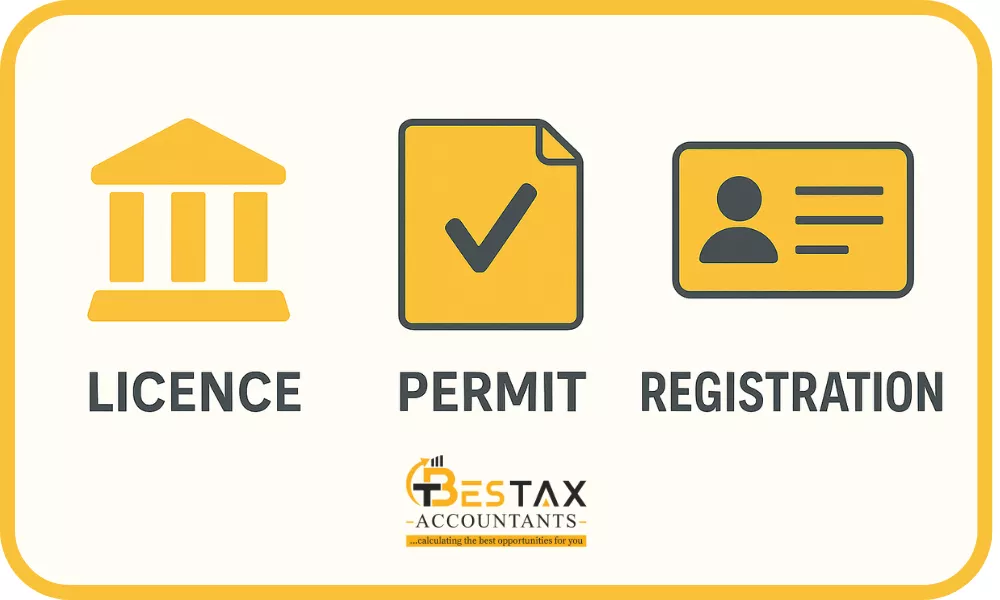
These terms are often used interchangeably, but they serve different purposes. The following table clarifies the differences:
| Term | Purpose | Example |
|---|---|---|
| Business licence | Permission from a government (often municipal) to operate a specific type of business. It ensures zoning compliance and consumer protection. | Municipal licence for a taxi company or hair salon |
| Permit | Authorization for specific activities or equipment, often related to health, safety or environment. | Food premises permit, building permit, environmental permit |
| Registration | Formal record of your business name or structure with provincial or federal authorities. | Master Business Licence (Business Name Registration), incorporation, CRA Business Number |
Understanding which category your needs fall into helps you complete the correct applications and avoid delays.
Do You Actually Need a Business Licence?
The requirement for a business licence depends on two things: your location and your type of business. Here’s how to determine whether you need one.
Use BizPaL to Check Requirements
The Ontario government recommends using BizPaL, a free online tool that filters permits based on your location, industry, and business activities. By entering your municipality and business type, BizPaL lists all required federal, provincial and municipal licences.
Home‑Based Businesses
Many home‑based businesses (e.g., freelance writers, consultants or graphic designers) do not need a licence. However, some home‑based operations still require permits, especially if they involve food preparation, childcare or transportation. When in doubt, check BizPaL or call your municipality.
Regulated Industries
If your business falls into one of the regulated categories (e.g., food service, transportation, trades, personal services), a municipal licence is almost always required. Provincial or federal licences may also apply. Failing to secure these licences can result in warnings, fines, suspension or prosecution.
Business Name Registrations
Even if your business type isn’t regulated, you must register if you operate under a name other than your personal name. This applies to sole proprietorships and partnerships. Corporations automatically register through the incorporation process.
Register Your Business and Obtain Licences in Canada
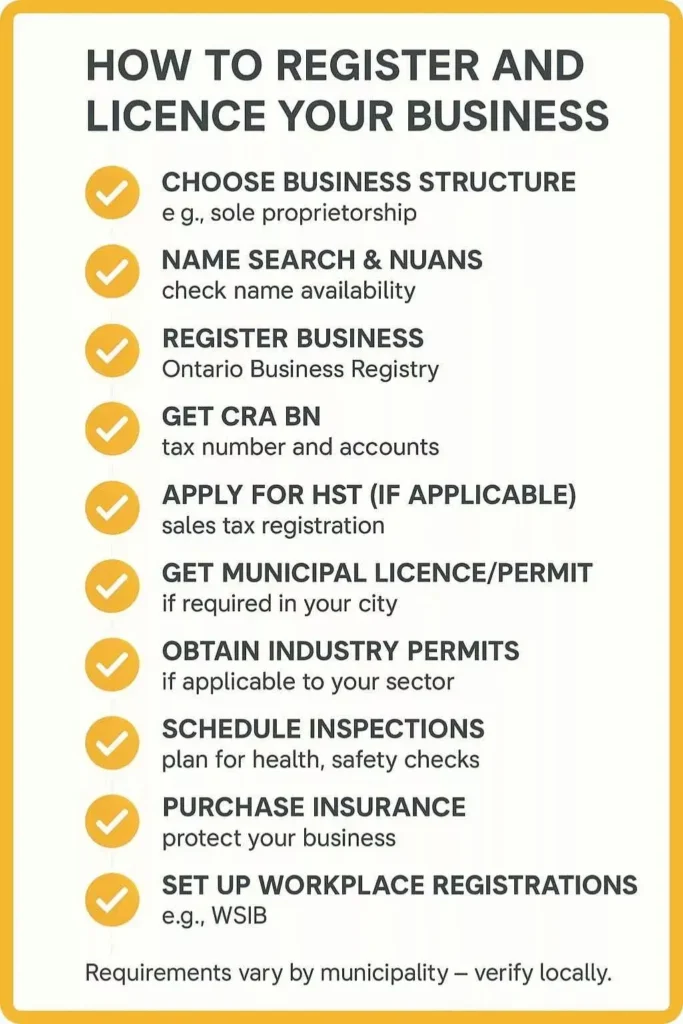
The licensing process can seem daunting, but breaking it into steps makes it manageable. Here’s a practical roadmap:
1. Register Your Business
- Choose your structure. Decide whether you will operate as a sole proprietorship, partnership or corporation. Each has different liability and tax implications.
- Create a My Ontario and Service Ontario account. You need these accounts to use the online registration system.
- Search the Ontario Business Registry to ensure your proposed business name is available.
- File the registration:
- Sole Proprietorship/General Partnership/LLP: The fee is $60 if you register online. In‑person or mail registration costs $80. Using a service provider like Ownr may cost around $49 and includes unlimited name searches.
- Limited Partnership: Registration costs $210.
- Corporation: Incorporating in Ontario costs $300 plus a Nuans name search report (approx. $8–$26).
- Obtain your BIN. Once registered, you’ll receive a nine‑digit Business Identification Number (BIN). This number is required for many provincial licences.
- Register for a CRA Business Number (BN) if you will collect GST/HST or have employees.
2. Use BizPaL to Identify Required Permits
Once your business is registered, visit BizPaL to see which licences, permits and registrations apply. The tool is easy to use: select your municipality and business activities, and it will generate a checklist of federal, provincial and municipal requirements.
3. Apply for Municipal Licences
If BizPaL indicates you need a municipal licence, you must apply to your municipality’s licensing department. Application requirements typically include:
- Your contact information and business name
- Basic business details (location, description of services)
- Declaration regarding criminal offences or compliance history
- Proof of insurance (if required)
- Criminal Record and Judicial Matters Check (for Toronto applications)
Fees: Municipal licence fees vary widely. A 2021 performance report found costs ranging from $50 to $760 per year, depending on the municipality and licence type. Be prepared to pay annually and budget accordingly.
Renewal: Most municipal licences are valid for one year and must be renewed annually. Failing to renew on time can lead to fines or licence suspension.
4. Apply for Provincial and Federal Licences
For industries regulated by the province or federal government (e.g., liquor sales, food service, trades, import/export), contact the appropriate agency:
- Alcohol and Gaming Commission of Ontario (AGCO) for liquor licences.
- Ontario Ministry of Health for food premises licences and food handler certification.
- Skilled Trades Ontario for trade certifications.
- Canada Revenue Agency for import/export permits and tax registrations.
- SOCAN for music licences if your business plays music publicly.
Costs and Fees: What to Budget For
Understanding the full cost of licensing helps you plan your start‑up budget. Costs vary by business type, municipality and method of registration. Below is a summary of typical fees:
| Item | Cost (CAD) | Notes |
|---|---|---|
| Business Name Registration / Master Business Licence | $60 online / $80 in person | Sole proprietorship/partnership. Third‑party services may be cheaper (≈$49). |
| Limited Partnership Registration | $210 | |
| Ontario Corporation Incorporation | $300 | Requires Nuans name search report ($8–$26). |
| Municipal Licence Fee | $50–$760 per year | Varies by municipality and business type. |
| Food Premises Licence | Varies | May require inspection and food handler certification. |
| Liquor Sales Licence | Varies | Issued by AGCO. |
| Environmental or Building Permits | Varies | Dependent on project scope. |
Renewing and Maintaining Your Licence
Staying compliant doesn’t end when you receive your licence. Keep these renewal guidelines in mind:
- Municipal licences must be renewed every year. Renew early to avoid late fees or lapses.
- Business Name Registration / Master Business Licence is valid for five years. You can renew via Service Ontario’s online portal, by phone or by mail.
- Replacement copies: If you misplace your business licence or need your BIN, log in to the Ontario Business Registry to download a copy.
- Changes to your business: If you change your business name or structure, cancel the old licence and apply for a new one.
Operating Without a Licence: Risks You Can’t Ignore
Some entrepreneurs assume a licence isn’t necessary or hope to avoid the paperwork. This is a risky strategy. Operating without the required licence or permit is akin to breaking the law. Consequences include:
- Warnings and fines: Most municipalities issue fines for unlicensed operations.
- Closure orders: Authorities can shut down your business until you obtain the proper licence.
- Legal penalties: Extreme cases there may be prosecution or jail time.
- Loss of reputation: Customers may distrust businesses caught operating illegally.
Compliance is not just a legal obligation; it’s an investment in your brand’s credibility.
Pro Tips for Smooth Licensing
- Start early: Research licensing requirements at the idea stage so you can budget time and money.
- Use BizPaL as your guide: It aggregates federal, provincial and municipal permits in one place.
- Keep records: Store digital copies of all licences, permits and renewal confirmations.
- Set renewal reminders: Municipal licences are typically annual; business name registrations last five years.
- Consult professionals: Lawyers and accountants can help you choose the right structure and ensure compliance.
- Stay updated: Regulations can change (e.g., Toronto’s 2025 update); monitor municipal websites for notices.
- Budget for hidden cost: Name searches, inspections and renewals can add up. Fees can range from $50 to $760 per year.
Conclusion and Next Steps
Whether you’re launching a food truck in Toronto or offering consulting services from your home office, understanding Ontario’s licensing landscape is essential. A business licence in Ontario isn’t just paperwork; it’s a legal requirement that protects your customers and your company. Begin by registering your business name and obtaining a BIN. Use BizPaL to identify required municipal, provincial and federal licences. Apply early, budget for fees and set reminders for renewals. By staying on top of licensing, you’ll avoid fines and focus on what matters most growing your business.
Quick FAQs
Do I need a business licence for a home‑based business in Ontario?
It depends on your industry. Freelance writers, consultants and many digital businesses typically do not need a municipal licence. However, if you operate a home daycare, catering company or any business that serves the public, you may need municipal or provincial permits. Always check BizPaL and contact your municipality.
What’s the difference between a BIN and a BN?
A Business Identification Number (BIN) is issued by Service Ontario when you register your business. It identifies your business for provincial licensing and is required for many provincial services. A Business Number (BN) is a nine‑digit number issued by the Canada Revenue Agency for federal tax accounts like GST/HST, payroll and import/export. You may need both numbers depending on your activities.
Do I need to register my business if I use my own name?
No. You are exempt from registering a business name if you operate under your exact legal name. If you add any descriptive words (e.g., “John Smith Consulting”), you must register that name.
How long does it take to get a business licence?
Processing times vary by licence. Business name registrations through Service Ontario are often instantaneous once payment is processed. Municipal licences can take a few days to several weeks depending on inspections and criminal checks. Fees and processing times can range from hundreds to thousands of dollars, so plan ahead.
What changed in Toronto’s licensing rules in 2025?
Effective January 1 2025, the City of Toronto updated its licensing and zoning by‑laws for restaurants, bars and entertainment venues. Businesses in these sectors should review the new requirements and contact the Toronto Municipal Licensing and Standards department for guidance.
Disclaimer: The information provided in this blog is for general informational purposes only. For professional assistance and advice, please contact experts.