



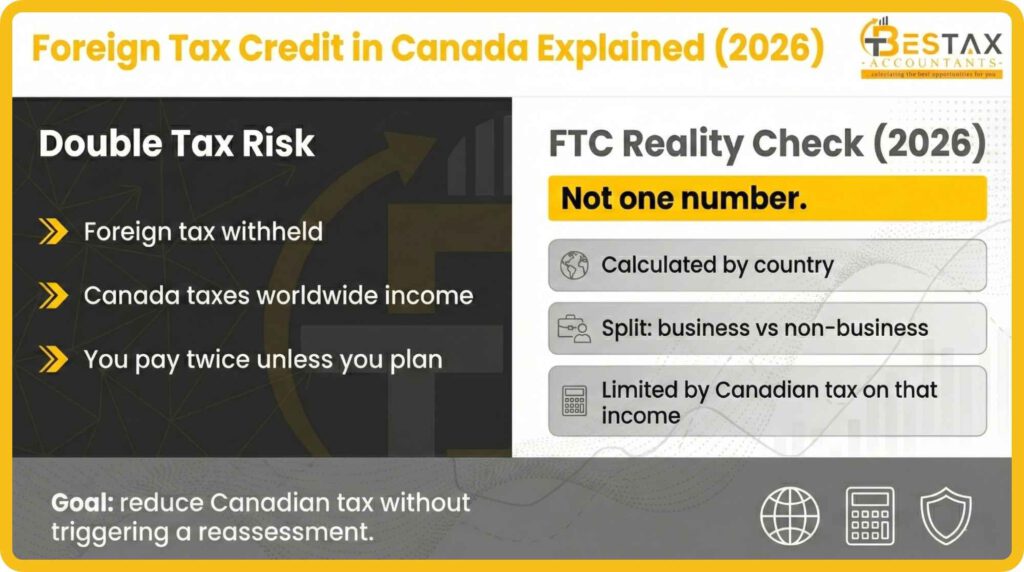
Here is the real problem. You can get taxed twice on the same income. Once overseas, then again in Canada.
The 2026 reality check is simple: the foreign tax credit is not one big number. In Canada, it is calculated by country, and it is split into business vs non-business buckets. That is why “quick math” often leads to surprises later.
In this guide, you will learn what counts, how the limit works, what forms to use, and the traps that trigger reassessments. If you want a practical starting point, bookmark this, foreign tax credit Canada.
Basics First: What the Foreign Tax Credit Really Does
Think of the foreign tax credit Canada rules as “double-tax relief with a cap.” You get relief, but only up to the Canadian tax that relates to that same foreign income.
This is why the Canada foreign tax credit is different from a deduction. A credit reduces the tax you owe. A deduction reduces taxable income before tax is calculated.
If you earn international income, this matters because Canada’s tax foreign income rules often tax residents on worldwide income. The international tax credit concept helps prevent paying full tax twice, but it does not guarantee a full offset.
Who Can Claim the Foreign Tax Credit?
Most people searching for “CRA foreign tax credit” fall into one of these groups.
Employees and contractors may have foreign withholding on pay, bonus, or stock income. Investors may see foreign tax withheld on dividends or fund distributions. Owners may have foreign rental income or business income.
The workflow changes depending on the income type, but the core idea stays the same: the Canada foreign tax credit is tied to eligible foreign tax on income that Canada also taxes.
If you are also cleaning up year-end slips and reporting, this internal guide can help you stay organized: personal tax return document checklist.
The 2026: FTC is Not One Calculation
The two buckets CRA cares about
CRA guidance separates foreign taxes into two main categories: foreign non-business income tax and foreign business income tax. That split changes how the credit is calculated and tracked.
The country-by-country rule (where most people slip)
This is the part many people miss. You do not just total “foreign taxes paid” and claim one number. The Revenue Canada foreign tax credit approach expects you to track by country, inside the correct bucket (business vs non-business).
A simple tracking method readers can copy
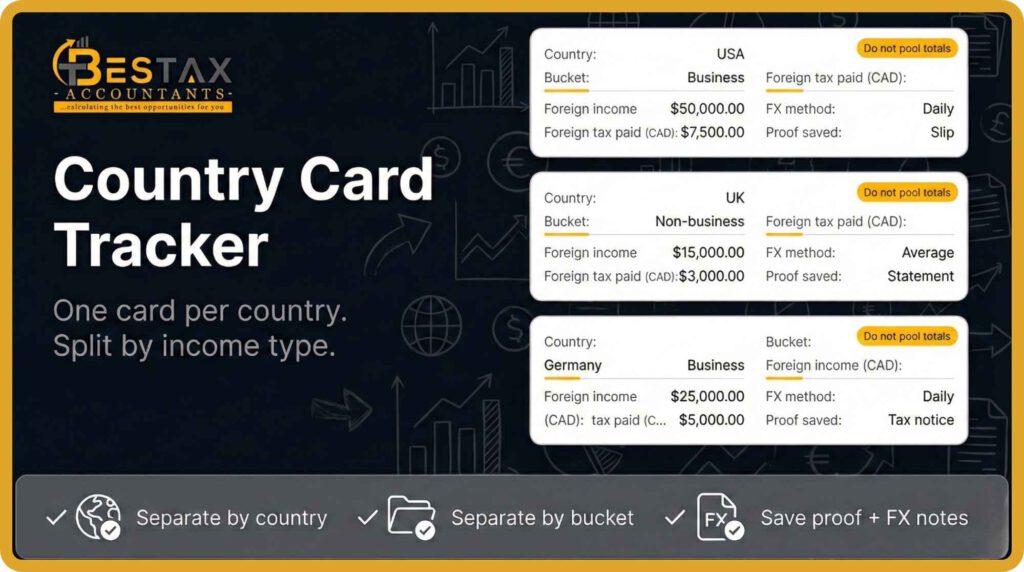
Use a “Country Card” for every country that withheld tax. Keep it simple:
- Country
- Income type (business vs non-business)
- Foreign income (CAD)
- Foreign tax paid (CAD)
- Proof documents you saved
Halfway checkpoint: if you want a clean review process before filing, use this second reference point: foreign tax credit Canada.
What Counts as “Foreign Tax” for the Credit and What Does Not
Use this list before you spend time on forms. It keeps your foreign tax credit work focused.
Usually qualifies (in many common situations):
- Foreign income or profits taxes tied to that income (including withholding on eligible foreign income).
Usually does not qualify:
- Sales or consumption taxes, customs duties, property taxes, and similar charges that are not income or profits tax.
This is where many foreign tax credit Canada example calculations go wrong. People include the wrong kind of “tax,” then wonder why the credit is reduced.
How the Foreign Tax Credit Works?
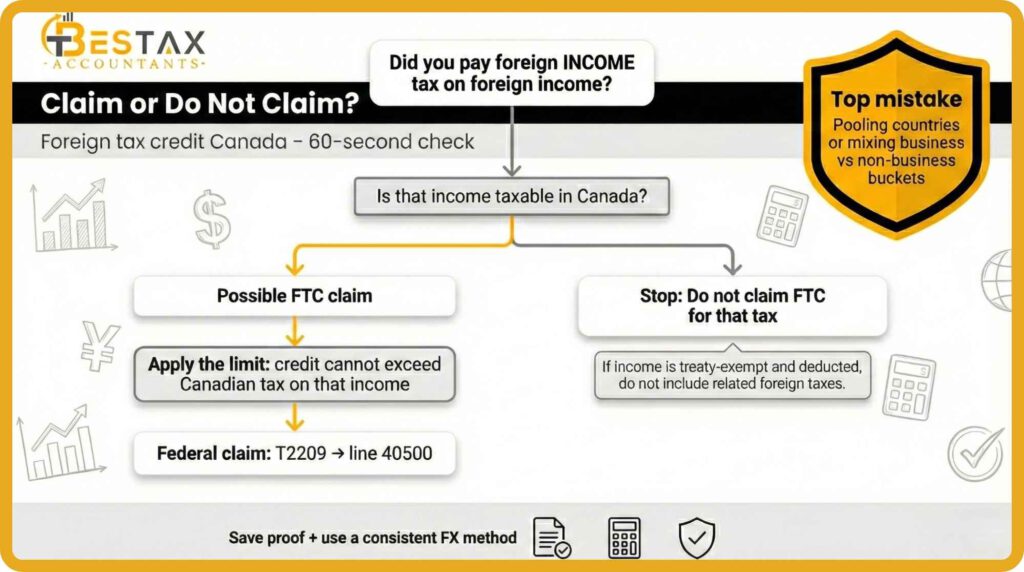
The rule is basically “lesser-of.” Your foreign tax credit is limited to the Canadian tax you would otherwise pay on that same foreign income.
Here is a simple foreign tax credit Canada example without heavy math. If Canada would tax that slice of foreign income at $X, your credit cannot be more than $X. Even if you paid $X plus extra overseas, the credit can be capped.
This is why the revenue Canada foreign tax credit limit matters. It is designed to prevent the credit from reducing unrelated Canadian tax beyond what applies to the foreign income.
The “Claim or Do Not Claim” Reality Check
The line 25600 style trap you must avoid
CRA guidance on line 25600 warns that if income is not taxable in Canada because of treaty treatment and you deducted it, you generally should not include related foreign taxes in the credit calculation.
This is a common “I did everything right” moment that turns into a reassessment. The fix is planning: confirm whether the income is taxable in Canada before you build your foreign tax credit Canada numbers.
When a credit may be limited and what that means
If foreign tax is higher than Canadian tax on that income, the credit may be capped. That does not mean you did something wrong. It means the credit is working as designed.
How to Claim on a Personal Return (T1)
Step 1: Gather the right slips and proof
Start with the documents. Save foreign slips, statements showing withholding, and any foreign assessment details you have. CRA expects you to keep support, even if you file electronically.
Step 2: Convert amounts to Canadian dollars the CRA way
Your numbers must be in CAD. Many people use a random app rate and regret it later.
A safe approach is using a consistent, credible rate source such as the Bank of Canada annual average exchange rates for year-wide income patterns, and more specific rates where needed for particular dates.
Here is a helpful context stat from Statistics Canada, at the end of Q3 2025, 97.0% of Canada’s international assets were denominated in foreign currencies, and 67.3% were in US dollars. That is a big reason why currency conversion keeps showing up in Canadian tax filing.
Step 3: Complete Form T2209 and claim line 40500
For the federal foreign tax credit Canada claim on a T1, you complete Form T2209, then enter the result on line 40500.
Step 4: Calculate the provincial or territorial portion (where applicable)
For non-business foreign taxes, provinces and territories generally use Form T2036 as part of the calculation.
If you are trying to organize your filing workflow end-to-end, this internal page can help: tax filing support and review.
Documentation and CRA Review-Proofing (2026)
Keep this tight. It saves real time if CRA asks questions later.
- Save foreign slips and proof of tax paid or withheld.
- Save your exchange rate method notes (date, rate source, and why you used it).
- If documents are not English or French, be ready to provide an acceptable translation if requested.
Common Mistakes That Cost People Money
This list covers the patterns that show up again and again in CRA foreign tax credit issues.
- Treating the foreign tax credit like one pooled total instead of country-by-country tracking.
- Mixing business and non-business taxes into one bucket.
- Using inconsistent FX conversion methods across slips and countries.
- Claiming taxes that are not income or profits tax (sales, property, customs).
- Forgetting the provincial or territorial portion when it applies.
Fast Examples Readers Actually Search
Here are quick situations people mean when they type Canada tax foreign income questions into Google.
US dividends with withholding: track the dividend amount, the withholding amount, the country, and the CAD conversion. The most common overclaim is treating withholding as fully refundable when the limit caps it.
Foreign employment income: keep the pay records and withholding proof. The surprise is usually the limit, especially when foreign tax rates are higher than Canadian tax on that same income. Foreign rentals or side business: keep clean income and expense records, and label the country clearly. This is where “country cards” prevent messy filings. Foreign mutual funds and ETFs: many statements show foreign tax paid indirectly. You still need clarity on the country and category to support the Canada foreign tax credit calculation.
Conclusion
The foreign tax credit system in Canada can save real money, but only if you track it properly. Keep it country-by-country, separate business vs non-business, convert currency consistently, and save proof. If you want this done cleanly, with fewer back-and-forth requests later, consider working with Bestax Accountants. A good review upfront often costs less than fixing a reassessment later.
Quick FAQs
Can I claim a foreign tax credit if I only had withholding tax taken off?
Yes, if it is eligible foreign income or profits tax, and the income is taxable in Canada. Your foreign tax credit is still limited by the Canadian tax on that same income.
What form do I use to claim the federal foreign tax credit?
On a T1 return, you use Form T2209, then enter the result on line 40500.
Do I calculate one credit for all countries combined?
No. CRA guidance expects country-by-country tracking and separate categories for business vs non-business foreign income taxes.
Is there a provincial or territorial foreign tax credit too?
Often yes, for non-business foreign taxes. The calculation generally uses Form T2036 along with your provincial or territorial tax calculation.
What is the fastest way to avoid a CRA reassessment on this?
Use a country card system, keep proof of tax paid or withheld, apply a consistent FX method, and do not mix business and non-business amounts. That is the simplest way to keep your CRA foreign tax credit claim defensible.
What is the foreign tax credit in Canada?
It is a credit that reduces Canadian tax when you already paid eligible foreign income tax on the same income, up to a limit.
Who can claim it?
Canadian residents who paid eligible foreign income tax on foreign-source income can usually claim it. Individuals claim it on a T1, and businesses claim it under their own return rules.
Where do I claim it on my tax return?
On a T1 return, the federal credit goes to line 40500, calculated using Form T2209.
What is the biggest mistake people make?
Yes. For non-business foreign tax, provinces and territories generally use Form T2036 as part of the calculation.
What is the biggest mistake people make?
Mixing everything together. CRA guidance requires country-by-country thinking, plus separate treatment for business vs non-business foreign income.
Disclaimer: The information provided in this blog is for general informational purposes only. For professional assistance and advice, please contact experts.