



Financial institutions operate by channeling funds from depositors to borrowers while managing liquidity, interest‐rate risk and profitability. Funds transfer pricing (FTP) is the internal mechanism banks use to allocate the cost and revenue of funds between their various business units.
This guide explains the meaning and importance of FTP, breaks down its components, compares common calculation methods, and offers practical steps for implementing FTP in Canadian financial institutions.
Why Funds Transfer Pricing Matters in Canadian Banking
Profitability Measurement
The single largest determinant of net interest margin (NIM), the difference between interest income and interest expense, in a bank’s internal profitability calculations, is the funds transfer pricing rate. A bank’s general ledger can measure NIM at an aggregate level, but to understand NIM by branch, product or customer segment, a granular FTP system is essential. FTP enables institutions to attribute a cost of funding (COF) rate to asset products (loans, investments) and a credit for funding (CFF) rate to liability and capital products. This approach ensures that the total cost of funds charged to asset businesses equals the total credit allocated to funding sources, allowing accurate profitability and return‑on‑equity calculations.
Risk Management
FTP is not just about measuring profits; it is also a critical risk‑management tool. By charging business lines for the funds they consume and crediting them for the funds they provide, FTP helps banks assess interest‑rate risk, liquidity risk and credit risk. OSFI’s Interest Rate Risk Management guideline notes that institutions should use an appropriate funds transfer pricing mechanism and establish a senior management committee to oversee FTP.
OSFI’s Liquidity Principles guideline further states that larger and more sophisticated institutions must incorporate the cost and benefits of liquidity into their FTP programs; business lines consuming liquidity should be charged, while those bringing in liquidity below market rates should receive credit. These regulatory expectations underscore FTP’s role in risk governance and align Canadian banks with global best practices.
Pricing Decisions and Strategic Planning
Accurate internal pricing of money enables banks to make informed decisions about loan and deposit pricing. Without FTP, a branch could offer loans at rates that appear profitable but do not cover the true cost of funds. FTP allows banks to set competitive yet profitable rates for mortgages, small‑business loans and deposits, ensuring fair compensation for risk while remaining market competitive. In strategic planning, FTP data informs branch performance reviews, resource allocation and capital planning. Because net interest margin accounts for 50–90 % of a typical bank’s net income, any mispricing can have a material impact on shareholder returns.
Components of Funds Transfer Pricing
A robust FTP system disaggregates the net interest margin into its constituent parts so that management can understand who earns and who pays for the funds. Most frameworks break FTP into three spreads:
- Asset spread (credit spread). The net interest margin earned by funds users – typically loans, investments and other assets – after assigning an FTP charge. This spread captures the incremental return the asset generates over the cost of funds.
- Liability spread (deposit spread). The net interest margin earned by funds providers on deposits, borrowings and other funding instruments that receive an FTP credit. This spread rewards business units for bringing in inexpensive or stable funding.
- Residual spread. The margin remaining after accounting for asset and liability spreads. It represents the Treasury or Funds Management unit’s reward for ensuring adequate liquidity and managing interest‑rate and other risks.
Breaking FTP into these components helps management evaluate the profitability of products, branches and even individual officers and supports strategic decisions on branch expansion, product offerings and marketing campaigns.
How Funds Transfer Pricing Works
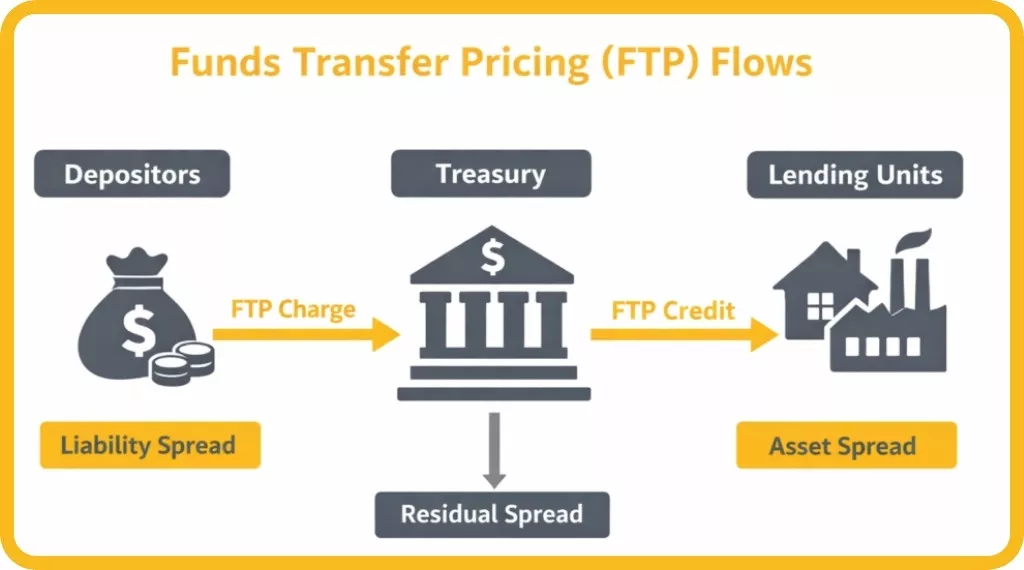
FTP assigns an internal rate at which funds are bought and sold within a bank. The process generally follows three steps:
- Internal rate determination. Treasury determines the internal cost of funds by referencing external market rates (e.g., Government of Canada bond yields or swap curves) and adjusting for liquidity and credit risk. This rate becomes the benchmark for charging asset units and crediting liability units.
- Allocation of funds. Funds are allocated to business units – retail banking, corporate banking, wealth management – based on their needs. Units drawing on funds are charged the FTP rate, while units supplying funds receive a credit.
- Profitability calculation. Each unit’s profitability is calculated by comparing its revenues (interest and fee income) to the cost of funds allocated to it. Units that generate higher returns relative to their funding cost are deemed more profitable.
FTP thus acts as an internal marketplace for money. It creates transparency, aligns business incentives and ensures that no unit is subsidized or penalized inadvertently. In Canada, where large banks operate nationwide branch networks and multiple lines of business, FTP provides a consistent framework for evaluating performance across different regions and products.
Common Funds Transfer Pricing Methodologies
There is no one‑size‑fits‑all approach to FTP; the method chosen depends on an institution’s size, complexity and data quality. The most common approaches are summarized below.
Net Funds Transfer Pricing
The net funds approach nets all assets and liabilities for each profit centre and assigns a cost or credit to the net funding shortage or excess. While simple to implement, it has significant limitations: it cannot analyze net interest margin below the branch or cost‑centre level, it provides little support for pricing analysis, and it leaves interest‑rate risk in business units that cannot manage it. Consequently, this method may be acceptable only for very small Canadian credit unions or trust companies.
Pool‐Based Transfer Pricing
The pool approach groups funds into broad buckets (e.g., short‑term, medium‑term and long‑term) and assigns each bucket a transfer rate. Products are assigned to pools based on their characteristics, and the pool’s FTP rate determines the charge or credit. Although easy to administer, this approach lacks precision: it ignores account attributes like origination date or amortization pattern and provides little confidence in the numbers. Managers may not buy into pool rates because they cannot trace their unit’s performance to specific funding decisions.
Matched‐Term (Matched‐Maturity) Transfer Pricing
The matched‑term approach (also known as matched‑maturity) is widely used in sophisticated banks and is recommended by many industry experts as the most accurate method. Under this method, each instrument or account is matched with a transfer rate based on its individual characteristics, such as origination date, term, cash‑flow pattern and embedded options. The internal funding desk buys funds from deposit businesses and sells funds to lending businesses at rates that align with market yield curves, thereby insulating business units from interest‑rate risk. The benefits of the matched‑term approach include:
- Consistency. Both sides of the balance sheet are valued against a single market yield curve.
- Risk insulation. Business units are protected from interest‑rate movements; Treasury assumes the risk and can hedge it centrally.
- Improved margin management. Managers can disaggregate margin into components and identify drivers of profitability.
Because of its accuracy, the matched‑term method is the standard in most large Canadian banks. However, it requires detailed cash‑flow data and a centralized funding desk.
Other FTP Calculation Methods
Banks sometimes adjust matched‑term FTP to reflect different funding assumptions. Three popular variations are described below:
- Coterminous maturity matched. The cost‑of‑funds rate is assigned based solely on the time period for which the loan rate is fixed. For example, a five‑year fixed‑rate loan is assigned a five‑year FTP rate. This method ignores principal paydowns and is straightforward but may over‑ or understate true funding costs.
- Duration cash‑flow method. The loan’s duration is calculated based on its term and amortization schedule. The FTP rate is assigned from the point on the yield curve that matches this duration. For instance, a five‑year fixed‑rate loan amortizing over 15 years may have a duration of around 4.6 years, so it receives a four‑to‑five‑year FTP rate.
- Coterminous cash‑flow method. Each principal payment is assigned an FTP rate based on the month the payment is due. A weighted average of the rates for each payment is then calculated. This method yields results similar to the duration approach but requires more granular data.
Step‑by‑Step Guide to Calculating FTP in Canada
The calculation of funds transfer pricing involves determining the cost of funds (COF) for loans and the credit for funds (CFF) for deposits and capital. Canadian banks often benchmark their FTP curves to market rates such as Government of Canada bond yields, swap curves or internal certificate‑of‑deposit (CD) rates. Below is a practical step‑by‑step guide.
1. Establish the FTP Curve
- Select a market benchmark. Choose an external curve that reflects the institution’s marginal cost of funds. Many Canadian banks use the Government of Canada yield curve or swap curves.
- Adjust for liquidity premiums/discounts. Depending on the balance sheet structure, add a liquidity premium or discount to the curve to reflect the bank’s funding cost and liquidity risk.
- Create the internal FTP curve. For each maturity (e.g., 1 month, 3 months, 6 months, 1 year, 5 years), determine the FTP rate. A hypothetical FTP curve might show rates ranging from 4.08 % for overnight funds to 5.28 % for 20‑year funds.
2. Calculate the COF Rate for Loans
- Identify loan characteristics. Determine the loan’s origination date, term, amortization schedule and interest‑rate reset frequency.
- Choose a COF methodology. Use one of the methods discussed above (coterminous maturity matched, duration cash‑flow or coterminous cash‑flow). For example, a five‑year fixed‑rate mortgage with monthly payments may have an effective duration of ~4.6 years.
- Assign the COF rate. Using the FTP curve, assign the rate corresponding to the loan’s duration. If the 4‑to‑5‑year FTP rate is 4.36 %, the COF rate for the loan is 4.36 %. If the bank adds a liquidity premium of 0.20 %, the final COF is 4.56 %.
- Calculate the FTP charge. Multiply the loan’s outstanding principal by the COF rate to determine the FTP charge. For a CA$500,000 mortgage, the annual FTP charge would be 500,000 × 4.56 % = CA$22,800.
3. Calculate the CFF Rate for Deposits
- Identify deposit characteristics. Determine whether the deposit is a term deposit (e.g., 1‑year GIC) or a non‑maturity deposit (e.g., savings or demand deposit). For term deposits, use the term to assign a CFF rate; for non‑maturity deposits, estimate the average life or duration.
- Assign the CFF rate. Use the FTP curve to assign a credit rate. For example, a three‑year term deposit might receive a CFF rate of 2.77 %, while a non‑interest‑bearing demand deposit with an average life of six years might receive 1.96 %.
- Calculate the FTP credit. Multiply the deposit balance by the CFF rate to determine the credit allocated to the funding unit. If a CA$200,000 savings account is assigned a CFF of 2.10 %, the annual FTP credit is 200,000 × 2.10 % = CA$4,200.
4. Determine Residual Spread and Profitability
- Compute asset and liability spreads. Subtract the COF charge from the loan’s interest income to find the asset spread; subtract the interest paid to depositors from the CFF credit to find the liability spread. Using the example above, if the mortgage’s coupon rate is 5.50 % and the COF rate is 4.56 %, the asset spread is 0.94 %. If the savings account pays 1 % interest and receives a 2.10 % CFF, the liability spread is 1.10 %.
- Calculate the residual spread. The residual spread goes to the Treasury unit to compensate for liquidity and interest‑rate risk management. It is calculated as the difference between the yield curve premium and the COF/CFF rates assigned to business units.
- Aggregate profitability by unit. Sum the asset spread, liability spread and residual spread across products and branches to assess each unit’s profitability. Units with higher spreads contribute more to net interest income.
5. Use FTP Data for Pricing and Planning
Once FTP rates are established, banks can use them to set customer rates. For example, if a term loan’s FTP rate is 4.56 % and the bank wants a 1.50 % risk‑adjusted margin, the minimum loan rate would be 4.56 % + 1.50 % = 6.06 %. Similarly, deposit rates can be set by subtracting a desired margin from the CFF rate. This ensures that product pricing covers funding costs and provides adequate returns.
Practical Examples
Example 1: Retail Banking Branch
A retail branch in Toronto manages CA$100 million in deposits and CA$75 million in consumer loans. The average duration of deposits is four years, and the FTP curve assigns a CFF rate of 2.10 %. Loans have an average duration of five years, and the COF rate is 4.36 %. The branch pays an average interest rate of 1.2 % on deposits and earns 5.7 % on loans. The FTP analysis is as follows:
- Deposit FTP credit: 100,000,000 × 2.10 % = CA$2.1 million
- Deposit interest expense: 100,000,000 × 1.2 % = CA$1.2 million
- Liability spread: CA$2.1 million – CA$1.2 million = CA$0.9 million
- Loan FTP charge: 75,000,000 × 4.36 % = CA$3.27 million
- Loan interest income: 75,000,000 × 5.7 % = CA$4.275 million
- Asset spread: CA$4.275 million – CA$3.27 million = CA$1.005 million
- Residual spread: The Treasury unit receives any difference between spreads and overall NIM as compensation for liquidity management.
This example shows how FTP identifies the profitability contribution of deposits and loans separately. The branch’s combined spread (CA$0.9 million + CA$1.005 million) equals CA$1.905 million before the residual spread. Without FTP, the branch might believe it earns CA$4.275 million in interest income and pays CA$1.2 million in interest, but this ignores the cost of funds.
Example 2: Corporate Banking Unit
A corporate banking unit in Calgary provides CA$500 million in commercial loans with an average maturity of three years. The loans are funded partly by CA$400 million in wholesale deposits with an average duration of six months and partly by long‑term borrowings. The FTP curve assigns a COF rate of 4.0 % for three years and 3.2 % for six‑month deposits. The unit charges clients an average rate of 6.0 % on loans and pays 2.5 % on wholesale deposits.
FTP allows the bank to allocate appropriate COF and CFF rates to each funding source and to price loans accordingly. For example, CA$300 million of the commercial loans matched to wholesale deposits would carry a COF of 3.2 %, while the remaining CA$200 million matched to long‑term funding would carry a COF of 4.0 %. Without FTP, the unit might underprice its loans, exposing the bank to a compressed margin when market rates rise.
Challenges and Best Practices in FTP Implementation
Data Quality and Systems
Accurate FTP relies on comprehensive, timely data. Incomplete or outdated loan and deposit data can lead to inaccurate FTP rates and mispricing. Canadian banks should invest in robust data‑management systems and ensure that systems across business lines are integrated to provide reliable cash‑flow and maturity data. Automation tools can reduce human error and speed up calculations.
Complexity and Internal Resistance
FTP can be complex, especially when using hybrid or matched‑term methods. Calculating FTP at the instrument level requires significant computing power and specialized knowledge. Some business units may resist FTP because it exposes their true profitability. Clear communication, training and buy‑in from senior management are crucial. Institutions should provide comprehensive FTP training for employees so they understand how FTP impacts profitability and pricing decisions.
Transparent Methodology and Regular Reviews
To maintain trust in the FTP framework, the methodology should be transparent and documented. Management should outline how FTP rates are derived, what benchmarks are used, and how premiums or discounts are applied. Regular reviews of FTP curves and assumptions are necessary to reflect changes in market conditions, risk appetite or regulatory requirements. For Canadian institutions, this includes monitoring changes in OSFI guidance or updates to international standards such as Basel III.
Incorporating Liquidity Costs and Contingent Risks
FTP should incorporate the cost and benefit of liquidity, as OSFI’s Liquidity Principles guideline mandates. Business lines that consume contingent liquidity – such as undrawn credit commitments – should be charged for the potential cost of meeting those obligations, while lines that bring in stable, low‑cost deposits should be credited. Assigning a value to liquidity ensures that decision‑makers consider the true cost of products and activities when pricing and managing risk.
Aligning FTP with Incentive Structures
FTP should align with compensation and performance incentives. For example, loan officers’ incentives may be tied to spreads that already include the cost of funds. This discourages officers from closing deals that look profitable on a gross basis but fail to meet the bank’s hurdle rate when funding costs are considered. Similarly, deposit‑gathering staff should be rewarded not just for volume but for bringing in low‑cost, sticky deposits that improve the CFF spread.
Regulatory and Governance Considerations in Canada
In Canada, the prudential regulator (OSFI) takes a principles‑based approach. Although there is no legislated requirement to implement FTP, OSFI expects larger institutions to have comprehensive FTP frameworks as part of their interest‑rate and liquidity risk management processes. The Interest Rate Risk Management guideline states that institutions should use an appropriate FTP mechanism and that a senior management committee representing all major business lines and treasury should oversee the process. This governance structure ensures accountability and consistent application across the organization.
OSFI’s Liquidity Principles guideline goes further by requiring larger and more sophisticated institutions to incorporate the cost and benefit of liquidity into their FTP programs. Business lines consuming liquidity must be charged based on the consumed and contingent liquidity, while those providing liquidity at below‑market cost are credited. Institutions must also assign value to contingent liquidity needs (e.g., potential drawdowns) and consider reputational risks when pricing products. These requirements align FTP with broader risk‑management frameworks and ensure that banks hold adequate liquidity buffers.
Funds Transfer Pricing vs. Transfer Pricing
FTP is sometimes confused with transfer pricing in tax practice. Transfer pricing refers to the prices charged between related entities in different jurisdictions and is regulated by tax authorities. Its goal is to ensure that profits are appropriately allocated and taxed. FTP, by contrast, is an internal management tool used within a single financial institution to allocate funding costs and revenues. While both involve setting internal “prices,” FTP is not related to tax compliance and does not involve cross‑border profit allocation. Banks must implement FTP to manage profitability, risk and regulatory expectations, whereas transfer pricing is required to satisfy tax laws.
Conclusion
FTP can significantly improve your institution’s profitability and risk management. Whether you’re a regional credit union or a national bank, implementing a disciplined FTP framework will help you make data‑driven decisions and meet regulatory expectations. Ready to strengthen your FTP process?
Consider investing in advanced analytics tools, comprehensive staff training and robust data systems. Engage your treasury and risk teams to develop a transparent methodology that aligns with OSFI guidance. By doing so, you’ll be well‑positioned to weather changing interest‑rate environments and achieve sustainable growth.
For more insights on advanced FTP methodologies, liquidity management and profitability analysis, stay tuned to our blog and contact us for consulting support.
Quick FAQs
What does funds transfer pricing mean?
Funds transfer pricing is an internal process used by financial institutions to assign a cost to funds borrowed and a credit to funds provided among their business units. It ensures that each unit is fairly charged for the capital it consumes and rewarded for the funding it brings in. Unlike transfer pricing for tax purposes, FTP is used to measure profitability and manage risk internally.
Why is FTP especially important for Canadian banks?
Canadian banks operate under OSFI’s principles‑based framework, which expects institutions to use FTP for interest‑rate and liquidity risk management. FTP supports accurate profitability measurement, aligns pricing decisions with funding costs, and helps banks manage risks across regions and products in a geographically diverse country.
How is the FTP rate determined?
The FTP rate is derived from external market rates (e.g., Government of Canada bonds, swap curves) and adjusted for liquidity and credit risk. Treasury uses this rate to charge asset units and credit liability units.
What is the difference between single‑rate and multi‑rate FTP methods?
A single‑rate FTP method assigns a uniform transfer rate to all assets and liabilities, providing a broad view of asset versus liability profitability. A multi‑rate method breaks assets and liabilities into groups and assigns different rates based on selected characteristics, offering more granularity. Multi‑rate methods are generally considered more accurate.
Can small credit unions use FTP?
Yes. Even small credit unions benefit from a simplified FTP framework. While they may not need complex matched‑term models, they can still implement a net‑funds or pool‑based approach to charge loan portfolios for the cost of funds and credit deposit portfolios for the benefit they provide. OSFI’s guidance allows smaller institutions to adopt simplified methods.
How often should FTP rates be updated?
FTP rates should be reviewed regularly, at least quarterly or whenever market conditions change materially. Regular updates ensure that rates reflect current funding costs, liquidity premiums and interest‑rate expectations. OSFI encourages institutions to conduct regular independent reviews of their interest‑rate risk management frameworks to ensure their effectiveness.
Disclaimer: The information provided in this blog is for general informational purposes only. For professional assistance and advice, please contact experts.