



Canada’s income‑tax system is progressive; the marginal tax rate you pay depends on how far your income extends into each tax bracket. Many people worry that earning a dollar more will push them into a higher bracket and cause all their income to be taxed at a higher rate, but that isn’t how it works. Instead, only the portion of income that sits within a higher bracket is taxed at that higher rate.
This guide unpacks how the system works in Canada, explains federal and provincial brackets and walks through a step‑by‑step example so you can estimate your own marginal rate.
What Is a Marginal Tax Rate?
In Canada, a marginal tax rate refers to the tax imposed on the last dollar of taxable income. It reflects the rate applied to additional income earned above the threshold of your current bracket. Because Canada uses a progressive, tiered system, taxable income is divided into segments (brackets), and each segment is taxed at a different rate.
Even if you move into a higher bracket, only the income that exceeds the bracket’s lower threshold is taxed at the higher rate. This design ensures that earning more never decreases your take‑home pay.
Why marginal rates matter
Understanding your marginal tax rate helps you:
- Estimate taxes on additional income. Knowing the rate that applies to your next dollar can help you set aside the right amount when you receive a raise, bonus or side income.
- Plan investment contributions. Contributions to registered plans such as RRSPs reduce taxable income, potentially moving you into a lower bracket and lowering your marginal tax rate.
- Make informed financial decisions. High marginal rates may affect decisions on when to realise capital gains or exercise stock options, and they influence the after‑tax return on investments.
Federal Marginal Tax Rates
Every Canadian taxpayer pays federal income tax, and for 2025 there were five federal tax brackets. Each bracket has a base rate that applies only to the income within that range. After legislation reduced the lowest federal rate to 14 % effective 1 July 2025, the effective rate for the lowest bracket in 2025 was 14.5 %. The full‑year rate is scheduled to be 14 % starting in 2026. The 2025 federal brackets and their marginal rates are as follows:
| 2025 federal income bracket (taxable income) | Marginal rate | Notes |
|---|---|---|
| Up to CA$57,375 | 14.5 % | Effective rate for 2025 (14 % starting 2026). |
| Over CA$57,375 – $114,750 | 20.5 % | Applies only to the portion over $57,375 and up to $114,750. |
| Over $114,750 – $177,882 | 26 % | Middle bracket. |
| Over $177,882 – $253,414 | 29 % | Fourth bracket. |
| Over $253,414 | 33 % | Top federal bracket. |
Federal rates apply uniformly across the country, but your combined marginal tax rate depends on the province or territory you live in because provinces have their own brackets and rates. The province or territory you reside in on 31 December determines which provincial rates apply.
Provincial Marginal Tax Rates: Ontario and Beyond
In addition to federal tax, each province or territory levies income tax with its own brackets. When you calculate your marginal rate, you add the federal rate for the income bracket you’re in to your provincial rate for that same portion of income. Below are key provincial rates for 2025.
Ontario Marginal Tax Rates (2025)
Ontario’s 2025 tax brackets are indexed for inflation. The marginal rates are:
| Ontario taxable income | Marginal rate |
|---|---|
| Up to CA$52,886 | 5.05 % |
| Over $52,886 – $105,775 | 9.15 % |
| Over $105,775 – $150,000 | 11.16 % |
| Over $150,000 – $220,000 | 12.16 % |
| Over $220,000 | 13.16 % |
Combined top marginal rate in Ontario
Adding federal and provincial rates yields a combined marginal tax rate. For incomes above CA$253,414, Ontario residents face a combined rate of 53.53 %. This is often referred to as the highest marginal tax rate in Ontario and includes surtaxes and the Ontario Health Premium. It means that each additional dollar earned above approximately $253 k is taxed at roughly 54 cents. Note that Ontario also applies surtaxes on provincial tax once your provincial tax exceeds certain thresholds.
British Columbia (BC) Marginal Tax Rates
BC’s progressive rate structure has more brackets because of the province’s lower starting threshold. According to the Canada Revenue Agency, the 2025 BC marginal tax rates are:
| BC taxable income | Provincial marginal rate |
|---|---|
| Up to CA$49,279 | 5.06 % |
| $49,279 – $98,560 | 7.7 % |
| $98,560 – $113,158 | 10.5 % |
| $113,158 – $137,407 | 12.29 % |
| $137,407 – $186,306 | 14.7 % |
| $186,306 – $259,829 | 16.8 % |
| Over $259,829 | 20.5 % |
Adding the federal rate to the provincial rate yields BC’s combined marginal rates. The top combined rate is about 53.5 %, slightly lower than Ontario’s top rate. Understanding these differences is crucial if you are comparing BC marginal tax rates with those in Ontario or considering relocation.
Other Provinces and Territories
To illustrate the diversity of rates, here are the highest combined marginal tax rates by province/territory for 2025:
| Jurisdiction | Highest combined rate (interest/ordinary income) |
|---|---|
| Nova Scotia | 54.0 % |
| Newfoundland & Labrador | 54.8 % |
| Ontario | 53.5 % |
| British Columbia | 53.5 % |
| Alberta | 48.0 % |
| Yukon | 48.0 % |
These numbers show that the combined Canada marginal tax rate varies widely, reflecting each province’s policy priorities. Nova Scotia and Newfoundland & Labrador currently have the highest marginal rates for 2025, while Nunavut and the Northwest Territories offer lower top rates.
How to Calculate Your Marginal Tax Rate
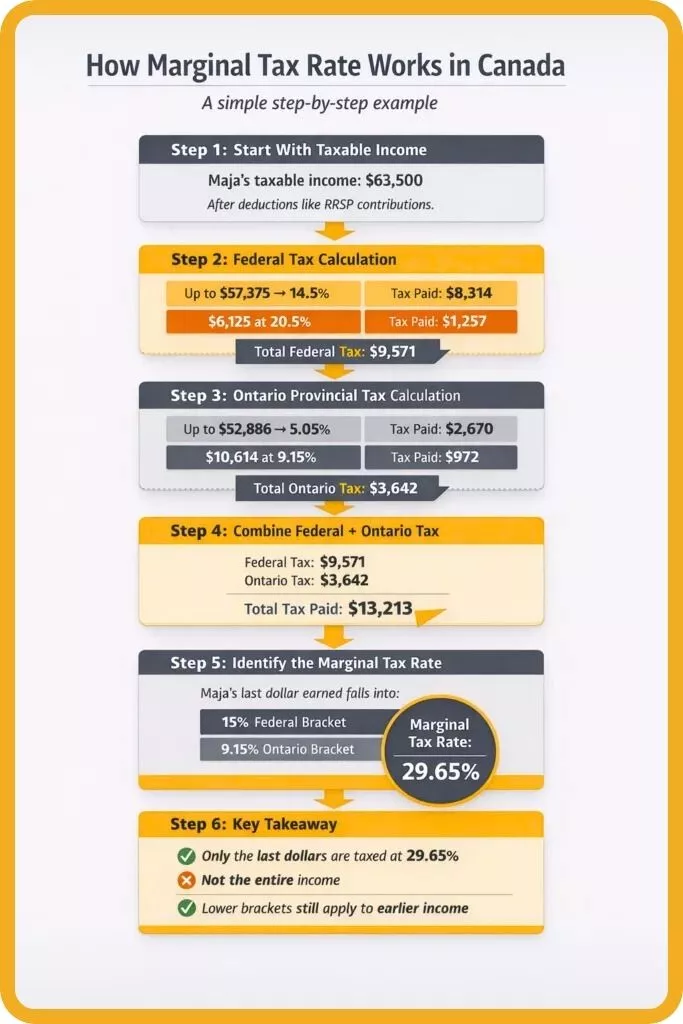
Calculating your marginal rate is straightforward if you know your taxable income and the relevant brackets. Follow these steps:
Step 1: Determine your taxable income
Start with your gross income and subtract allowable deductions such as contributions to Registered Retirement Savings Plans (RRSPs), pension plan contributions and certain expenses. For example, Maja, a business analyst who lives in Ontario, contributes to her RRSP and ends up with taxable income of CA$63,500.
Step 2: Compute the federal tax on each bracket
- Tax the first bracket. The initial $57,375 of Maja’s income is taxed at 14.5 %, giving $8,314.44 in federal tax.
- Tax the remaining federal bracket. Her remaining taxable income of $6,125 ($63,500 – $57,375) falls into the second federal bracket and is taxed at 20.5 %, amounting to $1,256.63.
- Sum the federal tax. Maja’s total federal tax is $9,571.07 ($8,314.44 + $1,256.63).
Step 3: Compute the provincial tax on each bracket
- Tax the first provincial bracket. The first $52,886 of her income is taxed at 5.05 %, yielding $2,670.36.
- Tax the remainder of the bracket. Her remaining $10,614 ($63,500 – $52,886) is taxed at 9.15 %, resulting in $971.92.
- Sum the provincial tax. Her total Ontario tax is $3,642.28.
Step 4: Combine federal and provincial tax to find your marginal bracket
Maja’s total tax is the sum of her federal and provincial liabilities: $13,213.35 ($9,571.07 + $3,642.28). Her marginal tax rate comprises the federal rate of 20.5 % (because her last dollar falls in the second federal bracket) and the Ontario rate of 9.15 % (because her last dollar falls in the second provincial bracket). So her combined marginal rate is 29.65 %. This rate applies only to additional income she earns above $63,500 until she enters the next bracket.
Distinguishing average and marginal tax rates
The average tax rate (sometimes called the effective rate) is your total tax paid divided by your total taxable income. In Maja’s case, dividing $13,213.35 by $63,500 yields an average rate of roughly 21 %. This is lower than her marginal rate because her first dollars were taxed at lower rates. Understanding the difference helps avoid the misconception that moving into a higher bracket will make all of your income subject to that rate.
Planning Strategies to Manage Your Marginal Tax Rate
Your marginal tax rate influences how much benefit you receive from deductions and credits, so strategic planning can keep more money in your pocket.
Here are some proven strategies (note that individual circumstances vary; consult a qualified tax professional before implementing):
1. Defer or split income
If you’re close to moving into a higher bracket, consider deferring income to a future year (if possible) when your income might be lower. Self‑employed individuals could delay issuing invoices until the next fiscal year. Alternatively, splitting income with a spouse through spousal RRSPs or prescribed‑rate loans can distribute taxable income across lower brackets.
2. Maximise RRSP and FHSA contributions
Contributing to a Registered Retirement Savings Plan (RRSP) reduces your taxable income dollar for dollar, possibly pushing you into a lower marginal bracket. For first‑time home buyers, the new First Home Savings Account (FHSA) also offers deductions. Contributing early in the year allows your money to grow tax‑free longer.
3. Use tax‑advantaged accounts for investment income
Interest and regular income are taxed at your full marginal rate, while capital gains and Canadian dividends benefit from preferential rates. Holding interest‑bearing investments in RRSPs or Tax‑Free Savings Accounts (TFSAs) shields that income from high marginal tax rates.
4. Time the realisation of capital gains
Capital gains are 50 % taxable, which often results in a lower effective rate compared with fully taxable income. If you plan to sell investments, schedule the sale for a year when your marginal rate is lower (e.g., after retiring or taking a sabbatical). Conversely, capital losses can offset gains and reduce taxable income.
5. Claim available credits and deductions
Non‑refundable credits (e.g., the basic personal amount, disability tax credit or caregiver credits) reduce your tax payable but don’t affect your taxable income. However, planning ahead to claim them in years with higher income can reduce the tax impact of a high marginal rate. Check provincial credits such as Ontario’s Care Tax Credit or Trillium Benefit for additional savings.
6. Consider provincial differences when relocating
Because provincial rates vary widely, moving from a high‑tax province (e.g., Nova Scotia) to one with lower rates (e.g., Alberta or Nunavut) can reduce your marginal tax rate. Note that your provincial rate is determined by where you live on December 31; therefore, you must relocate by the end of the tax year to benefit.
Seasonal and Geographic Considerations
Indexation and bracket creep
Both federal and provincial brackets are indexed annually for inflation. For 2025, the federal brackets were adjusted by approximately 4.7 %, raising the thresholds and increasing the basic personal amount. Ontario’s indexation factor for 2025 increased bracket thresholds by roughly 2.8 %. Failing to adjust withholding or instalments for these changes can lead to unexpected tax bills.
Mid‑year changes to federal rates
In 2025 the federal government reduced the lowest tax rate from 15 % to 14 % effective 1 July 2025. Because of this mid‑year change, the rate for the first bracket in 2025 is 14.5 %. Starting in 2026 the rate will be 14 %. Keep this in mind when estimating taxes based on partial‑year income.
Alternative Minimum Tax (AMT)
High‑income earners may be subject to the Alternative Minimum Tax (AMT), which ensures that certain tax preferences don’t reduce tax liability below a minimum threshold. Federal AMT rules changed in 2024, increasing the AMT rate to 20.5 % and setting the exemption equal to the start of the second‑highest federal bracket (CA$177,882 in 2025). When planning large capital gains, stock option exercises or other preference items, consult a tax professional to avoid AMT surprises.
Conclusion
After exploring how marginal tax rates work in Canada, you might want to assess your own situation. Consider consulting a certified tax professional like Bestax for personalised planning.
Understanding your marginal tax rate empowers you to make informed decisions about income, investments and deductions, helping you keep more of what you earn. Ready to take the next step? Reach out to our tax advisor to see where you stand.
Frequently Asked Questions (FAQs)
What is the marginal tax rate in Canada?
It’s the percentage of tax applied to the last dollar of your taxable income. Because Canada uses a progressive tax system with multiple brackets, your marginal rate depends on where your income falls within the federal and provincial brackets. Only the income in the highest bracket you reach is taxed at that bracket’s rate.
How do provincial rates affect my marginal tax rate?
Your marginal rate is the sum of your federal and provincial rates for the bracket you’re in. For example, if you live in Ontario and your taxable income is $63,500, your marginal rate is 29.65 % (20.5 % federal + 9.15 % provincial).
What is the top marginal tax rate in Ontario?
Ontario’s combined federal–provincial rate peaks at 53.53 % on taxable incomes above approximately CA$253,414. This rate includes provincial surtaxes and the federal 33 % bracket.
How do I find my marginal tax rate if I move provinces?
Your provincial tax rate is determined by the province or territory where you live on December 31 of the tax year. If you move after that date, you will still be taxed based on your previous province for that year.
What’s the difference between marginal and average tax rates?
The average tax rate is your total tax paid divided by your total income. It reflects your overall tax burden and is always lower than your marginal rate because your first dollars are taxed at lower rates.
Can my marginal tax rate change within a year?
Yes. If your income increases enough to push you into a higher bracket or if government legislation changes rates mid‑year (as with the federal rate dropping to 14 % on 1 July 2025), your marginal rate for additional income will change accordingly.
Disclaimer: The information provided in this blog is for general informational purposes only. For professional assistance and advice, please contact experts.