


Getting a refund feels like a win. Getting a balance owing can feel like a punch.
Either way, your real job starts when your CRA notice of assessment lands in your inbox or mailbox.
Think of it like this: CRA has reviewed your return and published their official version. If you do not read it carefully, you can miss errors that affect your refund, RRSP room, benefits, and next year’s tax situation.
Here are the exact steps to take, in order, so you fix issues fast and stay in control.
What is a CRA Notice of Assessment?
A CRA notice of assessment (NOA) is the summary CRA sends after they process your tax return. It shows CRA’s version for your income, deductions, credits, and the result (refund or balance owing). It also shows key carry-forward amounts and limits that affect future years, like your RRSP deduction limit. Unless you request a change or file an objection, the Notice of Assessment becomes CRA’s official record for that tax year.
Think of it as CRA saying: “Here is what we accepted, here is what we changed (if anything), and here is what you owe or get back.” If you only read the refund line, you can miss a change that costs you later.
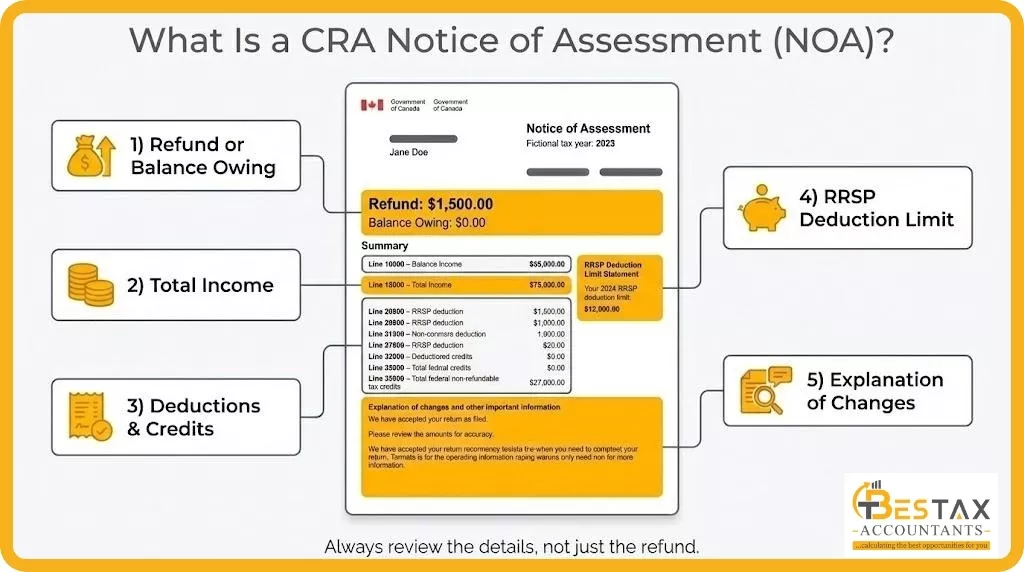
Step 1: Read the NOA Beyond the Refund Amount
Most people only look at the refund or balance owing. That is the fastest way to miss a problem.
Focus on the following:
- Income section (total income, taxable income)
- Deductions and credits (what was accepted vs reduced)
- RRSP deduction limit (this affects future contributions)
- CRA adjustments and notes (often called “explanation of changes”)
- Carryforward amounts (tuition, capital losses, donation carryforwards, if relevant)
This matters because the NOA is CRA’s final version of your tax return. If something is off here, it can ripple into next year.
Step 2: Compare the NOA With Your Filed Tax Return
Once you know what CRA “finalized,” compare it to what you actually filed. This is the quickest way to spot an adjustment.
Put these side by side:
- Your filed tax return (the version you submitted)
- Your Notice of Assessment (CRA’s version)
Then check these key totals:
- Total income
- Claimed deductions
- Credits
- Refund or balance owing
If any number does not match, CRA changed something. Now you move to the “why.”
Step 3: Identify What Changed and Why
This step is about pinpointing the exact issue, not guessing.
Look for the “Explanation of changes” area and any adjustment lines. CRA usually tells you what line was changed and sometimes why.
Ask yourself:
- Did CRA remove a deduction you claimed?
- Did CRA reduce a credit you expected?
- Did CRA change an income amount because of a slip they received?
Once you know the exact line that changed, you can collect the right proof and choose the right fix.
Step 4: Decide Who Made the Mistake
This is the fork in the road. Your next move depends on it.
Scenario A: CRA made the mistake
You filed correctly, but CRA misunderstood a detail, auto-adjusted, or missed a document you already had.
Scenario B: You made the mistake
A slip was missing, a number was entered incorrectly, or a claim was ineligible or unsupported.
If you are unsure, decide based on evidence. Do you have the slip, receipt, or form that supports your original claim? If yes, you likely push for a correction. If not, you correct your return properly.
Step 5: Take the Correct Action
Now you act, based on what you found.
If CRA made the mistake:
Call CRA and ask for clarification. Get the agent’s name and reference number. Ask what document or detail they need to reverse the adjustment. If the issue is factual, send the missing support. If the issue is interpretation, ask what reassessment path applies.
If the issue cannot be resolved informally, you generally have 90 days from the date of the Notice of Assessment to file a formal Notice of Objection.
If you made the mistake:
Fix it officially. That usually means requesting a change after assessment using CRA’s “Change my return” options.
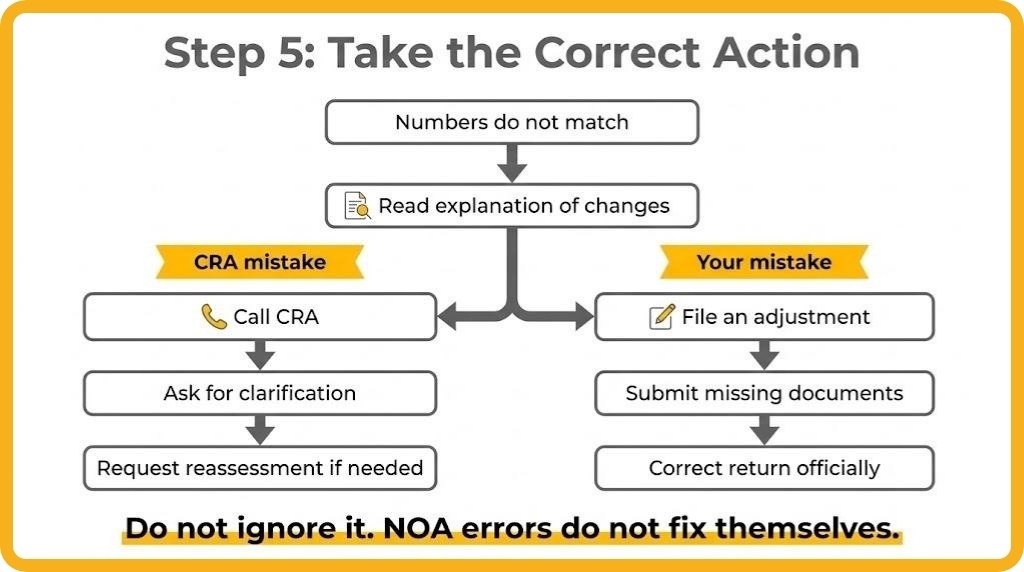
Keep this rule in your mind: do not ignore it. NOA issues rarely fix themselves.
Step 6: Act Quickly, Don’t Delay
Delays create avoidable problems.
If you owe money and wait, CRA can charge interest. CRA states that they charge daily compound interest on an outstanding balance from the day after it is due until it is paid in full. That is why “I will handle it later” can get expensive fast.
Even if you do not owe money, a wrong NOA can still hurt you. A wrong RRSP limit can affect contributions. A wrong income number can affect benefits and credits. Early action is usually the easiest action.
This is also where your CRA notice of assessment matters most, because the longer you wait, the harder it becomes to find documents, remember details, and respond cleanly.
Step 7: Keep Records for the Future
This is the step that saves you in audits, loan applications, immigration files, and future tax years.
Save these items together in one folder (digital or paper):
- Notice of Assessment
- Filed return (the exact version submitted)
- Supporting documents (slips, receipts, medical, donations, business expenses)
- CRA communication notes (dates, names, reference numbers)
If you want a simple rule of thumb, follow the six-year retention approach. CRA generally requires taxpayers to keep records for at least six years from the end of the tax year. Here is a practical guide you can follow: How long to keep tax records in Canada.
Final Takeaway
Receiving a Notice of Assessment is not the end. It is a checkpoint.
If you do not review and act, CRA’s version becomes the one that sticks, even if it is wrong.
If you want professional support, Bestax Accountants can help you review the NOA, identify what changed, and choose the cleanest fix. We are a Canadian tax team with 10+ years of experience, 35+ professionals, and 1000+ clients served.
Quick FAQs
Why does my Notice of Assessment not match my return?
CRA may have adjusted an amount, removed a claim, or processed a slip you did not include.
What should I check first on the NOA?
Start with total income, deductions, credits, RRSP deduction limit, and the explanation of changes.
How do I correct a mistake after I get assessed?
Use CRA’s “Change my return” process and submit the corrected line(s) with support.
What happens if I delay paying a balance owing?
CRA can charge daily compound interest from the day after the amount is due until it is paid.
Disclaimer: The information provided in this blog is for general informational purposes only. For professional assistance and advice, please contact experts.