

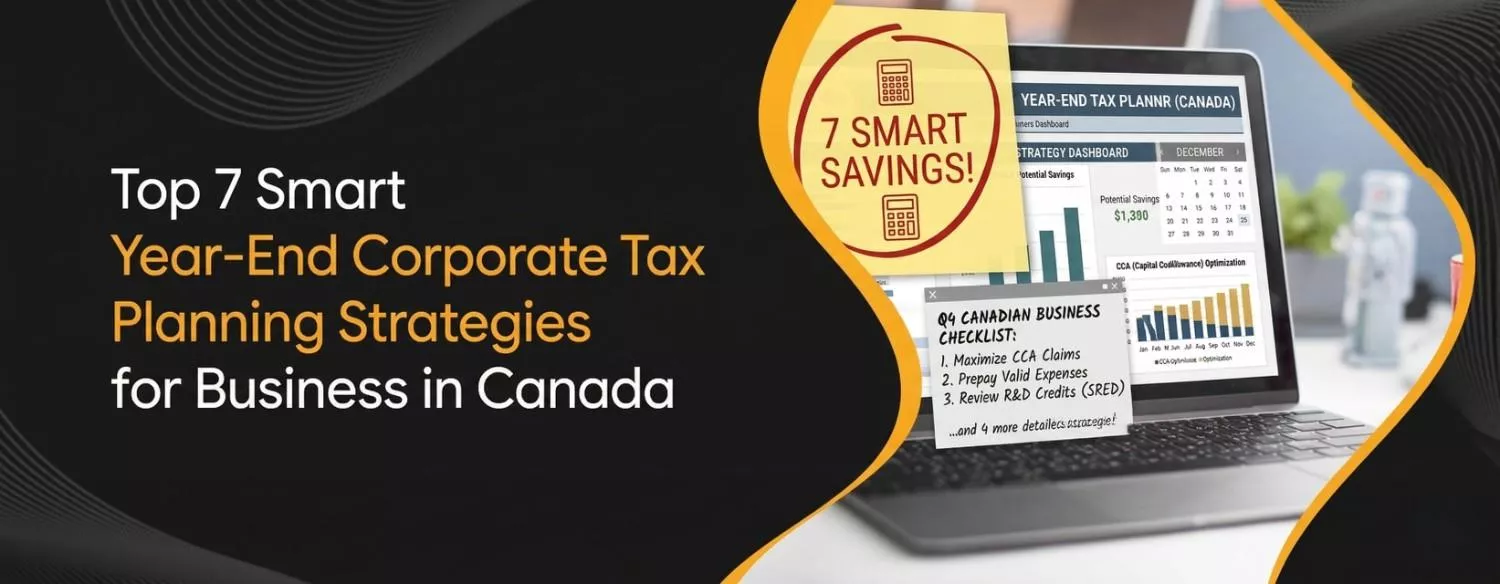
Canadian entrepreneurs often rush to assemble paperwork just weeks before their corporation’s fiscal year‑end. However, proactive tax planning strategies in Canada can reduce your corporate tax bill and strengthen your company’s financial health.
The federal government offers favourable tax incentives for small businesses and innovative companies, yet complex rules, like the Tax on Split Income (TOSI) or the half‑year rule, can trip up unprepared owners.
This guide combines official federal guidance with insights from leading accounting firms to provide smart tax planning strategies you can implement before year‑end.
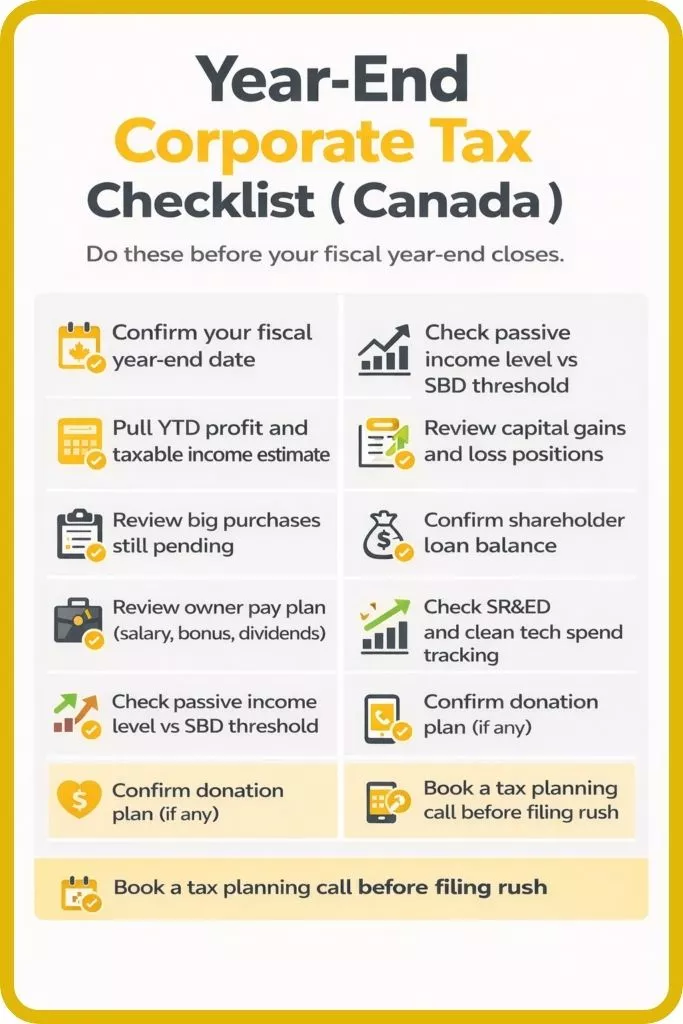
1. Plan Capital Purchases and Sales Before Year‑End
A common tax planning strategy in Canada is to deliberately time the purchase or sale of capital assets (equipment, vehicles, technology) around your corporation’s year‑end. You can claim a capital cost allowance (CCA), Canada’s version of depreciation, on eligible assets that are both acquired and available for use before the fiscal year ends. According to BDO’s 2025 update, the 2024 federal budget introduced accelerated first‑year CCA rates of 100 % on certain classes (e.g., patents, data‑network infrastructure, general‑purpose computer equipment) if the property is acquired after 16 April 2024 and used before 2027. Manufacturing and processing buildings acquired after 4 November 2025 may also qualify for immediate expensing until 2030.
Why it matters: Taking advantage of these accelerated rules can drastically reduce taxable income in the current year. Conversely, deferring the sale of depreciable assets with accrued gains can postpone the inclusion of recaptured CCA and capital gains until the following year.
How to implement
- Buy before year‑end: Purchase productivity‑enhancing assets (e.g., software, zero‑emission vehicles) before your fiscal year‑end so they’re “available for use.” Even with the half‑year rule, where only half of the normal CCA can be claimed in the first year, the deduction still shelters income.
- Delay profitable sales: When possible, delay selling depreciable property with gains until the new fiscal year to extend tax deferral and obtain another year of CCA.
- Accelerate loss sales: Sell loss‑making assets before year‑end so capital losses can offset current‑year capital gains; this “tax‑loss selling” technique is recognized as a common planning method by RBC.
Pro tip: Keep proper documentation showing that the asset was available for use, a requirement for claiming CCA. In most cases, “available for use” means the asset is installed and capable of functioning. If your company has multiple subsidiaries or year‑ends, consider a staggered purchasing schedule to spread deductions across different fiscal periods.
2. Harness Federal Tax Credits and Incentives
Government incentives reward companies that innovate or invest in clean technology. For Canadian‑controlled private corporations (CCPCs), the Scientific Research and Experimental Development (SR&ED) program offers an enhanced investment tax credit (ITC). The 2025 federal budget proposes increasing the annual expenditure limit eligible for the enhanced SR&ED ITC from $3 million to $6 million, extending the taxable capital phase‑out range to $15–75 million and reinstating the deduction of capital expenditures. This means more mid‑sized businesses can claim generous credits for qualifying research projects.
In addition, new Clean Economy Investment Tax Credits encourage the adoption of green technologies. Immediate expensing rules for clean‑energy machinery and zero‑emission vehicles (Classes 43.1, 43.2, 53, 54, 55 and 56) enable full cost deductions when the property is acquired after 1 January 2025 and available for use before 2030.
How to implement
- Identify eligible activities: Review ongoing projects for SR&ED eligibility, qualifying activities must be systematic and technological in nature (not just routine engineering). Document hypotheses, experiments and results to support your claim.
- Plan timing and budget: Since SR&ED credits and clean technology ITCs hinge on fiscal‑year timing, schedule expenditures before your corporation’s year‑end and ensure you have cash flow to maximize the credit.
- Combine incentives: Companies investing in sustainable manufacturing may qualify for both SR&ED credits and Clean Technology ITCs. Work with a professional to integrate these incentives into your corporate tax planning process.
Pro tip: Legislation to enact these proposals may still be pending; confirm details with your tax advisor. Credits can be complex, but when structured properly, they can significantly reduce your tax liability and free up capital for future R&D.

3. Optimize Compensation and Income Splitting
Choosing the right mix of salary, bonuses and dividends for you and your family members is essential to optimize your tax strategy. Paying salaries or bonuses before year‑end creates a corporate deduction and may provide your family with RRSP contribution room.
Dividends can also be used to split income with adult family members in lower tax brackets; some individuals may receive dividends tax‑free due to the basic personal exemption.
Salary, bonus or dividend?
| Factor | Salary/Bonus | Dividend |
|---|---|---|
| Yes, salaries and bonuses are deductible if paid within 180 days of year‑end | Yes, salaries and bonuses are deductible if paid within 180 days of the year‑end | No dividends are paid from after‑tax corporate profits |
| Increases RRSP/CPP room | Yes | No |
| Subject to payroll taxes (CPP/EI) | Yes | No (but TOSI rules apply) |
| Income splitting | Limited salaries must be reasonable | Possible by issuing dividends to adult family members in lower tax brackets |
| Tax on Split Income (TOSI) risk | Lower the rules don’t apply to reasonable salaries | Higher dividends to family may be taxed at top rates unless exclusions apply |
Other remuneration strategies
- Declare bonuses before year‑end: If you want a corporate deduction this year but defer personal taxation to the next year, declare a bonus before year‑end and pay it within 180 days.
- Pay reasonable salaries to family members: Salaries must be commensurate with the work performed to avoid TOSI; maintain documentation like job descriptions and timesheets.
- Consider provincial tax cuts: The federal personal rate on the lowest bracket was reduced from 15 % to 14 % effective 1 July 2025, giving more incentive to draw a salary within the lowest bracket.
- Withhold and remit payroll deductions: When paying salaries, ensure you remit income tax, CPP/QPP, and EI premiums to remain compliant.
Pro tip: Use dividends to compensate adult family members who own shares but have no other income; this may allow them to receive dividends tax‑free. Always consider the TOSI rules and maintain clear records of share ownership. When businesses are expanding, proper compensation planning is one of the best tax planning tips for expanding businesses in Canada.
4. Maximize the Small Business Deduction & Manage Passive Investment Income
The small business deduction (SBD) reduces the federal corporate tax rate from 15 % to 9 % for Canadian‑controlled private corporations (CCPCs) on active business income up to a designated business limit. Provincial rates vary, but in most jurisdictions the combined federal‑provincial tax on the first $500,000 of active business income is around 12 %, at least 12 percentage points lower than general corporate rates. Saskatchewan, Nova Scotia and Prince Edward Island have higher business limits of $600,000 to $700,000.
Preserve your small business status
The SBD can be reduced or lost if your corporation (and associated companies) earns more than $50,000 of adjusted aggregate investment income (AAII). For every dollar of passive investment income above $50,000, the SBD limit is reduced by $5, and it disappears completely when AAII reaches $150,000.
Strategies to maintain the SBD:
- Track and deduct related expenses: AAII is calculated net of expenses; consider deducting investment counsel fees, interest paid on investment loans and reasonable salaries paid to manage investments.
- Adjust your investment mix: Holding more equities may produce capital gains that are only 50 % taxable, whereas bond interest is fully taxable.
- Use corporate‑owned life insurance: Investing excess cash in an exempt life insurance policy can shelter investment income from AAII. The corporation pays lower premiums than an individual and enjoys tax‑deferred growth.
- Set up an Individual Pension Plan (IPP): IPP contributions are deductible and the plan’s passive income doesn’t count toward AAII.
- Pay out excess cash: Consider paying tax‑free capital dividends to shareholders or repaying shareholder loans to reduce passive income.
Manage passive investment income directly
There are several methods to reduce or defer passive income: claim expenses such as investment management fees and interest on investment loans; adopt a buy‑and‑hold strategy or invest in low‑dividend securities or funds that don’t distribute income annually; and invest in vehicles that pay return of capital rather than interest or dividends. The goal is to keep your corporation’s AAII below the $50,000 threshold.
Pro tip: As your business grows, consider separating operational income from investment income through a holding company. This is a form of corporate tax structuring; it can shield excess cash from operational risk and help preserve your SBD. However, Budget 2025 proposes new rules to limit tax deferral using tiered corporate structures, so consult your advisor before implementing.
5. Implement Loss, Reserve & Capital Dividend Account Strategies
Year‑end is the ideal time to manage capital gains and losses within your corporation. RBC’s guide recommends tax‑loss selling, disposing of investments with unrealized losses, to offset capital gains realized during the year. Transactions must settle before year‑end; for corporations with a 31 December year‑end and one‑day settlement, trades must be executed by 30 December. Be aware of the stop‑loss rules, which suspend a loss if you or an affiliated entity repurchases the same property within 30 days.
Use your Capital Dividend Account (CDA)
When a corporation realizes tax‑free amounts, such as the non‑taxable half of capital gains, life insurance proceeds or capital dividends from other companies, these amounts accumulate in its capital dividend account. Before triggering capital losses, it may be beneficial to pay a tax‑free capital dividend while the CDA is positive; otherwise, a capital loss may reduce the CDA balance. Pay careful attention to your CDA balance; paying out more than the available CDA balance can trigger penalty tax.
Carry losses forward or back
Unused net capital losses can be carried back three years or forward indefinitely. If the corporation carries a loss back, it may obtain a refund of taxes previously paid. This is a valuable cash‑flow management tool. Make sure to file the appropriate schedules with your corporate tax return.
Defer gains using reserves
If your corporation sells capital property and receives the proceeds over several years, it can claim a capital gains reserve, spreading the gain over up to five years. If you sell inventory or real property classified as inventory and the proceeds aren’t due until after year‑end, you may claim a business income reserve for up to three years. These reserves allow you to defer tax until cash is actually received.
Tax‑loss selling checklist
- Review your investment portfolio to identify unrealized losses.
- Confirm settlement dates; trades must settle in the current tax year to count.
- Avoid stop‑loss rules by waiting more than 30 days before repurchasing the same or identical securities.
- Consider paying a capital dividend before triggering losses to maximize your CDA.
- Decide whether to carry losses back or forward based on projected income.
Pro tip: Document every transaction meticulously date of trade, settlement date, amount and broker fees. CRA auditors often request detailed records for loss claims. During uncertain markets, implementing these tax strategies can preserve cash and reduce future taxes.
6. Build Retirement & Insurance Vehicles
Long‑term planning is just as important as year‑end tweaks. An Individual Pension Plan (IPP) is a defined‑benefit pension plan set up by a corporation for an employee or owner. RBC notes that IPPs allow greater annual contribution room than an RRSP and can extend benefits to spouses or family members employed by the corporation. Contributions are deductible and exempt from payroll and healthcare taxes. Your company can generally deduct IPP contributions made in the tax year or up to 120 days after year‑end, provided they relate to current or past service.
Benefits of an IPP:
- Tax deferral: Contributions are deducted from corporate income and grow tax‑deferred within the plan; taxes are paid when benefits are received in retirement.
- Income splitting: You may be able to split IPP retirement income with your spouse, reducing family taxes.
- Creditor protection: Assets in an IPP are generally protected from corporate creditors.
- Higher contributions with age: Contribution limits increase with the member’s age, making IPPs attractive for owners in their forties or fifties.
Corporate‑owned life insurance
Purchasing a permanent life insurance policy inside your corporation can be a powerful strategic tax planning tool. The investment income earned inside an exempt life insurance policy does not increase AAII, which helps preserve the SBD. Premiums paid by the corporation are generally lower than those paid personally due to lower corporate tax rates, and the investment growth is tax‑sheltered until disposition. Upon the insured’s death, a portion of the proceeds can be paid to shareholders as a tax‑free capital dividend through the CDA.
Other retirement vehicles
- Retirement Compensation Arrangement (RCA): Offers supplemental retirement benefits but has stricter funding rules and may not suit all businesses.
- Group Registered Pension Plan (GRPP): Suitable for corporations with multiple employees
- Spousal RRSP: Although not a corporate strategy, contributing to a spousal RRSP can help the owner’s family achieve retirement goals while balancing the corporate compensation mix.
Pro tip: Consider pairing an IPP with a corporate‑owned life insurance policy to diversify your retirement benefits and protect the SBD. Ensure your actuary and tax advisor coordinate contributions to avoid overfunding or double-counting.
7. Strategic Corporate Structuring & Year‑End Planning
Effective corporate tax structuring goes beyond year‑end housekeeping. It involves selecting a fiscal year‑end, structuring your corporate group and managing inter‑company transactions to defer or reduce tax. However, Budget 2025 warns against aggressive deferral: it proposes limiting the deferral of tax on investment income by using tiered corporate structures with mismatched year‑ends.
The budget notes that anti‑deferral rules already impose a refundable tax on investment income earned by CCPCs and that some corporations have exploited timing differences by paying dividends between connected corporations with different year‑ends. The proposed rules would suspend the payer’s dividend refund if the recipient’s balance‑due day occurs after the payer’s balance‑due day. To avoid the restriction, each recipient in the chain must pay a subsequent dividend on or before the payer’s balance‑due day.
Practical year‑end strategies
- Choose an appropriate fiscal year‑end: New corporations can choose any year‑end; many choose 31 December to simplify administration, while seasonal businesses might pick a slow period to facilitate inventory counts. Choosing a year‑end just after your busy season may ease bookkeeping and allow more time for strategic planning.
- Repay shareholder loans: If your corporation lent you funds, repay the loan before the end of the second taxation year following the year it was made to avoid including the loan as income.
- Donate securities in‑kind: Donating appreciated securities can eliminate the capital gain and provide a corporate tax deduction equal to the fair market value. The eliminated gain increases the CDA balance, allowing future tax‑free dividends.
- Use flow‑through shares: Flow‑through investments (e.g., resource sector) may provide deductions that reduce corporate taxes, but they carry higher risk and complex reporting. Evaluate the investment risk, diversification and liquidity before committing.
- Plan cash flow: Ensure enough cash is available to pay bonuses, purchase assets and make IPP contributions within required deadlines (e.g., 180 days for bonuses, 120 days for IPP contributions). Good cash management is critical for businesses looking to expand and take advantage of tax incentives.
Pro tip: Monitor upcoming legislative changes such as Budget 2025’s anti‑deferral rules. Restructure your corporate group if needed to prevent indefinite deferral of refundable tax credits. Consider staggering year‑ends only if the new rules do not apply or if the deferral benefit outweighs administrative complexity.
Want More Tax Planning tips for Expanding Businesses in Canada?
Smart tax planning takes time, documentation and an understanding of Canada’s evolving tax landscape. Don’t wait until your fiscal year‑end to start preparing; integrate these strategies into your quarterly reviews and consult a qualified tax advisor. Our team at Bestax Accountants can help you optimize your tax strategy, structure your corporation for growth and implement tax planning strategies Canada businesses need to thrive.
Reach out today to schedule a year‑end planning session and set your business on the path to long‑term success.
Frequently Asked Questions (FAQs)
What are the best tax planning strategies in Canada for small businesses?
Small businesses should time asset purchases to claim CCA and immediate expensing, leverage the small business deduction by keeping passive investment income below $50,000, and compensate owners using a mix of salary and dividends to maximize deductions and income splitting【350623522907862†L149-L176】.
How can I defer corporate income tax legally in Canada?
Legal deferral techniques include delaying the sale of assets with gains until after year‑end, claiming capital gains or business income reserves to spread tax over several years, and staggering year‑ends or using holding companies. Budget 2025 proposes to curb deferral via tiered corporate structures; dividends paid between affiliated corporations may no longer generate an immediate refund if year‑ends are misaligned.
What is the small business deduction and how do I maximize it?
The federal SBD reduces the corporate tax rate to 9 % for active business income up to a business limit; provincial rates vary. To maximize the SBD, keep passive investment income below $50,000, deduct related expenses, adjust your investment mix, and consider IPPs or life insurance to shelter investment income.
Should I take salary or dividends from my corporation?
Salaries and bonuses are deductible to the corporation and create RRSP room but are subject to payroll taxes. Dividends are not deductible but can facilitate income splitting with adult family members. The optimal mix depends on your cash needs, marginal tax rates and TOSI considerations. Declaring a bonus before year‑end and paying it within 180 days allows you to defer personal tax to the following year.
When should I purchase assets to maximize CCA?
An IPP is a defined benefit pension plan sponsored by your company. Contributions are deductible and exempt from payroll taxes, grow tax‑deferred and may allow income splitting with your spouse. Assets in an IPP are generally protected from creditors. IPPs are particularly attractive for owners aged 40 + who want higher retirement contributions than an RRSP allows.
When should I purchase assets to maximize CCA?
Acquire depreciable assets before your fiscal year‑end so they’re available for use. Even with the half‑year rule, the deduction shelters income in the current year. Immediate expensing rules allow full deduction for eligible manufacturing and clean‑energy property acquired in specific periods.
Disclaimer: The information provided in this blog is for general informational purposes only. For professional assistance and advice, please contact experts.