


If you are searching for How to Get Funding to Start a Business in Canada, you probably do not need another page that throws grants, loans, and investor terms at you. You need a clear path. That is where most new founders get stuck. The problem is usually not that money does not exist. The problem is that people chase the wrong money, too early, for the wrong reason.
That mistake costs time. It also leads to weak applications, bad debt, and funding that does not fit the business. A better approach is simple. First, understand what kind of money you actually need. Then match it to your business type, your stage, and your risk. That is how you build a funding plan that makes sense in 2026.
What Business Funding Means in Canada
What business funding actually is
Business funding is money you use to start, run, or grow a business. It can help you pay for setup costs, equipment, inventory, marketing, rent, payroll, or a cash buffer for the first few months. In Canada, most new businesses start small, so the right funding is often a mix of personal money, outside support, and careful borrowing.
That matters because small businesses still make up almost all employer businesses in the country. As of December 2024, Canada had 1.10 million employer businesses, and 98.2% of them were small businesses.
The main types of start-up funding in Canada
Most founders will look at a few common options:
- personal savings
- friends and family funding
- grants and incentive programmes
- term loans and lines of credit
- investor money
- incubators, accelerators, and competitions
Each option works differently. Some money must be repaid. Some takes a share of your business. Some comes with rules, reporting, or long wait times.
Why is not all funding good funding
A larger amount is not always better. Good funding fits the stage of your business, the use of the money, and your ability to handle the risk. A grant can look attractive but take months. A loan can solve a real need but create pressure if sales are still uncertain. Investor money can speed up growth, but it also means giving up a piece of control.
That is why the first question is not, “Where can I get money?” The first question is, “What kind of money fits this business right now?”
Know What Funding Your Business Needs
Are you funding an idea, a launch, or early growth
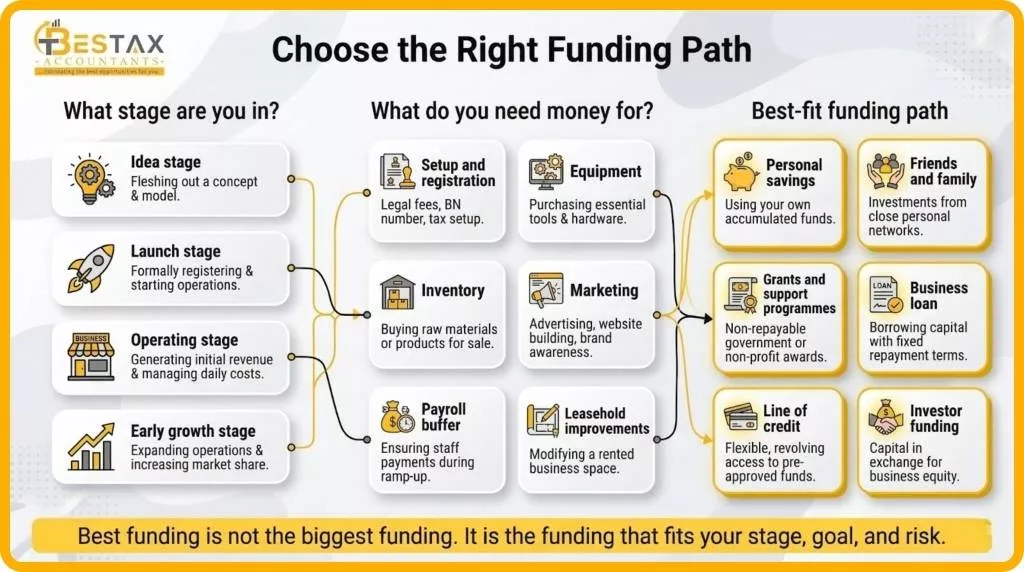
Start by naming your stage. An idea-stage business usually needs a small amount for testing, research, or a first version of the offer. A launch-stage business may need money for registration, branding, inventory, tools, or rent. An early-growth business often needs working capital, staff, or better systems.
When people skip this step, they apply for funding they are not ready for. A lender may want proof of repayment. A grant reviewer may want a clear project plan. An investor may want signs that the business can grow fast. One application will not suit every stage.
Are you funding assets, working capital, or survival
Now define what the money is for. This sounds basic, but it changes everything. Buying equipment is not the same as covering payroll. Renovating a leased space is not the same as testing a new service.
Your need may fall into one of these groups:
equipment, inventory, leasehold improvements, business setup, launch marketing, or a short-term cash reserve. Once you name the use of funds, the better funding options become easier to see.
Why does the purpose of money change the best source
Money for assets often fits debt better than money for guesswork. A lender is more comfortable with equipment, leasehold improvements, or a defined commercial use than with a vague plan to “see what happens.” Early testing, on the other hand, may be better funded through savings, part-time income, or a small local grant.
In 2024–25, the Canada Small Business Financing Program backed 6,409 loans worth close to $1.9 billion, and the largest share went to start-ups and firms under one year old. That same report shows that leasehold improvements and equipment were the most common uses.
Step 1: Choose the Right Funding Path
The biggest mistake founders make before applying
Many founders search for money before they choose a route. They see a grant, a bank page, or a funding list and start filling out forms. That is backwards. Funding works best when the path is chosen first and the application comes second.
Match your funding path to your business model
A service business often needs less upfront cash than a retail shop or a restaurant. An e-commerce brand may need money for inventory, ads, and fulfillment. A franchise often needs setup capital, fees, and equipment. A tech start-up may need time, product work, and proof of demand before it is ready for investor talks.
That is why funding should match the model. A low-cost consulting business may not need debt at the start. A physical location with renovation and equipment costs may need structured borrowing much sooner.
Match your funding path to your risk level
Risk also changes the answer. If you have no revenue yet, low collateral, and weak credit, large debt may be a bad move. If you have strong credit, a clear plan, and defined costs, debt may be reasonable. If you want full control, you will probably avoid equity for as long as possible. If your goal is fast scale and outside ownership does not bother you, investor funding may fit later.
The right path is not about what sounds exciting. It is about what your business can carry.
Step 2: Start With Founder-Ready Money
Bootstrapping and personal capital
The first money often comes from the founder. That can be savings, side income, or money earned before launch. This stage matters because it forces focus. It helps you test what customers want before you add outside pressure.
Self-funding also shows seriousness. Lenders and support programmes often look more closely at founders who have put some of their own money or effort into the business.
Friends and family funding
Friends and family money can help when the amount is small and the purpose is clear. It can bridge early setup costs or cover a short launch window. But it should never be casual. Write down the amount, the repayment terms, whether it is a loan or an investment, and what happens if the business takes longer than expected.
Clear paperwork protects the relationship. Confusion ruins it.
Why early founders should not rush into debt or equity
Early businesses need proof before pressure. If you borrow too soon, you may spend your first months trying to make payments instead of building the business. If you give up equity too soon, you may lose part of the company before it has real value.
At the start, the goal is not to raise the most money. The goal is to reduce guesswork.
Step 3: Explore Non-Dilutive Funding
Grants, incentives, and programme-based support
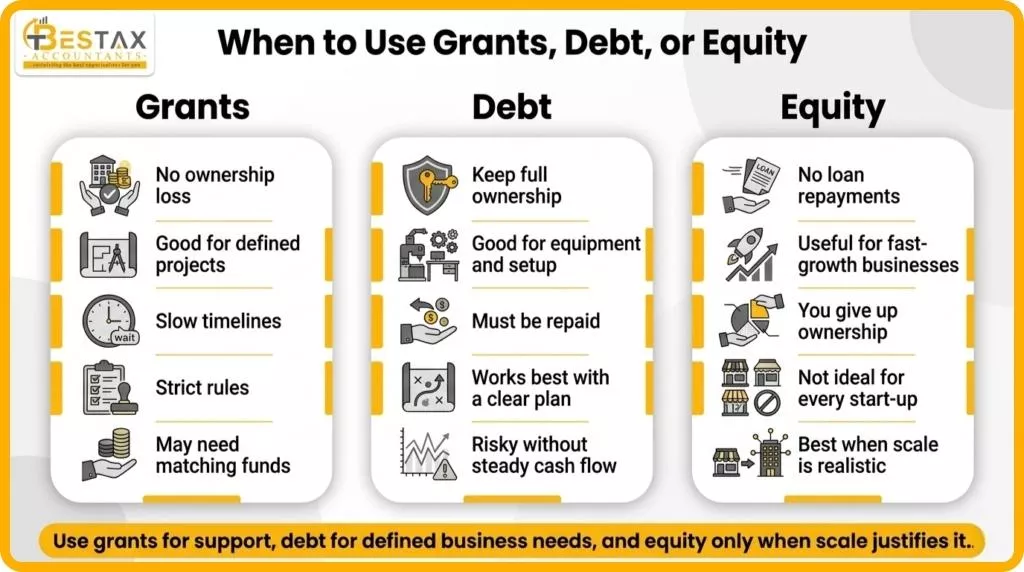
Non-dilutive funding means money that does not take ownership in your business. That can include grants, wage support, local start-up programmes, or project-based help. This kind of support can be valuable because it lowers pressure and preserves control.
It can also work well when the business has a clear project, a clear budget, and a clear reason the programme fits.
Competitions, incubators, and accelerators support
Not all support comes as cash. Some programmes offer training, mentors, pitch coaching, office space, or access to a stronger network. For a first-time founder, that support can be just as useful as a cheque.
Good mentoring can save months of mistakes. Good introductions can open doors that a cold email never will.
The hidden truth about grants
Grants can help, but they are not easy money. Many founders waste time here because they treat every grant as a fit.
- Timelines can be slow
- Eligibility rules can be strict
- Paperwork can be heavy
- Some programmes require matching funds
- Many are better for specific projects than general startup needs
That does not make grants bad. It means grants should be used with care, not hope.
Step 4: Use Debt Strategically
When a business loan makes sense
Debt makes sense when the business has a clear use for the money and a realistic path to repayment. Equipment, leasehold improvements, inventory, and a modest working capital need can all fit. The keyword is clear. If you cannot explain exactly how the money will be used and how the business will carry the repayment, you are not ready yet.
How government-backed loans can help start-ups
Government-backed business loans can help new firms get financing through banks and other lenders by lowering part of the lender’s risk. Under the federal small business financing programme, eligible firms can apply through participating lenders, and businesses with gross annual revenues of $10 million or less may qualify. The current maximum is up to $1.15 million, including up to $1 million in term loans and up to $150,000 in lines of credit.
When debt is the wrong choice
Debt is the wrong choice when the business has no repayment plan, no reliable pricing, or no real idea how sales will come in. It is also risky when borrowing is being used to cover a weak model instead of support a working one. Borrowing does not fix confusion. It only gives confusion more money.
Step 5: Look at Investors at the Right Time
What equity funding really means
Equity funding means you get money in exchange for ownership. That sounds simple, but the long-term cost can be large. You may give up decision power, future profit, or flexibility later.
Who investor funding is best for
Investor funding usually fits businesses with strong growth potential, repeatable sales, and the ability to scale beyond one owner or one location. It is a better fit for some tech, product, or expansion stories than for many small local service businesses.
Why many start-ups should avoid investors too early
Most founders do not need investors first. They need proof that customers want what they are offering. They need clean numbers, a workable price, and a better understanding of costs. Without that, investor talks can waste energy and push the business in the wrong direction.
Step 6: Build a Smart Funding Stack
What a funding stack is
A funding stack is a mix of money sources used in the right order. Instead of betting everything on one grant, one loan, or one investor, you combine what fits.
Example of a smart start-up funding stack
A new founder might use personal savings for setup, a small local programme for support, a loan for equipment, and a line of credit later for short-term cash flow. Equity, if it ever comes in, should come only when the business has a strong reason for it.
By this point, How to Get Funding to Start a Business in Canada should feel less like a search term and more like a checklist. The smart move is not to chase every source. It is to stack the right sources in the right order.
Why combining funding sources often works better
One source rarely does everything well. Savings give control. Grants reduce dilution. Debt can fund assets. Advisory support can sharpen the plan. A smart mix often gives better balance than one large funding bet.
Step 7: Get Funding-Ready Before You Apply
What lenders and programmes want to see
Before you apply, get your basics in order. That means a clear offer, a realistic budget, a sensible legal structure, and numbers you can explain. If you are still working through your model, it helps to build a proper business plan in Canada so your projections, use of funds, and market thinking are all in one place.
Legal setup matters too. If your structure is still unclear, sort out your company registration in Canada before you start sending formal applications. Lenders and support programmes want to see that the business is real, organised, and moving with purpose.
Documents you should prepare before applying
Have these ready before you ask for money:
- business plan
- cash flow forecast and basic projections
- use-of-funds breakdown
- founder contribution details
- registration and legal documents
- quotes for equipment, leasehold work, or setup costs
Signs you are applying too early
You are probably too early if your business model is still vague, your costs are rough guesses, your revenue assumptions are weak, or you still do not know what the money is for. Waiting a little longer to prepare is often better than sending a weak application now.
Step 8: Apply in the Right Order
A simple order most founders can follow
First, define the need. Second, test your readiness. Third, use founder money where it makes sense. Fourth, review grants and support programmes that fit the stage. Fifth, approach lender-based options for clear asset or cash flow needs. Sixth, consider investors only if the business can truly scale that way.
Why applying in the wrong order wastes time
The wrong order creates rework. You may prepare the wrong documents, target the wrong programme, or take on terms that do not suit the business. Good funding is not just about approval. It is about fit.
Common Funding Mistakes in Canada
Many new owners make the same errors. They confuse visibility with eligibility, so they assume every programme they find is a real option. They ask for too much or too little, which weakens the plan. They ignore the cost of capital, which means they focus on access but forget control, time, and repayment. They also treat every dollar the same, even though grant money, debt, and equity each come with a very different cost.
The better move is to slow down, define the need, and choose with care.
A Simple Start-Up Funding Plan for 2026
If you are still at the idea stage, keep costs lean and use personal money to test the market. If you plan to launch in the next three to six months, get your documents ready, price the setup properly, and look at grants or debt that fit a defined use. If you already have early sales, study your cash flow and decide whether the next step is better systems, asset funding, or a small working capital buffer.
A real plan is not flashy. It is specific.
Final Thoughts
The best funding plan is not about chasing every option you can find. It is about knowing your stage, knowing what the money is for, and picking the right mix at the right time. That is what turns a funding search into a business decision.
If you want help getting your numbers, structure, and documents ready before you apply, Bestax Accountants is a practical place to start.
Quick FAQs
The best way depends on the business stage and the use of funds. Many founders start with savings, then add grants or a small loan only when the need is clear.
Yes, some start-ups can qualify, especially for defined business costs. But approval still depends on the lender, your plan, your credit, and how the money will be used.
Not always. Grants do not need repayment, but they can take longer and may have strict rules. Loans can be faster and more flexible when the use of funds is clear.
Usually no. Most founders should test the market first. Early proof makes later funding talks much stronger.
At minimum, prepare a business plan, cash flow forecast, use-of-funds breakdown, founder contribution details, and the basic legal or registration documents for the business.
Disclaimer: The information provided in this blog is for general informational purposes only. For professional assistance and advice, please contact experts.

