

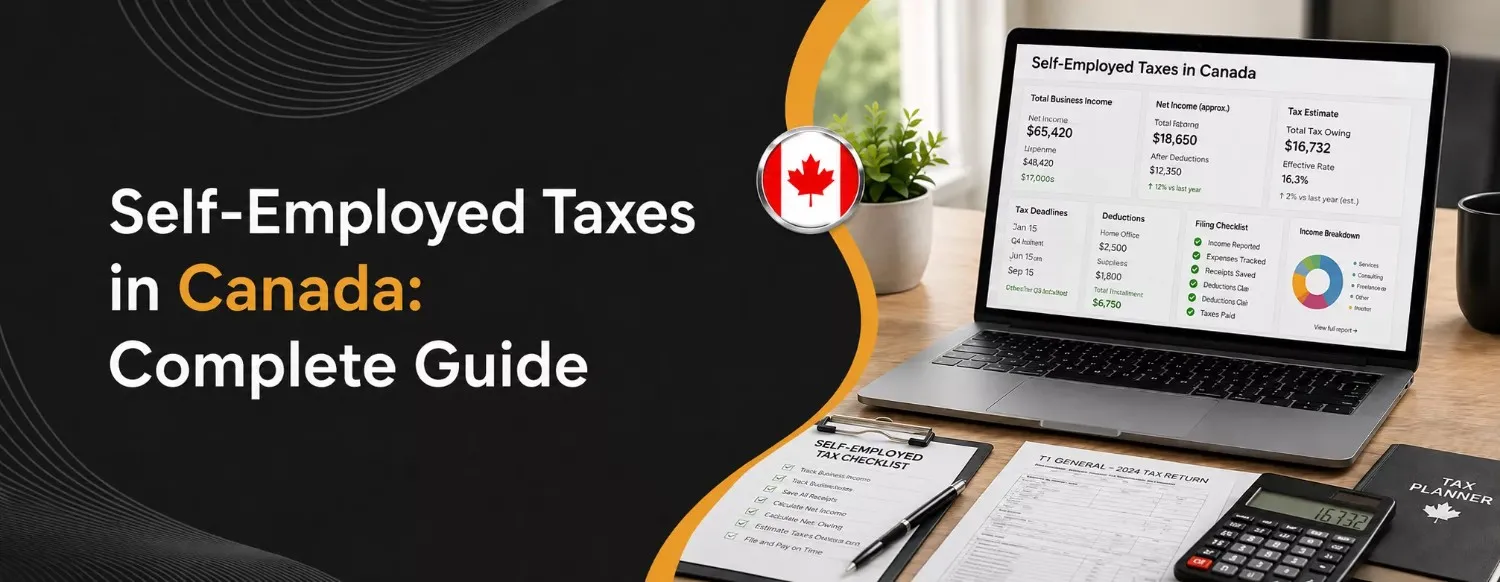
Self-employed taxes in Canada are the income tax and Canada Pension Plan contributions you pay on the profit from your own business, reported on your personal tax return using Form T2125. If you earn money as a freelancer, contractor, gig worker, consultant, or sole proprietor, you are responsible for calculating, reporting, and paying that tax yourself, because no employer is withholding it for you.
This guide breaks the whole system down in plain language, so even if you have never filed as a business owner before, you will know exactly what you owe, when it is due, and what you can legally claim to keep more of what you earn.
Who Counts as Self-Employed in Canada?
You are considered self-employed by the Canada Revenue Agency (CRA) if you earn income from a business you run yourself rather than from an employer who issues you a paycheque. This includes sole proprietors, independent contractors, freelancers, commission earners, gig and platform workers, and partners in a partnership.
The key difference is control and risk. An employee works under someone else’s direction and has taxes taken off automatically. A self-employed person decides how the work gets done, carries the financial risk, and receives payment in full with nothing withheld. That untaxed income is the reason Canada self-employed tax rules put the responsibility for reporting and paying squarely on you.
If your business is incorporated, you are not self-employed in the eyes of the CRA. A corporation is a separate legal entity that files its own corporate tax return, and this guide focuses on unincorporated self-employment. If you are still deciding how to structure things, our team can walk you through registering a business in Canada and whether sole proprietorship or incorporation suits you better.
How Self-Employed Income Tax Works
Self-employed income tax in Canada is not a separate or special tax. Your business profit is added to any other income you have, and the total is taxed at the same progressive federal and provincial rates that apply to everyone. Profit means your revenue minus your allowable business expenses, so you are taxed on what you actually keep, not on every dollar that comes in.
Canada uses a marginal system, which means only the income inside each bracket is taxed at that bracket’s rate. Moving into a higher bracket never reduces your take-home pay. For the 2025 tax year, the federal brackets are:
- 14.5 percent on taxable income up to $57,375
- 20.5 percent on the portion from $57,375 to $114,750
- 26 percent on the portion from $114,750 to $177,882
- 29 percent on the portion from $177,882 to $253,414
- 33 percent on income above $253,414
The lowest federal rate was reduced from 15 percent to 14 percent effective July 1, 2025, so the CRA applies a blended 14.5 percent rate for the full 2025 year and a full 14 percent rate starting in 2026. For the 2026 tax year, the one you are currently earning income in and paying instalments toward, the brackets have been indexed upward by 2 percent and the full 14 percent lowest rate applies:
- 14 percent on taxable income up to $58,523
- 20.5 percent on the portion from $58,523 to $117,045
- 26 percent on the portion from $117,045 to $181,440
- 29 percent on the portion from $181,440 to $258,482
- 33 percent on income above $258,482
On top of these federal rates, your province or territory adds its own income tax, calculated on the same taxable income in every province except Quebec, which collects its own.
Before any tax applies, the federal basic personal amount lets most people earn a base amount tax free. For 2025 that amount is $16,129, and for 2026 it rises to $16,452. This is why income tax for self-employed individuals often works out lower than people fear once deductions and the basic personal amount are applied.
Canada Pension Plan for the Self-Employed
This is the part that surprises most new business owners. When you are employed, you pay half of your CPP contribution and your employer pays the other half. When you are self-employed, you pay both halves yourself.
For the 2025 tax year, the self-employed CPP contribution rate is 11.9 percent on net business earnings between the $3,500 basic exemption and the first earnings ceiling of $71,300. Earnings above that first ceiling, up to a second ceiling of $81,200, are subject to the second additional contribution known as CPP2 at a self-employed rate of 8 percent.
For 2026, the first earnings ceiling rises to $74,600 and the second ceiling rises to $85,000, with the same 11.9 percent and 8 percent self-employed rates and the same $3,500 exemption. The maximum CPP2 contribution for a self-employed person in 2026 is $832, and the maximum total contribution, including CPP2, is $9,292.90.
There is a silver lining, and it is larger than many guides suggest. Your contributions are split between a deduction and a credit on your return, but the split is not a simple half and half. For the base portion of your contribution (4.95 percent employee side plus 4.95 percent employer side), you deduct the employer’s share and claim a non-refundable tax credit on the employee’s share, which the CRA collects on Line 31000, Base CPP or QPP contributions. The enhanced portion introduced by the CPP enhancement (the extra 2 percent) and every dollar of your CPP2 contributions are fully deductible. In other words, well over half of what you pay to CPP comes straight off your taxable income as a deduction. It also helps to budget for CPP separately, because it is calculated on top of your income tax and is easy to forget when you set money aside.
Employment Insurance is optional for self-employed people. You are not required to pay EI premiums, but you can choose to opt in through a voluntary agreement if you want access to special benefits such as maternity, parental, or sickness benefits.
If You Are Self-Employed in Quebec
Quebec runs its own versions of several pieces of this system, so a few of the rules above change if you live there. Instead of CPP, you contribute to the Quebec Pension Plan (QPP), and at a higher rate: the combined self-employed QPP rate is 12.8 percent for 2025, easing to 12.6 percent for 2026, plus a second additional contribution (QPP2) of 8 percent on earnings between the first and second ceilings, which mirror the CPP ceilings. The deduction-and-credit treatment works the same way as CPP.
You also pay premiums to the Quebec Parental Insurance Plan (QPIP), which is mandatory for self-employed workers in Quebec and funds maternity, paternity, parental, and adoption benefits. Because QPIP covers these benefits, the federal EI opt-in works differently for Quebec residents.
Finally, you file two returns: the federal T1 with the CRA and a separate TP-1 return with Revenu Québec, which collects Quebec income tax, QPP contributions, and QPIP premiums. Quebec’s instalment threshold is also lower, at $1,800 of net tax owing rather than the $3,000 that applies elsewhere in Canada.
GST/HST for the Self-Employed
GST/HST is separate from income tax and catches many first-time business owners off guard. You must register for and start charging GST/HST once your total revenue from taxable sales is more than $30,000 in a single calendar quarter or over the last four consecutive calendar quarters. Below that level you are considered a small supplier and registration is optional.
How quickly you must act depends on how you crossed the threshold, because the CRA treats the two paths differently:
- If you exceed $30,000 in a single calendar quarter, you stop being a small supplier immediately. Your effective date of registration is the day of the sale that pushed you over the threshold, you must register within 29 days of that date, and you have to charge GST/HST on that sale and everything after it.
- If you exceed $30,000 over the previous four (or fewer) consecutive calendar quarters, but not in any single quarter, you keep your small-supplier status until the end of the month following the quarter in which you crossed the threshold. Your effective date of registration is no later than your first taxable sale after that grace period ends, and you must register within 29 days of that effective date.
The rate you charge follows the province where the sale takes place, so it may be 5 percent GST or a higher harmonized rate depending on the location.
One important exception: if you are a self-employed taxi driver or commercial ride-sharing driver, you must register for GST/HST from your very first fare. The small-supplier threshold does not apply to you, no matter how little you earn.
Many self-employed people register voluntarily even before they hit $30,000. The reason is input tax credits, which let you recover the GST/HST you pay on business expenses. If you spend a lot on equipment, software, or supplies, voluntary registration can put money back in your pocket and can make your business look more established to clients. If you would rather not handle the paperwork, Bestax manages GST registration, HST registration, and GST/HST return filing from start to finish.
Self-Employed Tax Forms You Need to Know
The self-employed tax forms that matter most are short in number but important to get right:
- Form T2125, Statement of Business or Professional Activities. This is the core form where you report your business income and expenses. It attaches to your personal T1 return and is where your profit is calculated.
- Guide T4002. This CRA guide walks you through business, professional, commission, farming, and fishing income line by line. It is the official companion to the T2125 and explains what belongs on each line.
- Form T4A. If you were paid as a contractor, you may receive a T4A slip reporting that income. Even if you do not receive one, you must still report all of your earnings.
- The T1 General return. Your business results flow into your personal T1, which is the return every individual files. If you live in Quebec, you also file a TP-1 return with Revenu Québec.
Keeping clean records throughout the year makes these forms simple. If your books are behind, catching up before filing season is far easier than reconstructing a full year in April, and our backlog accounting service exists for exactly that situation.
Self-Employed Tax Deadlines in Canada
The self-employed tax deadline in Canada is generous on filing but strict on payment, and mixing up the two is a common and expensive mistake. Because you are reading this in the middle of 2026, it helps to separate the season that has just closed from the one now in progress.
For the 2025 tax year (the return most people have just wrapped up):
- Payment of any balance owing was due April 30, 2026. This date has already passed.
- The filing deadline for you and your spouse or common-law partner was June 15, 2026. This date has also passed.
If you missed either date and still owe tax, file as soon as you can, because late-filing penalties and interest keep growing until you do.
For the 2026 tax year (the year currently underway, filed in 2027):
- Quarterly instalments, if the CRA requires them, fall on March 15, June 15, September 15, and December 15, 2026. The March and June instalments have already passed, while the September 15 and December 15 instalments are still ahead of you. Instalments are required when your net tax owing is more than $3,000 ($1,800 for Quebec) in the current year and in either of the two previous years.
- Payment of any balance owing will be due April 30, 2027.
- The filing deadline will be June 15, 2027.
The instalment dates during 2026 are payments toward your 2026 taxes, while the April 30, 2026 and June 15, 2026 dates settled your 2025 taxes. You can always confirm the current schedule against the CRA list of tax deadlines for self-employed individuals. Because your final payment is always due before your filing deadline, the safest habit is to estimate what you owe early and set the money aside. A simple rule many self-employed people use is to save a fixed percentage of every payment they receive in a separate account so the tax bill never becomes a shock.
Self-Employed Tax Deductions in Canada
Deductions are where self-employed taxpayers gain the most control over their bill. A deduction lowers the profit you are taxed on, so every legitimate business expense you track reduces what you owe. The rule is straightforward: the expense must be reasonable and incurred to earn business income, and you must keep the receipt.
Common tax write-offs for self-employed Canada business owners include:
- Business-use-of-home expenses. If you work from home, you can claim a portion of rent or mortgage interest, utilities, property taxes, and home insurance based on the share of your home used for business.
- Motor vehicle expenses. If you use your vehicle for work, you can claim the business-use portion of fuel, insurance, maintenance, and other running costs. A mileage log is essential.
- Supplies and materials. Anything consumed to deliver your product or service.
- Advertising and marketing. Website costs, online ads, and promotional material.
- Office expenses and software. Subscriptions, accounting tools, and day-to-day office costs.
- Professional fees. Accounting, bookkeeping, and legal fees tied to your business.
- Meals and entertainment. Generally limited to 50 percent of the amount you spend.
- Capital cost allowance. Larger assets such as computers, equipment, and furniture are deducted gradually over time rather than all at once.
- Most of your CPP contributions. As noted above, you deduct the employer’s share of your base contributions plus the entire enhanced and CPP2 portions; the remaining employee share of the base contribution is claimed as a non-refundable tax credit instead.
Self-employed tax deductions in Canada are not about aggressive loopholes. They are about claiming what you are genuinely entitled to and documenting it properly, which is exactly what protects you if the CRA ever asks questions. The full line-by-line list of allowable expenses is set out in Guide T4002.
Self-Employed Tax Benefits in Canada
Beyond deductions, several self-employed tax benefits in Canada can lower your overall tax and build long-term security. Contributing to an RRSP reduces your taxable income today and defers tax until retirement, which is valuable when your business income is high. A TFSA does not reduce your tax but shelters growth going forward, making it a useful place to park a tax reserve. Splitting income with a spouse where the rules allow, planning the timing of large purchases, and choosing the right accounting method can all shift your bill in your favour.
The flexibility to time income and expenses is one of the real advantages of self-employment. An employee cannot decide when to buy equipment or when to invoice. You can, and used carefully that flexibility is a legitimate planning tool. Working with a small business tax specialist through the year, rather than only at filing time, is usually where the biggest savings are found.
Gig Workers and Digital Platform Earners
If you earn through apps and online platforms, the income tax rules apply to you the same way they apply to any other self-employed person, with one major exception: as covered above, taxi and commercial ride-sharing drivers must register for and charge GST/HST from their first fare, even below the $30,000 small-supplier threshold.
Reporting requirements now also require platform operators in parts of the sharing and gig economy to collect and report seller information to the CRA, and to give you a copy of what they report by January 31 each year. In practical terms, assume the CRA can see your platform income and report all of it. Failing to report income is expensive: if you leave $500 or more off your return in the current year and did the same in any of the three previous years, the CRA can apply a repeated-failure penalty of 10 percent of the unreported amount federally plus an equivalent provincial or territorial penalty, capped at 50 percent of the understated tax minus any tax already withheld on that income. That is a costly mistake to make by accident.
Common Mistakes to Avoid
The most frequent errors are predictable and preventable. Forgetting that the payment deadline is April 30 while the filing deadline is June 15 leads to surprise interest, and filing late with a balance owing triggers a penalty of 5 percent of what you owe plus 1 percent for each full month you are late, up to 12 months. If you were also penalized for late filing in any of the three previous years, that jumps to 10 percent plus 2 percent per month, up to 20 months. Overlooking CPP means underestimating the bill by thousands. Missing the $30,000 GST/HST threshold can leave you owing tax you never collected from customers. Poor record keeping causes missed deductions and stressful filing seasons. And treating self-employment income as if it were tax free, because nothing was withheld, is the single most dangerous assumption of all.
How Bestax Helps Self-Employed Canadians
Getting self-employed taxes right takes time that most business owners would rather spend on their actual work. Bestax is an accounting firm based in Mississauga, Ontario that works with self-employed people, freelancers, and small business owners across Canada, with more than a decade of combined experience and a team that also serves clients in the UAE.
The support that matters most for self-employed clients is practical. Bestax handles bookkeeping so your records stay clean and ready, prepares and files your personal and small business tax return accurately and on time, manages GST/HST registration and filing, plans deductions and tax strategy through the year rather than only at filing season, and catches up backlog accounting when you have fallen behind.
If you want your self-employed taxes handled correctly, and your deductions maximized without cutting corners, book a free consultation with the team.
Quick FAQs
How much tax do I pay if I am self-employed in Canada?
You pay the same progressive income tax rates as everyone else, applied to your business profit rather than your gross revenue. For 2025 the federal rates run from 14.5 percent on the first $57,375 up to 33 percent on income above $253,414, plus your provincial rate. For 2026 the lowest rate is a full 14 percent, applied to the first $58,523. On top of income tax you also pay Canada Pension Plan contributions at the self-employed rate of 11.9 percent on earnings between $3,500 and the annual ceiling.
When are self-employed taxes due in Canada?
For the 2025 tax year, the return was due June 15, 2026 and any balance owing was due April 30, 2026, so both of those dates have now passed. For the 2026 tax year, your balance owing will be due April 30, 2027 and your return will be due June 15, 2027. The rule to remember every year is simple: file by June 15 but pay by April 30.
What can I write off on my taxes if I am self-employed?
You can write off reasonable expenses incurred to earn business income, including a portion of your home costs if you work from home, business use of your vehicle, supplies, advertising, software, and professional fees. You also deduct most of your CPP contributions: the employer’s share of base contributions plus all enhanced and CPP2 amounts. Meals and entertainment are generally limited to 50 percent, and larger assets are deducted over time through capital cost allowance.
Do I need to register a business to be self-employed?
Not always. A sole proprietor operating under their own legal name can often begin without formal registration, though you may need a business number to register for GST/HST or payroll. Registration requirements vary by province and by the type of business, so it is worth confirming what applies to you.
How do I pay CPP when I am self-employed?
You pay both the employee and employer halves of CPP yourself, calculated on your net business income when you file your personal return. For 2025 the combined self-employed rate is 11.9 percent on earnings between $3,500 and $71,300, with an additional CPP2 contribution on earnings above that first ceiling. On your return, you deduct the employer’s share of the base contribution plus the entire enhanced and CPP2 portions, and you claim a non-refundable tax credit on the employee’s share of the base contribution.
What is a T2125 form?
Form T2125, the Statement of Business or Professional Activities, is the CRA form where you report your self-employment income and expenses. It attaches to your personal T1 return and calculates the business profit that gets taxed.
How much should I set aside for taxes when self-employed?
Because nothing is withheld from your income, saving a fixed share of every payment into a separate account is the safest approach. The right percentage depends on your income level and province, but building the habit of setting money aside for both income tax and CPP prevents a shock at filing time. An accountant can help you calculate a target that fits your situation.
What happens if I file my self-employed taxes late?
If you owe money and file late, the penalty is 5 percent of your balance owing plus 1 percent for each full month you are late, up to 12 months, on top of interest that runs from May 1 onward. If you were also penalized for late filing in any of the three previous years, the penalty rises to 10 percent plus 2 percent per month, up to 20 months. Separately, if you fail to report $500 or more of income in the current year and any of the three previous years, the CRA can charge a repeated-failure penalty of 10 percent of the unreported amount federally plus an equivalent provincial penalty, capped at 50 percent of the understated tax minus tax already withheld. Filing on time, even if you cannot pay in full, reduces the damage.
Is self-employment income taxed differently than a salary?
The tax rates are the same, but the mechanics differ. A salaried employee has tax, CPP, and EI withheld automatically and pays only their half of CPP. A self-employed person receives income in full, pays both halves of CPP, and is responsible for calculating and remitting everything, which is why planning and record keeping matter so much more.
Do I have to pay tax in instalments?
You may be required to pay quarterly tax instalments if your net tax owing is more than $3,000 ($1,800 if you live in Quebec) in the current year and in either of the two previous years. When required, instalments are due March 15, June 15, September 15, and December 15. The CRA will usually notify you if you need to pay this way.
Can I do my own self-employed taxes, or should I hire an accountant?
You can file your own return, and simple situations are manageable with the CRA guides. As your income grows, or once GST/HST, vehicle and home expenses, capital assets, and instalments enter the picture, a professional often saves more in tax and avoided errors than they cost. Firms such as Bestax handle the return and the year-round planning so nothing is missed.
What records do I need to keep as a self-employed person?
Keep every receipt and invoice that supports your income and expenses, along with bank and credit card statements, a mileage log if you claim vehicle costs, and records of any assets you buy. Organized records make filing faster, maximize your deductions, and protect you if the CRA reviews your return.
Disclaimer: The information provided in this blog is for general informational purposes only. For professional assistance and advice, please contact experts.