


Every spring, millions of Canadians file their tax returns, hoping to see a refund. Most treat it like a surprise bonus, something CRA is sending as a gift. But a tax refund from Canada is not a gift. It is a correction. You already paid money toward your tax bill during the year through payroll deductions, and a refund simply means you paid more than you actually owed.
The real question is not just whether I get money back, but how the CRA actually calculates what comes back, and why the number surprises so many people. This guide walks through every stage of the process, from income to deductions, from credits to assessment, so you understand exactly where your refund comes from, when to expect it, and what factors affect the final amount.
How a Tax Refund Works in Canada
What a Canadian tax refund really means?
A refund means CRA's calculation shows you paid more tax during the year than you actually owed. The agency compares the total tax payable, based on your income, deductions, and credits, against all the tax already collected or paid on your behalf. When what was paid is higher, the difference comes back to you. Some people even receive a refund when they did not expect one, usually because of a credit or deduction they did not account for.
Why CRA compares tax payable with the tax already paid?
Throughout the year, your employer withholds income tax from every paycheque and sends it to CRA. These are called source deductions. If you earn extra income, make instalment payments, or have tax withheld on investment or pension slips, those amounts also count as prepaid tax. Your return takes all of those payments and compares them against what the rules say you actually owe for the year.
When a filed return lead to a refund or a balance owing?
Filing a return can produce two results: a refund or a balance owing. A refund means your payments exceeded your tax. A balance owing means they fell short. The difference often comes down to something small, one missed deduction, a change in income, or an additional credit. Not every return produces money back, and filing is still required even when you expect to owe nothing.
The Step-by-Step Refund Calculation
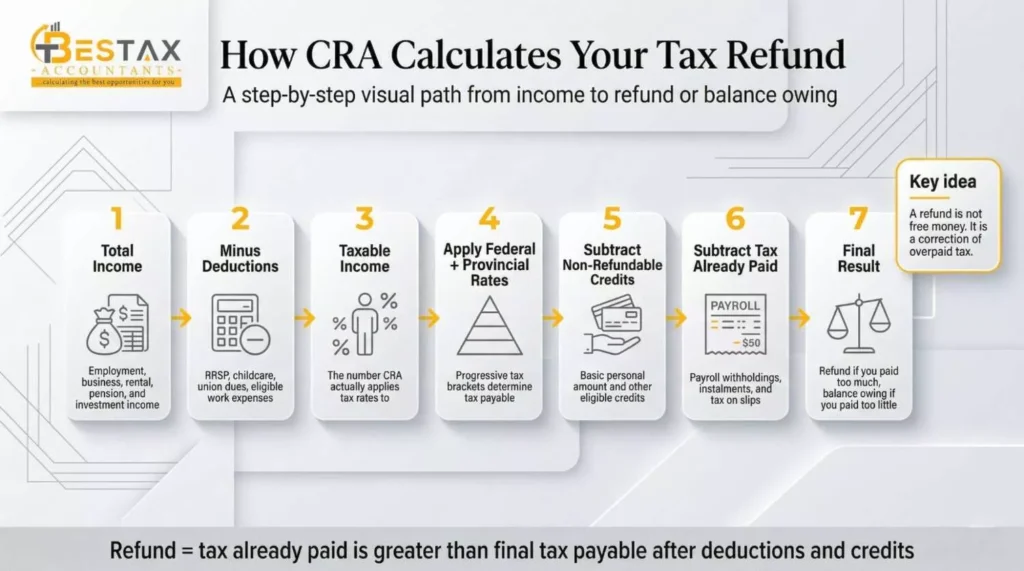
Start with total income for the tax year
Everything starts with your total income: employment earnings from a T4 slip, self-employment income, rental income, investment income from a T5 slip, pension amounts, and any other taxable sources. All of it gets combined into one number. Leaving out even one income source, even if no slip arrived in the mail, can lead to a CRA reassessment later.
Subtract deductions to reach taxable income
Deductions pull your income number down before any tax is calculated. Common ones include RRSP contributions, childcare expenses, union dues, and eligible employment expenses like home office costs or tools. A deduction does not reduce your tax dollar for dollar, it reduces the income that gets taxed. The higher your tax bracket, the more a deduction saves you.
Apply tax brackets and rates to find tax payable
Canada uses a progressive tax system, meaning higher portions of income are taxed at higher rates. Federal brackets in 2026 start at 15 percent and go up from there. Your province adds its own rates on top. Tax is calculated on taxable income, not on gross income. That distinction matters because deductions have already reduced the number before this step.
Subtract tax credits and taxes already paid
Non-refundable tax credits, like the basic personal amount, reduce the amount of tax you owe, but they cannot push your tax below zero on their own. After applying credits, the tax already withheld from your paycheques and other sources is subtracted. This is where the refund math becomes visible: if what was withheld exceeds what you owe after credits, the difference is your refund.
Add refundable credits to reach the final amount
Refundable credits are different from non-refundable ones. They can actually create a refund or increase it, even if your tax payable was already reduced to zero. The GST/HST credit and certain provincial credits work this way. For some lower-income filers, these credits are the main reason a refund appears at all.
Income, Deductions, and Taxable Income
What counts as income on a personal tax return?
Employment income is the most common, but taxable income also includes business income, freelance earnings, rental income, interest and dividends, pension payments, and government benefits like EI or CPP. Each income type may carry its own rules. Missing a single T-slip because it arrived late or went to an old address is enough to trigger a CRA correction later.
Common tax deductions that lower taxable income?
RRSP contributions are one of the most valuable deductions available to Canadians. Childcare expenses, eligible moving expenses, carrying charges on investment loans, and certain support payments also reduce net income before tax is applied. Deductions matter most for people in higher tax brackets because reducing taxable income by $1,000 saves more tax when the marginal rate is 33 percent than when it is 20 percent.
How are net income and taxable income different?
Net income is what remains after subtracting certain deductions from total income. Taxable income is calculated after a few additional adjustments below the net income line. Benefits, credits, and many government programs, like the GST/HST credit and child benefits, use net income to determine eligibility and payment amounts. Taxable income is what your actual tax rate gets applied to.
Why does business income change the refund process?
Self-employed people generally have no employer withholding tax on their behalf throughout the year. They track income, subtract eligible business expenses, and calculate what they owe. Because nothing is automatically prepaid, many self-employed filers end up with a balance owing rather than a refund, especially in the first few years of business when instalment payment habits are not yet established.
Tax Credits, Tax Payable, and Refund Math
How non-refundable tax credits reduce tax payable
Non-refundable credits lower your tax bill but cannot take it below zero. The basic personal amount, which every Canadian can claim, is the most widely used. Other examples include the age amount, disability tax credit, tuition credits, and medical expense credits. Many filers overestimate the impact of these credits because they think of them as dollar-for-dollar reductions on their refund, when they actually reduce tax payable at a fixed percentage rate.
How can refundable credits increase a refund?
Refundable credits can produce a payment even when tax owing is zero. They work like a payment from the government, not just a reduction of what you owe. The refundable portion of the Canada Workers Benefit is one example. For eligible filers, this can meaningfully change the final result on a return that might otherwise show nothing owed and nothing back.
How to determine your tax refund correctly
The simple formula is: take your total tax payable after credits, then subtract all the tax already paid through withholding and instalments. If the result is negative, CRA owes you that amount as a refund. If it is positive, you owe that amount to CRA. Looking at just one piece, one deduction or one credit, without running the full picture, is how people end up with incorrect expectations.
Why refund estimates change from one calculator to another
Online calculators only know what you tell them. Change the province, add an RRSP contribution, or include a different income type, and the estimate changes immediately. Calculators are useful tools for planning, but CRA's assessment after filing is the only number that actually counts. If your inputs are incomplete or wrong, the estimate will be too.
How to Calculate Your Tax Refund
How do you calculate your tax refund manually?
Manual calculation follows the same path CRA uses: add all income, subtract deductions to reach net income, make any remaining adjustments to get taxable income, apply federal and provincial tax rates, subtract non-refundable credits, and then subtract tax already withheld. The result tells you whether you will receive money back or owe a balance. Working through the math manually at least once helps you understand your return rather than just accepting a software result.
How a tax and refund calculator help estimate results?
A tax calculator tax refund estimate is useful for planning before you file, checking how an RRSP contribution would change your result, or how a new income source might affect your bracket. Most Canadian calculators let you enter income, deductions, and province to get a quick picture. They are not substitutes for filing, but they help you go into the process with realistic expectations.
When is a tax calculator estimate enough?
If your income comes entirely from one employer, you have no major deductions beyond the standard ones, and you had no unusual events during the year, a calculator estimate can be fairly close to your actual result. Simple returns with one T4 and a straightforward set of credits are the situations where estimates carry the least risk of being off by a meaningful amount.
When is software or expert help the better option?
Self-employment income, rental properties, significant investment activity, multiple T-slips, large deductions, or prior-year corrections are all situations where a calculator or basic software is not enough. Complexity increases the chance of missing something that changes the refund or creates unexpected liability. In these cases, working with a professional is not just convenient; it is the safer financial choice.
If you have questions about how your specific income or deductions affect the final calculation, a resource on how payroll taxes work in Canada can help you understand the withholding side of the equation before you file.
CRA Assessment and the Final Refund Result
What happens after you file with the Canada Revenue Agency
Filing your return is not the final step, it is the beginning of CRA's review process. After you submit, CRA receives the return, checks that it matches the slips on file, and processes the numbers against the rules for that tax year. Electronic returns filed through NETFILE are generally processed faster than paper returns sent by mail.
According to CRA's NETFILE overview, the vast majority of electronically filed returns are assessed within two weeks when filed with direct deposit set up. Paper returns take considerably longer and are more likely to involve delays.
How income tax assessment can change your expected refund
CRA may adjust your return if numbers do not match the T-slips on file, if a credit is disallowed, or if a deduction needs support documentation. Any of these changes affects the final refund amount. What your software showed before filing may not match the Notice of Assessment that arrives afterward.
Why your Notice of Assessment matters
The Notice of Assessment is CRA's official confirmation of your tax year result. It shows your refund or balance, your RRSP contribution room, your carry-forward balances, and how CRA calculated your return. Reading it carefully, rather than just checking the refund line, helps you catch discrepancies and understand your tax position going into the next year.
What happens if CRA reviews or adjusts your return
CRA can request documents to support a claim, or issue a reassessment if something changes after the initial assessment. This can happen months or even years after the original filing. Keeping your tax records, slips, receipts, and statements for at least six years gives you the documentation needed to respond without scrambling.
How Long CRA Take to Send a Refund
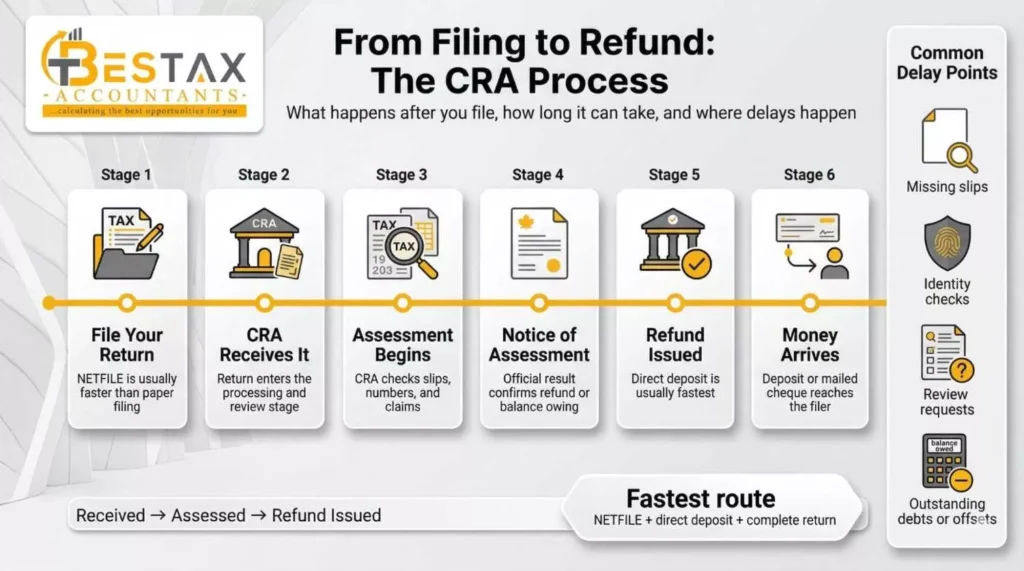
How long to get a tax refund in Canada depends mainly on how you filed and whether your return was complete. Electronic returns with direct deposit set up are the fastest path. Paper returns with a mailed cheque take much longer. CRA does not publish a single guarantee for all filers, but electronic returns in good order are typically assessed within two weeks.
CRA returns with direct deposit are generally processed within 12 weeks when filed correctly. Paper returns can take 8 weeks or more, and mailed cheques add additional delivery time on top of that. How long it take for a tax refund to arrive also depends on whether CRA needs any additional information, a review or a document request can pause processing entirely.
Setting up direct deposit with CRA before you file is the single most effective way to speed up your refund. It removes cheque printing and mailing from the timeline. Filing with all required slips and matching details reduces the likelihood of a review that pauses assessment. Incomplete returns, missing income, mismatched social insurance numbers, or absent forms, add weeks to the process.
Common causes of delays include identity verification checks, missing T-slips that CRA expected to see, outstanding government debts that offset the refund, and prior-year assessments that have not been resolved. If your refund has not arrived within the expected window, checking your CRA tax refund status through My Account is the right starting point before contacting anyone.
How to Check CRA Tax Refund Status
The official place to check your CRA tax refund status is through CRA My Account, which shows whether your return has been received, assessed, and whether a refund has been issued. Tracking through CRA directly is the only reliable source, third-party sites cannot access your actual account data.
When the status shows your return was received, it means CRA has it but has not finished processing it. Assessed means the review is complete and a Notice of Assessment has been issued. Refund issued means the payment has been sent. A status update to assessed does not always mean the money has already left CRA, especially for cheques.
What to do if your refund is late
First check whether your return was filed completely and that direct deposit information was correct. Then check your status through CRA My Account. If the status shows assessed and more than 5 business days have passed with direct deposit, CRA's contact line can provide more detail. Most delays have a simple explanation that becomes clear once you check the status first.
When CRA may hold or offset your refund
CRA can apply a refund against outstanding balances, things like prior-year tax owing, student loan debt administered through the federal government, or other government-owed amounts. The refund is reduced by whatever is owed, and you receive the remainder. If the entire refund was applied to a debt, CRA will notify you through your My Account or by mail.
Why Some Filers Owe Taxes Instead
A tax return is a calculation, not a payment request. It simply compares what you owe against what you already paid. If you underpaid during the year, through low withholding, extra income, or a change in circumstances, the return shows a balance owing. Filing is still required either way. A refund is not a reward for filing; it is the result of overpaying during the year.
How low withholding creates tax liability
If your employer withholds less tax than you actually owe, because you have a second job, received bonus income, or did not update your TD1 form, the gap becomes a balance owing at filing time. The payroll system only knows what it is told. When income comes from more than one employer simultaneously, each source withholds independently and may not account for the combined bracket.
Why self-employed filers often owe taxes
Without automatic withholding, self-employed people carry the full responsibility for setting aside tax during the year. When that does not happen, especially in year one, a large balance appears at filing time. CRA may also require quarterly instalment payments once a balance owing exceeds a threshold in two consecutive years.
Common reasons people misjudge their refund amount
Expecting last year's refund to repeat is one of the most common mistakes. Income changes, new credits, expired deductions, and updated bracket thresholds all affect the result differently each year. Refund expectations based on what a friend or family member received are equally unreliable; every return is different because every tax situation is different.
Employees and Business Owners: Key Differences
Employees often receive refunds because employers withhold based on annual salary projections and standard credit assumptions. If your real deductions are higher than what the payroll system assumed, an RRSP contribution at year-end, eligible employment expenses, or additional childcare costs, the gap between what was withheld and what you owe produces a refund. CPP and EI overpayments from multiple employers are also refunded through the return.
How business owners manage their own taxes
Business owners calculate their own net income after expenses, estimate their full-year tax bill, and either pay in instalments or settle the balance at filing. No employer is doing this on their behalf. Good bookkeeping throughout the year and a realistic estimate of income are the two things that separate business owners who file smoothly from those who face unexpected bills every April.
How multiple income sources affect returns
When employment income is combined with freelance earnings, rental income, or investment income, the total pushes taxable income higher, sometimes into a higher bracket. The tax withheld from the employment side may not be enough to cover the additional tax owed on the other sources. The return calculates everything together, which is why people with multiple income streams are more likely to owe a balance than those with a single employer.
Why records and planning matter more for business filers
Business tax errors almost always start with poor records, missed expense receipts, misclassified costs, or income that was not properly tracked. A year of incomplete records can mean paying more tax than necessary or triggering a CRA review. Year-round recordkeeping and working with a professional before filing, rather than after, is the approach that protects both accuracy and peace of mind.
How to Increase Your Refund Legally
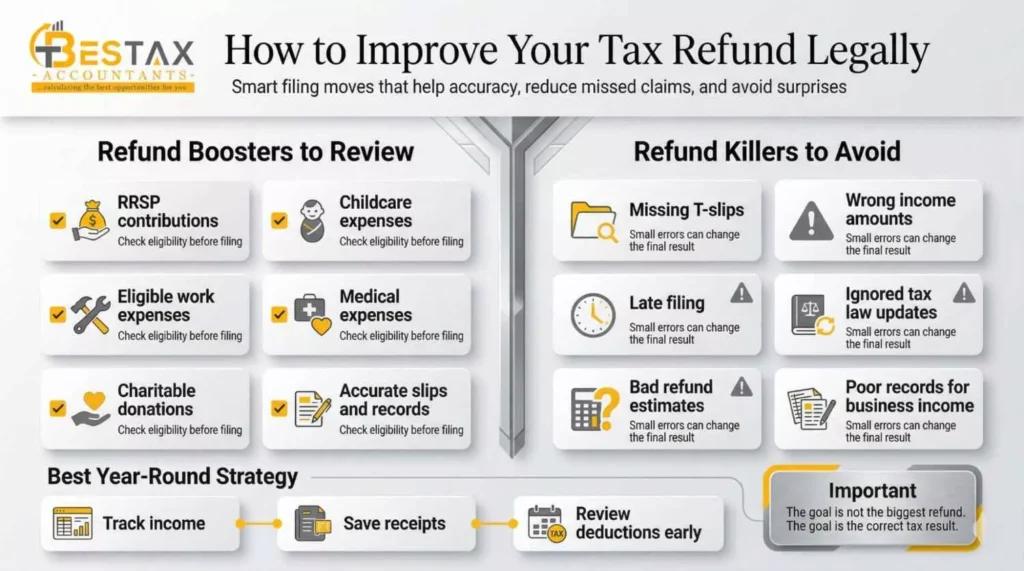
Before filing, go through a checklist of commonly missed items: RRSP contributions, medical expenses above the threshold, charitable donations, public transit costs where eligible, union dues, and home office expenses if you worked remotely. Missing a single eligible deduction because you did not check can change your refund by hundreds of dollars. A checklist approach is slower than guessing but consistently more accurate.
How RRSP, childcare, and work expenses can help
RRSP contributions reduce net income directly, which lowers your tax payable and increases your refund, more so in higher brackets. Childcare expenses reduce the income of the lower-earning spouse. Employment expenses like a required uniform, tools, or home office costs require Form T2200 from your employer before you can claim them. Each item has eligibility rules that determine whether it applies to your situation.
Why filing on time protects government benefits
Many government benefits, including the Canada Child Benefit and the GST/HST credit, depend on your most recently filed tax return to calculate eligibility and payment amounts. Filing late or not at all interrupts those payments even when no tax is owed. This is a practical reason to file every year, regardless of refund expectations.
How to aim for a better result without chasing a maximum refund
A large refund is not automatically good news. It often means you overpaid throughout the year and gave CRA an interest-free loan of your own money. The goal of accurate filing is not the largest possible refund, it is paying exactly what you owe, no more and no less. Planning your deductions and withholding carefully is more financially sensible than banking on a big cheque in spring.
Common Refund Mistakes That Cost You Money
CRA matches slips to returns automatically. If you leave out a T4 or T5 because the slip did not arrive, CRA will find the discrepancy and reassess your return, sometimes adding income you did not report and reducing your refund. Missing eligible deductions works the other way: you paid more tax than necessary and cannot reclaim it unless you file an adjustment.
Confusing software estimates with final CRA results
Tax software shows what your return should produce based on what you entered. It does not know if a slip is missing, if a deduction will be disallowed, or if CRA's records show something different. The Notice of Assessment is always the final result. Software estimates are a starting point, not a guarantee of what CRA will confirm.
Filing late or using the wrong amount
Late filing on a return with a balance owing triggers interest from the April 30 deadline, plus a late filing penalty. Wrong amounts, whether from a typo or a misread slip, can lead to reassessment and additional interest. Speed at filing time is less important than accuracy, and accurate records throughout the year are what make accurate filing possible.
Ignoring changes in tax law and filing deadline rules
Federal and provincial tax rules update every year. Brackets shift, new credits appear, and some deductions change or expire. Using last year's assumptions without checking current rules is a reliable way to get the wrong answer. CRA's website and current-year tax software are updated annually to reflect these changes; using outdated tools or knowledge creates avoidable errors.
When to Get Expert Help With Your Return
A single T4 and no major events is a straightforward return. Add rental income, a home sale, business expenses, foreign income, or a major life change, such as marriage, divorce, death of a spouse, and the complexity rises quickly. Each new element carries its own rules, forms, and risk of error. The more moving parts, the higher the value of accurate, informed help.
Situations where expert help can protect your refund
CRA audits, reviews requesting supporting documents, prior-year mistakes that need correction, and late filings with penalties are all situations where expert guidance makes a measurable difference. Getting a refund right the first time is easier than fixing a reassessment later, and the cost of correcting a mistake after the fact is almost always higher than the cost of doing it correctly up front.
When service, support, or software may not be enough
Software is only as good as the data entered into it and the logic built into it. For complex situations, multiple business entities, cross-border income, unusual deductions, or significant capital transactions, software cannot substitute for professional judgment. A tool that asks the wrong questions or lacks the right form cannot protect you from a CRA challenge.
How expert help reduces filing mistakes and liability
Professionals who file tax returns regularly know where errors appear most often, which claims need supporting documents, and which assumptions CRA will question. They also help with year-round planning so the return itself is not a surprise. If you want reliable guidance on personal tax return filing in Canada, working with a team like those offering personal tax return services in Canada gives you both accuracy and someone to turn to when CRA asks questions.
Concluding Remarks
The formula behind every refund is straightforward: total tax payable minus total tax already paid, adjusted for credits. But the inputs that go into that formula, income sources, deductions, credits, withholding amounts, are where most of the complexity lives. A refund is not a measure of how well you filed. It is a measure of how close your year-long prepayments came to your actual tax obligation.
Accurate filing matters more than a large refund. A refund that feels big often means you overpaid during the year. A balance owing does not mean you made a mistake; it may simply mean your withholding did not keep pace with your income. Understanding the difference between these outcomes puts you in a much better position to make intentional choices throughout the year, not just at filing time.
If your return is straightforward, the steps in this guide give you the framework to file with confidence. If it is more complex, business income, rental property, significant investments, or major life changes, Bestax Accountants provides personal tax return support for Canadians who want accurate filings, clear explanations, and fewer surprises when the Notice of Assessment arrives.
FAQs About Tax Refund Canada
Yes. A tax refund in Canada is issued when the total tax you paid during the year, through payroll deductions, instalments, or withholding on slips, is more than the total tax you owe after credits and deductions are applied. Anyone who overpaid is eligible to receive the difference back from CRA, regardless of income level.
CRA takes your total income, subtracts eligible deductions to arrive at taxable income, applies federal and provincial tax rates to that income, subtracts non-refundable tax credits, and then subtracts all tax already paid during the year. If the result is negative, meaning you overpaid, that negative balance is your refund. Refundable credits can add to this amount even when tax payable has already reached zero.
For electronic returns filed through NETFILE with direct deposit registered, CRA typically processes the return within 8 to 14 business days. Paper returns mailed to CRA take 8 weeks or more in most cases. The exact timing also depends on whether the return is selected for additional review or if any information is missing. Filing early in the year and setting up direct deposit are the two most reliable ways to receive a refund as quickly as possible.
The average tax refund in Canada has generally been in the range of $1,500 to $2,000 in recent years, but that number reflects a wide mix of filers and income situations, it is not a useful target for any individual return. Your refund depends entirely on your specific income, deductions, credits, and the amount withheld throughout the year. Comparing your result to a national average tells you very little about whether your own filing was accurate.
CRA does not publish a formal maximum wait time, but paper returns in complex situations can take several months if additional review is required. In cases where a return is selected for audit, or where CRA requests supporting documents and those documents are delayed, the refund can be held until the review is resolved. Electronic filing and proactive document-keeping significantly reduce the chances of an extended wait.
Yes. CRA My Account is the official tool for checking your tax refund status online. It shows whether your return has been received, whether it has been assessed, and whether a refund has been issued. You can also register for direct deposit, update your banking information, and view your Notice of Assessment through the same account. Using CRA's official channels is the only accurate way to check your status, unofficial websites cannot access your actual tax file.
Disclaimer: The information provided in this blog is for general informational purposes only. For professional assistance and advice, please contact experts.

