
Accounting
Why Double-Entry Accounting Matters for Your Business: A 2026 Canada Guide
Learn how double-entry accounting works, why Canadian businesses use it, and how it supports CRA records, GST/HST, audits, and financial reporting.


If your books have ever refused to balance, you already understand the quiet logic behind double-entry accounting. Every dollar that moves through your business comes from somewhere and goes somewhere, and double-entry bookkeeping is the system that records both halves of that journey. It is the foundation of nearly every accounting program in Canada, the backbone of the financial statements your lender and the Canada Revenue Agency (CRA) expect to see, and the single best safeguard against errors that quietly distort your numbers.
This guide explains what double-entry accounting is, how the double-entry bookkeeping system works, and, most importantly, why it matters for Canadian businesses in 2026.
What Is Double-Entry Accounting?
Double-entry accounting (also called double-entry bookkeeping, double bookkeeping, or simply the double-entry system) is a method of recording every financial transaction in at least two accounts: once as a debit and once as a credit. The two entries are always equal and opposite, so the books stay in balance at all times.
The idea is roughly 500 years old. The method was first comprehensively documented in 1494 by the Italian mathematician Luca Pacioli, often called the father of accounting, who described the system Venetian merchants were already using. Five centuries later, the same principle runs underneath QuickBooks, Xero, Sage, and every other modern accounting platform.
Here is the core insight: a single transaction always has two sides. When you sell a coffee, your cash increases and your inventory decreases. When you take out a loan, your bank balance goes up, and your debt goes up. Single-entry bookkeeping records only one side of that story; double-entry records both. That is why people sometimes call it double-ledger bookkeeping; each transaction touches two places in your ledger.
So what is double-entry bookkeeping really doing for you?
It is enforcing a mathematical rule that makes mistakes visible. If the two sides of your books ever stop matching, you know immediately that something is wrong.
The Accounting Equation in Canada: The Rule That Never Breaks
Every double-entry transaction must keep one equation in balance:
Assets = Liabilities + Equity
- Assets are what your business owns (cash, inventory, equipment, money customers owe you).
- Liabilities are what your business owes (loans, accounts payable, and taxes payable).
- Equity is what is left over for the owners after liabilities are subtracted from assets.
This equation is the heart of accounting double-entry. Whenever you record a transaction, the two entries must keep the left side equal to the right side. If a transaction increases an asset, it must also either increase a liability or equity or decrease another asset. The equation can never legitimately fall out of balance, and if it does, a bookkeeper has made an error somewhere.
Debits and Credits: How the Double-Entry System Works
Debits and credits are simply the two sides of each entry. By long-standing convention, debits are recorded on the left and credits on the right. They are not "good" or "bad", they just describe direction.
The rules depend on the type of account. Here is the cheat sheet every Canadian business owner should keep handy:
| Account type | A debit does this | A credit does this |
|---|---|---|
| Assets (cash, equipment, receivables) | Increases | Decreases |
| Expenses (rent, wages, supplies) | Increases | Decreases |
| Liabilities (loans, payables, taxes) | Decreases | Increases |
| Equity (owner's capital, retained earnings) | Decreases | Increases |
| Revenue/income (sales, fees) | Decreases | Increases |
The golden rule of the double-entry bookkeeping system: for every transaction, total debits must equal total credits. This is what keeps the accounting equation intact and your books self-checking.
The Five Account Types in Double-Entry Bookkeeping
Every account in your books falls into one of five categories. Together, they make up your chart of accounts, the master list of every account your business uses to classify transactions.
- Assets: Resources the business owns or controls, from cash and inventory to vehicles, equipment, and accounts receivable.
- Liabilities: Obligations the business owes, such as accounts payable, credit-card balances, lines of credit, loans, and GST/HST payable.
- Equity: The owners' residual interest, including share capital, owner contributions, and retained earnings.
- Revenue (income): Money earned from selling goods or services.
- Expenses: The costs of running the business, such as rent, salaries, utilities, and cost of goods sold.
A well-structured chart of accounts is the difference between books that produce meaningful reports and books that produce a headache. Tailoring it to your specific operations makes every later report and every conversation with your accountant far more useful.
Double-Entry Bookkeeping Examples
The fastest way to understand the system is to see it in action. Here are four common double-entry bookkeeping examples for your business. (These examples are just an estimate for actual calculation; it is advisable to contact experts)
Notice that in every case, the debits equal the credits, and the accounting equation stays balanced.
Example 1: Buying equipment with cash
You buy a $2,000 laptop and pay cash.
| Account | Debit | Credit |
|---|---|---|
| Equipment (asset) | $2,000 | |
| Cash (asset) | $2,000 |
One asset (equipment) goes up; another asset (cash) goes down. Total assets are unchanged, so the equation stays balanced.
Example 2: Buying inventory on credit
You purchase $5,000 of inventory and agree to pay the supplier later.
| Account | Debit | Credit |
|---|---|---|
| Inventory (asset) | $5,000 | |
| Accounts payable (liability) | $5,000 |
Assets rise by $5,000, and liabilities rise by $5,000. Both sides of the equation increase together.
Example 3: Making a sale and tracking HST
You sell $1,000 of goods to an Ontario customer and collect 13% HST, paid in cash.
| Account | Debit | Credit |
|---|---|---|
| Cash (asset) | $1,130 | |
| Sales revenue (income) | $1,000 | |
| HST payable (liability) | $130 |
This is a perfect illustration of why double-entry matters in Canada: the system cleanly separates the $1,000 you earned from the $130 of sales tax you are holding on behalf of the government. Total debits ($1,130) equal total credits ($1,130).
Example 4: Repaying a loan
You make a $1,000 payment toward a bank loan.
| Account | Debit | Credit |
|---|---|---|
| Loan payable (liability) | $1,000 | |
| Cash (asset) | $1,000 |
The debt shrinks by $1,000 and your cash shrinks by $1,000. A single-entry system would record only the cash leaving your account and would leave the loan balance overstated, a classic error that double-entry prevents.
From Journal to Ledger to Trial Balance
Double-entry bookkeeping follows a clear flow that turns raw transactions into reliable reports:
- The journal records each transaction in chronological order, the initial entry of every debit and credit.
- The general ledger sorts those same entries by account, so each account (cash, sales, payroll, and so on) shows a running balance. This is the "double ledger" stage that gives double-ledger accounting (commonly referred to as double-entry accounting) its name.
- The trial balance lists the closing balances of every account and adds up all the debits and credits. If the system has been used correctly, the two totals match exactly. If they do not, you have found an error that must be corrected before you produce financial statements.
That self-checking trial balance is the everyday payoff of double-entry: it catches mistakes before they reach your tax return.
Single-Entry vs Double-Entry Bookkeeping
| Feature | Single-entry bookkeeping | Double-entry bookkeeping |
|---|---|---|
| Entries per transaction | One | Two (a debit and a credit) |
| What it tracks | Income and expenses only | Assets, liabilities, equity, income, and expenses |
| Built-in error detection | Minimal | Strong, the books must balance |
| Financial statements | Hard to produce; often incomplete | Full balance sheet and income statement |
| Fraud resistance | Low | Higher |
| Best suited to | Very simple, cash-only operations with no inventory or debt | Most businesses, and all incorporated companies |
Single-entry can work for an extremely simple operation, say, a side business with no inventory, no employees, and no loans. But as soon as you add assets, debts, payroll, or sales tax, single-entry stops giving you an accurate picture. For most Canadian businesses, double-entry is the right choice from day one.
Why Double-Entry Accounting Matters for Canadian Businesses
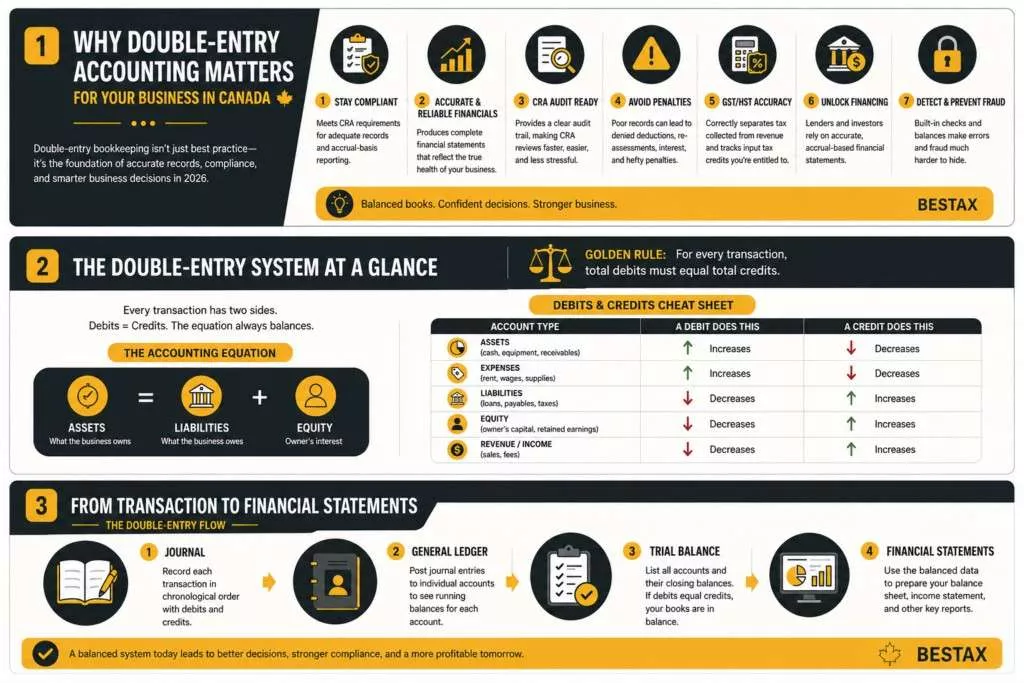
Here is where the Canadian context becomes decisive. Double-entry is not just a tidier way to keep books; for most businesses operating in Canada, it is what makes compliance possible. Below are the reasons it matters in 2026.
1. The law requires adequate records, and most businesses must use the accrual method
Under Section 230 of the Income Tax Act, every person carrying on a business in Canada must keep adequate books and records that allow the CRA to determine the taxes payable. The CRA interprets this broadly: your records must support every income and expense figure on your return.
Crucially, the CRA requires most businesses to report income using the accrual method, which recognizes income when it is earned and expenses when they are incurred, regardless of when cash changes hands.
According to the CRA, only farmers, fishers, and self-employed commission sales agents may choose the simpler cash method; all other self-employment income must be reported on the accrual basis. Accrual accounting requires you to track receivables, payables, inventory, and prepaid amounts across periods, and double-entry is the system built to do exactly that. In practice, accrual reporting effectively requires double-entry bookkeeping.
Late filing carries a penalty of 5% of the balance owing plus 1% per month, up to 12 months, under the CRA's late-filing rules.
2. Accounting standards are built on double-entry
When your business prepares formal financial statements, it does so under Canadian Generally Accepted Accounting Principles (GAAP). Canada uses a multi-framework model maintained by the Accounting Standards Board (AcSB): publicly accountable enterprises must use International Financial Reporting Standards (IFRS), mandatory since January 1, 2011, while private companies can use the simpler Accounting Standards for Private Enterprises (ASPE), found in Part II of the CPA Canada Handbook.
Both frameworks are prepared on the accrual basis and assume a double-entry system underneath. There is no practical way to produce a compliant balance sheet, which lists assets, liabilities, and equity, without double-entry bookkeeping.
3. It keeps you ready for a CRA audit
The CRA has broad statutory powers to inspect, audit, and examine your books, records, documents, property, and processes. Records must generally be kept for six years from the end of the last tax year to which they relate, but different periods apply in some cases: a dissolved corporation must keep certain records for two years after the date of dissolution, records tied to long-term property or the eventual sale or wind-up of a business may need to be kept indefinitely, and records connected to a notice of objection or appeal must be kept until the matter is resolved.
Business records generally must be kept in Canada unless the CRA gives written permission for another arrangement; where electronic records are maintained outside Canada, the CRA may accept copies made available in Canada in a readable, usable electronic format. Whatever the medium, electronic records must remain readable, usable, and available to CRA officials when requested.
Double-entry records provide the complete, traceable audit trail auditors expect. When your debits and credits already balance and every transaction ties back to a source document, an audit becomes a matter of producing files rather than reconstructing your year from scratch.
To put the stakes in perspective: the CRA's 2024–25 Departmental Results Report indicates the agency completed tens of thousands of audit and compliance cases in that year. Audits are a routine part of doing business in Canada, not a remote possibility.
4. The penalties for poor records are real
Failing to keep adequate books and records is a distinct issue under the Income Tax Act. The CRA can deny unsupported deductions, reassess your return with additional tax plus interest, and in serious cases pursue penalties or prosecution. Among the consequences set out in the Act and CRA guidance:
- Failure to keep adequate records can lead to a formal requirement to comply and, on conviction, fines (the Act sets a minimum fine of $1,000, with higher fines and possible imprisonment for non-compliance).
- Gross negligence can trigger a penalty of 50% of the understated tax under subsection 163(2).
Clean double-entry books are the most reliable way to stay on the right side of every one of these rules.
2026 Compliance Note: The CRA continues to emphasize electronic record-keeping. Businesses keeping records digitally must ensure they are readable and backed up. Failure to provide records in an acceptable format during a review can result in additional penalties.
Accurate double-entry records are especially important for corporations claiming the small business deduction (9% federal tax rate on the first $500,000 of active business income). Lenders and the CRA scrutinize balance sheets and retained earnings closely.
5. It makes GST/HST and input tax credits accurate
If your business exceeds the $30,000 small-supplier threshold, you generally must register for GST/HST, charge it on sales, and remit it to the CRA, while claiming back the GST/HST you pay on purchases as input tax credits (ITCs).
As Example 3 above showed, double-entry naturally isolates the tax you collect from the revenue you earn, and tracks the tax you pay separately. That separation is what lets you file accurate GST/HST returns and claim every ITC you are entitled to, without overpaying or triggering a review.
6. It unlocks financing and investment
Lenders and investors do not lend against a spreadsheet of cash in and cash out. They want formal financial statements, a balance sheet, and an income statement prepared on the accrual basis, and those can only come from a double-entry system. Whether you are applying for a business loan, raising capital, or preparing for due diligence, double-entry books are the price of admission.
7. It deters and detects fraud
Because every entry must be balanced by an opposite entry, it is far harder to hide a missing or fraudulent transaction in a double-entry system than in a single-entry one. The built-in checks and balances make discrepancies surface quickly, a meaningful layer of protection for any growing business.
Who Is Required to Use Double-Entry in Canada?
It is worth being precise here, because online sources often overstate the rule. The Income Tax Act does not name "double-entry" as a legal requirement. What the law actually requires is adequate records, and what the CRA requires is accrual reporting for most businesses, plus GAAP financial statements where applicable. The honest summary:
- Incorporated companies prepare financial statements under ASPE or IFRS and need double-entry in practice. For corporations, double-entry is effectively non-negotiable.
- Sole proprietors and partnerships that report on the accrual basis. which is most of them, also need double-entry to track the assets and liabilities accrual accounting demands.
- Farmers, fishers, and commission sales agents who elect the cash method have more flexibility, but they still benefit from double-entry, especially once they own equipment, carry inventory, or take on debt.
In short: while double-entry is not literally written into the statute by name, the combination of accrual reporting and accounting-standard requirements makes it the practical standard for nearly every business in Canada.
How to Set Up Double-Entry Bookkeeping
You do not need to memorize debits and credits to use the system. Modern software handles the mechanics for you.
- Choose Canadian-ready accounting software. QuickBooks Online, Xero, Sage 50, and FreshBooks all run on double-entry principles and include Canadian features such as GST/HST tracking. When you classify a transaction as revenue or an expense, the software automatically posts the matching second entry in the background, giving you the accuracy of double-entry without the manual effort.
- Build a chart of accounts that reflects how your business actually operates, organized by the five account types.
- Separate business and personal finances. A dedicated business bank account keeps your records clean and your deductions defensible. Mixing personal and business expenses is one of the most common ways to distort profit and create CRA exposure.
- Set up GST/HST tracking if you are registered, so collected tax and ITCs are recorded correctly from the start.
- Reconcile regularly. Compare your records to your bank and credit-card statements every month to catch discrepancies early.
2026 Update: AI-Powered Bookkeeping
Modern Canadian accounting software (QuickBooks Online, Xero, Sage Intacct, FreshBooks) now uses AI to automatically categorize transactions, flag anomalies, and suggest journal entries. Some tools even auto-generate trial balances and draft financial statements.
While the software handles the double-entry mechanics in the background, business owners should still review categorizations monthly to maintain CRA compliance.
In 2025–2026, the CRA has increased its focus on digital economy businesses, gig workers, and crypto transactions. Clean double-entry records with proper source document links (invoices, bank feeds) significantly reduce audit stress.
Common Double-Entry Bookkeeping Mistakes to Avoid
- Recording only one side of a transaction, for example, logging a loan payment as cash leaving the account but never reducing the loan balance, which leaves the liability overstated.
- Misclassifying accounts, putting an expense in the wrong category distorts both your taxes and your decision-making.
- Recording personal expenses as business expenses, this inflates deductions and invites a reassessment.
- Skipping bank reconciliation, small discrepancies compound into big problems at tax time.
- Falling behind, entering transactions weeks late makes errors harder to trace and your reports less reliable.
The Bottom Line
Double-entry accounting earns its place in your business for one simple reason: it tells the truth about your money. By recording both sides of every transaction, it keeps your books balanced, makes errors visible, and produces the accrual-based financial statements that Canadian accounting standards, lenders, investors, and the CRA all expect. For incorporated companies, it is effectively essential, and for almost every other business in Canada it is the smartest foundation you can build on.
If you are setting up your books for the first time, start with double-entry from day one, choose Canadian-ready software, build a clean chart of accounts, and consider working with a professional bookkeeper or CPA to make sure your system is compliant and audit-ready well before your next filing deadline.
Quick FAQs
What is double-entry accounting in simple terms?
What is the double-entry system of bookkeeping based on?
What is the difference between single and double bookkeeping?
Is double-entry accounting required by law in Canada?
Do I need to know debits and credits to use double-entry?
How long do I have to keep my accounting records in Canada?
Disclaimer: The information provided in this blog is for general informational purposes only. For professional assistance and advice, please contact experts.


