


Canada’s federal luxury tax (formally the Select Luxury Items Tax) is administered by the Canada Revenue Agency (CRA). It came into force on 1 September 2022 and was initially applied to high‑priced vehicles, aircraft and boats.
The 2025 federal budget announced that the tax would no longer be payable on subject aircraft and vessels effective 5 November 2025; the tax continues to apply to subject vehicles priced or valued above CA$100 000. The tax is imposed separately from GST/HST and provincial sales taxes, so a luxury car buyer needs to consider both the federal tax and their province’s sales taxes when budgeting.
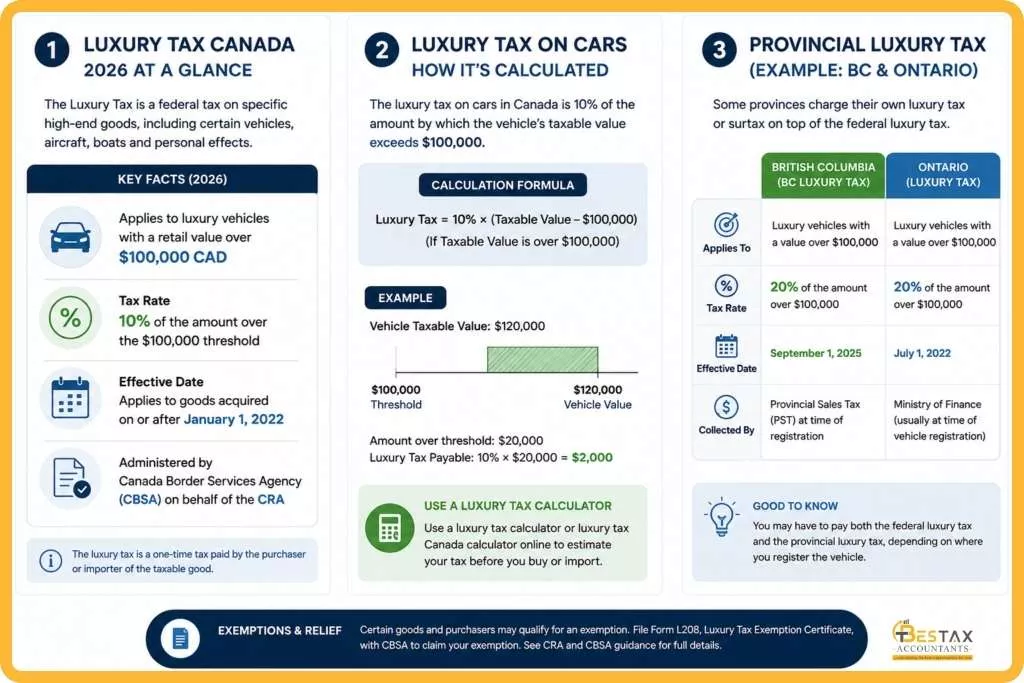
What qualifies as a subject vehicle
A subject vehicle is defined in the Select Luxury Items Tax Act as a motor vehicle designed primarily to carry individuals on highways or streets, with seating for not more than ten passengers, a gross vehicle weight rating no higher than 3 856 kg, a manufacture date after 2018 and four or more wheels.
Examples include sedans, coupes, hatchbacks, convertibles, sport‑utility vehicles and light‑duty pickup trucks. Certain vehicles are excluded: ambulances, hearses, police or emergency vehicles and recreational vehicles fitted with living amenities (cooking facilities, fridge, toilet, heating/air‑conditioning and water system). Motor vehicles registered before September 2022 are also exempt.
Price threshold and taxable amount
The price threshold for a subject vehicle is CA$100 000. The taxable amount used to compute luxury tax depends on the transaction:
- For a sale, it is generally the total consideration (cash, trade‑in value and value of improvements).
- For importations, it is the vehicle’s value for customs duty purposes plus any duties and excise taxes other than GST/HST or provincial sales tax.
- For leases, the taxable amount is the retail value at the time possession is transferred or when the lessee has the right to use the vehicle.
- Trade‑ins and down payments do not reduce the taxable amount.
GST/HST and provincial taxes apply on the value for tax, which is the taxable amount plus the luxury tax. The luxury tax is therefore calculated before GST/HST or provincial sales taxes.
How to calculate the luxury tax
The luxury tax on a subject vehicle is equal to the lesser of:
- 10 % of the taxable amount, and
- 20 % of the portion of the taxable amount above CA$100 000.
A simple way to think of this is that the tax cannot exceed 10 % of the total sale price; however, it may be lower if 20 % of the amount over the $100 000 threshold is smaller.
For example, if a registered vendor sells a vehicle for $150 000, the taxable amount is $150 000, and the luxury tax is the lesser of $15 000 (10 % of $150 000) and $10 000 (20 % of $50 000), so the tax payable is $10 000. If a vehicle is leased or imported, the same calculation applies using the lease or importation taxable amount.
Calculating improvements
If you buy a vehicle just under the $100 000 threshold and later install upgrades (such as a new sound system or custom wrap), the improvements may be subject to luxury tax. The CRA calculates the tax on improvements as the difference between the luxury tax on the total taxable amount (vehicle plus improvements) and the tax previously paid. This rule prevents buyers from evading tax by purchasing a base vehicle below $100 000 and then adding expensive accessories.
Exemptions and certificates
Several exemptions allow a subject vehicle to be sold or imported without the luxury tax when specific conditions are met:
- Sales between registered vendors. Registered vendors (for example, manufacturers and licensed dealers) may sell subject vehicles priced above the threshold to each other without collecting luxury tax if the purchaser provides an exemption certificate. The purchaser uses Form L100‑1, Luxury Tax Exemption Certificate for Subject Vehicles, to certify that they are a registered vendor.
- Previously registered vehicles. Luxury tax does not generally apply to sales or importations of used subject vehicles that have already been registered with a Canadian government. However, if the previous registration occurred only because of the sale or importation and the vehicle has never been licensed for road use, the tax may still apply.
- Vehicles equipped for military or policing. Vehicles equipped for military or policing activities are exempt when sold or imported for use by a military or police authority. The purchaser must provide evidence that the vehicle will be used by an eligible authority.
- Importations by registered vendors. Registered vendors may import high‑value vehicles and hold them in inventory tax‑free, deferring luxury tax until the vehicle is sold to a non‑registered purchaser.
If no exemption applies, individuals and businesses must report and pay luxury tax on Form B500 (for registrants) or Form B501 (for non‑registrants). These returns are generally filed quarterly and are due by the end of the month following the end of the reporting period.
Provincial context: PST and HST on high‑priced vehicles
In addition to the federal luxury tax, buyers must pay GST/HST and any provincial sales tax (PST) or harmonized sales tax (HST) when purchasing or importing a vehicle. Provinces do not levy separate “luxury taxes,” but some have higher PST rates for expensive passenger vehicles, which are sometimes described as luxury car taxes.
British Columbia (B.C.)
British Columbia’s PST on non‑zero‑emission passenger vehicles starts at 12 % when the purchase price is below $55 000 and increases on high‑value vehicles. The rate jumps to 15 % for vehicles priced between $125 000 and $149 999.99 and to 20 % for vehicles $150 000 or more. Passenger vehicles priced between $57 000 and $124 999.99 are taxed at 10 %. Trucks and vans larger than three‑quarter ton, motor homes and motorcycles with engines under 250 cc are not considered passenger vehicles. These provincial rates apply in addition to the federal luxury tax. Zero‑emission vehicles (ZEVs) have similar graduated PST rates but the thresholds begin at $75 000.
Ontario
Ontario does not levy a separate luxury tax on vehicles. When a vehicle is purchased from a dealer, HST applies at 13 % (8 % provincial portion plus 5 % federal portion). When a used vehicle is purchased privately, Ontario charges a retail sales tax (RST) at 13 % on the greater of the purchase price and the average wholesale value. There is no provincial surcharge for high‑priced vehicles; however, GST/HST is applied on top of any federal luxury tax, so the overall cost can still be substantial. Buyers must budget for HST on the entire price, including the federal luxury tax.
Alberta
Alberta does not have a provincial sales tax. Vehicle purchasers pay only the 5 % federal GST and, if the price exceeds $100 000, the federal luxury tax. As of 2026, there is no provincial luxury or surtax on vehicles. Alberta residents benefit from lower total sales taxes, but the federal luxury tax still applies when a vehicle’s taxable amount exceeds the threshold.
Other provinces
- Saskatchewan and Manitoba impose provincial sales taxes (typically around 6–7 %) on vehicles, but there is no additional provincial luxury surcharge.
- Quebec applies QST at 9.975 % plus the 5 % GST. There is no specific provincial luxury tax on cars.
- Atlantic provinces levy HST ranging from 13 % to 15 %, and there is no provincial luxury surcharge on vehicles. However, the HST is calculated on the price including the federal luxury tax.
Conclusion
The federal luxury tax on vehicles remains in force in 2026. It applies to new or imported passenger vehicles priced above $100 000 and is calculated as the lesser of 10 % of the purchase price or 20 % of the amount above $100 000. Subject aircraft and vessels have been removed from the regime, so buyers of boats or private aircraft no longer pay the tax after 5 November 2025.
Vehicle buyers must also consider GST/HST and, in some provinces such as B.C., higher provincial sales tax rates on expensive vehicles. Understanding the rules, thresholds, and available exemptions can help Canadians plan their purchases and comply with CRA reporting requirements.
Quick FAQs
The luxury tax is a federal levy on the sale, lease or importation of certain new vehicles priced above $100 000. Individuals, businesses and importers pay the tax when purchasing or importing subject vehicles unless an exemption applies. The tax is reported to the CRA and is separate from GST/HST and provincial taxes.
The tax is calculated as the lesser of 10 % of the vehicle’s taxable amount and 20 % of the amount above $100 000. For example, on a $200 000 vehicle the taxable amount is $200 000; 10 % of $200 000 is $20 000 and 20 % of the $100 000 above the threshold is $20 000, so the luxury tax payable is $20 000. Because the tax is capped at 10 % of the total price, it will never exceed that percentage.
Generally, no. Sales or imports of used vehicles that have already been registered with a Canadian government are exempt from luxury tax. The tax may apply if the previous registration occurred only because of the sale or importation and the vehicle has never otherwise been licensed for road use.
Yes. The federal luxury tax applies to all subject vehicles priced over $100 000, including electric vehicles and plug‑in hybrids, unless an exemption applies. However, some provinces (such as B.C.) have different PST thresholds for ZEVs.
The CRA does not provide a separate luxury tax calculator, but the formula is simple. Multiply the taxable amount by 10 %; separately, subtract $100 000 from the taxable amount and multiply the result by 20 %. The luxury tax is the smaller of these two amounts. Some private websites offer calculators, but they are not official.
If you are a registered vendor purchasing a vehicle for resale, use Form L100‑1, Luxury Tax Exemption Certificate for Subject Vehicles to certify your status to the seller. Keep the certificate for six years in case the CRA requests it. Other exemptions (e.g., vehicles equipped for military or policing) require appropriate documentation.
Disclaimer: The information provided in this blog is for general informational purposes only. For professional assistance and advice, please contact experts.

