



Registering a non-profit organization in Ontario can feel like “just paperwork.” That is where people get stuck. If you choose the wrong structure or write the wrong purpose, you can end up re-filing, delaying grants, or losing momentum when your team is excited.
This guide gives you a clear, step-by-step path. You will know what to prepare, what to file, and what to do right after incorporation so your group can open a bank account, sign agreements, and run programs with confidence.
What is a Non-Profit Organization?
A non-profit is an organization created for a purpose other than paying profit to owners. Any extra money is used to run the mission, improve services, and cover costs. Some people call it a non-profit making organization, but the main idea is the same: money supports the purpose, not private owners.
This is also why the “definition of a non-profit company” can confuse people. In day-to-day talk, some say “non-profit organization” to mean a not-for-profit corporation. In Ontario, the clean way to say it is “not-for-profit corporation.”
What Does “Register” Mean in Ontario?
In Ontario, “registering” a non-profit usually means incorporating it. Incorporation creates a separate legal body. That matters because the corporation can hold a bank account, sign contracts, and own property in its own name, not in a volunteer’s name.
It also helps with risk. When the corporation signs a lease or service contract, the legal responsibility sits with the corporation (not automatically with one person who meant well).
Non-Profit vs Charity: Do Not Mix These Two
A non-profit organization and a registered charity are not the same thing. This matters for fundraising, receipts, and rules.
A non-profit can run programs and raise funds, but it cannot issue official donation receipts unless it becomes a registered charity. Charity status is a separate CRA process with its own tests and its own documentation.
Here is a useful reality check: the CRA reported 2,782 charity registration applications received in the 2024 – 2025 fiscal year, and about 81.9% of charitable registration applications were approved.
That tells you two things: many groups apply, and many succeed, but the paperwork and purpose still need to line up.
For this guide, we stay focused on Ontario registration. If you want charity status later, you will plan for that in one key step below.

Step-by-Step: How To Form a Nonprofit Organization in Ontario
This is the practical path for starting a not-for-profit organization without guesswork. Keep your first goal simple: incorporate properly, then get “operational-ready” fast.
Step 1: Write your mission in one sentence
Before you file anything, write one sentence that answers three questions: who you serve, what you do, and how you do it. This reduces board conflict later and makes your filing choices easier.
A strong one-sentence mission also helps with grants. It shows you are focused and realistic, not vague.
Step 2: Choose a structure that matches your real work
Ask yourself what you will do in the next 12 months. Will you hire staff? Handle ongoing donations? Sign rental agreements? Work with minors? Run events?
If the answer is “yes” to any of those, incorporation is usually the safer path. This is the step that answers, “how to start a nonprofit company” in a way that fits real operations, not just theory.
Step 3: Pick your first directors with care
Ontario requires at least three directors for a not-for-profit corporation.
Do not pick “warm bodies” just to meet the number. Pick people who will actually show up.
Aim for a balanced mix:
- One person who is comfortable reading numbers and budgets
- One person who can run operations and volunteers
- One person who understands the community you serve
Step 4: Prepare your incorporation filing package
This is where most people mean “how to form a nonprofit organization.” You will be filing Articles of Incorporation under Ontario’s not-for-profit law.
Ontario’s official instructions set the filing fee at $155.
Build your budget around that, plus the basic startup costs you can control (banking setup, recordkeeping, and any professional review you choose).
Step 5: File your Articles, then protect your records immediately
Once you are incorporated, your next win is simple: do not let your records become a mess. A lot of new groups get incorporated and then forget the “boring” setup that keeps everything clean.
This is where many organizations lose time later, especially when a bank, grant, or partner asks for proof of governance.
The “Registration-to-Real” Readiness Test
Incorporation gives you a legal shell. The next step is making it usable in real life. This is where many new groups stall.
Before you call it “done,” do this quick readiness test:
- Bank-ready: You can explain who signs, who approves spending, and where receipts are stored.
- Board-ready: You have a meeting cadence and a way to vote and record decisions.
- Money-ready: You have a simple budget and a tracking method (even if it is basic at first).
- Program-ready: You can describe your first program in clear steps and expected costs.
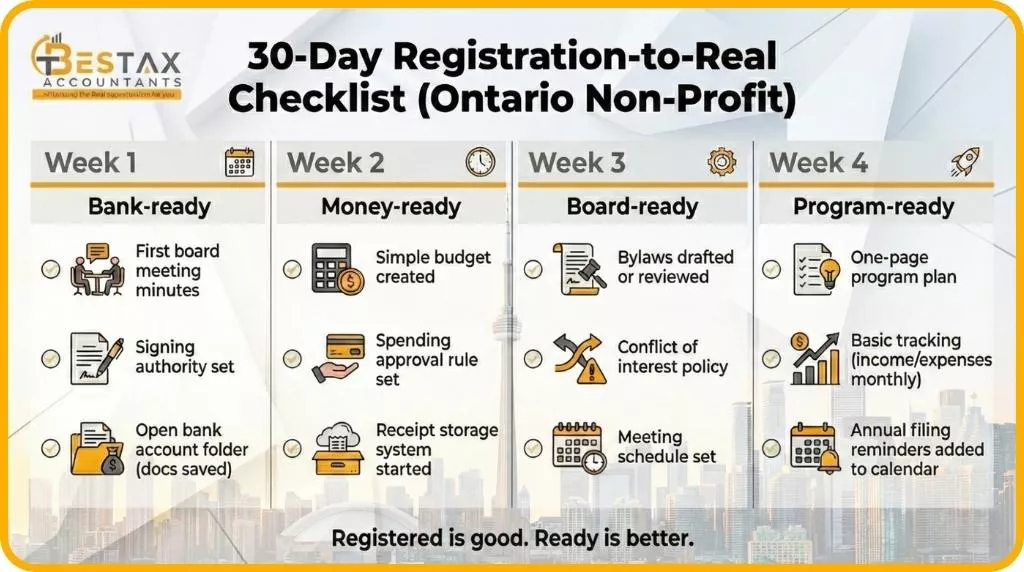
If you cannot answer these clearly, pause and fix this now. It saves months later.
After You Incorporate: Set Up Compliance So You Do Not Get Surprised Later
This is the second place you should use support, because the biggest problems happen after the filing. Your group still needs ongoing compliance habits, especially if you plan to apply for grants or charity status later.
Here is the practical next move: use non-profit organization filing guidance so your annual obligations do not get missed when volunteers get busy.
Also, set up your basics right away:
- Open a bank account in the corporation’s name
- Create a simple approval rule for spending
- Store receipts and agreements in one shared place
- Track income and expenses monthly, not “later”
This is not about perfection. It is about control.
If You Plan To Become A Charity Later, Plan Now
Even if you are not applying for charity status today, you should plan for it while you write your purposes and design your activities. Fixing purposes later can be slow and frustrating.
The CRA’s own reporting shows a high volume of applications and a strong approval rate, but groups still get delayed when their activities and documents do not match.
So the smart move is simple: draft your mission and programs with future fundraising reality in mind.
Common Mistakes That Slow Registration and How To Avoid Them
New groups usually get stuck for predictable reasons. The fix is being cleared early.
- They file without a mission that fits real programs.
- They pick directors who do not have time to govern.
- They treat bookkeeping like an “end-of-year” problem.
- They assume “non-profit” means “no rules” after incorporation.
If you avoid these four, you are ahead of most first-time founders.
Final Remarks
Registering in Ontario is not only about getting a certificate. It is about setting up a structure that can handle money, decisions, and programs without confusion.
If you want help from start to finish, Bestax Accountants can support your incorporation, record setup, and ongoing compliance so your group stays organized while you focus on the mission.
Quick FAQs
How do you start a nonprofit organization in Ontario if you are a small community group?
Start with a clear mission and a small board. If you will handle money or contracts, incorporation is usually the safer option.
What is the difference between a non-profit company and a charity?
A not-for-profit corporation is a legal structure. A registered charity is a CRA status that can issue official donation receipts.
Can a non-profit organization pay staff in Ontario?
Yes. Paying staff is allowed if it supports the mission and is properly documented.
What does it cost to register a non-profit in Ontario?
Ontario’s Articles of Incorporation instructions list a government filing fee of $155.
What is the biggest mistake when starting a not-for-profit organization?
Filing first and figuring out governance and money controls later. That is how small problems turn into big delays.
How do you start a nonprofit organization in Ontario?
Most groups start by incorporating under Ontario’s not-for-profit law, then setting up basic records, banking, and ongoing filing habits.
What does it cost to register?
Ontario’s Articles of Incorporation instructions list a government filing fee of $155.
Do you need directors?
Yes. Ontario requires at least three directors for a not-for-profit corporation.
Disclaimer: The information provided in this blog is for general informational purposes only. For professional assistance and advice, please contact experts.