



Here is something that trips up a lot of people every tax season. They worked abroad, received money from another country, or moved to Canada mid-year, and now they are sitting with a pile of questions and no clear answers.
Most people go searching for a fixed dollar number when they ask how much foreign income is tax free in Canada. They want something clean and simple, like “$10,000 from abroad is safe.” That answer does not exist here. Canada’s tax rules do not work that way, and any source that hands you a single number without asking about your situation is pointing you in the wrong direction.
What actually matters is your residency status, the type of income you received, which country it came from, and whether a tax treaty or foreign tax credit changes the outcome. This guide breaks all of that down for both residents and non-residents, step by step, with no jargon and no guesswork.
Why Foreign Income Is Not Tax Free by Default in Canada Now
Why is there no fixed tax-free foreign income amount
Let’s correct the biggest misunderstanding right away. Canada does not offer a set dollar amount of foreign income that is always tax-free. There is no threshold you can find that automatically shields your foreign earnings from CRA.
What “tax free” can mean in Canadian tax rules
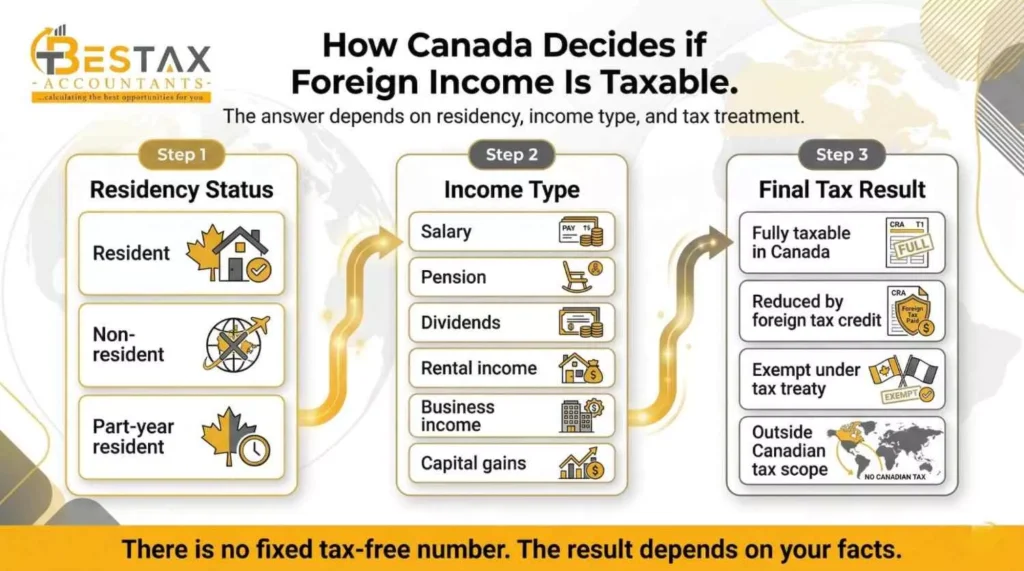
When someone says foreign income is “tax free” in Canada, they usually mean one of three different things. First, some foreign income is exempt by treaty, still listed on your return but then removed through a deduction. Second, some income is offset by a foreign tax credit, taxable in Canada, but the money you already paid abroad reduces what you owe here. Third, some income never enters the Canadian return at all because of your non-resident status, meaning Canada had no claim on it to begin with.
The 4 outcomes readers often mix up
The four outcomes that matter most are: income that is fully taxable in Canada, income reduced by a credit, income exempt under a tax treaty, and income that never appears on the Canadian return. Knowing which bucket applies to you is the whole point.
How CRA Decides If Foreign Income Is Taxable in Canada Today
Before anything else, CRA asks one question: Are you a tax resident of Canada? That single answer drives almost everything that follows.
Why tax residency is the first test
If you are a resident, Canada generally taxes you on income from all over the world. If you are a non-resident, Canada generally taxes you only on income from Canadian sources. That one line changes the entire picture.
How income type changes the tax result
After residency, the type of income matters. A salary, a pension payment, dividends from foreign stocks, rental income from a property abroad, and business earnings do not all follow the same rules. Each one can lead to a different tax result.
Why source country and treaty terms still matter
Then comes the source country question. Where did the money come from, and does Canada have a tax treaty with that country? According to CRA’s official tax treaty page, Canada has tax treaties with over 93 countries. The terms of those treaties can significantly change how specific income types are handled.
Residents: When Worldwide Income Must Be Reported in Canada
Who CRA treats as a resident for income tax purposes
Being a Canadian tax resident is not just about where you sleep most nights. You can spend months outside Canada and still qualify as a tax resident. CRA looks at your ties to Canada, your home, your family, your bank accounts, and your social connections. If your life is rooted here, you are likely a resident for tax purposes even when you are working abroad temporarily.
Why do residents usually report worldwide income
As a resident, foreign income generally belongs on your Canadian tax return. That includes salary from an employer abroad, investment income, rental income, pension payments, and most other money earned outside Canada. Reporting is the starting point, not the exception.
Why reporting income does not always mean double tax
Here is where many people make a wrong assumption. They see “report worldwide income” and think that means paying double tax, once in the other country and once in Canada. That is not always what happens. Reporting income and paying full Canadian tax on it are two different things. Some of that income may be covered by a treaty. Some may qualify for a foreign tax credit. The income gets reported first, and the tax outcome depends on what step follows.
Non-Residents: When Foreign Income Stays Outside Canada Now
As a non-resident of Canada for tax purposes, Canada’s tax reach is limited to income from Canadian sources. Foreign-source income, money earned in and connected to another country, generally does not appear on a Canadian return at all.
Here is a straightforward example. If you are a non-resident and you receive bank interest from a U.S. savings account or a salary from a company in Singapore, that money has no Canadian source. It does not belong on a Canadian return. This is not a treaty benefit and it is not an exemption. Canada simply never had the right to tax it based on your status.
This is one of the clearest distinctions in the entire foreign income conversation. “Not taxed in Canada” can mean two completely different things, either a treaty says Canada will not tax a specific income type, or Canada never had the scope to tax it in the first place. These look like the same result, but come from completely different rules.
If you are dealing with Canadian-source income, withholding obligations, or non-resident filing requirements, getting proper guidance from non-resident tax services in Canada can save you from both overpaying and missing what you are actually required to file.
Tax Treaty vs T2209 Credit: Know the Key Difference in 2026
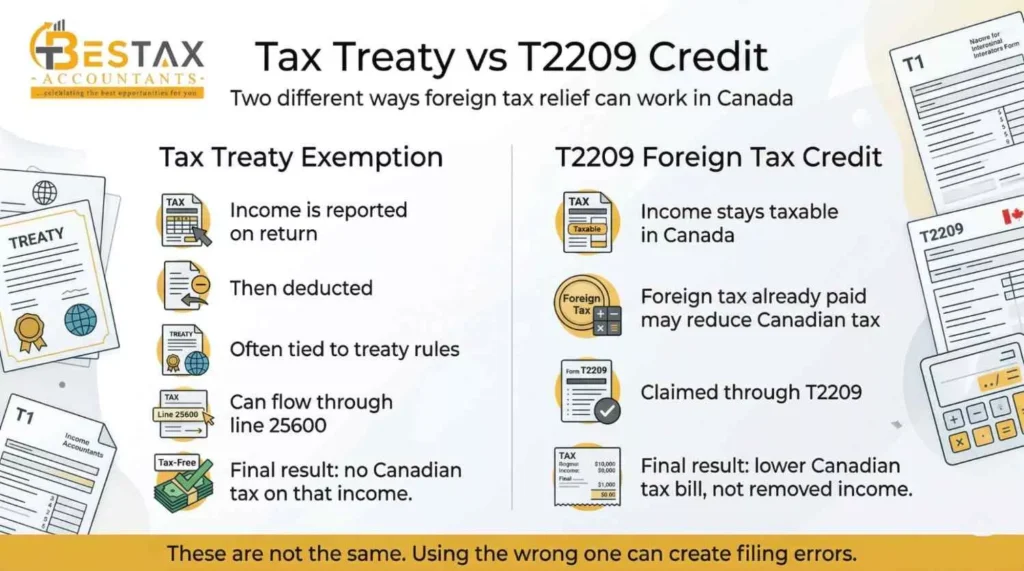
These two things are often confused because they can both reduce what you pay in Canada. But they work through different rules, and mixing them up causes real filing errors.
When a tax treaty can make foreign income exempt
A tax treaty exemption means Canada has agreed with another country not to tax a specific type of income earned there. That income still shows up on your Canadian return, but it is then removed through a deduction such as line 25600. You report it, then it comes back off. The net result is zero Canadian tax on that income.
When the T2209 foreign tax credit reduces Canadian taxes
A foreign tax credit through Form T2209 is different. Here, the income remains taxable in Canada. But because you already paid income tax on it in another country, Canada allows you to reduce your Canadian tax by part or all of what you paid abroad. The income does not disappear from your return. The tax bill shrinks instead.
Why treaty relief and tax credits are not the same
Do not treat these as interchangeable. One removes income from Canadian tax through a treaty arrangement. The other keeps the income taxable but prevents double-taxation through a credit. If you are unsure which applies to your situation, working with someone who handles foreign tax credit in Canada claims properly can prevent costly mistakes on the wrong line of your return.
Why the 90% Rule Does Not Set Tax-Free Foreign Income Limits
This is one of the most misread rules in Canadian tax. Some articles describe the 90% rule as though it creates a foreign income exemption, as if 10% of your foreign earnings are automatically tax-free. That interpretation is wrong.
The 90% rule applies to non-residents and deemed residents who want to claim certain federal non-refundable tax credits on a Canadian return. If at least 90% of your worldwide income is taxable in Canada during the year, you may qualify for those credits. It is a threshold test for credit eligibility, not a cap or exemption on foreign income.
CRA’s guidance for non-residents makes clear that this threshold relates to allowable non-refundable credits only. If you have read that the 90% rule means a portion of your foreign income is untouched by Canadian tax, set that aside. It does not say that, and acting on that reading can create a filing error that CRA will spot.
Part-Year Residents Need Split-Year Income Tax Rules in 2026
If you moved to Canada or left Canada partway through the year, you are a part-year resident. Full-year rules do not apply to your situation, and treating yourself as a full-year resident or full-year non-resident is one of the most common errors in cross-border tax filing.
For the part of the year before you became a Canadian resident, foreign income generally falls outside Canada’s scope. The worldwide income rule applies from the date you established Canadian residency, not from January 1. Income earned before you became a resident typically does not belong on your Canadian return for that earlier period.
Once your residency begins, the worldwide income rule starts with it. From that point in the year forward, income from anywhere generally goes on your return. CRA’s guidance for newcomers confirms that you report world income only for the portion of the year you were a resident, with some limits on specific credits. The date your residency began is one of the most important facts in your first Canadian tax filing.
Foreign Income and Foreign Assets Are Not the Same in Canada
Why foreign income tax rules are one issue
These two topics come up together often, but they operate under completely separate rules. Foreign income questions are about whether the money you earn abroad is taxable in Canada. Foreign asset questions are about whether you need to report what you own abroad, regardless of whether it has earned anything.
Why is T1135 foreign asset reporting another issue?
If you hold specified foreign property with a total cost above $100,000 CAD, including foreign bank accounts, foreign shares, and real property outside Canada that you do not use in a business, you are required to file Form T1135. This is a disclosure form, not a tax calculation. It does not create a tax bill on its own, but failing to file it carries real penalties.
When foreign assets trigger forms even without extra tax
Many people assume that if they owe no additional Canadian tax on their foreign assets, there is nothing to disclose. That is not correct. Your T1135 filing obligation and your income tax bill are entirely separate. You can have property that triggers a T1135 requirement in a year where no extra income tax is owing.
How to Check If Your Foreign Income Is Taxable Step by Step
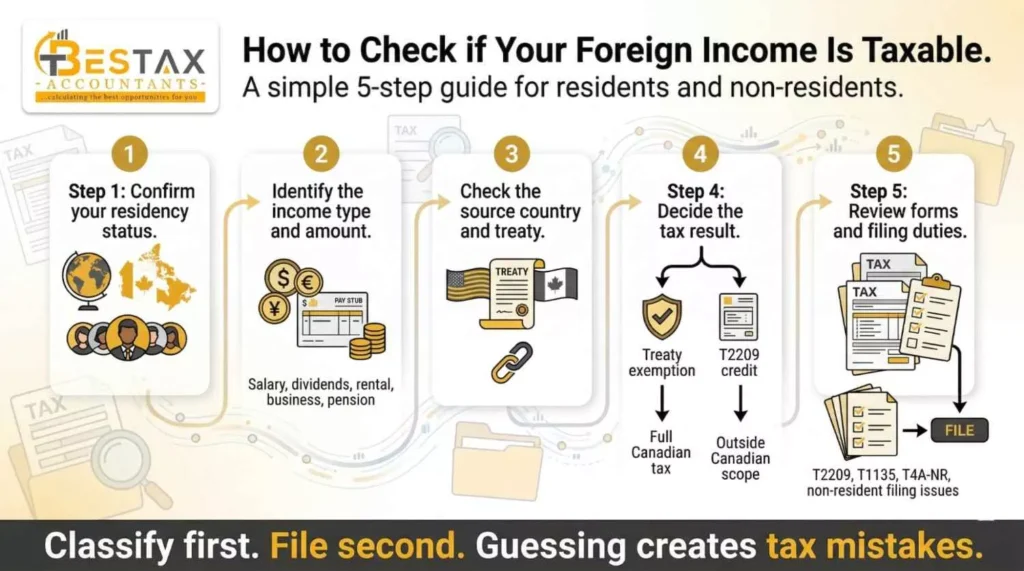
Here is a practical way to work through this for your own situation:
- Step 1: Confirm your residency status. Resident, non-resident, or part-year resident. Without this answer, nothing else is reliable.
- Step 2: Identify the income type and amount. Salary, dividends, pension, rental income, business income, or capital gains. Each can lead to a different result.
- Step 3: Check the source country and any applicable treaty. Does a treaty change how your income type is taxed between Canada and that country?
- Step 4: Decide the tax outcome. Treaty exemption through line 25600, a T2209 foreign tax credit, or full Canadian taxation with no relief?
- Step 5: Review your forms and filing duties. This may include T2209, T1135, and non-resident filing forms depending on your situation.
Common Foreign Income Filing Mistakes That Trigger CRA Now
Not reporting worldwide income as a Canadian resident is the most straightforward mistake CRA catches. Residents often assume that because they paid tax in another country, the income does not belong on their Canadian return. It does. You report first, and the treaty or credit question gets sorted next.
Confusing treaty-exempt income with credit-eligible income is another consistent problem. Both can reduce what you pay, but through different rules and different lines on the return. Treating one as the other puts both the income reporting and the credit claim at risk.
Missing the T1135 form is a separate but equally real issue. If your foreign property crossed the $100,000 cost mark during the year, the filing requirement applies whether or not any extra tax is owing. CRA’s penalties for missing this form are not automatically forgiven.
Beyond these three, two other mistakes show up regularly. The first is using the 90% rule to justify a foreign income exemption, which, as covered earlier, is not what that rule does. The second is assuming that leaving Canada ends all Canadian tax obligations. Non-residents with Canadian-source rental income, pensions, or other payments often still have withholding and filing duties in Canada.
Top Tax Forms, Credits, and Records to Review This Tax Year
T2209 for foreign tax credits
T2209 is the form for claiming the foreign tax credit. If you paid income tax in another country on earnings that Canada also taxes, T2209 is how you claim relief against your Canadian bill. Keep foreign tax slips and proof of taxes paid abroad to back up the claim.
T1135 for specified foreign property reporting
T1135 handles foreign asset disclosure. It applies when specified foreign property exceeds $100,000 CAD in total cost. It is a compliance form, not a direct tax calculation, but missing it carries penalties.
T4A-NR and other non-resident tax form issues
T4A-NR is issued for certain payments made to non-residents. If you received Canadian-source income while living outside Canada, this slip may be part of your picture.
For records, keep foreign income slips, bank statements, pay stubs, and foreign tax assessments. If CRA ever asks about a T2209 claim or a T1135 filing, organized documentation is what keeps the review manageable.
Final Thoughts
Foreign income taxation in Canada is not based on a single exemption number. It is built around residency status, income type, source country, and treaty terms, and those four factors together determine whether your foreign income is fully taxable, credit-eligible, treaty-exempt, or entirely outside Canadian scope.
If your situation involves cross-border income, a mid-year move, or a mix of treaty and credit questions, Bestax Accountants can help. Their team works with both residents and non-residents on foreign income reporting, T2209 claims, T1135 compliance, and CRA filing requirements. Getting the details right the first time is always the better move.
Quick FAQs
Do you pay tax on foreign income in Canada?
If you are a Canadian tax resident, yes. Foreign income generally goes on your return and may be taxed here. A treaty or T2209 credit may reduce that tax, but reporting always comes first.
What is the 90% rule in Canada?
It is a threshold that determines whether non-residents can claim certain federal non-refundable credits on a Canadian return. It is not a foreign income exemption and does not mean 10% of foreign income is tax free.
How much of my foreign income is taxable?
There is no single number that works for everyone. Residency status, income type, source country, and treaty terms all shape the answer. The question of how much foreign income is tax free in Canada only makes sense after you work through those four factors together, and the answer is different for almost every person who asks it.
How does CRA know about foreign income?
Canada shares tax information with many countries through treaty-based agreements and international reporting systems. Income that goes unreported in Canada but appears through information exchange or unmatched foreign slips can trigger a CRA review.
What happens if you do not report foreign income?
CRA can reassess your return, add interest on amounts owing, and apply penalties. The longer unreported income goes unaddressed, the larger the total grows. Voluntary disclosure is available in some situations, but reporting correctly from the start is always the lower-risk path.
Disclaimer: The information provided in this blog is for general informational purposes only. For professional assistance and advice, please contact experts.