



Sell your business in Canada with confidence: build a CRA Sale-Readiness Pack, pick asset vs share deals, and stop price cuts during due diligence in 2026.
Selling a business is not a one-day decision. It is a months-long process with paperwork, numbers, and nerves. If you are searching for how to sell your business, start with one simple truth: buyers pay more for proof, not promises.
Here is the reality check most sellers miss. Many businesses take 6 to 12 months to sell, and delays can cost you real money. This guide shows you the exact steps to prepare, market, negotiate, and close, without the mistakes that trigger price cuts.
What “Selling Your Business” Means in Canada
In Canada, you usually sell one of two things:
- Shares sale (share deal): the buyer buys the corporation.
- Asset sale (asset deal): the buyer buys equipment, inventory, contracts, and goodwill.
This choice changes your taxes, your legal paperwork, and what you keep after closing. It also changes what the buyer will ask for in due diligence. What buyers really buy is confidence. They want clean financials, clean compliance, and clean contracts.
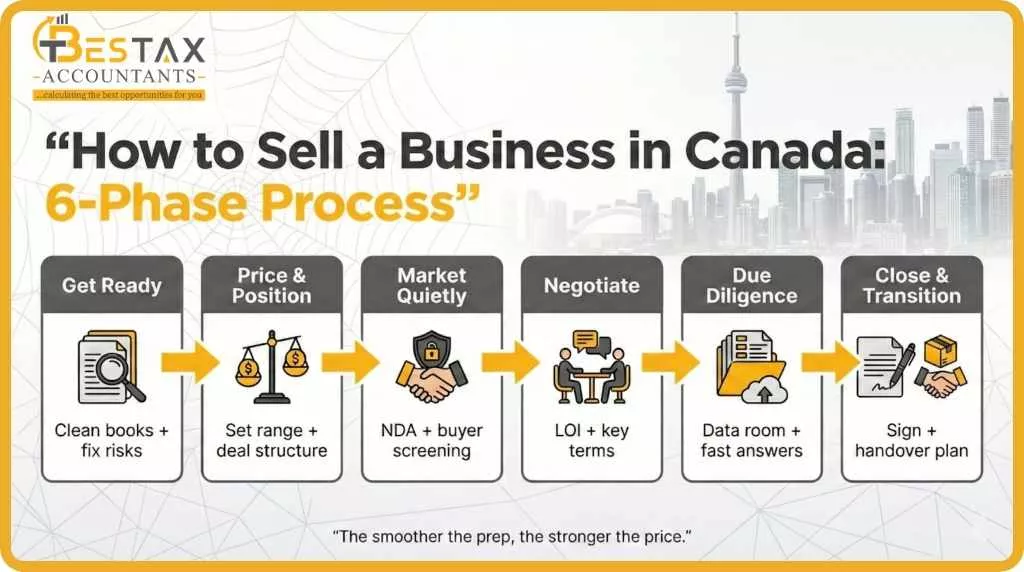
The “How To Sell Business in Canada” Process
Think in phases, not steps. Each phase supports the next.
- Phase 1: Get ready. Clean books, fix risks, build your document pack.
- Phase 2: Price and position. Set a realistic range and the deal structure.
- Phase 3: Market quietly. Screen buyers, use NDAs, share info in stages.
- Phase 4: Negotiate. Lock the big terms in the LOI.
- Phase 5: Due diligence. Fast answers, no surprises, clean support files.
- Phase 6: Close and transition. Sign, get paid, hand over, and update records.
Start earlier than your gut tells you. A Canadian business lender points out that exit planning is often advised at least two years before the exit. The same source highlights a major wave of owners exiting, with retirement as a top reason, and over $2 trillion in business assets involved.
Build a CRA Sale-Readiness Pack Before You List
Most sellers lose leverage during due diligence. Not because the business is bad, but because the files are messy.
Your unique advantage is a simple folder: a CRA Sale-Readiness Pack.
It is not complicated. It is just organized. And it answers buyer questions before they become deal breakers.
Include these items:
- A clean summary of GST/HST, payroll, and corporate tax filing status
- A list of assets and how you track them (what is owned, leased, financed)
- A clear inventory method and a current count (if inventory matters)
- Notes on owner perks and one-time expenses (so earnings look “normal”)
- A short “change of ownership” checklist (accounts, logins, permits, bank, CRA)
This pack stops the most common re-trade line: “We found issues, so the price needs to drop.”
10 Steps to Avoid Costly Mistakes
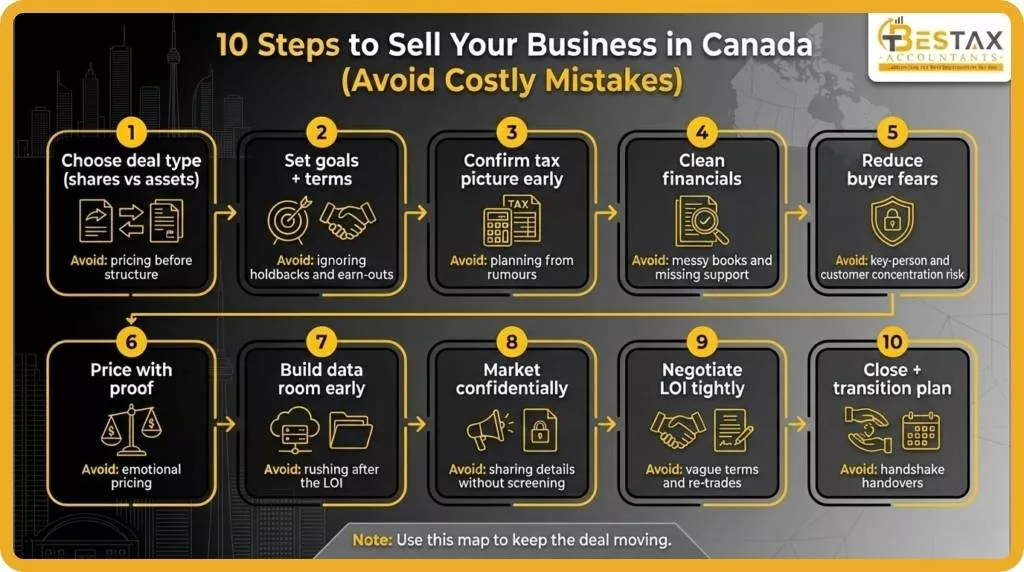
Step 1: Decide what you are selling (shares vs assets)
Do not agree on a price before you agree on the structure. In a sale of a business, structure is half the deal. Write a clear “what is included” list. Add what is excluded too. This prevents ugly fights over vehicles, tools, software, and client lists.
Step 2: Set the goal and the rules (price, terms, timeline)
A high price with bad terms can still be a bad deal.
Set:
- Your walk-away number
- Your ideal close date
- Three terms you will not accept (examples: long holdback, unclear earn-out, weak non-compete)
This is how you avoid regret after you “sell a business” on paper but do not get paid cleanly.
Step 3: Confirm your 2026 tax reality before you plan your take-home cash
Tax rules can shift. News headlines can confuse people fast. Before you sign anything, confirm the current tax treatment for:
- Capital gains
- Eligible lifetime capital gains exemption (if it applies)
- Asset vs share sale impacts
- How payments are split (goodwill, equipment, inventory, consulting)
This one step often decides whether a deal is “good” or “painful.”
Step 4: Clean up financials so buyers can verify fast
Buyers do not pay extra for confusion. They discount it.
Prepare:
- 3 years of financial statements
- A trailing 12-month view
- A simple add-back list for owner expenses (reasonable and provable)
If your numbers are easy to trust, your valuation conversation gets easier too.
Step 5: Fix the top buyer fears before they appear in due diligence
Most buyers worry about the same things:
- Customer concentration (one client = big risk)
- Key-person risk (one employee runs everything)
- Undocumented processes (no SOPs, no training plan)
- Shaky contracts (handshake deals)
- Compliance gaps (tax filings, payroll, permits)
Fix even two of these, and you will feel the difference in buyer confidence.
Step 6: Price using a range and a buyer lens
Pricing is not a feeling. It is a story backed by proof.
A buyer-friendly price explanation includes:
- Why margins are stable
- How revenue repeats (contracts, retention, referrals)
- What growth looks like without “magic”
Avoid emotional pricing. It scares serious buyers and attracts time-wasters.
Step 7: Build a due diligence data room before marketing
If you are serious about how to sell your business without last-minute panic, build your data room before you list.
Use a simple folder structure:
- Legal: leases, major customer/vendor contracts, licences
- People: org chart, key roles, payroll summary, contractor agreements
- Operations: insurance, equipment list, supplier terms, basic SOPs
- Finance: statements, AR/AP summary, inventory method, capex list
This prevents the worst timing problem: building documents after the LOI, when you are under pressure.
Step 8: Market confidentially and filter buyers hard
Confidentiality protects your staff, your customers, and your leverage.
Use a staged process:
- Teaser first (no name, no exact location)
- NDA second
- Buyer screening third (proof of funds or financing path)
- Full info last (data room access)
This is especially important when selling a business in Ontario, where your market can feel small.
Step 9: Negotiate the LOI like it is the deal
LOIs create momentum. They also create traps.
Lock these items clearly:
- Structure (share vs asset)
- Price and how it is paid
- Working capital logic (what is “normal” at closing)
- Holdback and conditions
- Timeline and due diligence scope
If the LOI is vague, the buyer can re-trade later.
Step 10: Close cleanly and protect the first 90 days after sale
Closing is not the finish line. Transition is where deals stay healthy.
Agree in writing on:
- Training time and handover support
- Who tells staff and customers, and when
- What happens if issues show up post-close
- How disputes are handled (so things do not turn personal)
A calm transition protects payments and reputation.
The Most Common Costly Mistakes
- Waiting too long to prepare, then rushing decisions
- Listing before the CRA Sale-Readiness Pack is complete
- Accepting an LOI without clear working capital rules
- Sharing sensitive info before an NDA
- Assuming “busy” equals “sellable” without proof
Final Remarks
Selling a business in Canada is a big move. A little planning can protect a lot of money. If you want help building your Sale-Readiness Pack, cleaning your files, and planning the tax side, Bestax Accountants can support you through the process.
Quick FAQs
How long does it take to sell a business in Canada?
Many businesses sell within 6 to 12 months, but it depends on industry, size, and preparation.
What is the difference between selling shares and selling assets?
Shares mean the buyer takes the corporation. Assets mean the buyer picks what they want to buy. The tax and legal results can be very different.
What should be inside a Sale-Readiness Pack?
Clean tax filing status, clear asset and inventory lists, normalized financials, and a simple change-of-ownership checklist.
What deal terms usually create the biggest seller risk?
Holdbacks, earn-outs with fuzzy rules, and unclear working capital targets are common trouble spots.
What is the biggest mistake sellers make?
Waiting until a buyer asks for documents. By then, you are negotiating under pressure, and buyers can push the price down.
Disclaimer: The information provided in this blog is for general informational purposes only. For professional assistance and advice, please contact experts.