


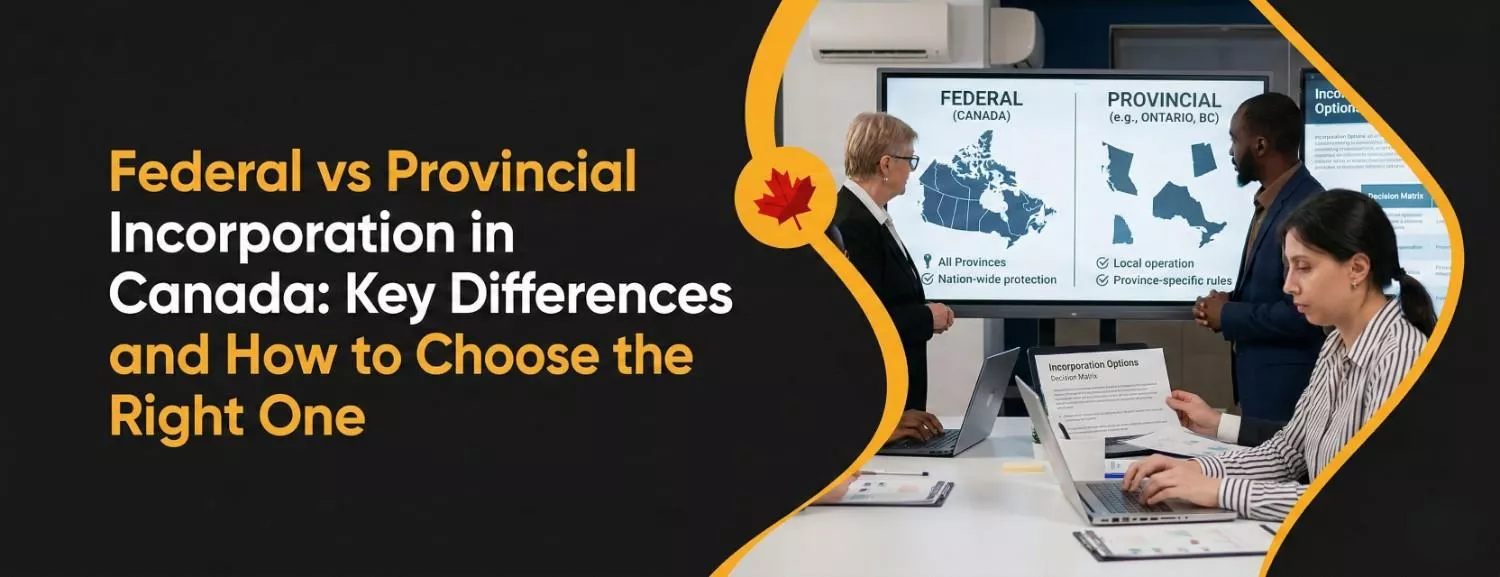
If you are stuck on federal vs provincial incorporation, you are not alone. Most founders think incorporation is the finish line. It is not.
The real pain shows up after you incorporate. That is when banks ask for documents, provinces ask for registrations, and your “quick” launch turns into delays and extra fees.
A question normally arises in the owner’s mind: If I incorporate federally, do I still need provincial registration?
Yes. If you operate in Ontario (or any other province/territory), you generally must register there as well. Canada’s business registration steps also flag extra-provincial registration as a required “where you plan to do business” step.
In this guide, we will keep it simple. You will learn the real differences, how to choose, and what steps come next so you can move fast without mistakes.
Basics First: What “Incorporation” Actually Means
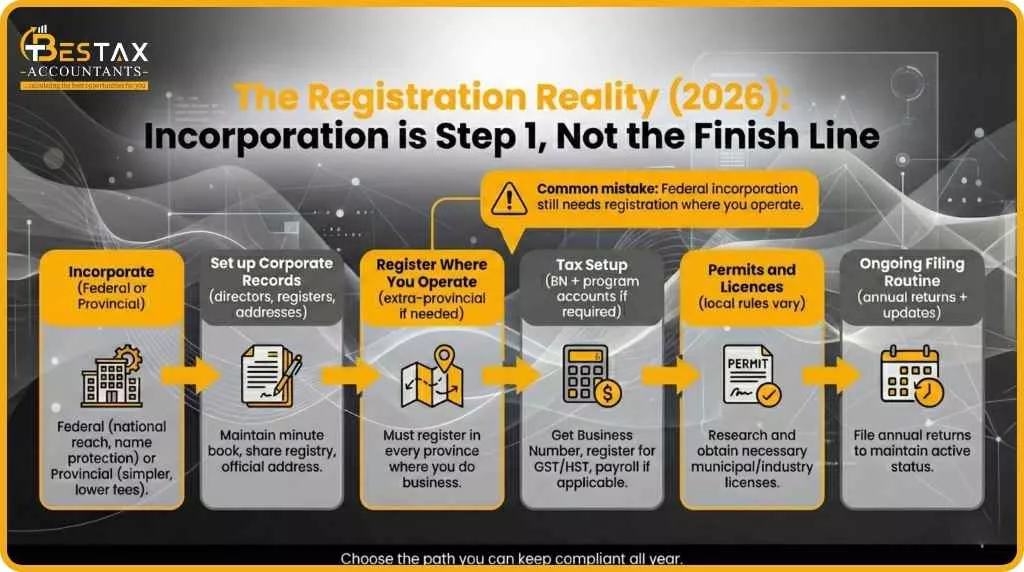
Incorporation means you create a corporation, which is its own legal person. It can own assets, sign contracts, and borrow money. Shareholders own the corporation, but they are usually not personally on the hook for corporate debts. Here is the mix-up that causes problems: incorporation is only one step. You may still need a business number, tax accounts, permits, licences, and registrations in the provinces where you actually work.
The 2026 Reality Most People Miss: Incorporation vs “Where You Operate”
You can incorporate in one place and operate in another. That is normal. The mistake is forgetting that “where you operate” triggers extra steps.
The Registration Reality Checklist
If you do business outside your incorporating jurisdiction, you may need:
- Extra-provincial registration in the province/territory where you operate
- Local permits or licences (city rules can differ)
- Updates to your corporate records (address, directors, records location)
- Bank, payment, and contract updates (to match the legal entity name)
Federal incorporation can help with national name protection, but it does not remove provincial registration duties.
Difference Between Federal and Provincial Incorporation
Here is the comparison of people who actually save.
| Topic | Federal incorporation | Provincial incorporation |
|---|---|---|
| Name protection scope | Often broader across Canada, once approved | Usually stronger inside that province/territory |
| Operating across Canada | You can carry on business anywhere, but still register where you operate | You can expand, but extra-provincial registration may be needed elsewhere |
| Ongoing filings | Federal annual returns + updates | Provincial annual returns + updates |
| Admin load | Can rise if you register in multiple provinces | Often simpler if you stay in one province |
| Investor comfort | Can look “national” and familiar to some buyers/investors | Can still be investor-ready, depends on setup |
| Best fit | Expansion path, national brand plans | Local-first businesses, simple setup |
If you want the federal government’s own plain breakdown of federal benefits like cross-Canada name protection, the “right to carry on business anywhere,” and online filings, it is summarized here.
2026 Compliance Updates You Cannot Ignore
A lot of founders pick a route based on cost, then get surprised by record-keeping rules later. In 2026, the safe move is to assume you will be asked for:
- Clean ownership records
- Clear director/officer lists
- Up-to-date addresses and corporate filings
- Proof you followed the right registration steps
If you want less stress later, build your corporate records like you expect due diligence now, not “someday.”
How to Choose the Right One
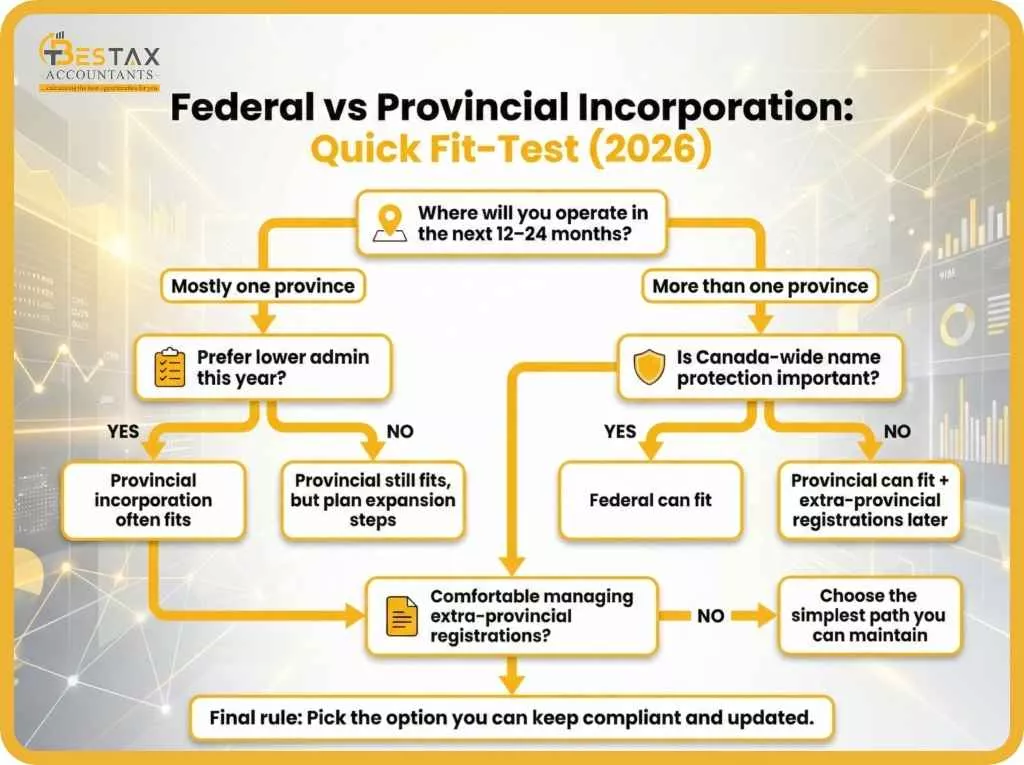
This is a practical way to decide without overthinking it.
The 10-question Fit-Test
- Will you operate in more than one province in the next 12–24 months?
- Do you want stronger Canada-wide name protection?
- Are you ready to register where you operate (extra-provincial), even if incorporated federally?
- Will you apply for financing soon (and need clean paperwork fast)?
- Will you bring in investors or sell later (and want a tidy structure now)?
- Is your business mostly local (one province, local clients, local contracts)?
- Do you want the lowest admin load this year?
- Do you need flexibility on where your records and meetings happen?
- Are you comfortable managing filings on time (or paying someone to do it)?
- Are you building a national brand from day one?
If your answers are mostly “local + simple + low admin,” provincial is usually the smoother start. If your answers are mostly “national brand + expansion + investor path,” federal can make sense, as long as you plan the registrations where you operate.
The Real-World Process: Two Paths, Same End Goal
No matter what you choose, you are trying to reach the same finish line: a legal corporation, registered where it operates, and ready for banking and contracts.
Path A: Federal incorporation (what happens next)
You incorporate federally, then you register in the province where you operate. You also set up tax accounts and any permits/licences you need.
Path B: Provincial incorporation
You incorporate in Ontario, keep your records current, and if you expand later, you register extra-provincially in the new province/territory.
Director Residency and Governance
Some founders only discover governance rules when they are already mid-application. The best move is to check the director’s rules early for the route you want.
If you are a solo founder or you have non-resident owners involved, do not assume the rules are the same everywhere. Build your plan around what you can actually support.
Name Protection: What You Get, What You Do Not Get
Name protection is a big reason people pick federal. Federal approval can offer broader protection across Canada.
But two quick cautions:
- It is not the same as a trademark.
- It does not automatically secure your domain or social handles.
If your name matters, do the checks before you spend money on branding.
Common Mistakes That Waste Time and Money
- Picking federal, then forgetting to register where you operate
- Assuming “I can operate anywhere” means “no registrations needed”
- Mixing up incorporation with CRA program accounts and permits
- Choosing a name first, then finding conflicts later
- Delaying records upkeep until a bank or investor asks
Quick Scenarios (So You Can Self-Identify Fast)
- Local service business (Ontario only): Provincial is often the simplest start. You can still expand later.
- E-commerce shipping across Canada: Either can work. The key is where you truly “carry on business” and what registrations you need.
- SaaS planning investors: Either can be investor-ready. The real win is clean records, clear ownership, and fast answers in due diligence.
- Founder planning expansion in 12 months: Federal may make sense, but only if you plan extra-provincial registration from day one.
Final Takeaway
In 2026, the smartest choice is not “federal sounds bigger” or “provincial is cheaper.” The smartest choice is the one you can run cleanly, file on time, and register properly where you operate. If you want a specialist to review your situation (local vs expansion, paperwork readiness, and next steps), Bestax Accountants can help you map the route and get it done right.
Quick FAQs
Do I need to register in Ontario if I incorporate federally?
Yes, if you are carrying on business in Ontario. Federal incorporation does not eliminate the need for provincial registration.
Is federal incorporation worth it for a small business?
It can be, if you want broader name protection or plan to operate in more than one province. If you are staying local, provincial can be simpler.
What is extra-provincial registration and when do I need it?
It is registration in a province/territory that is not your incorporating jurisdiction. You typically need it when you operate there (employees, office, contracts, regular work).
What is the safest way to decide quickly?
Answer two questions: “Where will I operate this year?” and “Will I expand within 24 months?” Then pick the route that keeps admin simple while still supporting your plan.
How big is the Canadian business landscape in 2026?
Canada’s scale is huge. In June 2025, there were 1.38 million employer businesses and 3.59 million non-employer businesses (with annual revenues over $30,000). That is why clean registration and compliance habits matter.
What is the difference between federal and provincial incorporation?
Federal incorporation creates your corporation under federal law. Provincial incorporation creates it under one province or territory’s law. The difference shows up in name protection, ongoing filings, and how expansion works in real life.
Which one is better in 2026?
Neither is “best” for everyone. The right choice depends on where you operate, your growth plans, your comfort with transparency rules, and how much admin work you want this year.
Disclaimer: The information provided in this blog is for general informational purposes only. For professional assistance and advice, please contact experts.