


Running a successful private corporation in Canada isn’t just about generating profit. It’s also about extracting those profits in the most tax‑efficient way. The capital dividend account (CDA) is a powerful mechanism that allows Canadian private corporations to return certain corporate profits to shareholders tax‑free.
While the concept has existed for decades, recent rule changes surrounding capital gains and ongoing fiscal policy debates mean that the CDA remains a hot topic for 2026.
This guide dives deep into capital dividend account rules, calculations, planning strategies and the latest developments so you can confidently plan for your company’s future.
What Is a Capital Dividend Account (CDA)?
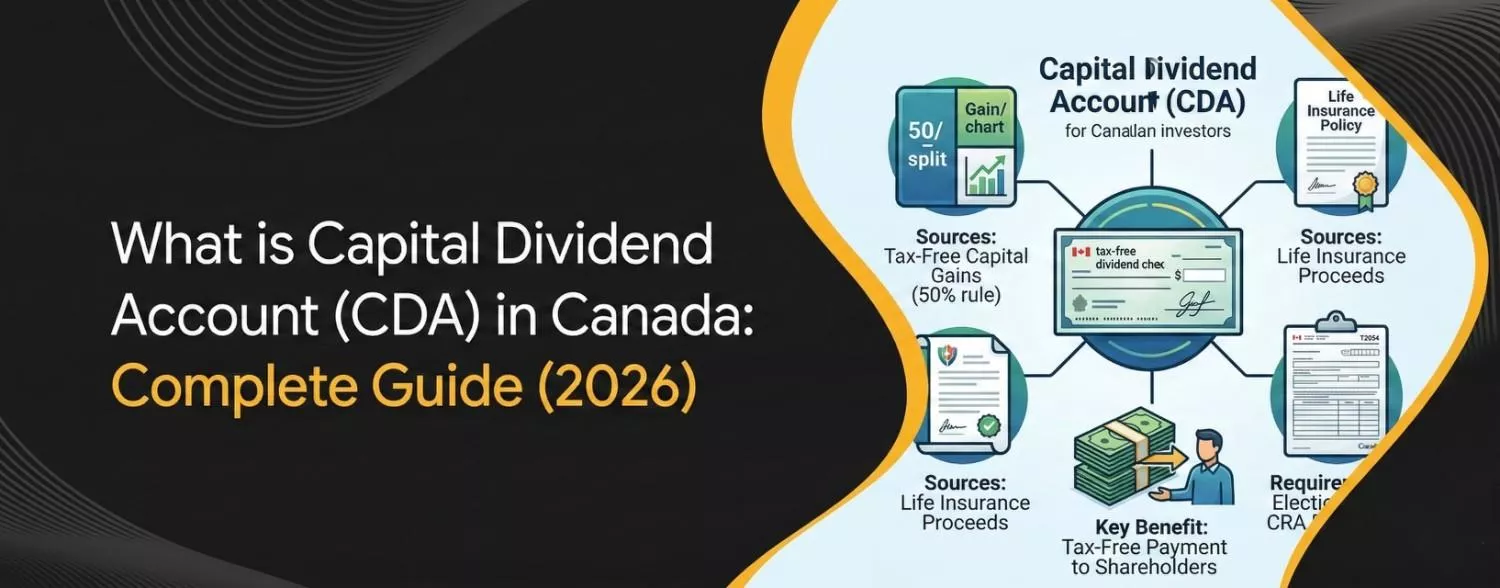
A CDA is not a bank account. It’s a notional ledger maintained by a private corporation that records tax‑free surpluses. When a company earns tax‑free amounts, such as the non‑taxable portion of capital gains, life‑insurance proceeds above the policy’s adjusted cost basis or capital dividends received from another corporation, these amounts are credited to the CDA. When the company elects to pay a capital dividend, that amount reduces the CDA balance.
Why the CDA Exists
Canadian tax law tries to ensure that earnings are taxed only once, either in the hands of the corporation or the shareholder. This “integration” principle means profits already taxed at the corporate level shouldn’t face full taxation again when distributed to shareholders. The CDA records the untaxed portion of specific profits so they can be returned to shareholders tax‑free without violating this principle.
Who Can Use a CDA?
Only private corporations resident in Canada may maintain a CDA. Public companies, non‑resident corporations and corporations that lose their private status cannot use it. The account is cumulative, and balances can carry over across tax years. Capital dividends may also flow through partnerships and trusts to their partners or beneficiaries.
Is a CDA a Separate Account to Open?
No. There’s no special bank account to open; the CDA exists only on paper. You “open” a CDA by keeping records of qualifying transactions on your corporate books. CRA may ask for documentation (adjusted cost base statements, board resolutions, dividend ledgers, etc.) to verify your balance. Keeping meticulous records from incorporation is essential because errors can trigger audits or penalties.
Why the Capital Dividend Account Matters
- Tax‑free distributions: The CDA lets a private corporation distribute certain profits to shareholders without personal income tax. For example, if your corporation has $200,000 of eligible amounts in its CDA, you can pay a $200,000 capital dividend and shareholders will not report that dividend as income.
- Flexibility for buyouts and estate planning: CDA balances can fund shareholder buyouts, succession plans or the redemption of shares on death. Because distributions are tax‑free, they preserve cash for shareholders.
- Integration with corporate‑owned life insurance: When a policy pays a death benefit, only the portion above the policy’s adjusted cost basis (ACB) increases the CDA. This mechanism helps pass life‑insurance proceeds tax‑free to heirs or partners.
- Estate equalization: Entrepreneurs can use CDA amounts to equalize inheritances among children who are active in the business and those who are not, thereby avoiding double taxation on death.
Components That Increase or Decrease Your CDA Balance
| Component | Effect on CDA | Key Notes |
|---|---|---|
| Non‑taxable portion of capital gains | Credit | Only the tax‑free portion of capital gains adds to the CDA. Before June 25 2024 the inclusion rate was 50 %; after June 24 2024, proposals indicate it may rise to 66⅔ %. That means one‑half (or one‑third if inclusion rates rise) of realized capital gains adds to the CDA. |
| Capital dividends received from other corporations | Credit | If your corporation holds shares in another private corporation and receives a capital dividend, that tax‑free receipt is added to your CDA. |
| Life‑insurance proceeds in excess of ACB | Credit | Proceeds from corporate‑owned life insurance minus the policy’s ACB increase the CDA. |
| Non‑taxable portion of eligible capital amounts | Credit | Gains from selling eligible capital property (e.g., goodwill) are partially non‑taxable and increase the CDA. |
| Trust distributions of capital dividends | Credit | Tax‑free trust distributions (e.g., from a family trust) that are capital dividends add to the CDA. |
| Non‑deductible portion of capital losses | Debit | The non‑taxable portion of capital losses reduces the CDA. |
| Capital dividends paid | Debit | Each tax‑free dividend paid reduces the CDA dollar‑for‑dollar. |
Pro Tip: Keep separate ledgers for gains, losses and capital dividends paid. A single arithmetic mistake can lead to a negative CDA and 60 % penalty tax.
How to Calculate the CDA Balance
Your CDA balance is the cumulative tax‑free surplus. To compute it, add up all qualifying credits and subtract the debits:
CDA Balance = (Tax‑free capital gains+Life‑insurance proceeds over ACB+Capital dividends received+Other tax‑free amounts) − (Capital dividends paid+Non‑deductible capital losses).
For example, consider a corporation that realized a $50,000 non‑taxable portion of capital gains, received $100,000 of life‑insurance proceeds above ACB and $20,000 of capital dividends, then paid $30,000 in capital dividends and incurred $10,000 in non‑deductible losses. Its CDA balance is $50,000 + $100,000 + $20,000 − $30,000 − $10,000 = $130,000.
Example: Tracking Sam’s Coffee Shop CDA
Sam owns a small café in Ontario. In 2023, the business sold old equipment at a gain of $60,000 and collected $200,000 from a key‑person life‑insurance policy; $20,000 of premiums were paid over the years. The non‑taxable portion of Sam’s capital gain is $30,000 (half of $60,000) and the net insurance credit is $180,000 ($200,000 to $20,000).
That year Sam’s CDA increased by $210,000. When he later paid a $50,000 capital dividend and suffered a $20,000 capital loss (half of which, $10,000, is non‑taxable), his CDA decreased by $60,000. Sam ended the year with $150,000 left in his CDA.
Step‑by‑Step Guide to Paying Tax‑Free Capital Dividends
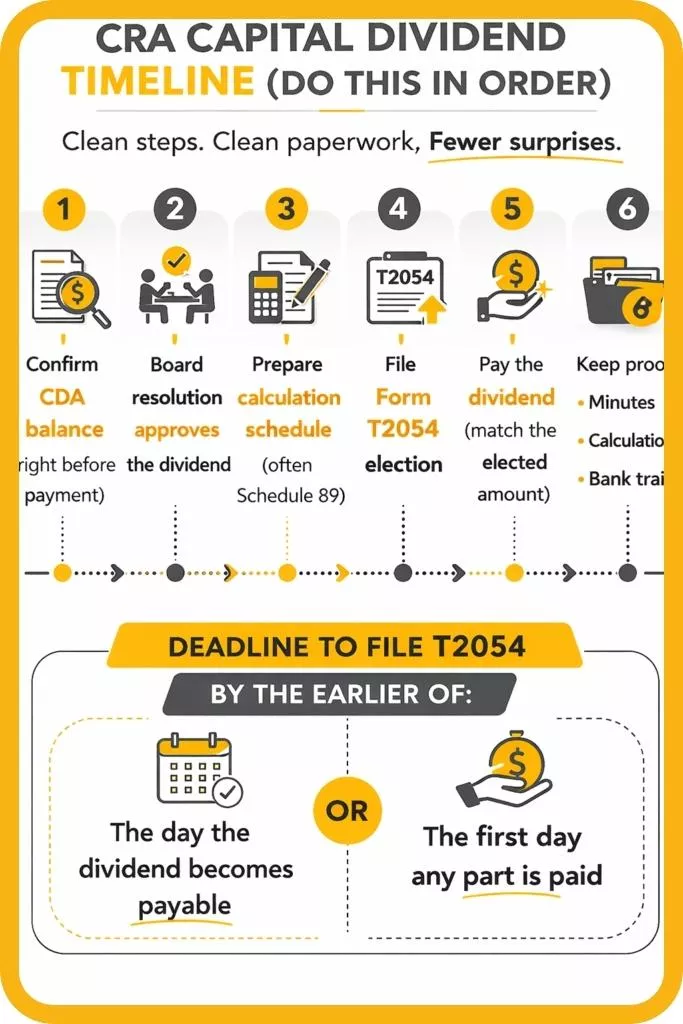
The Canada Revenue Agency (CRA) outlines a prescribed process for designating a dividend as a capital dividend. Follow these steps carefully to avoid penalties and ensure your distribution remains tax‑free:
- Check your CDA balance: Use CRA’s My Business Account or file Schedule 89 (Request for Capital Dividend Account Balance Verification) to confirm the available amount. Overpaying triggers a 60 % penalty and interest.
- Get board approval: The corporation’s directors must authorize the dividend via a dated resolution. Keep a certified copy for CRA.
- File Form T2054 (Election for a Capital Dividend): Submit Form T2054 by the earlier of the date the dividend becomes payable or the first date any portion is paid. Include the directors’ resolution and a schedule showing your CDA calculation (often using Schedule 89).
- Attach supporting documents: When filing Form T2054, attach Schedule 89 and any ACB calculations, trust distribution schedules, and other evidence of your CDA balance.
- Pay the dividend: Transfer the cash or in‑kind property to shareholders. Ensure the amount matches the amount elected on Form T2054. Direct bank transfers with proof-of-payment statements make CRA audits easier.
- Report the dividend on your T2 return: Record the capital dividend on Schedule 3 of the T2 corporate return.
Late filing penalty: If you miss the election deadline, CRA imposes a penalty equal to the lesser of $41.67 per month or 1/12 of 1 % of the dividend amount per month. Late elections must include the penalty payment.
CRA Rules and Penalties
Excess Election and Part III Tax
Declaring a dividend larger than your CDA balance is known as an excessive election. The corporation must pay a 60 % Part III tax on the excess amount. Shareholders still receive the full dividend tax‑free, but the corporation bears the penalty.
To avoid this penalty, the corporation can file a second election under subsection 184(3) to treat the excess amount as a regular taxable dividend. This must be done within 90 days of CRA’s notice of assessment. In that case the excess is taxed in shareholders’ hands at dividend tax rates while the corporation avoids Part III tax.
Late Election
If Form T2054 is filed after the payment date, CRA still allows the election but levies a late filing penalty (see above). The corporation must file the same documents as for a timely election along with the penalty.
Non‑Resident Shareholders
Capital dividends paid to non‑resident shareholders are subject to a 25 % withholding tax, which may be reduced under tax treaties. This withholding is payable by the corporation at the time of payment.
Anti‑Avoidance Rules
CRA’s anti‑avoidance rules prevent abuse. Transactions structured solely to create a CDA balance may be recharacterized as taxable dividends. Always ensure that tax planning has genuine economic substance.
Negative CDA Balances and Part III Tax
A CDA balance can never go below zero. If losses or dividends cause the account to go negative and you still elect to pay a capital dividend, the excess will trigger Part III tax and interest. For example, CI Global Asset Management notes that paying a capital dividend when the CDA is negative (e.g., after a series of capital losses) attracts Part III tax at 60 % plus prescribed interest.
Mitigation:
- Monitor CDA after each transaction. Avoid paying dividends after significant capital losses until the balance returns to positive.
- Reclassify any excess portion as a regular taxable dividend under subsection 184(3) to avoid the 60 % penalty.
- Carryforward planning: Understand that capital loss carryforwards offset capital gains at the prevailing inclusion rate. This ensures you don’t inadvertently wipe out CDA credits.
Planning Strategies and Timing Tips (2026 and Beyond)
- Trigger gains strategically: Realizing capital gains at strategic times can create CDA credits. For instance, if inclusion rates increase to two‑thirds, only one‑third of gains will be non‑taxable and added to the CDA. In 2026 there is no increase, but future governments may revisit the proposal. Consider realizing gains sooner if you expect higher inclusion rates.
- Pay dividends before going public or selling: Public corporations cannot pay capital dividends. If you plan to list on the stock exchange or sell your company, use your CDA beforehand to extract tax‑free cash.
- Coordinate with life‑insurance planning: Corporate‑owned life insurance can significantly grow your CDA balance. Use it for succession, buy‑sell agreements or estate equalization. Ensure you understand ACB and death benefit interactions.
- Use trust structures: Family trusts can allocate capital gains and capital dividends to beneficiaries. Distributions of capital dividends from a trust increase the corporate CDA. Work with a tax professional to optimize trust planning.
- Cross‑border considerations: Non‑resident shareholders face withholding tax. Consider paying capital dividends before a shareholder becomes non‑resident or explore treaty relief.
Recent Changes and Outlook (2024 to 2026)
Budget 2024 proposed increasing the capital gains inclusion rate for corporations and many trusts from one‑half to two‑thirds for gains realized on or after June 25 2024. The proposal would have reduced the non‑taxable portion added to the CDA from 50 % to 33⅓ %, slowing the accumulation of CDA credits.
However, political changes postponed the change: in March 2025 the government announced it would not proceed with the inclusion‑rate increase slated for January 1 2026. For 2026 the inclusion rate remains at 50 %, but fiscal pressures could lead future governments to revisit the change.
Key Takeaways for 2026
- Current inclusion rate: 50 % of capital gains are taxable; the other 50 % goes into the CDA.
- Future possibility: If inclusion rates rise, CDA build‑ups will slow and planning will become more important.
- Stay informed: Monitor federal budgets and Department of Finance releases. The Department provides backgrounders when proposals are tabled, explaining effective dates and transition rules.
Case Studies
Tech Entrepreneur Extracts Cash Before IPO
A Toronto tech founder plans to take her company public in mid‑2026. During 2025 the corporation sells a division, realizing a $180,000 capital gain. The non‑taxable portion (50 %) adds $90,000 to the CDA. Her tax adviser recommends paying a $90,000 capital dividend before the IPO.
She files Form T2054 on time, attaches Schedule 89 and a board resolution, and pays the dividend. Because public corporations can’t pay capital dividends, extracting these funds beforehand preserves tax‑free cash for the founder.
Family Business Uses CDA for Succession
A family‑owned manufacturing company in Calgary has built up a CDA of $400,000 through years of capital gains and life‑insurance credits. The owners intend to transfer the business to the next generation.
By paying capital dividends to the retiring parents, the children can acquire the shares without triggering immediate personal tax. The parents file T2054 elections, pay dividends equal to the CDA balance, and document the transactions in the share purchase agreement.
Avoiding a Negative CDA
A real estate holding corporation experiences large capital gains early in 2024, adding $150,000 to its CDA. In August 2024 the company sells a property at a significant loss, reducing the CDA by $75,000. The board wants to distribute funds for a shareholder buyout.
The accountant notes that paying a dividend larger than the remaining $75,000 would push the CDA negative and trigger a 60 % penalty tax. Instead, the company pays a $70,000 capital dividend and treats the remaining amount as a regular dividend. This strategy avoids Part III tax and preserves cash for future years.
CDA and Life Insurance Planning
Corporate‑owned life insurance (COLI) is a key tool for boosting CDA credits and funding shareholder buyouts or estate obligations. When a policyholder dies, the death benefit minus the policy’s ACB is credited to the CDA. For example, a $2 million death benefit with a $200,000 ACB yields a $1.8 million CDA credit. That credit can be distributed tax‑free to shareholders or used to redeem shares from an estate. Insurance planning should therefore be integrated with CDA strategy:
- Purchase policies at the corporate level to ensure death benefits flow to the corporation rather than the shareholder’s estate.
- Track premiums and adjustments to the ACB; only the excess over ACB is credited to the CDA.
- Structure buy‑sell agreements to use life‑insurance proceeds for share redemptions and pay tax‑free capital dividends to heirs.
Conclusion
Ready to optimize your company’s CDA strategy?
Contact our tax planning specialists for a personalised review of your corporation’s CDA balance, life‑insurance planning, and dividend strategy. We help businesses across Canada, from Toronto to Vancouver, navigate the complexities of tax law and unlock their CDA potential.
Quick FAQs
What is a capital dividend account?
A CDA is a notional ledger within a private Canadian corporation that tracks tax‑free surpluses. These surpluses include the non‑taxable portion of capital gains, life‑insurance proceeds above ACB, capital dividends from other corporations and certain trust distributions. The balance indicates how much tax‑free dividend can be paid.
Who can open a CDA?
Any Canadian private corporation (including Canadian‑controlled private corporations) can maintain a CDA. Public companies, non‑resident corporations and corporations that lose their private status cannot pay capital dividends.
How do I calculate my CDA balance?
Add up all the non‑taxable portions of gains, life‑insurance proceeds and other credits; subtract any tax‑free dividends paid and non‑deductible capital losses. Schedule 89 may be filed with CRA to verify your calculation.
Are capital dividends truly tax‑free?
Yes, when a valid election is filed, capital dividends are tax‑free for Canadian‑resident shareholders. Non‑resident shareholders are subject to a 25 % withholding tax.
How do I verify my CDA balance with CRA?
You can request your balance through CRA’s My Business Account or by filing Schedule 89. CRA may require documentation such as ACB statements, board minutes and gain/loss reports.
Can I have a negative CDA?
No. The CDA balance must always be zero or positive. If losses and dividends push it below zero, you cannot pay a capital dividend without incurring Part III tax.
What happens if I exceed my CDA balance?
Any excess amount is subject to a 60 % Part III tax plus interest. You can elect under subsection 184(3) to treat the excess as a regular taxable dividend within 90 days of CRA’s notice.
Does the CDA apply to non‑resident shareholders?
Capital dividends paid to non‑residents are subject to 25 % withholding tax, though treaties can reduce this rate.
How long do I have to file the election?
Form T2054 must be filed by the earlier of the date the dividend becomes payable or the first date any portion is paid. A late election is permitted but incurs penalties.
Are there proposed changes to the CDA rules?
As of 2026, there are no direct changes to CDA rules. Budget 2024 proposed raising the capital gains inclusion rate, which would slow CDA accumulation, but that proposal was shelved in 2025. Future governments may revisit inclusion‑rate changes.
Disclaimer: The information provided in this blog is for general informational purposes only. For professional assistance and advice, please contact experts.