


You can do everything “by the book” and still get hit with a surprise bill. That bill is often the alternative minimum tax.
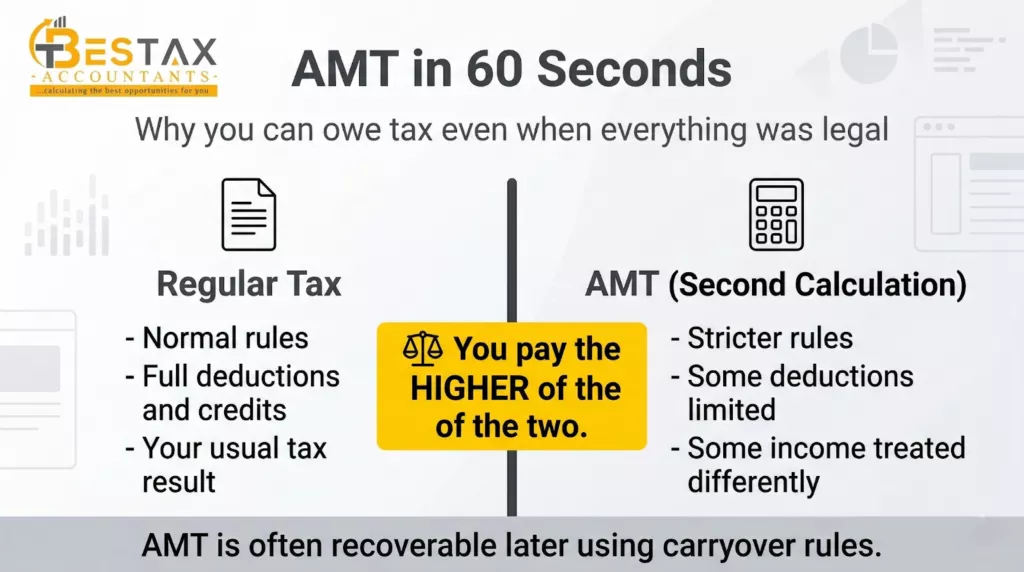
Here is the hook. AMT is a second tax calculation. You pay it only if it comes out higher than your regular tax. In other words, you do your normal return, then AMT runs a second check in the background.
This guide shows you two things most people only learn the hard way. First, how to spot AMT risk before year-end. Second, how to recover AMT later using the carryover rules, so it does not sit there like dead money.
Basics First: What AMT Actually Is and Why it Exists
AMT is not a penalty for doing something wrong. It is a parallel tax system that limits how much certain deductions, credits, and preferential income rules can reduce tax in a single year.
Think of it like this. Regular tax rules reward certain actions, like donations, eligible deductions, or special treatment of some income. AMT rechecks your return with a stricter lens. If you reduced your tax too far under regular rules, AMT may push your tax bill back up for that year.
That is why people ask, “What is AMT?” right after they file. The return looked fine, then the notice came in with an extra amount owing.
The AMT Math in Simple Steps: No Heavy Formulas
AMT calculation feels intimidating because the form is detailed. The logic is simple when you see the flow.
Start with your taxable income, then adjust it to build an “AMT base.” That base is built by adding back or adjusting certain items that get special treatment under regular tax. Next, AMT applies its own rate and exemption rules. Then it limits how much certain credits can reduce AMT. Finally, it compares AMT to your regular tax.
If the alternative minimum tax is higher, you pay AMT. If the regular tax is higher, you pay the regular tax. The full computation lives on the T691, but the decision is always the same: pay whichever is higher.
This is why you will see people call it “alt minimum tax” or “alternate tax.” It is literally an alternate calculation that runs beside your normal one.
What Triggers AMT?
If you want to avoid a surprise, this is the section to read twice. These are common AMT minimum triggers that show up in real returns.
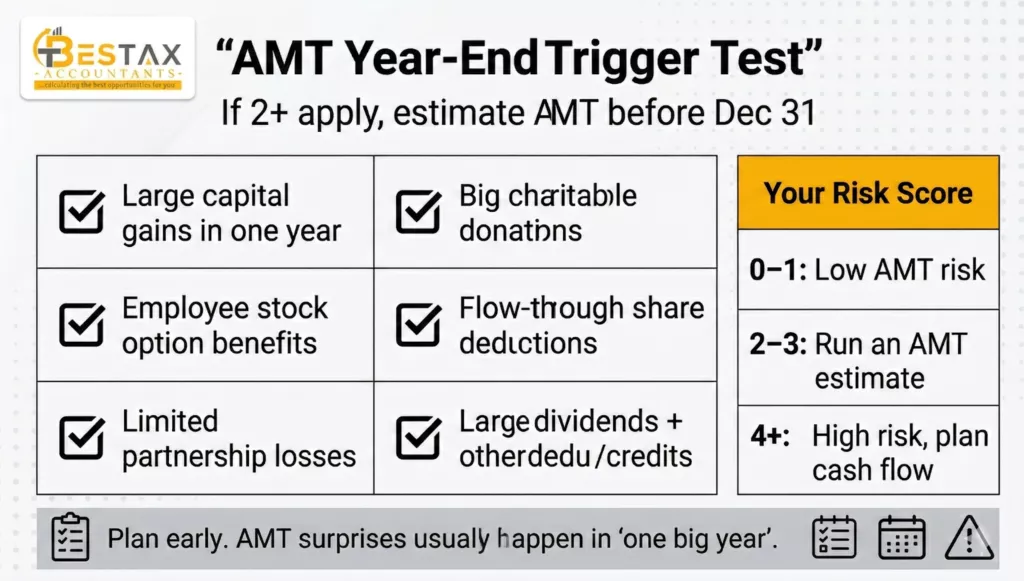
- Large capital gains in one year, especially from a big sale
- Learn how gains feed your tax bill here: capital gains tax in Canada
- Big charitable donations in the same year as a major gain
- Stock option benefits (common in certain jobs)
- Flow-through share deductions
- Limited partnership losses
- Large dividend amounts combined with other preference items
CRA’s minimum tax guidance for the 2025 return (filed in 2026) includes a practical check: if your total is more than $177,882, you may need to complete T691 to confirm whether minimum tax applies.
If two or more triggers apply to you, run an AMT estimate before December 31. That is where planning actually saves money.
2024+ AMT Rules That Still Matter in 2026
AMT got tighter starting in 2024. The important 2026 takeaway is not the fine print. It is the direction of travel.
AMT now catches more “one big year” situations, and the bill can be larger when triggered. That means the old habit of waiting until filing season is riskier than it used to be. If you are planning a major sale, a major donation, or a large stock option event, it is worth running the AMT check early.
The Uniqueness Section: Build an “AMT Recovery Plan”
Most articles stop at “you might owe AMT.” That is only half the story. The other half is whether you can recover it later.
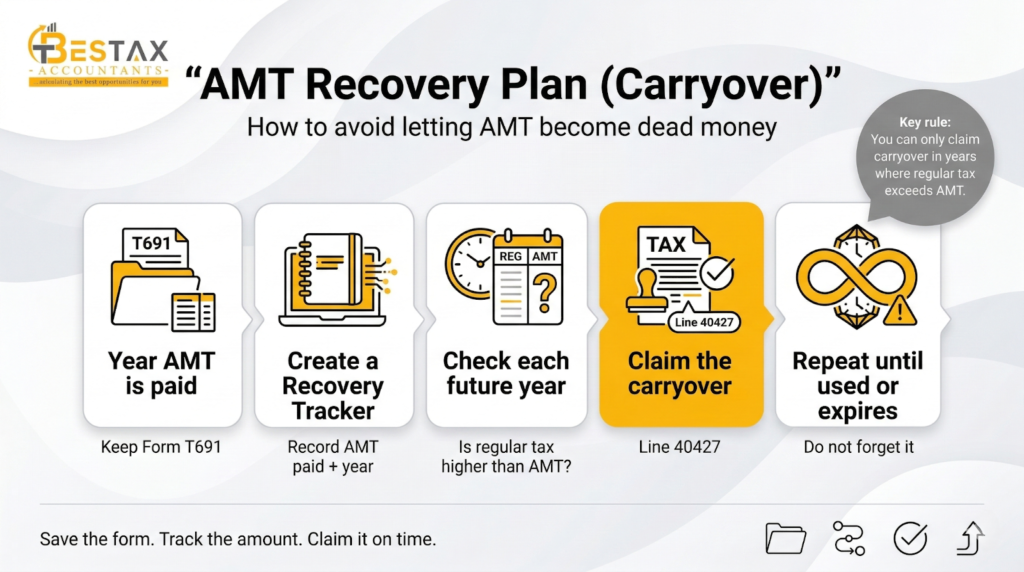
Step 1: Confirm if you paid AMT (and save your T691)
If you file electronically, keep your T691 with your tax records. It is your proof of what triggered the alternative minimum tax and how the carryover was calculated. If you file on paper, it gets attached, but you still want your own copy.
Step 2: Track your carryover like an asset
If you paid AMT, you can claim a minimum tax carryover in a future year. The key rule is simple: you can only claim it in a year when your regular tax exceeds AMT for that future year.
A practical way to manage this is a one-page “AMT Recovery Tracker.” Write the year you paid AMT, the amount, and a reminder to check line 40427 every year until it is used.
CRA’s line 40427 guidance for tax year 2025 explains who may claim minimum tax carryover and points you back to completing T691. It also notes that if you paid minimum tax on returns from 2016 to 2024, and you do not have to pay minimum tax for 2025, you may be able to claim some or all of it.
Step 3: Claim it properly on your return
You calculate the claim using the applicable parts of T691, then enter the result on line 40427. This is where many people miss the recovery, because they forget to claim it in later years.
If you want help filing AMT correctly and tracking carryovers year to year, personal income tax support can keep the paperwork clean and the carryover from getting lost.
AMT Planning Moves That Reduce Surprise Bills
AMT planning is mostly timing, documentation, and expectations. You are not trying to game the system. You are trying to avoid creating one giant “tax preference year” that triggers AMT.
Timing matters. If you control the timing of a sale or a donation, spreading events across tax years can reduce the chance that AMT becomes the higher calculation. This is especially useful when a large capital gain and a large donation occur in the same year.
Donations need planning, too. A large donation can be an excellent move, but it can interact with other items in the same year. If you donate in a year with a major gain, run the AMT estimate first so the cash flow does not surprise you.
Stock options are another common trigger point. If you exercise options, do not assume the tax result will look like “regular income tax only.” Always estimate AMT impact before you commit, especially if the exercise year also includes gains or large credits.
Trusts need extra caution. Some trusts do not get the same exemptions and treatment that individuals expect. If a trust is involved, confirm AMT exposure early and document your assumptions. A good starting read is family trust planning, especially if you are using a trust for long-term structure and distribution planning.
Common Mistakes: What Causes the “Why Am I Paying This?” moment?
These are the patterns that cause the biggest AMT tax surprises.
- Doing a major transaction without running an AMT estimate first
- Assuming large deductions always reduce tax the same way every year
- Forgetting AMT is often felt as a cash-flow shock, because the “big year” is when you need liquidity
- Paying AMT, then not tracking the carryover year to year
- Missing the line 40427 carryover claim later, even when you are eligible
Real-World Scenarios
Scenario 1: You sell investments and have a large one-year gain.
Your regular tax goes up, but AMT can also kick in depending on what else is on your return. Run an AMT estimate before year-end if you can control the sale timing.
Run estimate → decide timing → document → file.
Scenario 2: You claim a large donation in the same year as gains.
The donation helps, but AMT can limit how far your tax drops under the alternate calculation. Estimate first so you can plan cash flow.
Run estimate → decide timing → document → file.
Scenario 3: You exercise employee stock options.
The option benefit can interact with other preference items and credits. Do not assume your employer’s withholding covers the full picture.
Run estimate → decide timing → document → file.
Scenario 4: You claim flow-through or limited partnership amounts.
These can reduce regular tax sharply in one year, which is exactly when AMT may reappear. Track every slip, and do the AMT check early.
Run estimate → decide timing → document → file.
Conclusion
AMT exists to limit how low your tax can drop in certain years. You can still use legal incentives, deductions, and credits, but you need to know when AMT becomes the higher calculation.
The smart play in 2026 is simple: run the year-end trigger test, estimate AMT when two or more triggers apply, and keep an AMT Recovery Tracker so you actually claim the carryover when you can.
Quick If you want help with planning, filing, and carryover tracking, Bestax Accountants can help you stay ahead of AMT instead of reacting after the notice arrives.
Quick FAQs
1) What is AMT and why did I owe it this year?
AMT is an alternate calculation that can override regular tax when certain deductions, credits, or preferential items reduce your regular tax too far. You pay whichever is higher: regular tax or AMT.
2) How do I know if I must complete Form T691?
CRA provides a practical screen on line 41700 for the 2025 return (filed in 2026). If your total is more than $177,882, you may need to complete T691 to confirm whether minimum tax applies.
3) Can I get my AMT back later? How does minimum tax carryover work?
Often, yes. If you paid minimum tax in earlier years but you are not subject to minimum tax in the current year, you may be able to claim some or all of it as a minimum tax carryover. CRA explains the rule and points you to T691 for the calculation.
4) Where do I claim minimum tax carryover on my return?
You calculate it on the relevant parts of T691, then claim it on line 40427 of your return.
5) What should I do before a big capital gain, donation, or stock option event?
Run an AMT estimate before December 31, plan cash flow, and document your numbers. If two or more AMT triggers apply, treat AMT as a real possibility and plan for it early.
Disclaimer: The information provided in this blog is for general informational purposes only. For professional assistance and advice, please contact experts.