


Most “start consulting” guides stop at picking a niche and making a website. That is not what breaks beginners. What breaks a consulting business in Canada is messy onboarding and weak payment protection. You do great work, then scope creeps, timelines slide, and invoices sit unpaid.
So this guide leads with a Deal-Proof Starter Pack: scope, SOW, change orders, invoices, and proof files. Build that early, and you avoid the two things that kill new consultants: scope fights and late payments.
One more reason this matters now: consulting is a real, growing market. Statistics Canada reported $39.9 billion in operating revenue for management, scientific and technical consulting services in 2024, up 6.3% from 2023.
What Consulting Really Is In 2026
A consultant diagnoses the problem, designs the plan, and guides decisions. You often own the outcome and the roadmap. A contractor or freelancer usually executes tasks you assign. The work can be excellent, but the role is different.
Consulting runs on trust, proof, and clear boundaries. Your job is to make the client feel safe saying “yes” and safe paying you on time.
10-Step Beginner’s Guide to Start a Consulting Business
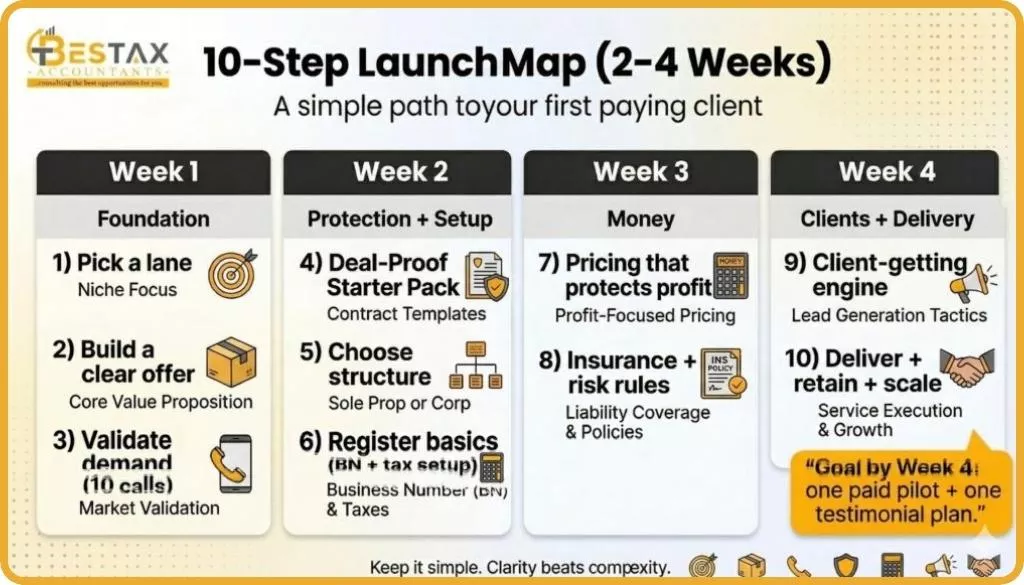
Step 1: Pick a lane with money and urgency
Start narrow. You want one audience and one painful problem. If you try to help everyone, your message gets ignored.
Pick an audience you understand. Then pick a problem they will pay to fix now, not “someday.” Think leads, cash flow, compliance, operations, hiring, customer retention, or reporting.
Write one sentence you can say in 10 seconds:
“I help X do Y without Z.”
If you cannot say it simply, you will struggle to sell it.
Step 2: Turn your skill into an offer people can buy
Beginner consultants often sell “hours.” That is risky because hours invite debates. Sell a result and a clear deliverable.
Build 1–3 offers that match how buyers think: a quick audit, a fix project, and a monthly support plan. Keep each offer tied to a concrete outcome.
Decide what the client receives. Examples include a plan, templates, dashboards, SOPs, training, or weekly check-ins. Proof matters too, even if you are new. Use a small case study, a before/after, or a clean sample deliverable.
Step 3: Validate demand before building anything big
You do not need a fancy site to validate. You need conversations.
Do 10 short discovery calls with your target buyers. Ask what they tried, what failed, what they fear, and what “winning” looks like in numbers.
Then sell a small paid pilot with a fixed scope. Keep it fast and simple. If people will not pay for a pilot, your offer is not clear enough yet.
Step 4: Build the Deal-Proof Starter Pack
This is your signature step. Most beginners skip it, then pay for it later.
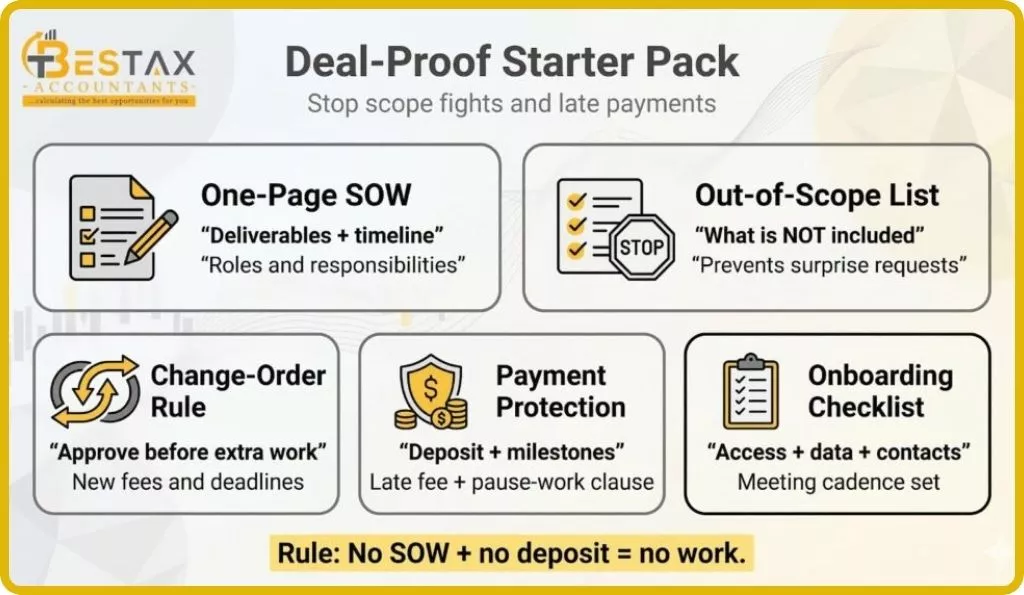
Use this pack to stop scope fights and protect cash flow:
- One-page SOW template: deliverables, timeline, responsibilities
- Out-of-scope list: what you do not do
- Change-order rule: how extra work gets approved and billed
- Payment protection: deposit, milestones, late-fee line, pause-work clause
- Onboarding checklist: access, data, contacts, meeting cadence
When you send a proposal, this pack makes you look organised and serious. It also makes it easier for the client to say yes, because the plan is clear.
Step 5: Choose a structure that fits your risk
You do not need a complicated setup on day one, but you do need a smart one.
A sole proprietorship is simple and low-cost, but it can expose you personally in some situations. A corporation can add admin, but it can help with liability and long-term planning, especially as revenue grows.
Pick a structure based on your risk, your income goals, and how “formal” your clients expect you to be.
Step 6: Register and set up your basics
This is the part many people delay, then regret. Bigger clients and procurement teams often ask for proof you exist as a business.
- First, get a CRA business number.
- Next, decide if and when you must register for GST/HST. If you are unsure, this overview helps you make the call: GST/HST registration in Canada.
- Then set up one invoice format you will use every time. Keep it clean and consistent: business name, address, invoice number, scope reference, due date, and payment terms. Consistency reduces payment delays and client confusion.
Here is why this matters in Canada: most employer businesses are small, and small businesses buy consulting when the offer is clear and the process is easy. In Canada, there were 1.10 million employer businesses as of December 2024, and 98.2% were small businesses.
Step 7: Price in a way that protects profit
Pricing problems usually come from a vague scope. Fix scope first, then price.
Choose a default model that fits your work: fixed project, monthly retainer, or a hybrid. Then build a simple scope ladder so clients understand what they are buying: discovery, strategy, build, support.
Add a minimum engagement fee. It protects your calendar and filters out tiny, messy jobs that eat time and rarely turn into long-term clients.
Step 8: Protect yourself with insurance and risk rules
Consulting is advice. Advice has risk.
At a minimum, understand professional liability or errors and omissions coverage for your niche. If you go onsite, general liability can matter too.
Also set basic data rules: where files live, who has access, how passwords are shared, and what you do if a client sends sensitive info in email. Simple habits prevent big problems.
Step 9: Build a client-getting engine you can repeat
A good marketing plan is boring on purpose. It is repeatable.
Pick one platform where your buyers already spend time. Build one lead magnet that proves your value, like a checklist, a mini-audit, or a calculator. Then follow one weekly routine: outreach, helpful content, follow-ups, and referral asks.
Your goal is not viral fame. Your goal is a steady pipeline of the right people.
Step 10: Deliver, retain, and scale without burning out
Deliver with a simple process: kickoff, weekly updates, clear milestones, and a closeout summary. People pay faster when they see progress.
Ask for a testimonial right after the win, not months later. Then turn one-time wins into retainers, like monthly reporting, quarterly reviews, or support hours.
When you are ready to scale, subcontract the task you dislike most first. Keep delivery quality high by keeping your core thinking work in-house.
Common Mistakes Beginners Make
- Selling hours instead of outcomes
- Starting work without an SOW or change-order rule
- Starting work before a deposit or first milestone payment
- Leaving the project without a written handoff
- Delaying tax setup until year-end
Conclusion
Starting a consulting business is not hard. Running one smoothly is the real skill.
If you build the Deal-Proof Starter Pack early, register properly, and run a repeatable client-getting routine, you will avoid the most expensive beginner mistakes. Your second mention matters too: a consulting business in Canada grows faster when onboarding and billing are clean from day one.
If you want help setting up your structure, registrations, and tax basics the right way, Bestax Accountants can support you so you can focus on delivering great work.
Quick FAQs
Do I need to incorporate to start consulting in Canada?
No. Many consultants start as sole proprietors. Incorporation can make sense later if your income rises, your risk increases, or your clients expect a more formal setup.
When do I need to register for GST/HST as a consultant?
It depends on your revenue and your situation. The safest move is to decide early, then follow one clear rule for invoicing and collecting tax when required.
What should be in a consulting contract or SOW?
At minimum: deliverables, timeline, responsibilities, payment terms, out-of-scope items, and a change-order rule. Clarity prevents disputes.
How do I price my first consulting offer?
Price the result, not the time. Start with a fixed pilot that has a clear scope and deliverables. Then move to a retainer once you prove value.
How do I get my first 3 clients fast?
Talk to your target buyers, run short discovery calls, and sell a small paid pilot. Keep the offer simple, the scope tight, and the next step obvious.
Disclaimer: The information provided in this blog is for general informational purposes only. For professional assistance and advice, please contact experts.