


Line 10100 on your Canadian tax return is where you report your total employment income for the year, your salary, wages, tips, commissions, bonuses, gratuities, and honoraria. For most people, it is simply the total of the amounts shown in box 14 of every T4 slip they received from an employer.
If you have ever opened your tax return and felt lost in a sea of five-digit line numbers, you are not alone. We are here to break it down for you.
What Is Line 10100?
Line 10100 is the employment income line on the T1 Income Tax and Benefit Return, the form every Canadian individual uses to file taxes. It captures the money you earned through work as an employee.
According to the CRA, employment income consists of amounts you receive as salary, wages, commissions, bonuses, tips, gratuities, and honoraria, and this income is usually shown in box 14 of your T4 slip.

If you filed taxes before 2019, you may remember this as Line 101. The CRA expanded its three-digit line numbers to five digits, so the old Line 101 became Line 10100. The meaning did not change, only the number got longer.
Think of line 10100 as the starting point of your return. It is one of the first income figures you enter, and it feeds into the bigger totals the CRA uses to calculate what you owe or what you get back.
What Income Goes on Line 10100?
The simplest answer: add up box 14 from all of your T4 slips and report the total on line 10100. Box 14 is literally labelled "Employment income," and the CRA's T4 guidance directs you to enter that exact amount on line 10100.
The income types that fall under line 10100 include:
- Salary and wages: your regular pay from a job
- Commissions: also reported separately on line 10120, but already included in box 14
- Bonuses: performance or year-end bonuses from your employer
- Tips and gratuities: when they appear on your T4
- Honoraria: token payments for services, such as serving on a board
If you worked more than one job during the year, you will receive a T4 from each employer. You add together box 14 from every slip and enter the combined figure on line 10100.
Where Is Line 10100 on Your Tax Return (and Where to Find It)?
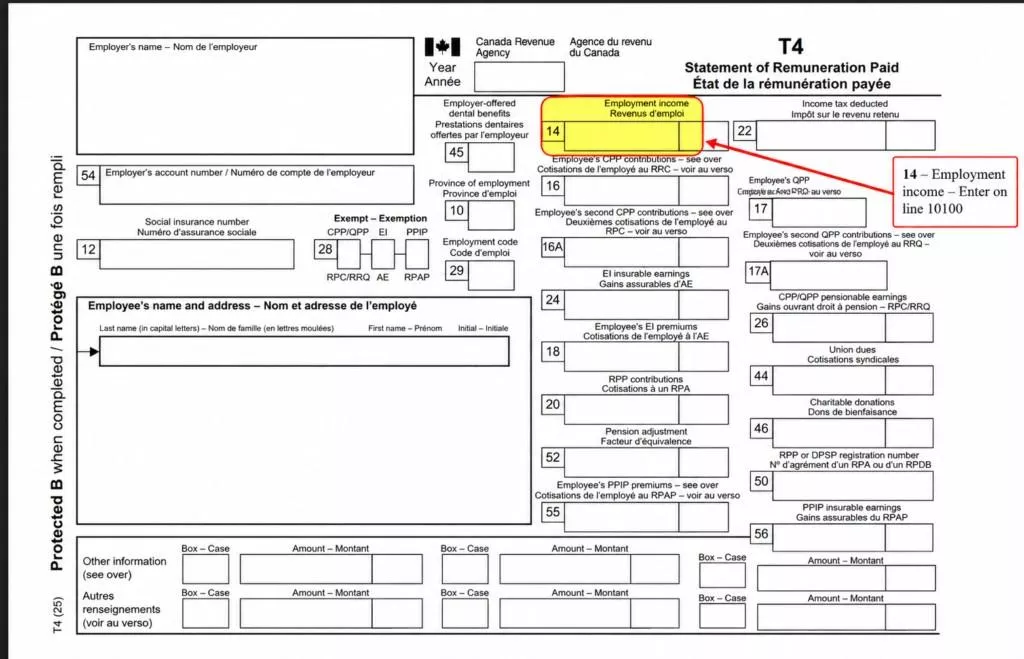
This is one of the most common questions taxpayers ask, so here is the short version:
- On your tax return: Line 10100 appears in the "Total income" section (Step 2) of the T1 return. It is one of the very first income lines.
- On your T4 slip: The number you need is in box 14, labelled "Employment income/ Revenus d'emploi”.
If you have a single T4, finding your line 10100 amount is as easy as reading box 14. If you have several T4s, you total all of their box 14 amounts. If you cannot find a slip, you can usually retrieve copies of your T4s through your CRA My Account, since the CRA receives a copy from your employer.
If you do not receive your T4 by early April, or you have a question about an amount on a slip, the CRA advises you to contact your employer directly.
Special Situations That Affect Line 10100
Most employees just copy box 14 and move on. But a few situations change how you complete this line. Here are the ones the CRA highlights.
Emergency Services Volunteers
If you volunteered as a firefighter, ambulance technician, search and rescue volunteer, or other emergency worker, the T4 issued to you generally shows only the taxable part of your payment in box 14, the part that is more than $1,000. The exempt portion appears in box 87.
If you qualify, you may instead claim the $6,000 volunteer firefighters' amount (VFA) or the search and rescue volunteers' amount (SRVA). The CRA notes that if you are eligible for both the $1,000 exemption and the VFA or SRVA, you must choose one, you cannot claim both.
Security (Stock) Option Benefits
If you bought securities through your employer below fair market value, you report the taxable benefit on line 10100. For 2025, you report the taxable benefits you received in (or carried forward to) 2025 on certain security options you exercised.
Wage-Loss Replacement Plan (WLRP) Income
If box 14 includes payments from a wage-loss replacement plan, you may not have to report the full amount. The CRA allows you to report the WLRP income you received minus the contributions you made to the plan that you did not use on a previous year's return.
Members of the Clergy
If you received a clergy housing or eligible-utilities allowance, the CRA's line 10100 instructions explain how to adjust your box 14 amount before reporting it, with the allowance portion reported on line 10400. Because this is a specialized situation, and because how the allowance appears on your slip can vary, it's worth confirming the figures with the slip issuer or a tax professional before you file.
Line 10100 vs. Line 15000 vs. Line 10400: Clearing Up the Confusion
These three lines trip people up constantly. Here is the difference in plain terms:
- Line 10100 – Employment income. Your T4 box 14 earnings only.
- Line 10400 – Other employment income. Employment income not on a regular T4, such as tips and gratuities not shown on a T4, foreign employment income, royalties for a work or invention, supplementary unemployment benefits, and certain T4A amounts.
- Line 15000 – Total income. Your grand total of all income from every source, which builds on line 10100 and the other income lines.
A helpful way to picture it: line 10100 is a single ingredient (your job income), and line 15000 is the finished dish (everything combined). If your only income is from one employer, your line 10100 and line 15000 figures may be identical. The more income sources you have, the more they diverge.
Note that fees for services in box 048 of a T4A slip are not employment income, those generally go on the self-employment lines (13499 to 14300), not line 10100.
"I Don't Have a Line 10100 on My Tax Return", What Now?
If line 10100 is blank or missing, it usually means one of the following:
- You had no T4 employment income this year. If you were self-employed, your earnings are reported on the business/self-employment lines and Form T2125 instead, not on line 10100. The CRA is explicit that certain self-employment amounts, such as those for taxi drivers, barbers, hairdressers, and placement-agency workers, should not be entered on line 10100 (CRA, 2026c).
- Your employment income was "other" income. Tips with no T4, foreign employment income, and similar amounts belong on line 10400, not line 10100.
- You have not filed yet. Line 10100 only appears once you complete the income section of your return.
So a missing line 10100 is not necessarily an error, it often just means your income came from somewhere other than a standard T4 job.
Don't Forget Line 22900: Employment Expenses Tied to Your Job
If you are an employee who had to pay for work-related expenses your employer required (and did not reimburse), you may be able to deduct them on line 22900, which directly reduces the income flowing through from line 10100. Most employees cannot claim these, and you generally need a signed Form T2200 from your employer.
A few figures the CRA confirmed as new for the 2025 tax year show how these limits are adjusted over time:
- The maximum capital cost for a passenger vehicle in Class 10.1 is $38,000 before tax (CRA, 2026d).
- Deductible leasing costs rose to $1,100 per month before tax for new leases entered into on or after January 1, 2025.
- The maximum tradesperson's tools deduction is $1,000, calculated against a $1,471 income threshold.
- Long-haul truck drivers can deduct 80% of eligible meal costs during eligible travel periods, versus the standard 50% for other transport employees.
The takeaway for beginners: line 10100 reports what you earned, and line 22900 is one of the few places employees can deduct what they spent to earn it.
Common Mistakes to Avoid With Line 10100
- Forgetting a T4. If you held multiple jobs, every box 14 must be added together. Missing one understates your income.
- Confusing it with total income. Line 10100 is employment income only, not your full income picture (that's line 15000).
- Putting self-employment income here. Business and freelance income belongs on the self-employment lines and Form T2125, not line 10100.
- Reporting amounts already in box 14 twice. Several T4 "Other information" boxes (such as boxes 30, 32, 34, 36, 38, 40) are already included in box 14 and should not be added again.
Get Line 10100 Right With Bestax
Employment income looks simple until a stock-option benefit, a wage-loss plan, or a second T4 enters the picture, and a small error on line 10100 can ripple through your entire return. That is where professional help pays off.
Bestax Accountants is a Mississauga-based accounting firm with over a decade of combined experience serving individuals and businesses across Canada. Clients consistently describe the experience the way one reviewer, Kim Angelo, put it:
“the process was easier than expected, everything was explained in plain language with no jargon, and the filing was done on time”
Our personal income tax specialists make sure your T4 income, deductions, and credits are reported accurately so you keep more of what you earn and stay fully compliant with the CRA.
Ready to file with confidence? Visit bestax.ca to book a free consultation today.
Quick FAQs
Line 10100 is the line on your T1 return where you report your total employment income for the year, salary, wages, tips, commissions, bonuses, and honoraria. For most people it equals the total of box 14 from all their T4 slips.
Yes. Line 10100 is specifically your employment income, which is usually shown in box 14 of your T4 slip. Other kinds of income go on different lines.
You'll find line 10100 in the "Total income" section (Step 2) of the T1 Income Tax and Benefit Return. The amount itself comes from box 14 of your T4 slip.
Add together the box 14 amounts from every T4 slip you received and enter the combined total on line 10100.
Line 10100 is only your employment income from your T4s. Line 15000 is your total income from all sources combined. If a job is your only income, the two numbers can be the same; if you have other income, line 15000 will be higher.
Line 15000 is your total income, the sum of all your income before deductions. It builds on line 10100 plus any other income you report.
No. Line 15000 does not appear on a T4. Your T4 shows employment income in box 14 (which goes on line 10100). Line 15000 is a calculated total that appears on your completed tax return and your Notice of Assessment.
That figure is the total income on your most recent assessed return. You can find it on your tax return or your Notice of Assessment. The CRA's sign-in process generally accepts the line 15000 amount from one of your last two tax years.
A blank line 10100 usually means you had no standard T4 employment income for example, if you were self-employed (reported on Form T2125) or your earnings were "other employment income" reported on line 10400 instead.
No. Self-employment and business income are reported on the self-employment lines (13499 to 14300) using Form T2125, not on line 10100.
Line 10100 is employment income shown on a T4. Line 10400 is other employment income not on a regular T4, such as tips without a T4, foreign employment income, and royalties for a work or invention.
Yes. If you report employment income on line 10100, you can claim the Canada employment amount on line 31260 of your return.
Disclaimer: The information provided in this blog is for general informational purposes only. For professional assistance and advice, please contact experts.

