


You checked your T4 slip and your reported income is higher than what actually landed in your bank account all year. That is not a printing error. What you are looking at is a taxable benefit, a dollar value your employer added to your reported income for a perk you received outside of your regular paycheck. This catches thousands of Canadian employees off guard every single year, and most of them only find out when their tax return looks different from what they expected. Getting a clear picture of how taxable benefits in Canada work, on both sides of the employment relationship, is one of the most useful things you can do before tax season arrives. This guide walks through what taxable benefits are, how CRA decides when something qualifies, how the reporting process works, and what it all means for your return.
What Are Taxable Benefits in Canada?
Simple Meaning of Taxable Benefits
A taxable benefit is any item of value your employer provides that is not a regular cash wage. It is extra compensation delivered outside of your paycheck, and CRA treats it as part of your employment income. Taxable benefit, meaning, at its core, comes down to one idea: if your employer covers a personal cost that you would otherwise pay out of your own pocket, that coverage generally counts as income in the eyes of CRA.
Think of it this way. If your employer pays your gym membership, you are not spending that money yourself. CRA considers that income, value you received because of your job, and it gets added to your overall tax picture for the year.
How Taxable Benefits Affect Income and Taxes
When a taxable benefit is added to your pay, it raises both your gross income and your taxable income, even though you never received extra cash. Higher reported income means more income tax withheld through payroll deductions, adjustments to your Canada Pension Plan contributions, and a larger number showing up on your T4 slip at the end of the tax year.
A detail that confuses many employees is what box 40 is on T4. Box 40 is where your employer reports the total dollar value of taxable benefits you received during the year. It is not extra pay you missed. It is the value of those benefits, recorded so CRA can include them in your total reported income.
Why Both Sides Need to Understand This
Employees need this knowledge because a T4 showing more income than expected often results in a larger tax bill or a smaller refund. For employers, the responsibility is heavier. CRA holds them accountable for calculating, tracking, and reporting each taxable benefit correctly throughout the year. Wrong reporting leads to payroll adjustments, CRA reassessments, and corrections that take real time to fix.
Benefits, Allowances, and Reimbursements Explained
What Counts as an Employee Benefit
Employee benefits cover a broad range of employer-provided items: group insurance plans, life insurance premiums, company vehicles, employer-paid housing, and similar perks. These are fringe benefits, compensation that sits on top of your salary, even if you never see it arrive in your bank account. Compensation benefits like these make up a larger portion of total pay packages than most employees realize, and their tax treatment varies depending on the type and structure.
What Are Allowances
An allowance is a fixed amount your employer pays you to cover a specific type of expense, a monthly car allowance, a daily meal allowance during travel, or a remote work stipend. Allowances are generally taxable unless CRA has a specific rule that excludes them. One common exception is a reasonable per-kilometre reimbursement for business driving, which CRA treats differently from a flat cash allowance.
What Are Reimbursements
A reimbursement happens when you pay a work-related expense first, and your employer pays you back afterward. In most cases, genuine business expense reimbursements do not create taxable income because you are simply recovering a cost you already paid. But if the expense served a personal purpose rather than a business one, CRA may still consider the reimbursement taxable.
Why This Difference Matters for Taxable Income
The tax result depends entirely on how the payment is structured. An employer paying for your personal gym membership directly is a taxable benefit. Reimbursing you for a work phone used entirely for business may not be. CRA looks at whether the cost served the employee personally or the business operationally, and the answer is what determines taxable or non-taxable benefit treatment.
How CRA Decides If a Benefit Is Taxable
The CRA Test
CRA applies three questions when determining whether a benefit triggers benefit taxation. First, does it give the employee a personal economic advantage? Second, can its value be measured in dollars? Third, was it received because of the employment relationship? When all three answers are yes, the benefit is taxable.
Is the Employee Receiving a Personal Advantage?
If the benefit primarily serves the employee personally, not the business, CRA treats it as part of their compensation. A company laptop used only at the office sits in a grey area. A vehicle you drive every weekend for personal trips does not. The personal use is the trigger.
Is the Value Measurable in Money?
A benefit must have a dollar figure that can be established. Group insurance premiums have a known premium cost. That cost is measurable, and CRA expects it to be included in the employee’s reported income. If a benefit cannot be valued, it is harder to tax, but most common workplace benefits have a clear monetary equivalent.
Is It Part of Employment Compensation?
CRA also asks whether the employer is providing the benefit specifically because of the employment relationship. If the answer is yes, it is considered compensation. Taxable employee benefits are treated no differently from wages when it comes to reporting requirements. The label the employer uses does not change the tax outcome, only the nature of what is being provided.
Why One Benefit May Be Taxable and Another May Not
Context determines everything. The same item, a meal, a parking spot, a phone plan, can be taxable or non-taxable depending on why it was provided, how it was structured, and who primarily benefits from it. This is the part where most confusion happens, and where professional guidance tends to offer the most practical value.
The 4-Step Process for Taxable Benefits
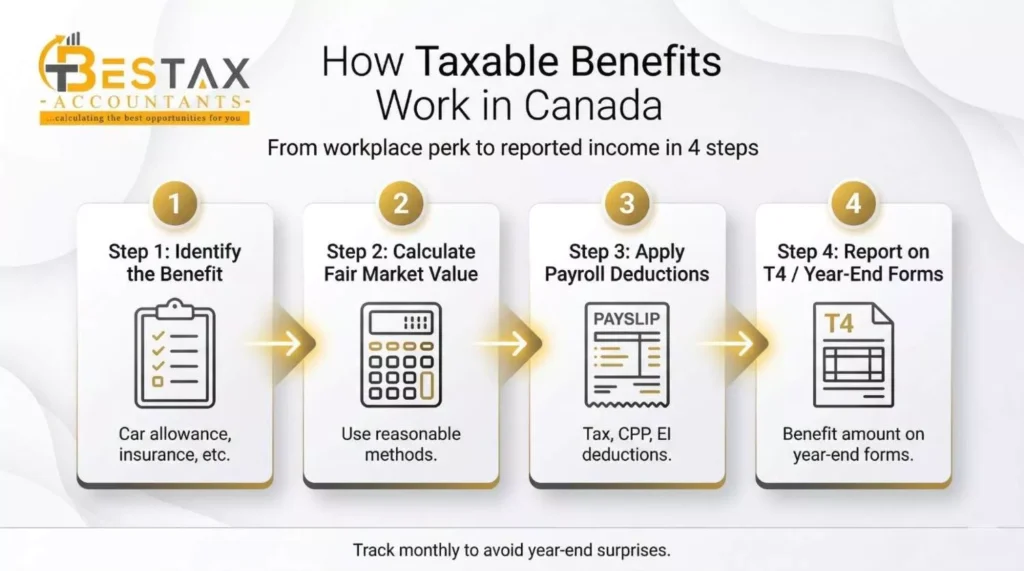
Step 1: Identify the Benefit
List every non-wage item provided to employees: vehicles, insurance, parking, gifts, loans, housing support, and similar. If an employer pays for something an employee would otherwise pay for personally, it belongs on this list. Starting with a complete inventory is the only way to make sure nothing gets missed.
Step 2: Calculate the Value
CRA requires fair market value as the starting point, what the benefit would cost the employee if they paid for it themselves. For vehicles, this means applying CRA’s standby charge formula. For loans, it uses the prescribed interest rate set each calendar quarter. This is the step where most reporting errors begin, and where accuracy matters most.
Understanding how benefit values connect to payroll deductions and source withholding is covered in detail in this resource on how to calculate payroll taxes in Canada.
Step 3: Apply Payroll Deductions and Taxes
Once the value is established, the employer adds it to the employee’s gross income and withholds income tax, CPP contributions, and EI premiums accordingly. These source deductions run through regular payroll cycles. The benefit value goes through the system exactly like a regular wage, the only difference is that no extra cash changes hands.
Step 4: Report It on Year-End Forms
At year-end, the employer reports the taxable benefit on the employee’s T4 slip. Box 40 captures the total taxable benefit value for the year. The employee then carries that income figure into their personal tax return. Any shortfall in withholding during the year, amounts that should have been deducted but were not, shows up as taxes owing when the return is filed.
Why This Process Matters for Employers and Employees
Employers who track benefits monthly and apply deductions at each pay period avoid year-end scrambles and T4 corrections. Employees who understand the four-step process are less likely to be caught off guard when their refund is smaller or their balance owing is larger than they planned for.
Types of Taxable Benefits in Canada
Group Insurance and Life Insurance Premiums
Employer-paid group life insurance premiums are among the most frequently missed taxable items. If your employer pays the premiums on a group term life policy on your behalf, that premium value is generally added to your income for the year. Health and dental premiums may also be taxable depending on the province and how the plan is structured.
As outlined in CRA’s Employers’ Guide – Taxable Benefits and Allowances (T4130), group term life insurance premiums must be reported as employment income in the year they are paid. This is one of the more frequently mishandled items in employer payroll submissions, and it often goes unnoticed until a CRA review surfaces.
Personal Use of a Company Vehicle
Using an employer’s vehicle for personal travel creates a taxable benefit every year it happens. CRA calculates this using two amounts: a standby charge for having the vehicle available and an operating cost benefit based on personal kilometres driven. Both figures get added to the employee’s income.
Parking, Meals, and Housing Support
Employer-provided parking at a commercial lot has a market value, and that value is taxable when the employer covers it. Free or subsidized meals may also be taxable depending on how the arrangement is structured. Housing provided directly by an employer, or a housing allowance paid on behalf of an employee, is taxable in nearly every situation CRA encounters.
Gifts, Awards, and Near-Cash Items
CRA allows employers to give non-cash gifts of up to $500 per employee per year without triggering taxable income. Any amount above that threshold becomes taxable. Near-cash items, gift cards, vouchers, or certificates, are treated the same as cash by CRA. There is no minimum threshold below which a gift card becomes non-taxable, regardless of the dollar amount or the reason it was given.
Low-Interest and Interest-Free Loans
If an employer provides a loan at a rate below CRA’s quarterly prescribed rate, the difference between what the employee pays and the prescribed rate counts as a taxable benefit. This applies to home purchase loans, investment loans, and general employee financing arrangements. The tax consequences apply each year the loan is outstanding, not just in the year it is issued.
Other Common Taxable Benefits Examples
Other items that regularly appear on the taxable benefits list in Canada include employer-paid professional memberships used for personal purposes, travel benefits extended to family members of employees, subsidized access to recreational facilities, and certain education payments not tied to the employee’s current job duties. Each carries its own CRA treatment, and the details matter more than the category label.
Non-Taxable Benefits in Canada
When a Benefit May Be Non-Taxable
Not every employer-provided item leads to additional tax. CRA has specific rules that allow certain benefits to sit outside of employment income, but documentation is always required. Treating something as non-taxable without being able to support that treatment is a risk, not a strategy.
Health and Medical Support That May Not Be Taxable
Private health services plan premiums are generally excluded from taxable income in most Canadian provinces when the employer pays them. Employer contributions to a registered pension plan are also excluded. These two items make up a significant portion of the non-taxable income benefits that Canadian employees receive through their workplace.
Work-Related Reimbursements and Business Expenses
Reimbursements for genuine business costs, client-related expenses, work travel, or equipment used entirely for work, are generally not taxable when documented properly. The test is whether the employee is recovering a business cost or receiving a personal benefit. When it is purely business, the reimbursement does not create income.
Some Gifts and Awards Under CRA Policy
Non-cash gifts within the $500 annual limit, along with non-cash long-service awards and safety recognition awards within their own $500 thresholds, may be non-taxable. Once the total value across all categories exceeds those limits, the excess amount becomes part of taxable employment income.
Special Cases and Exceptions
Some benefits fall under narrow CRA exceptions that apply only in specific circumstances. A partial list of non-taxable benefits in Canada that commonly come up includes:
- Employer contributions to a registered pension plan (RPP)
- Private health services plan premiums in most provinces
- Non-cash gifts within the CRA annual $500 threshold
- Genuine business expense reimbursements with documentation
- Job-related training directly tied to the employee’s current role
- Certain transportation subsidies for employees at remote work locations
These exceptions are narrow. The conditions must be met exactly for non-taxable treatment to apply.
Cash, Near-Cash, and Non-Cash Benefits
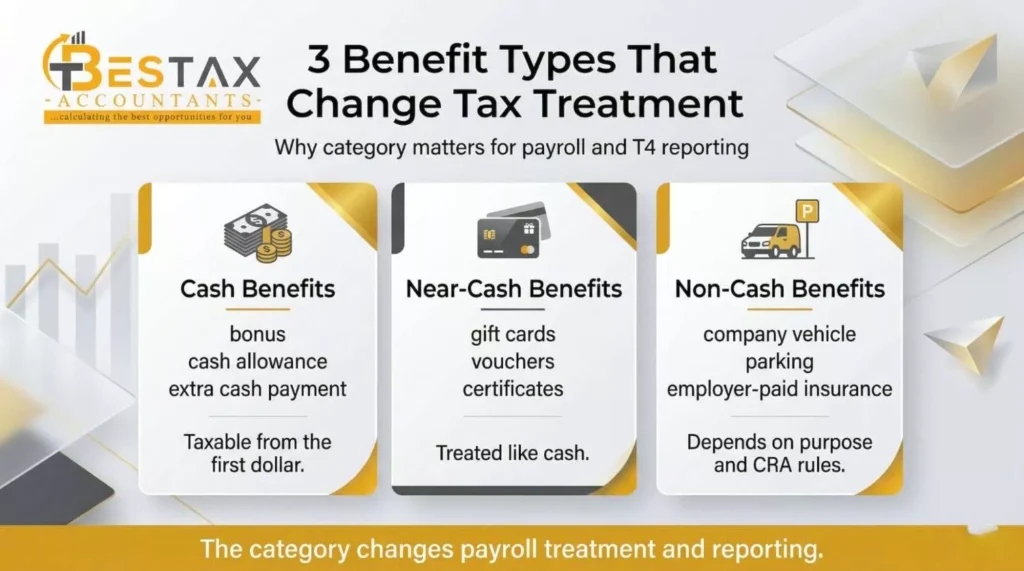
Cash Benefits
Cash benefits, bonuses, cash allowances, extra payments made outside of regular wages, are always taxable and always flow directly into employment income. There is no formula to apply and no threshold to consider. Cash is income from the first dollar.
Near-Cash Benefits
Near-cash benefits are items that can be quickly exchanged for cash or used identically to cash, gift cards, gift certificates, and securities. CRA treats these exactly the same as cash. The amount does not matter. A $25 gift card is a taxable near-cash benefit just as much as a $500 one, and the same CRA rule applies to both.
Non-Cash Benefits
Non-cash benefits are physical goods or services provided by an employer: a vehicle, a parking spot, employer-paid insurance, or travel coverage. Whether a non-cash benefit is taxable depends on the personal-versus-business purpose, the dollar value, and any specific CRA policy that governs that particular type of benefit.
Why the Type of Benefit Changes the Tax Treatment
Cash, near-cash, and non-cash items are calculated differently, flow through payroll differently, and land in different T4 boxes. Treating a near-cash gift card as a non-cash benefit, or assuming a non-cash item automatically escapes taxation, is one of the most consistent sources of payroll errors that attracts CRA scrutiny.
How Taxable Benefits Affect Employees
Many employees first notice something is off when their tax return comes back with a balance owing they were not expecting, or a refund that is smaller than it was the previous year. In most cases, the explanation is the same: taxable benefits were included in the T4 income, and not enough tax was withheld during the year to cover the added amount.
This happens most often with non-cash benefits, company vehicles, low-interest loans, and group insurance premiums, where the value is calculated at year-end rather than tracked and withheld month by month. By February, the T4 shows higher income than the employee knew about. By April, the shortfall becomes a tax bill.
How They Change Taxable Income
Every taxable benefit added to a T4 increases total reported income. That increase can move an employee into a higher marginal tax bracket, reduce the size of an expected refund, or turn a break-even return into a balance owing. The amount may seem small per pay period, but it accumulates over a full year.
How They Affect Payroll Deductions and Take-Home Money
Payroll deductions are recalculated when a taxable benefit is included in gross pay. CPP contributions, EI premiums, and income tax withholding are all calculated on the expanded income amount. That can reduce the take-home portion of regular cash wages even though no extra cash was paid to the employee.
How They Appear on Forms and the Tax Return
Box 40 of the T4 shows the total value of taxable benefits for the year. That number is already embedded in the Box 14 employment income total, employees do not add it again on their personal return. But knowing what is in Box 40 helps explain why Box 14 is larger than salary or hourly wages alone.
Why Employees Are Often Surprised at Year-End
The benefit felt like a work perk, not income. Nobody hands the employee cash. The gym membership is just there. The parking spot is just available. That mental disconnect is why understanding how taxable benefits Canada applies to real employment situations matters throughout the year, not just in April when it is too late to adjust withholding.
Employer Responsibilities for Taxable Benefits in Canada
Employers carry the primary responsibility for benefit taxation compliance throughout the year. CRA does not expect a December scramble. It expects real-time tracking, accurate calculations, and correct source deductions applied at each pay period. When tracking falls behind, the result is guesswork, and guesswork leads to T4 corrections and, sometimes, payroll audits.
Tracking Benefits During the Year
Each benefit type requires its own record-keeping. Vehicle use logs, insurance premium invoices, loan balances, and housing payment records all need to be maintained from the date the benefit begins. Gaps in tracking compounds over time make year-end reporting harder than it needs to be.
Calculating the Right Amount
Different benefits have different CRA-approved formulas. Using the wrong calculation method, or applying a reasonable estimate instead of the required method results in under-reporting or over-reporting. Both outcomes carry compliance risk, and CRA’s matching systems are designed to flag T4 amounts that fall outside expected ranges.
Applying Deductions Correctly
Once a benefit’s value is set, it flows through source deductions alongside regular wages. Income tax, CPP, and EI calculations must include the benefit amount at each pay period. Skipping this step means the employee ends up with a year-end shortfall, and CRA holds the employer responsible for correcting the withholding record.
Reporting on Forms and Avoiding Payroll Mistakes
Year-end T4 preparation is where errors become visible. Each benefit type has a specific reporting box on the T4. An amount reported in the wrong box, or a benefit omitted entirely, creates a discrepancy that CRA’s matching systems will surface.
According to Statistics Canada, Canada’s total employed workforce has exceeded 20 million in recent years, which means the volume of T4 slips filed each year nationally is enormous. CRA processes all of them, and its automated matching is built to find inconsistencies at scale.
Getting Expert Support When Benefit Treatment Is Unclear
When the right treatment for a benefit is genuinely unclear, unusual compensation arrangements, cross-provincial situations, or complex vehicle use calculations, getting outside input before filing is far better than correcting it after a CRA notice arrives.
Businesses managing multiple employee benefit types benefit from working with professionals who offer payroll services in Canada and understand how to apply CRA rules accurately to real-world payroll situations.
How to Calculate Taxable Benefit in Canada
What Value Should Be Used
The starting point is always fair market value, the amount the employee would pay to receive the same benefit from an independent provider. For benefits where the employer negotiated a group rate, fair market value may still be the retail rate rather than the negotiated one, depending on the benefit type and CRA’s specific guidance for it.
What Deductions May Apply
If the employee contributes toward the cost of the benefit, pays a portion of a parking fee, or contributes to an insurance premium, that payment reduces the taxable value. Only the net amount (fair market value minus what the employee paid) is the taxable benefit. Employer and employee contributions must be tracked separately.
A Simple Taxable Benefits Example
Your employer provides a parking space at a commercial lot worth $220 per month. You pay $45 per month for it. The taxable benefit is $175 per month, or $2,100 for the year. That amount gets added to your income each pay period and runs through source deductions the same way regular wages do.
Why a Taxable Benefits Canada Calculator Can Only Give Estimates
Online tools marketed as a taxable benefits Canada calculator can help with rough planning numbers, but they cannot replace the actual CRA formulas required for payroll reporting. Vehicle benefit calculations involve standby charge rates tied to the original cost of the car and the percentage of personal use. Loan benefit calculations use CRA’s quarterly prescribed rate. These are regulatory requirements, not approximations, and the numbers must reflect the correct formula each time.
Common Mistakes With CRA Taxable Benefits
Mixing Up Benefits and Allowances
A flat monthly car allowance is taxable income, full stop. A per-kilometre reimbursement at CRA’s approved rate is not. They look similar, but they are treated completely differently under CRA rules. Treating them the same leads to both under-reporting and over-reporting, and either direction creates a problem.
Assuming Every Employee Benefit Is Tax Free
Group life insurance premiums, health plan contributions in certain provinces, and employer-paid parking at commercial lots are regularly treated as non-taxable when they are not. The assumption that benefits are perks rather than income is the most common reason for T4 errors that require correction.
Forgetting to Track Life Insurance Premiums or Group Insurance
Group insurance benefits are one of the most frequently missed items on T4 slips across all employer sizes. Because the premium is paid by the employer directly to the insurance carrier, it never appears on a pay stub, which means it is easy to forget. That does not make it non-taxable.
Using the Wrong Amount or Form
Reporting a benefit in the wrong T4 box, or using an estimated value instead of the CRA-required formula result, creates a discrepancy that CRA’s automated systems are built to detect. The right amount in the wrong box is still a reporting error. It needs to be corrected just the same as the wrong amount.
Waiting Until the End of the Tax Year
Taxable benefits should be tracked monthly, not calculated all at once in December. When employers delay the tracking, the withholding gap for the full year becomes a large correction at year-end. For employees, that means a larger-than-expected tax bill in April. For employers, it means amended T4s, potential interest, and administrative time that could have been avoided.
A Simple Checklist for Employees and Employers
Employee Checklist
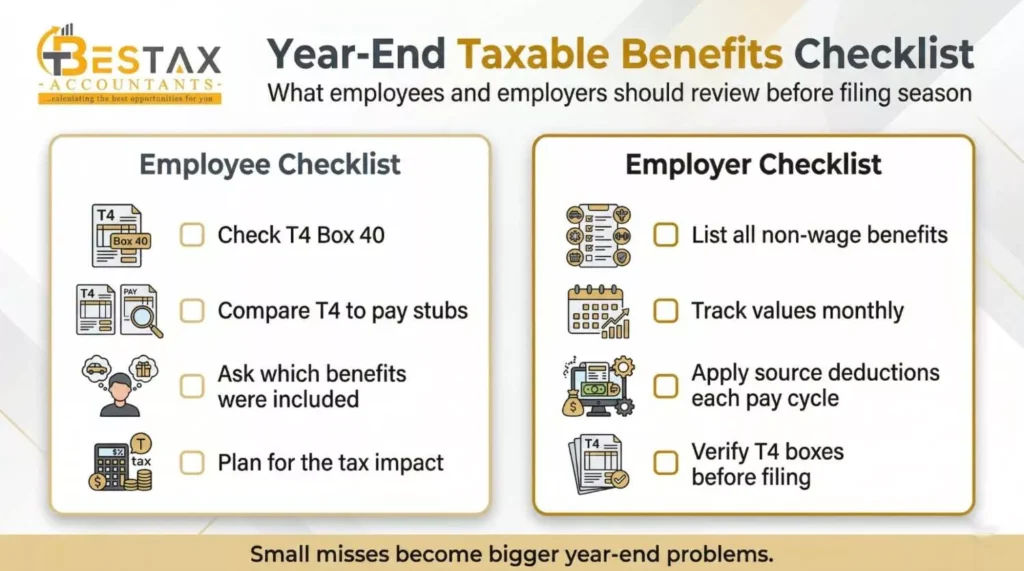
- Check your T4 each year and look at Box 40 for the total reported taxable benefit value
- Compare your total T4 employment income to your pay stubs for the year to understand the difference
- Ask your employer’s HR or payroll team what benefits were included and what value was reported
Employer Checklist
- List all non-wage benefits provided to each employee at the start of the tax year
- Track benefit values monthly and apply source deductions at each regular pay cycle
- Verify all benefit amounts and T4 box assignments are accurate before submitting year-end slips to CRA
When to Get Professional Advice
For Employers Handling Multiple Benefit Types
When a business provides vehicles, group insurance, housing support, and loans across a workforce with different employment arrangements, the reporting requirements multiply quickly. One missed vehicle log entry or one misclassified insurance premium can lead to a full payroll review. Getting advice before year-end, not after receiving a CRA notice, is where professional input has real value.
For Employees With Unusual Compensation or Reporting Questions
If you received a relocation package, employer-paid housing, a low-interest loan, or other forms of unusual compensation during the year, reviewing your return before filing is time well spent. CRA can reassess prior tax years, and correcting a return after the fact takes more paperwork and more time than getting it right the first time.
Why Accurate Planning Matters Before Filing the Return
An employee who knows their company car adds $3,200 to their reported income can plan for that throughout the year, adjust voluntary withholding, contribute to an RRSP, or simply set money aside. An employee who finds out in April cannot. The same logic applies to employers managing remittance schedules. Financial planning around taxable benefits works best when it happens before year-end, not after.
Conclusion
Taxable benefits in Canada are not just background details on a T4. They affect reported income, payroll deductions, year-end tax calculations, and CRA compliance for everyone involved. When employees understand what counts as a taxable benefit and why it appears on their T4, the year-end picture stops being a surprise. When employers track and report these benefits correctly throughout the year, payroll stays clean, and compliance becomes routine.
If you are looking for experienced support with taxable benefit reporting, payroll compliance, and year-end T4 preparation, Bestax Accountants offers accurate, practical help for both businesses and individuals. Their team works with CRA requirements year-round and can make sure your payroll and tax filings reflect exactly what the rules require.
Frequently Asked Questions
1. What is considered a tax benefit?
A tax benefit is any non-wage item provided by an employer that has a measurable monetary value and gives the employee a personal advantage. This includes employer-paid insurance premiums, personal use of a company vehicle, housing allowances, low-interest loans, and gift cards. CRA considers all of these part of employment income for the year in which they are received.
2. What tax benefits can I claim in Canada?
This question typically refers to personal tax credits and deductions, RRSP contributions, medical expenses, tuition, or the basic personal amount, rather than workplace taxable benefits. Employment benefits provided by an employer are added to income, not claimed as deductions. The two operate on different parts of the tax return and serve different purposes.
3. What is the tax-free benefit in Canada?
Some employer-provided items fall outside of taxable income under CRA rules. These include private health services plan premiums in most provinces, employer contributions to a registered pension plan, non-cash gifts within the $500 annual threshold, and genuine business expense reimbursements. Documentation is required in all cases to support the non-taxable treatment.
4. How to calculate taxable benefits in Canada?
Start with fair market value, what the benefit would cost the employee if they paid for it directly. Subtract any employee contribution toward the cost. The remaining amount is the taxable benefit, added to income and processed through source deductions. Each benefit type has its own CRA-approved formula. Vehicles use the standby charge method; loans use the quarterly prescribed interest rate; most other benefits use fair market value directly.
5. How do tax benefits work?
Taxable benefits work by converting non-cash compensation into reported employment income. The employer calculates the benefit’s value, includes it in payroll, withholds the required income tax, CPP, and EI, and reports the total on the employee’s T4 at year-end. The employee’s T4 income includes both wages and benefit values. Any gap between what was withheld during the year and what is owed becomes a balance owing when the personal return is filed.
Disclaimer: The information provided in this blog is for general informational purposes only. For professional assistance and advice, please contact experts.