
Bussiness Setup
How to Register Your Business Online in Ontario
Register your business online in Ontario with clear steps on structure, name search, OBR filing, BIN vs BN, permits, fees and first-month tasks.


You can register your business online in Ontario through the Ontario Business Registry. The basics are to pick a structure, check that your business name is available, fill in your details, pay the fee and download your confirmation. Registration is just the first step; many businesses also need tax accounts, GST/HST registration if they cross the $30 000 small‑supplier threshold, permits, proper bookkeeping and a business bank account. According to Innovation, Science and Economic Development Canada, there are over 410,000 small employer businesses in Ontario, so understanding the process can help thousands of new founders.
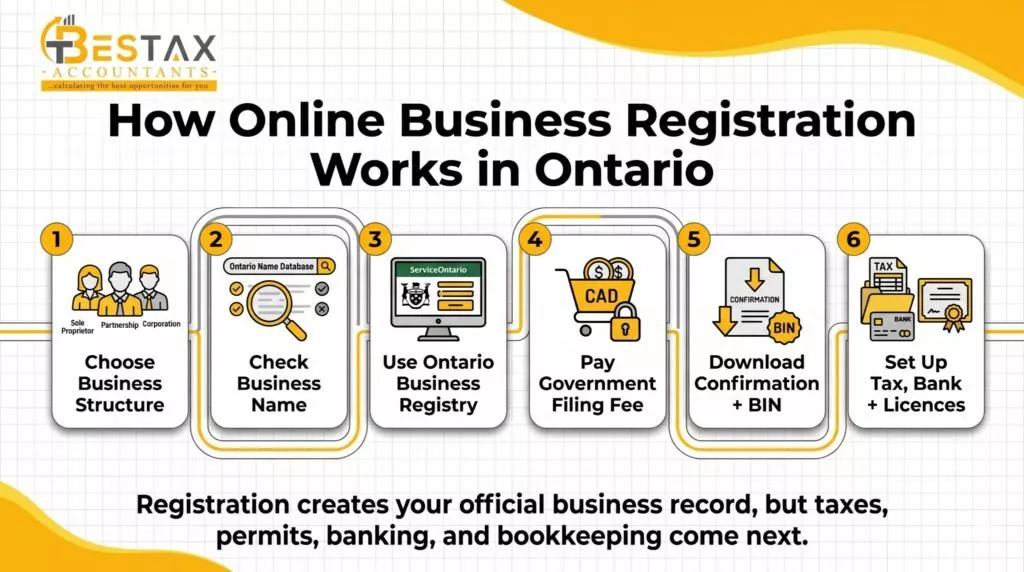
How Online Business Registration Works in ontario
1. What It Means to Register a Business Online in Ontario
Business registration creates an official record of your business with the provincial government. In Ontario this is done through the online portal known as the Ontario Business Registry. When you register, you choose a legal structure, sole proprietorship, partnership or corporation, and provide basic details about your business. The process is sometimes described as business formation or online business setup because it establishes a legal entity that can sign contracts, open bank accounts and file taxes.
Registration is different from tax registration, licensing and opening a bank account. Registering proves that your business exists, but you still need to open tax accounts, obtain necessary licences and set up proper bookkeeping. The sections below explain when registration is required and how to complete it.
2. Do You Need to Register Before You Start Selling?
If you sell under your own legal name as a hobby and have no employees or physical location, you may not need to register at first. The law requires registration when you operate under a name that is not your personal legal name or if you hire staff, rent space or open a shop. In other words, once you use a business name or establish a place of business you should register before taking payments; registration protects your name and enables you to open bank and tax accounts.
3. Choose the Right Business Structure
Your business structure determines how you pay taxes, how much paperwork you must complete and how much personal liability you take on. Ontario recognises three main structures: sole proprietorships, partnerships and corporations.
Sole proprietorship
A sole proprietorship is run by one person and is simple and inexpensive to start. Income and expenses are reported on the owner’s personal tax return, but the owner is personally responsible for all debts and obligations. Registration is required when using a business name or hiring anyone.
Sole proprietors enjoy full control but also shoulder all risk. Because the business and the owner are legally the same, profits are taxed at the individual’s marginal rate, and losses can be deducted against other income. If the business borrows money or is sued, the owner’s personal assets can be seized.
Partnership
In a partnership, two or more people share profits and decision‑making. Partnerships are easy to set up, but each partner is personally liable for the debts of the business and for the actions of the others. A written partnership agreement can clarify responsibilities.
Partnerships offer flexibility. They allow owners to pool resources and expertise and divide tasks. Income flows through to the partners’ personal tax returns and is split according to the partnership agreement. The main drawback is joint liability: each partner is responsible for the entire debt of the business and may be liable for contracts signed by the others. Clear agreements and insurance can mitigate some of this risk.
Corporation
A corporation is a separate legal entity that shields owners from many liabilities and can help raise capital. It has higher start‑up costs and more complex record‑keeping. High‑risk businesses or those planning to hire staff often incorporate to limit personal risk.
Corporations issue shares to bring in investors or co‑owners. The corporation pays corporate income tax on its profits, and shareholders pay personal tax only on salaries or dividends. However, corporations require annual meetings, minute books and separate tax filings. Directors have fiduciary duties and must keep the company in good standing. Despite the extra work, incorporation provides a strong foundation for growth.
Choosing a structure
Picking a structure depends on risk, taxes and growth plans. Sole proprietorships work for low‑risk ideas, partnerships suit multiple owners, and corporations suit high‑risk or growing ventures. You can start as a sole proprietor and incorporate later, but you cannot retroactively shield past liabilities.
4. Pick a Business Name That Works
Your business name will appear on invoices, bank accounts and marketing materials. Choose it carefully. Before filing, use the Ontario Business Registry search tool to see if the name is available. If you plan to incorporate with a custom name, you must obtain an Ontario‑biased Nuans name search report. A federal Nuans report does not satisfy Ontario’s requirement.
A good name should be easy to spell, clear about what you do and distinct from competitors. Check whether a matching domain name and social media handles are available. A name that is too similar to another business can lead to confusion or legal issues. Ask yourself a few simple questions before you lock in the name: Is it easy to pronounce? Does it look professional on invoices? Will it still make sense if my business expands or changes direction? Spending time on name selection now prevents rebranding later.
5. Understand BIN, BN and the Small‑Supplier Threshold
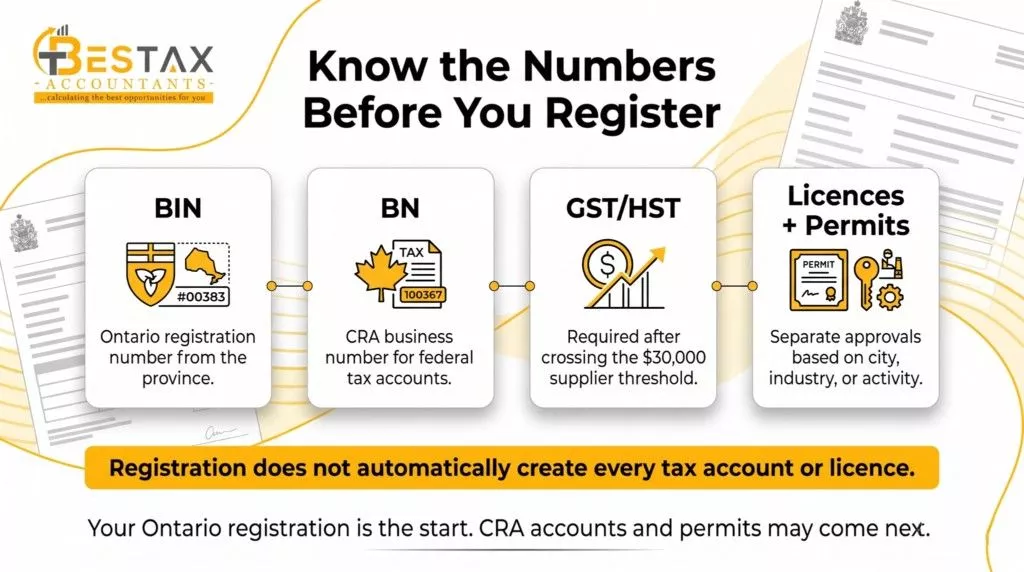
Many entrepreneurs confuse the Business Identification Number (BIN) with the Business Number (BN). The BIN is the nine‑digit number you receive when you register provincially; it identifies your business in Ontario records. The BN is a separate nine‑digit number issued by the Canada Revenue Agency for federal tax programs. You need a BN when you incorporate or register for GST/HST, payroll or other CRA accounts.
The small‑supplier threshold is the revenue level at which HST registration becomes mandatory. If your taxable supplies are $30 000 or less over four consecutive quarters or in a single quarter, you are a small supplier and do not need to charge HST. Once you exceed that amount, you must register within 29 days and begin charging tax. Taxi and ride‑sharing drivers and commercial landlords must register regardless of revenue. Voluntary registration is allowed and gives you the right to claim input tax credits on your expenses, but once registered, you must collect and remit HST on all taxable sales, file returns, and keep records.
6. Using the Ontario Business Registry Portal
The Ontario Business Registry portal is the official online platform for registering, renewing and updating businesses. You can access it through the Ontario Business Registry page on the Ontario government website. To register, create an Ontario Business Account, select your structure and fill in your business name, address, description and owners’ details. After paying the government fee, about $60 for a sole proprietorship or partnership and about $300 for a corporation, you submit the form and download your confirmation and BIN. Keep your login credentials safe for future updates, and use the official portal rather than third‑party services that charge extra fees.
7. Prepare Before You Start the Online Form
Gather your information before opening the portal. Decide on your structure and have a backup name in case your first choice is unavailable. Corporations need an Ontario‑biased Nuans report. Collect your physical and mailing addresses, a short description of your business activities, contact information for owners or directors, an email for confirmations and a credit or debit card for the fee. If you will operate a partnership or corporation, gather the names and addresses of all partners or directors and make sure everyone agrees on their roles.
Double‑check your addresses; misspellings or incorrect postal codes can delay mail or cause documents to be returned. If you intend to open CRA accounts immediately, have your Social Insurance Number ready. Writing a clear one‑sentence description of what you do (for example, “we design websites for small businesses” or “I sell handmade candles online”) helps the government assign your business to the correct industry. Preparing these items lets you complete the form quickly and accurately.
8. Save and Organise Your Documents
When you submit your registration, the portal gives you a confirmation with your BIN and, if applicable, your articles of incorporation. Save these documents in a secure digital folder along with your receipt and note the business name expiry date (names must be renewed every five years). Also, save your CRA BN letter and any HST or payroll confirmations once you register for those accounts. Back up your folder in the cloud and on an external drive; banks and accountants may ask to see these documents.
9. After Registration: Licences, Permits and HST
Registration does not grant industry licences. Restaurants must meet health and safety rules; trades and construction need contractor licences; childcare providers require provincial certification; regulated professions such as real estate and health services have their own licensing bodies, and even home‑based businesses may need municipal permits. Check your municipality and regulator to see what applies to you.
If your taxable supplies exceed the $30 000 threshold, or if you run a taxi, ride‑sharing or commercial landlord business, you must register for a GST/HST account and begin charging HST. Voluntary registration is possible if you want to recover input tax credits. You can register through the CRA’s online system or by filing Form RC1 (see the CRA’s GST/HST registration rules). After registering your business, open a business bank account, set up bookkeeping and consider insurance. If you will hire employees, register for a payroll account with the CRA. For a broader roadmap that covers everything from choosing a structure to opening your first account, you can read our detailed guid for starting a business in Ontario.
10. Common Mistakes to Avoid
Learning from others’ mistakes can save you stress. Here are key pitfalls to watch for:
Common problems include choosing a structure that does not match your risk level, picking a confusing or hard‑to‑spell name, mixing up the BIN with the BN, assuming registration covers licences, ignoring the HST threshold and failing to separate personal and business finances. Watching for these errors prevents delays and penalties.
11. When to Seek Professional Help
If you are unsure which structure fits your goals, when to register for HST or how to set up payroll, consider consulting a professional. Accountants and business advisors can explain tax implications and help with incorporation, bookkeeping and compliance. For hands‑on support, Bestax Accountants provides Ontario business registration services that include HST registration, payroll setup and ongoing accounting. Professional guidance is especially useful when you plan to expand or hire employees.
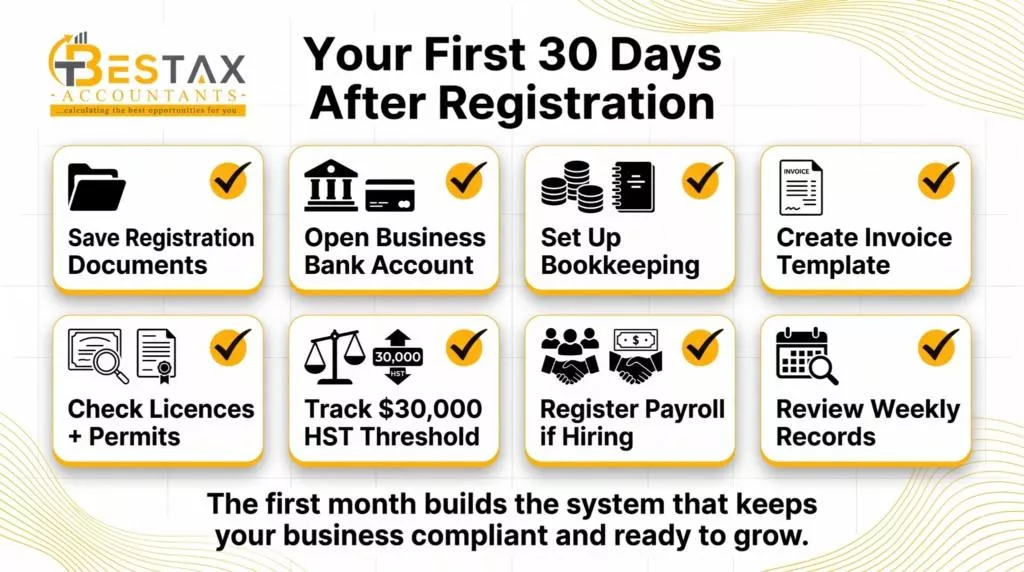
12. Your First Month After Registration
During the first month, take a few deliberate steps that lay the groundwork for growth. Organise and back up your registration documents, then open a business bank account and deposit any initial funds. Set up simple bookkeeping, whether you use a spreadsheet or accounting software, so you can record sales and expenses from day one and keep receipts. Create invoice templates that include your BIN and, when you get them, your BN and HST numbers; consistent invoices help your customers and support your tax filings. Apply for licences and permits required by your municipality or industry. Review your projected revenue to decide whether you will cross the HST threshold soon; if so, register voluntarily so you can claim input tax credits on early expenses. If you plan to hire employees, register for a payroll account and learn about employer responsibilities such as source deductions. Plan a weekly slot to update records, reconcile bank statements and monitor deadlines for renewals or filings, consistent routines prevent problems later.
Conclusion
Registering a business online in Ontario is straightforward if you plan ahead. Choose the right structure, select a strong name and use the official portal to file your registration. Understand the difference between the BIN and the CRA’s BN, monitor your revenue for the HST threshold and obtain any required licences or permits. Save all documentation, keep your business and personal finances separate and set up bookkeeping from day one. When in doubt, consult professionals like Bestax Accountants who can guide you through registration, tax accounts and compliance. With careful preparation, you can register your business confidently and focus on serving your customers.
Quick FAQs
Can I register my business online in Ontario?
How do I register a business online in Ontario?
What is needed to register a business online?
Can I register a business online for free in Ontario?
Can I register a business name online in Ontario?
Do I need HST after registering my business online?
Where do I register a business in Ontario?
Disclaimer: The information provided in this blog is for general informational purposes only. For professional assistance and advice, please contact experts.


