


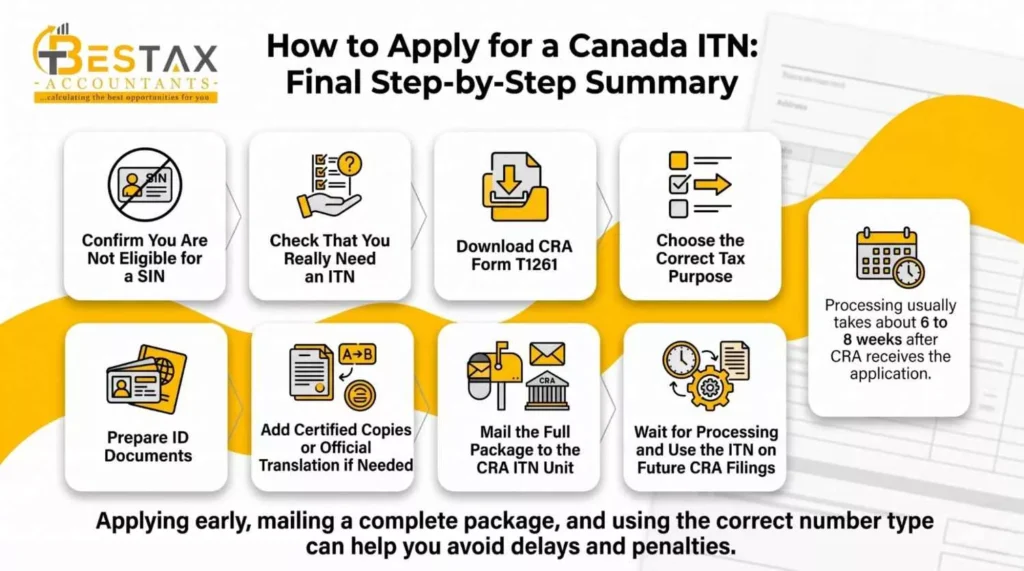
If you are a non‑resident who earns Canadian income or owns Canadian property, you may need a Canadian Individual Tax Number (ITN). To apply for an ITN, a non‑resident must confirm they are not eligible for a Social Insurance Number (SIN), complete the Canada Revenue Agency (CRA) Form T1261, attach acceptable proof of identity, select the appropriate tax purpose, and mail the signed application package to the CRA.
Many applications are delayed because people confuse Canada’s ITN with the U.S. ITIN, use an incorrect tax identification number, omit documents, send poor‑quality identity copies, or apply just before a tax return is due.
CRA guidelines say you can request an ITN if you are a non‑resident without a SIN and need a CRA tax number to file a Canadian tax return, reduce withholding tax, dispose of taxable Canadian property, file a section 216 return, or submit an Underused Housing Tax (UHT) return. This guide explains the process in plain language and helps you avoid common mistakes.
More than 16.1 million income tax returns had been filed in Canada by April 12 2026, and over 9.9 million refunds worth $22.2 billion had already been issued. While most of those returns come from residents, growing numbers of non‑residents also owe taxes or need refunds. New student and work‑permit arrivals to Canada fell from 292,990 students and 393,350 workers in 2024 to 115,270 students and 208,900 workers in 2025.
With fewer newcomers arriving, each non‑resident’s tax obligations may stand out more, so an accurate tax number is vital. Keep reading to learn what an ITN means, how it compares with other identification numbers, when you need it, and how to prepare a strong application.
What an Individual Tax Number Means in Canada Today
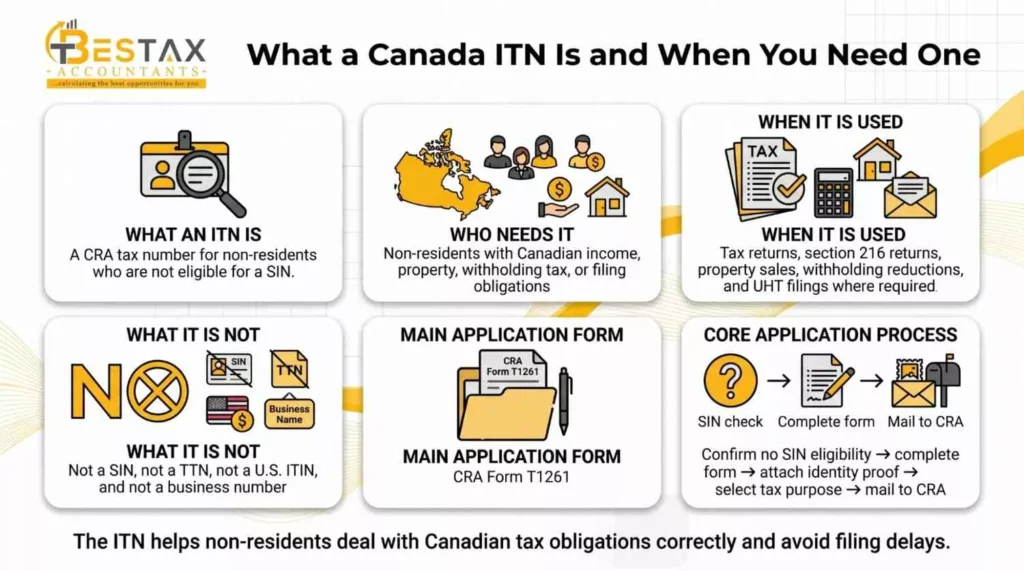
An Individual Tax Number (ITN) is a nine‑digit identifier issued by the Canada Revenue Agency for certain non‑residents who need to deal with the Canadian tax system. The ITN is used to identify a person for tax purposes and appears on CRA correspondence. It is not a work permit, immigration status document, credit number, or business number.
Think of it as a personal tax account for people who do not qualify for a Social Insurance Number but still have to report Canadian income or meet other tax requirements.
Because the ITN is tied to federal tax administration, it is sometimes referred to as a taxpayer identification number, tax identification number, tax ID, or individual tax identification number. Those terms all describe the same concept: a unique number used by the tax authority to track an individual’s income reporting, withholding tax and refunds. In Canada the tax authority is the CRA, so an ITN is a CRA tax ID.
Once assigned, it stays with the person for life and should be cited on all Canadian tax filings and correspondence.
Checking SIN, TTN and ITIN Before Applying for an ITN
Before filling out Form T1261, make sure you need an ITN and not another tax identification number. Canada issues three main identification numbers for individuals:
| Number | Country | Main purpose |
|---|---|---|
| SIN (Social Insurance Number) | Canada | Allows eligible individuals to work in Canada, access government benefits, and file income taxes. A SIN is required for employment and many federal programs. |
| ITN (Individual Tax Number) | Canada | CRA tax filing number for non‑residents who are not eligible for a SIN. It is used to file Canadian tax returns, reduce withholding tax, report rental income, sell property and comply with other CRA requirements. |
| TTN (Temporary Tax Number) | Canada | A short‑term CRA number issued in limited situations, such as when a return must be processed but the taxpayer has not yet obtained a SIN or ITN. A TTN often expires once the permanent number is assigned. |
| ITIN (Individual Taxpayer Identification Number) | United States | A U.S. number issued by the Internal Revenue Service (IRS) to individuals who cannot obtain a Social Security Number (SSN). It is requested using IRS Form W‑7 and is not valid for Canadian tax filing. |
Many applicants mistake the U.S. ITIN for the Canadian ITN. An ITIN is for U.S. tax filings with the IRS, while an ITN is for Canadian CRA tax matters. If you already have a SIN, ITN, or TTN, do not complete Form T1261. People who have requested a SIN or ITN but have not yet received it should still file their tax return on time and attach a note explaining that their number is pending. This avoids late‑filing penalties.
When Non‑Residents Need a Canada ITN for Tax Filing
Non‑residents need an ITN when they have taxable ties to Canada but are not eligible for a SIN. Before filling out the form, consider the tax purpose for the number. Common situations include:
- Filing a Canadian tax return: If you earned Canadian‑source income such as employment income, rental income, pensions, scholarships or capital gains, you may need to file a T1 non‑resident return. The ITN becomes your taxpayer identification number on the return.
- Reporting Canadian‑source income without a return: Some payments, like royalties or dividends, may require withholding tax at the source. An ITN allows you to apply for a waiver or reduction of withholding tax and ensure the income is reported accurately.
- Reducing or waiving withholding tax: Non‑resident tax is often withheld at a default rate (25 %) on certain payments. By obtaining an ITN and submitting the appropriate CRA forms, you can request treaty benefits or a lower rate.
- Disposing of taxable Canadian property: When selling Canadian real estate or other taxable property, non‑residents must remit taxes and report the sale to CRA. An ITN links the transaction to your personal tax account.
- Filing a section 216 return: This special return allows non‑resident property owners to pay tax on net rental income instead of gross rent. A valid ITN is needed to file a section 216 return.
- Filing an Underused Housing Tax (UHT) return: Certain non‑residents who own residential property may have needed to file a UHT return for 2022–2024; the federal government has since proposed eliminating the UHT for 2025 and later years. When required, a valid ITN allows electronic filing.
- Other CRA requirements: Students who receive scholarships or awards, artists performing in Canada, or recipients of Canadian pensions may also need an ITN to satisfy reporting or tax compliance obligations.
Remember that an ITN is not optional. Without one, your filings may be rejected or delayed, and you may be charged the default withholding rate or face penalties for late filing.
Preparing CRA Form T1261 and Your ITN Application Package
The official ITN application form is Form T1261, Application for a Canada Revenue Agency Individual Tax Number (ITN) for Non‑Residents. You can download the fillable PDF from the CRA’s website. Fill out the form carefully using clear print or typing. A direct link to the form (anchor text) is provided here: CRA Form T1261 for non‑residents. Review each section:
- Reason for applying: Check the box that matches your tax purpose (e.g., filing a return, reducing withholding tax, disposing of property). Choosing the right purpose helps the CRA process your application more quickly.
- Identification information: Provide your legal name, date of birth, current address, foreign address (if different), and contact information. Make sure the names and dates match your supporting documents exactly.
- Certification section: Sign and date the form. A hand‑signed signature is required even if the form is completed electronically.
- Supporting documents: Indicate which documents you are submitting (passport, driver’s licence, study permit, etc.) and whether they are originals or certified copies.
The CRA will return original documents but will not return certified copies. Keep photocopies for your records.
Selecting the Correct CRA Tax Purpose Before Mailing
Your application’s tax purpose determines why you need an ITN. Selecting the right reason prevents processing delays and ensures your ITN is linked to the correct CRA program. Common tax purposes include:
- Non‑resident filing a Canadian return: Check this box if you will submit a T1 return or a section 216 return for rental income.
- Non‑resident selling Canadian property: Select this reason if you are disposing of taxable Canadian property or requesting a clearance certificate.
- Non‑resident reporting rental income: For section 216 filings or other rental income reporting.
- Student or performer receiving Canadian payments: Choose this option if you receive scholarships, awards, research grants, or artist fees.
- Withholding tax reduction: Select if you are applying for a waiver or reduction of non‑resident withholding tax on payments like interest, dividends or pensions.
Only check the federal tax purpose boxes relevant to your situation; do not use U.S. terminology like Form W‑7 or federal tax return. Canada’s tax authority is the CRA, not the IRS, and the ITN is for Canadian tax compliance.
Certifying Identity Documents for Your ITN Application
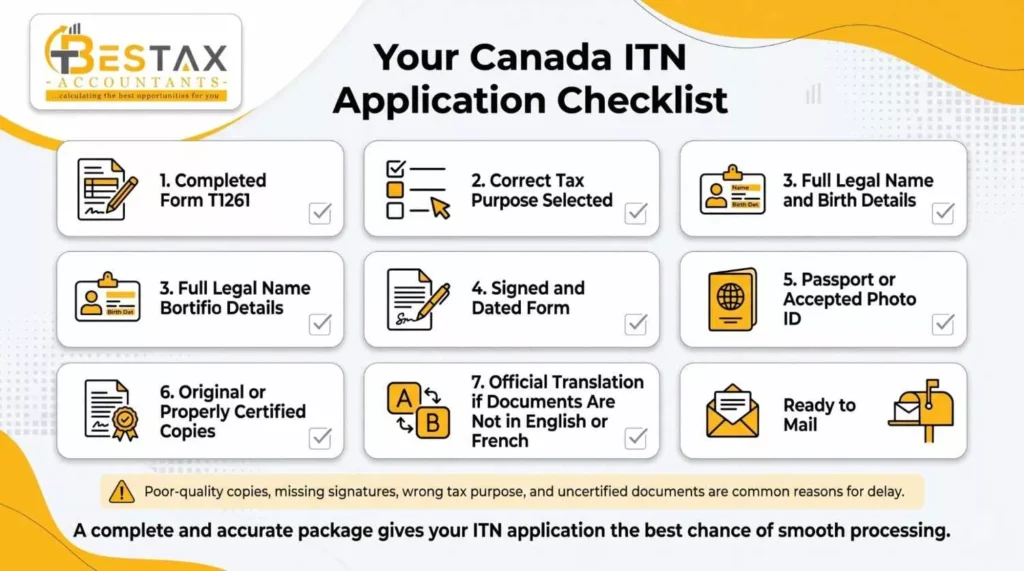
Your identity documents are often the make‑or‑break part of the ITN application. CRA requires current documents that show your name, date of birth, and photograph. Acceptable documents include:
- Valid passport (recommended) or national identity card
- Driver’s licence
- Study permit or temporary resident visa
- Government‑issued identification card with photo
You must submit original documents, certified copies, or notarized copies. If you use certified or notarized copies, they must show:
- An ink signature of the certifying official
- The official’s title, address, and contact number
- A statement that the document is a true copy of the original
Photocopies or faxes of certified documents will not be accepted. You cannot certify your own documents. The certification should appear directly on the document; if on a separate page, it must reference the document being certified.
Translating Non‑English Documents
If your identity documents are not in English or French, they must be accompanied by an official translation. An official translation is done by a certified translator who is a member in good standing of a professional translation association. The translation must include the translator’s seal or stamp and membership number, and all non‑English or non‑French stamps and seals on the documents must be translated. Failing to translate properly is a common cause of delays.
Mailing Your ITN Package With Proof and Tracking
The ITN application process is paper‑based; there is no fully online submission. Assemble the following items:
- Completed Form T1261
- Original or certified identity documents
- Optional: A cover letter explaining your tax purpose and listing enclosed documents
Make a copy of everything for your records. Send the package by tracked mail or courier and keep the tracking number. Address the envelope to:
Attn: ITN Unit
Services and Benefits - Benefits Division
Sudbury Tax Centre
1050 Notre Dame Avenue
Sudbury ON P3A 5C1
Canada
Allow 6 to 8 weeks after the CRA receives your application for them to notify you of your ITN. If you have not received a reply after eight weeks, contact the CRA to check the status. Because processing times can vary, do not wait until the tax filing deadline to apply. Send your application well in advance to ensure you have an ITN before filing or disposing of property.
For detailed mailing guidance, consult the CRA ITN application guide here: CRA Individual Tax Number application guide. The guide provides up‑to‑date addresses, contact numbers and helpful tips.
Planning CRA Processing and Filing Dates
Planning ahead reduces stress and ensures compliance. Consider these timelines:
- ITN processing: Expect 6–8 weeks after the CRA receives your application.
- Tax return deadlines: Most non‑resident returns for the 2025 tax year are due April 30 2026; self‑employed individuals have until June 15 2026, but any balance owing is still due April 30.
- Section 216 returns: If you elect under section 216, file your return by June 30 of the year after the rental income year.
- UHT returns: Past UHT returns were due April 30 of the following year; however, the 2025 federal budget proposes to eliminate the tax starting in 2025. Check current CRA guidance if UHT requirements return.
While waiting for your ITN, prepare your tax return, gather income slips and calculate withholding tax. If you plan to sell property or request a withholding waiver, begin the ITN process as soon as you know you will need it. Do not rely on same‑year processing during busy tax season.
Using Your ITN Correctly for Income Reporting and Tax Returns
Once you receive your ITN, store the CRA letter in a safe place. Use the same ITN for all future CRA correspondence; never apply for another number unless CRA instructs you to do so. When filing returns:
- Enter your ITN in the identification area of your T1 return or section 216 return.
- Provide your ITN when completing CRA forms for withholding waivers or clearance certificates.
- Use your ITN when registering for CRA My Account or calling CRA; it helps agents locate your file quickly.
- Do not use your ITN for business activities or as a business number; a business number (BN) is separate.
If you later become eligible for a SIN (for example, by obtaining a Canadian work permit), you should start using your SIN for tax purposes. Contact CRA to update your records and link your old ITN to your new SIN. Do not apply for another ITN.
Avoiding U.S. ITIN and IRS Confusion
Search engines often mix U.S. tax information with Canadian content. To stay on track:
- Remember that a U.S. ITIN (Individual Taxpayer Identification Number) is issued by the IRS and is valid only for U.S. federal tax returns. It is requested using Form W‑7 and relates to U.S. tax obligations. It does not replace a Canadian ITN, nor can you file Canadian taxes with an ITIN. Likewise, a U.S. SSN is not a Canadian SIN.
- Use the correct terms: Social Insurance Number (SIN), Individual Tax Number (ITN), Temporary Tax Number (TTN) and business number (BN) for Canada. Avoid using federal tax return or IRS when discussing Canadian filings.
- When searching online, add “Canada CRA” to your keywords to filter results.
Getting Tax Help for Canadian Income or Property
If you are applying for an ITN because of Canadian‑source income, property, withholding tax or a non‑resident filing requirement, you may benefit from professional guidance. A qualified advisor can help you understand treaty benefits, plan for withholding tax reduction, prepare section 216 returns and navigate complex cross‑border rules.
Bestax Accountants offers cross‑border and international tax services in Canada to help non‑residents comply with CRA obligations and avoid errors. Proper planning can save money, reduce penalties and provide peace of mind.
Conclusion
Applying for a Canadian Individual Tax Number can seem complex, but with proper preparation, it becomes a straightforward administrative step. First confirm that you do not qualify for a SIN or already hold an ITN or TTN. Then complete Form T1261 accurately, select the correct tax purpose, and provide certified identity documents. Translate non‑English documents, mail the application well before any tax deadlines, and keep records of everything you send.
Once you have your ITN, use it consistently for all CRA interactions and keep it safe. If your situation involves cross‑border income, property sales or treaty relief, professional advice may be worthwhile. Bestax Accountants offers tailored support for non‑residents and can help you navigate complex CRA requirements. By following this 2026 guide, you will obtain your ITN efficiently and stay compliant with Canadian tax law.
Quick FAQs
An ITN is a nine‑digit tax identification number issued by the CRA to certain non‑residents. It is used to file Canadian tax returns, reduce withholding tax, report rental income, dispose of property and comply with other tax requirements when a person is not eligible for a SIN. It is not a work permit or credit number.
Non‑residents who receive Canadian‑source income (employment, rental, pensions, scholarships, capital gains, etc.), plan to sell Canadian property, or need to file a section 216 or UHT return may need an ITN. Students without work permits and performers paid in Canada also often need an ITN. If you are eligible for a SIN, you should use your SIN instead.
Download and print CRA Form T1261. Complete the form, select the appropriate tax purpose, attach original or certified identity documents (with translations if necessary), sign and date it, and mail the package to the CRA’s Sudbury Tax Centre. Allow 6–8 weeks for processing.
No. A Canadian ITN is issued by the CRA for Canadian tax matters. A U.S. ITIN is issued by the IRS for U.S. tax purposes and cannot be used in Canada. If you file taxes in both countries, you may need both numbers, but they are separate.
Your ITN will be printed in the notification letter sent by the CRA once your application is approved. It will also appear on any notices of assessment for returns filed with the number. Keep this letter in a secure location. If you forget your ITN, contact CRA for assistance.
Usually not. An ITN identifies an individual for tax purposes. A business needs a Business Number (BN) or program account depending on its activities. Using your ITN for business could lead to incorrect filings. Apply for a BN through CRA Business Registration Online or by phone.
The ITN process is primarily paper‑based. You must mail your completed Form T1261 with supporting documents to the CRA. At present, there is no full online application. However, you can download the form electronically and track your mail delivery.
Disclaimer: The information provided in this blog is for general informational purposes only. For professional assistance and advice, please contact experts.

