
Accounting
How to Handle Bookkeeping for Real Estate Agents in Canada (Step-by-Step Guide)
Handle bookkeeping for real estate agents with deal trackers, HST savings, mileage logs, CRA/FINTRAC records, reports, and a 30-day plan for 2026.


Tracking commissions and paperwork isn’t the most exciting part of real estate, but it’s one of the most important. Bookkeeping for real estate agents means keeping a clear record of every commission you earn, separating the HST you collected from money that is truly yours, recording deductible expenses, tracking mileage for showings, keeping Canadian Revenue Agency (CRA) and FINTRAC records organized, and checking financial reports every month.
Agents don’t get paid like most employees. You might close a big deal one month and go weeks without another sale. Commissions come with brokerage splits, referral fees and marketing costs. There is HST to collect and remit, travel mileage to track and irregular cash flow to manage. Without a system, it’s easy to miss deductions or end up short of cash at tax time. In this guide, we’ll break down real estate financial records into simple steps so you can spend less time on paperwork and more time with clients.
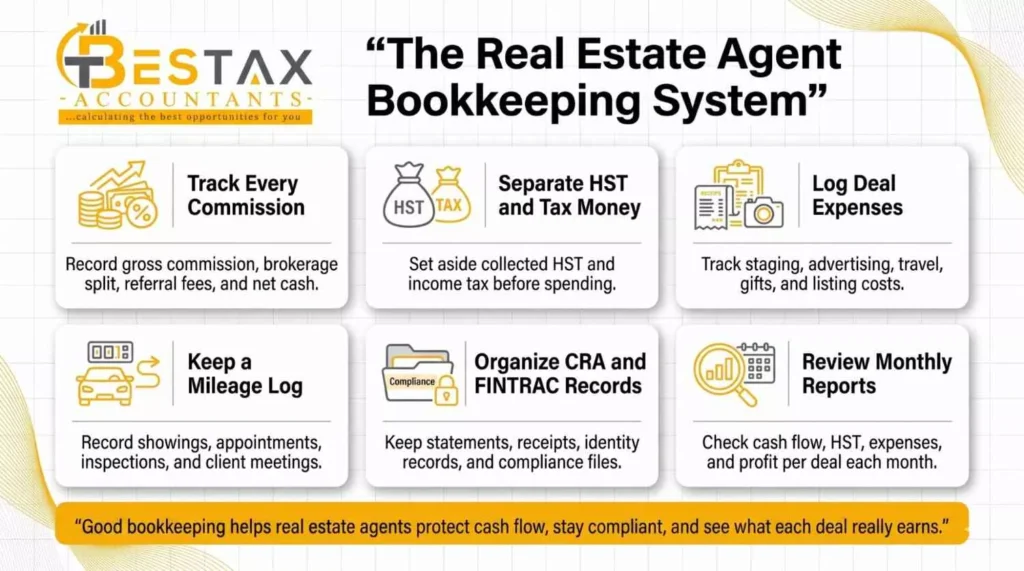
Why Real Estate Bookkeeping Needs Deal‑by‑Deal Records
Bookkeeping for real estate agents differs from that of a coffee shop or consulting firm. Instead of steady monthly sales, agents earn irregular commission income. A deal may include referral fees, brokerage splits, advertising costs, staging, gifts and travel expenses. HST is collected on most commissions, and you must set aside money to remit it. If you try to lump everything together, you won’t know whether a sale actually made money.
A good practice is to treat each deal as its own mini‑project. Create a deal tracker that records the property address or client code, closing date, gross commission, brokerage split, referral fee, HST collected, deal expenses and the net cash you actually keep. That way you can answer questions such as:
- Which type of transactions bring the best profits?
- Do expensive ads and staging pay off?
- Which leads or referral sources bring high‑value clients?
By organising real estate transactions deal by deal, business owners gain insight into what’s working and where to improve. The goal isn’t just to have clean books; it’s to know what each deal really earned.
Set Up Agent Accounts Before Commission Income Arrives
Before commissions start flowing, set up separate accounts for different purposes. Real estate agents should have:
- Business bank account: All commission income should be deposited into this account. Don’t mix personal and business funds. Mixing transactions makes tax preparation harder and can trigger CRA audits.
- Business credit card: Use this for marketing, staging, client meals, and other deductible expenses. That way you don’t have to sift through personal statements looking for business items.
- HST and tax savings account: Every time you receive a commission, move the HST collected and a portion for income tax into this savings account. This money is not yours to spend.
- Personal transfer account: Once you’ve set aside HST and tax, transfer your net pay to your personal account. This separation makes budgeting easier.
- Digital receipt folder: Store copies of invoices and receipts in a cloud folder. If the CRA asks for documentation, you’ll have it ready.
Keeping accounts separate shows that you run your practice as a small business, not a hobby. It also prevents confusion when using bookkeeping services or handing records over to an accountant.
Track Each Deal From Gross Commission to Net Cash Kept
A commission tracker lets you see the flow of money from the time you earn a commission until the cash hits your pocket. Here is a simple template:
| Field | What to record |
|---|---|
| Deal code | Property address or client code |
| Closing date | When the commission was earned |
| Gross commission | Total commission before deductions |
| Brokerage split | Amount kept by your brokerage |
| Referral fee | Fee paid to another agent (if any) |
| HST collected | Tax collected on commission |
| Deal expenses | Ads, staging, travel, gifts |
| Net cash kept | Actual usable income |
When you close a deal, record the gross commission shown on your commission statement. Subtract the brokerage split and any referral fees. Calculate HST on your portion of the commission and set it aside. Then deduct deal expenses such as photography, staging, advertising and client gifts. The remainder is your net income.
An example might look like this: a $20,000 gross commission on a $500,000 property, with a 25 % brokerage split ($5,000), a $2,500 referral fee, 13 % HST on your portion, and $1,000 spent on marketing. After subtracting these amounts and putting HST aside, you might keep around $9,300. Without a tracker, it’s easy to misjudge your profit.
Separate HST and Tax Savings Before Spending Your Agent Cash
HST collected on commissions is not income. In Canada, once your commissions exceed the $30,000 small‑supplier threshold in 12 months, you must register for the GST/HST. When that happens, you charge HST on each commission and send the net amount to the government. If you fail to set aside HST and income tax, you may end up short when your return is due.
A simple rule:
- Calculate HST collected: Multiply your portion of the commission by the applicable rate (e.g., 13 % in Ontario). Record this amount in your deal tracker and move it into your HST savings account.
- Track HST paid: Keep receipts for HST paid on business expenses. You can claim these input tax credits to reduce your HST remittance.
- Calculate net HST remittance: At tax time, subtract HST paid from HST collected. Remit the balance to the CRA.
- Save for income tax: Set aside a percentage of your net commission for income tax (20–30 % depending on your tax bracket). Move this amount to your tax savings account. When you remit taxes, the money is ready.
The CRA’s GST/HST registration rules require businesses to register and start collecting once they stop being small suppliers. Because real estate deals are large, many agents cross this threshold quickly. Build the habit of separating HST and tax money before you spend.
Build a CRA‑Ready Mileage Log for Showings and Listing Trips
Real estate work involves driving to showings, open houses, listing appointments, buyer tours, inspections, sign installations, client meetings and brokerage meetings. These kilometres are a legitimate expense, but only if you keep accurate records.
A good mileage log should include:
| Date | Starting point | Destination | Business purpose | Kilometres driven | Parking or tolls | Related client or deal code |
|---|
Whenever you drive for business, write down the date, starting point (e.g., home or office), destination (e.g., client property), the reason for the trip and the number of kilometres. Record any parking fees or tolls. At the end of the year, add up your total business kilometres and total vehicle kilometres. The percentage of business use determines how much of your vehicle expenses (fuel, insurance, repairs, depreciation) you can deduct. Guessing at tax time can lead to missed deductions or CRA challenges.
Categorize Agent Expenses Without Missing Tax Deductions
Proper expense categorization is essential for accurate accounting for property transactions. Saving receipts and tagging them monthly helps ensure you claim every deductible expense. Common categories for real estate professionals include:
- Brokerage fees: Desk fees, transaction fees and other charges from your brokerage.
- Board and association dues: Membership fees for CREA, provincial or local boards.
- Multiple Listing Service (MLS) fees: Costs to list properties on the MLS.
- Advertising and paid ads: Online ads, yard signs, flyers and marketing materials.
- Photography and staging: Professional photos, staging furniture and décor.
- Client gifts: Closing gifts, client appreciation meals or small gifts (keep receipts and note the client).
- Vehicle expenses: Fuel, insurance, maintenance and lease payments allocated by business use percentage.
- Phone and internet: Monthly plans and data used for business.
- Software subscriptions: CRM systems, email marketing, online scheduling and property management software.
- Home office costs: A portion of rent or mortgage interest, utilities and maintenance if you use part of your home exclusively for business.
- Insurance: Errors and omissions insurance and general business liability coverage.
- Professional development: Courses, conferences, licences and training.
Organize receipts into these categories monthly. Use your bookkeeping template to tag each expense with the related deal or client when possible. This makes tax deduction preparation much easier.
Keep FINTRAC and CRA Records Organized From Day One
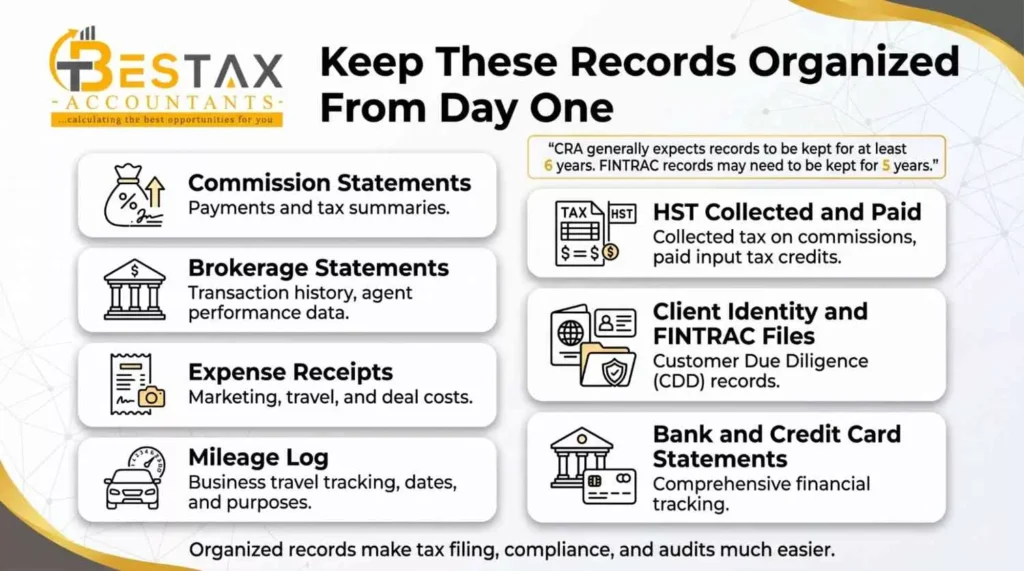
Real estate bookkeeping isn’t just about taxes – it also supports legal compliance. FINTRAC (the Financial Transactions and Reports Analysis Centre of Canada) enforces anti‑money‑laundering rules. Starting October 1 2025, FINTRAC requires real estate licensees to verify the identity of unrepresented parties in a transaction and keep records for five years. Required records include:
- Suspicious Transaction Reports (STRs): Copies must be retained for five years.
- Large cash and virtual currency transaction records: Required when receiving $10,000 or more in cash or virtual currency.
- Receipt of funds records: Detailed records of any funds received, even small amounts.
- Information records: Client identity documents for each party in a transaction, including unrepresented parties.
These records must be stored in an organized system. In addition to FINTRAC obligations, the CRA expects you to keep commission statements, brokerage statements, receipts, mileage logs and bank statements for at least six years. Having tidy records will also help if the CRA asks for proof of income or expenses.
Use Monthly Money Resets to Reconcile Agent Books Faster
Bookkeeping can pile up quickly. Instead of waiting until year‑end to sort through receipts, block off 30 minutes each month for an Agent Money Reset. This routine keeps your books clean and makes tax time less stressful. Include these tasks:
- Match bank and card transactions: Compare your bank statements and credit card transactions with your bookkeeping software or spreadsheet. Look for missing transactions or duplicate entries.
- Upload missing receipts: Scan or snap photos of receipts and store them in your digital folder. Tag them with the correct category and deal.
- Update mileage: Add any missing entries to your mileage log. Make sure dates and distances are accurate.
- Tag listing‑specific costs: Assign marketing costs, staging, and gifts to specific deals in your tracker.
- Review HST collected and paid: Ensure the amounts match your deal tracker and expense receipts.
- Move tax savings aside: Transfer HST and income tax amounts into your savings account.
- Check unpaid commissions: Review outstanding deals or referral fees owed to you.
- Review monthly profit: Look at net cash kept per deal. Identify which expenses are higher than expected.
Consistency is key. A monthly reset keeps small errors from turning into big problems.
Review Profit Per Deal, Not Just Annual Agent Income
Many agents look at their total annual income and feel successful. But a high gross commission doesn’t mean high profit. A $30,000 commission on a luxury listing may require expensive staging, premium photography, paid ads, larger gifts, and higher referral fees. A $10,000 commission on a modest home might require fewer expenses and yield higher net income.
By tracking profit per deal, you can answer critical questions:
- Which lead sources generate profitable clients?
- Do certain marketing channels (e.g., social media ads, printed flyers) produce better return on investment?
- Are there client types or property types that cost more to win than they return?
Remember, the goal is to build a sustainable career. Reviewing property investment analysis for each transaction helps you focus on deals that contribute the most to your bottom line.
Prepare Financial Reports Accountants Can Use Quickly
When tax season arrives, your accountant will appreciate well‑organized records. Prepare these items:
- Commission statements: Each transaction’s statement showing gross commission, brokerage split, and referral fees.
- Brokerage fee statements: Monthly or annual statements from your brokerage.
- Bank and credit card statements: Include statements for your business accounts.
- Receipt folder: Digital copies of all expense receipts, organized by category and deal.
- Mileage log: Summarize total business kilometres and vehicle expenses.
- HST summary: Show HST collected and HST paid so your accountant can calculate your net remittance.
- Home office costs: Provide utility bills and rent/mortgage statements used to calculate your home office deduction.
- Phone, internet and software bills: Document monthly charges used for business.
- Prior‑year notice of assessment: Useful for adjusting instalment payments.
Having these documents ready saves time and reduces your accounting fees. It also shows you run a professional operation.
Choose Software or Bookkeeping Services by Deal Volume
A simple spreadsheet may work when you start out with a few transactions. But as your volume grows, commissions, HST, expenses and receipts become harder to track manually. Look at the complexity of your work:
- Low volume (fewer than 10 deals per year): A basic Excel or Google Sheets bookkeeping template could be enough. You can build a deal tracker, expense log and mileage sheet yourself.
- Medium volume (10–20 deals per year): Consider bookkeeping software like QuickBooks or Xero, which can automate bank feeds, categorize expenses and generate HST reports. You might also explore digital receipt apps to reduce paperwork.
- High volume (more than 20 deals per year) or additional income streams (rentals, payroll): At this point, it may be wise to hire a professional bookkeeper or accountant. As your business grows, you may need help with payroll, payroll taxes or corporate tax filings. For example, Bestax Accountants offer comprehensive bookkeeping and accounting services in Mississauga for small businesses, including real estate agents and property investors. They help organize commissions, expenses, HST, financial records and provide tax‑ready reports.
If you want to explore tools, their blog on the best payroll software in Canada 2026 compares popular payroll platforms. Another post explains what accounting automation is and how to automate your accounting, which is helpful if you plan to reduce manual work.
Create a 30‑Day Bookkeeping Action Plan for Realtors in 2026
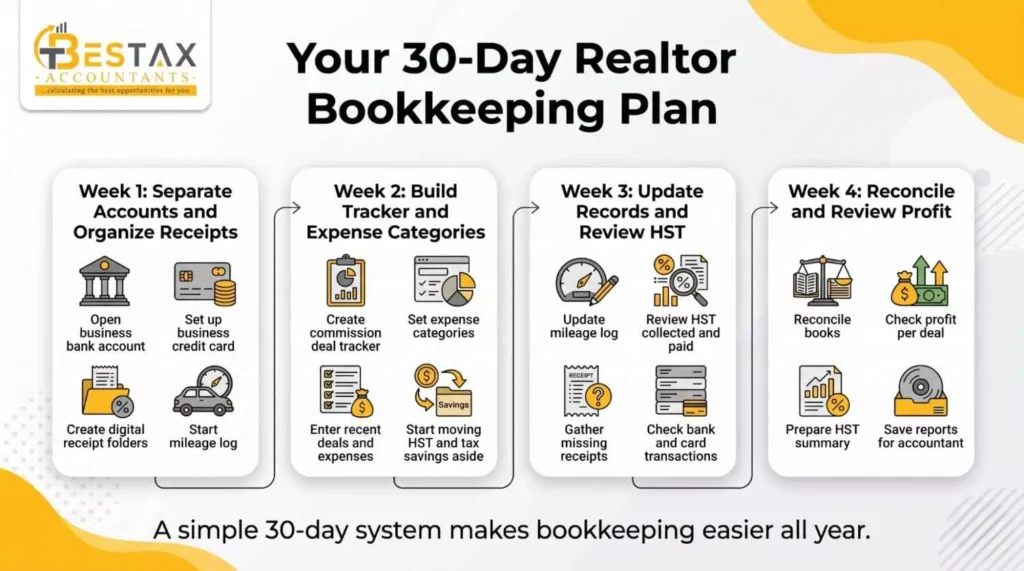
Busy agents need a simple action plan to organize their finances quickly. Here’s a four‑week plan you can follow:
Week 1: Separate Your Accounts and Organize Receipts
- Open or designate your business bank account, business credit card, HST/tax savings account and personal account.
- Create a digital folder structure for receipts, sorted by month and category.
- Set up a mileage log (paper or digital) and record all trips this week.
- If you collect HST, register for a GST/HST account if you exceed the $30,000 threshold.
Week 2: Build Your Deal Tracker and Expense Categories
- Create your commission deal tracker with fields for deal code, closing date, gross commission, brokerage split, referral fee, HST collected, deal expenses and net cash.
- Set up categories for expenses (brokerage fees, MLS fees, advertising, staging, vehicle, phone, software, home office, etc.).
- Enter your recent deals and expenses into your tracker. Assign each expense to the proper category and deal.
- Start transferring HST and tax savings to your designated account whenever you receive a commission.
Week 3: Update Mileage, HST Records and Missing Receipts
- Review your mileage log and add any trips you forgot to record.
- Summarize HST collected and HST paid so far. Make sure each receipt includes the HST amount.
- Gather any missing receipts (client meals, open house snacks, staging supplies) and upload them to your digital folder.
- Check your bank and credit card statements to ensure all transactions are in your books.
Week 4: Reconcile Books, Review Profit and Prepare Reports
- Reconcile your bank and credit card statements with your bookkeeping records. Fix any discrepancies.
- Calculate profit per deal by comparing net cash kept to gross commission. Identify deals with high or low profitability.
- Review your overall cash flow. Are you setting aside enough for taxes and personal savings?
- Prepare a short profit‑and‑loss statement, an HST summary, and your mileage log. Save these for your accountant.
- Consider scheduling a consultation with a professional firm like Bestax Accountants if you need help with taxes, payroll or accounting software.
Following this plan for one month will put you in control of your finances and give you a system you can maintain all year.
Conclusion
Proper bookkeeping is essential for Canadian real estate agents because your income and expenses are irregular and complex. Treat each transaction as its own mini‑project, separate your accounts, track every expense and kilometre, and review your profit per deal. Follow the 30‑day action plan to get organized, and remember to set aside HST and income tax before spending your commission.
If your real estate bookkeeping has grown beyond a basic spreadsheet, or you need help with payroll, HST or corporate taxes, consider partnering with a professional firm. Bestax Accountants offers expert bookkeeping and accounting services in Mississauga to help agents manage commissions, expenses and taxes smoothly. By taking a systematic approach, you’ll spend less time on paperwork and more time helping clients buy and sell homes.
Quick FAQs
How do you do bookkeeping for real estate agents?
Do real estate agents need accounting in Canada?
Is QuickBooks good for real estate agents?
What expenses can real estate agents deduct?
Should realtors use spreadsheets or bookkeeping software?
When should a realtor hire a bookkeeper?
Can a bookkeeper prepare financial statements?
Disclaimer: The information provided in this blog is for general informational purposes only. For professional assistance and advice, please contact experts


