



Starting a family-owned business feels natural. You trust each other, share values, and want the same outcome, and that is exactly what makes it risky. When ownership goes undocumented, roles are assumed instead of assigned, and money moves informally, the business quietly pulls the family apart. The real dangers are not startup costs or market competition. They are the conversations most families skip because they feel unnecessary early on. This 2026 guide covers every step, legal structure, ownership, governance, pay, and succession, so you can build something that holds up under both growth and real pressure.
What a Family-Owned Business Means in Canada
What Counts as a Family-Owned Business
A family owned business is one where two or more family members hold significant ownership, with at least one actively running daily operations. This includes businesses owned by spouses, siblings, parents and children, or extended relatives. It does not need to be inherited to qualify, a startup launched by two cousins counts just as much as a multigenerational company.
How Family-Owned Businesses Differ from Other Firms
In most non-family firms, ownership and management are separate. Shareholders hold equity; hired managers handle operations. In a family-owned enterprise, the same people often fill both roles simultaneously, making this model structurally unique and significantly more personal. According to Family Enterprise Canada, family-owned businesses account for63.1% of private sector firms in Canada, generate 48.9% of private sector real GDP, and employ 6.9 million people across the country.
Why Family Values Can Help or Hurt Success
Long-term thinking and shared commitment are genuine strengths in a family company business. Families often make decisions with a 10 to 20-year horizon rather than chasing short-term returns. But those same qualities create blind spots. When a family member underperforms, loyalty delays the necessary conversation.
Choose the Right Legal Structure First
Sole Proprietorship, Partnership, or Corporation
Before registering anything, decide how the business will be legally organized. A sole proprietorship works when one person owns and runs everything. A partnership suits two or more people sharing ownership without incorporating. A corporation is a separate legal entity, with its own rights, debts, and tax obligations apart from its owners.
Which Structure Fits Family-Owned Firms Best
For most family businesses with more than one owner, incorporation is the strongest choice. It separates personal assets from business debts, allows multiple share classes, and creates a clear framework for profit sharing, which matters when multiple relatives hold stakes.
For a complete breakdown of your options and how to complete your company registration in Canada, Bestax walks you through every step without the guesswork.
How Structure Affects Growth, Tax, and Liability
Your legal structure determines your tax rate, personal liability, and how cleanly ownership transfers later. A corporation qualifies for the small business tax rate, considerably lower than personal income tax, a gap that becomes significant as revenue grows.
Set Ownership Before Roles and Money
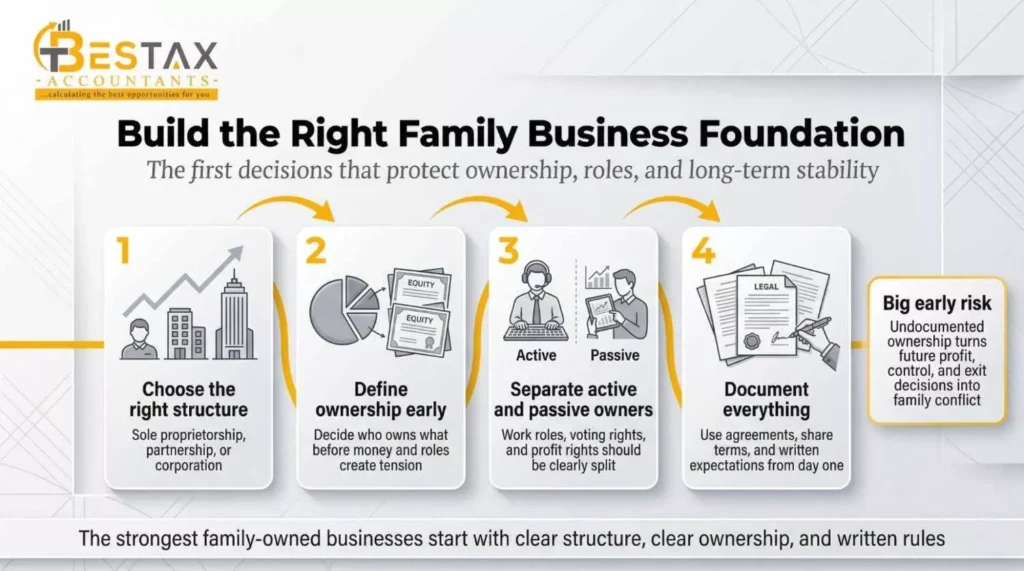
How to Divide Ownership Fairly Among Family Members
The most damaging early mistake in a family-owned business is assuming everyone already knows their share. That assumption creates legal and emotional problems years later. Ownership should be written into a shareholders’ agreement or partnership agreement from the start, based on each person’s contribution in capital, time, or skills, not family rank.
Active Owners vs. Passive Owners in a Family Enterprise
Passive owners contribute capital but stay out of daily operations; active owners hold shares and work inside the company. That distinction shapes pay, voting rights, and exit terms. According to Corporations Canada, corporations can issue different share classes, allowing families to separate voting rights from dividend rights, a practical tool for managing both ownership types without ongoing conflict.
Why Ownership Structure Must Be Clear from Day One
When ownership is vague, every financial decision becomes personal. If one person believes they own 50% while another assumes 33%, the first profit distribution turns into a fight. Documented ownership protects family relationships more than any other single action at startup.
Write Rules Before Conflict Starts
Why Family Governance Matters Early
Governance is the set of agreed-upon rules your family and business follow when making decisions. Most families skip this because things feel smooth at the start. A governance plan clarifies who can vote, who approves major expenses, how disputes get resolved, and when a family member can be removed.
What to Include in a Family Business Agreement
A solid family business agreement should cover:
- Ownership percentages and share classes for each family member
- How can new family members join as owners or employees
- What happens when someone wants to exit or sell their share
- How and when profits are distributed
- A defined process for resolving disagreements
How Rules Protect Relationships and Business Continuity
When written rules exist, a disagreement becomes a process rather than a personal attack. Without them, every business conflict turns into a family fight. Businesses that establish governance early consistently report fewer ownership disputes and more stable long-term performance.
Build Leadership and Governance Early
Who Makes Decisions in the First Year
The most important leadership question in year one is: who has the final say on daily operations? If two co-owners have equal weight with no tiebreaker, every disagreement becomes a stalemate. Appoint one person as the operating decision-maker for daily matters, while major decisions go through joint agreement. This keeps things moving without stripping shared ownership of its meaning.
How Leadership Works Across Generations
As the business grows and younger family members get involved, leadership needs a clear handover path. Identifying who has the skills to lead in the next generation, and actively developing them, is work that begins long before any formal control transfer.
When to Separate Family Talks from Business Meetings
One of the most practical habits any family in business can build is keeping business topics and family conversations in different settings. Business meetings need written agendas, documented decisions, and clear follow-through. Conversations about values and personal expectations happen separately.
Separate Family Pay From Business Profit
Salary, Dividends, and Owner Draws Explained
In a family-owned enterprise, money flowing to family members comes from three sources: salary for work performed, dividends paid based on ownership percentage, or owner draws used in unincorporated businesses. Each carries different tax implications.
How to Pay Working and Non-Working Family Members
A family member working inside the business should receive a market-rate salary, the same rate a qualified non-family employee would earn in that role. Passive owners receive income through dividends, not salary. This protects the company’s financials and removes ambiguity about what each person’s compensation represents.
Why Poor Financial Management Causes Family Tension
When pay is informal, one person takes more because they ask, another takes less out of discomfort, quiet resentment builds, and eventually damages both the company and the relationship. Written pay policies prevent this before it starts.
Register and Make the Business Tax-Ready
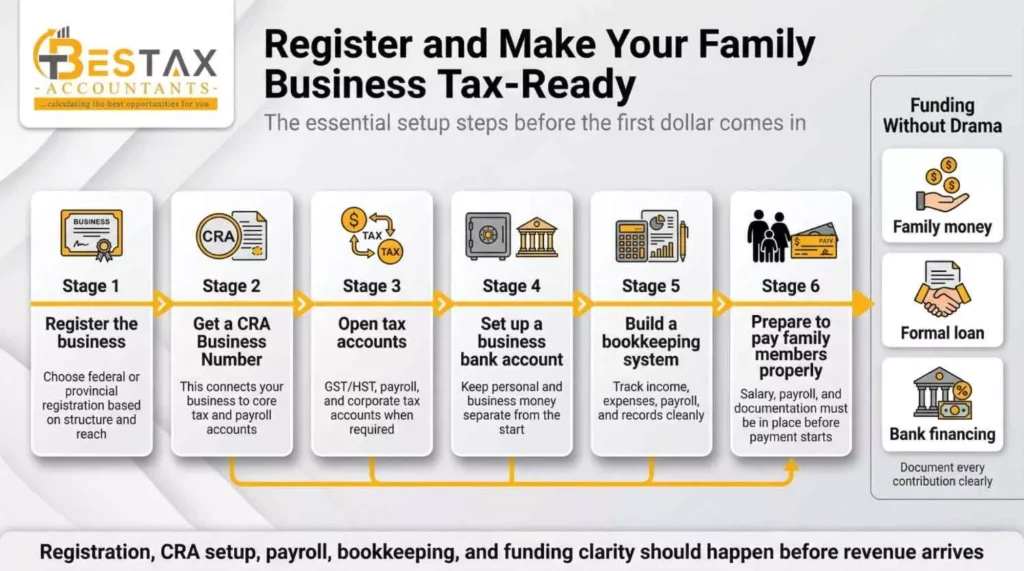
Federal and Provincial Registration Steps
Every business in Canada must be registered with the appropriate authority. Sole proprietorships and partnerships register provincially. Corporations can register federally or provincially, depending on where they operate. The Government of Canada’s starting a business portal outlines which specific steps apply to your business type and province, a reliable first stop for any new founder in Canada.
CRA Accounts, Payroll, and Tax Filing Basics
After registration, your business needs a CRA Business Number connecting you to your GST/HST account, payroll deductions account, and corporate income tax account. If you plan to pay family members as employees, which most family businesses do, a payroll account must exist before the first paycheque goes out. The CRA’s business number registration guide explains each account type and when registration is required.
What Small Businesses Need Before Earning Revenue
Before accepting your first dollar, make sure you have:
- Your CRA Business Number confirmed
- An HST number registered if annual revenue will exceed $30,000
- A dedicated business bank account separate from personal finances
- A basic bookkeeping system in place
Starting before revenue arrives is far simpler than catching up afterward.
Fund the Business Without Hurting Relationships
Family Money, Bank Loans, and Private Ownership
Startup capital in most family businesses comes from personal savings, family contributions, or bank loans. Family contributions without documentation cause the most long-term damage because expectations are rarely aligned from the start. One person treats the money as a gift. Another expects full repayment with interest. That gap is where lasting resentment takes root.
When a Loan Is Better Than Giving Away Ownership
If a family member wants to contribute capital but you are not ready to share ownership, structure the money as a formal loan, written agreement, stated interest rate, and a repayment schedule both parties sign. Both parties then understand exactly what the money means and when they get it back.
How to Document Money Between Family Members
Every financial transaction between family members and the business should be recorded, loans, wages, reimbursements, and profit distributions included. Proper documentation protects you during a CRA review and eliminates disputes about who contributed what.
Hire Family Fairly and Protect Culture
How to Assign Roles Based on Skills, Not Emotion
Bringing in a family member because they need work, not because they are the right fit, is one of the most common and costly errors in a family company business. Every position needs a clear job description, defined qualifications, and measurable expectations, regardless of whether the person shares your last name.
Why Family Culture Needs Professional Boundaries
A strong family culture is a real competitive advantage. Loyalty, shared identity, and long-term commitment are qualities most businesses cannot create from scratch. But that culture weakens fast when non-family employees watch relatives break policies without consequences. Consistent standards applied equally to everyone keep culture from becoming a liability.
How to Keep Trust and Loyalty Without Nepotism
Nepotism damages a business because it signals to every non-family employee that results do not actually matter. Hold family members accountable to the same standards as any other employee. When family hires earn their positions through results, their presence strengthens the team rather than creating division.
Plan Succession From Day One
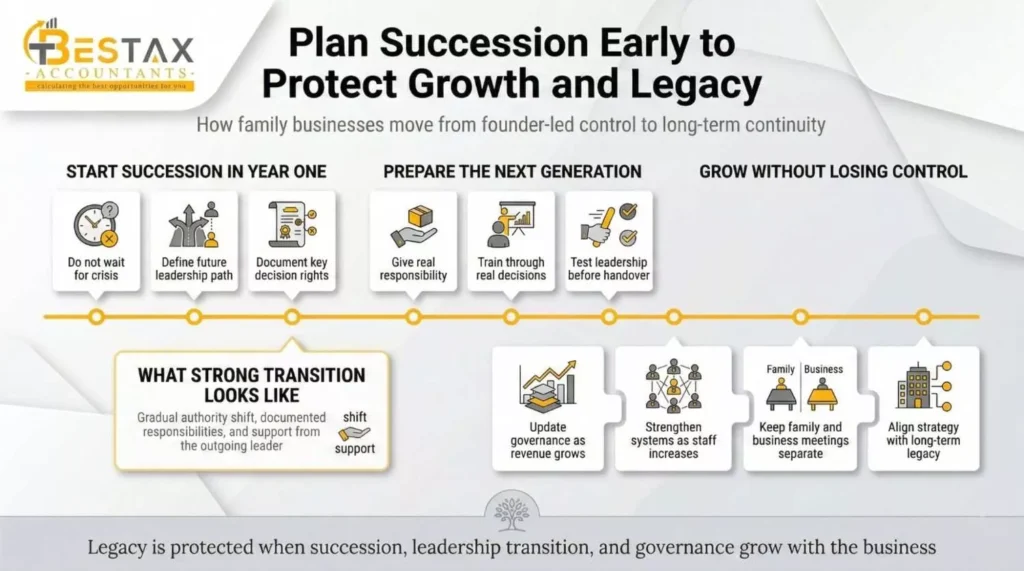
Why Succession Planning Is Not Only for Later
Most families treat succession as a conversation for when the founder turns 60, and that thinking is expensive. A succession plan answers one core question: what happens to this business if the key person cannot continue? Illness, burnout, or an unexpected personal change can force a transition at any point, which makes a plan necessary from the very beginning.
How to Prepare the Next Generation Early
Preparing younger family members means real responsibilities, real accountability, and honest feedback, not just titles. The actual problem is waiting until you urgently need someone to lead before discovering where the gaps are.
Getting this right requires proper legal and financial structure. Bestax’s family business succession planning guide connects leadership transition with tax planning, shareholder agreements, and ownership transfer, protecting everyone involved.
What a Leadership Transition Should Look Like
A well-handled leadership transition is gradual, documented, and supported by the outgoing leader. The incoming leader participates in key decisions before making them independently, and authority shifts in stages rather than all at once, protecting staff confidence and business stability throughout the change.
Grow the Business Without Losing Control
How to Balance Growth with Family Governance
Growth puts pressure on every system inside a family-owned business. When revenue doubles, the informal processes that worked early on begin to crack. A business that expands without updating its rules ends up with authority held by whoever pushes the hardest, not whoever is best positioned to lead.
What Challenges Appear as the Business Expands
As the business grows, new demands arrive: more employees, larger capital needs, more complex tax obligations, and stakeholders with no connection to the family. Each requires a structure that most family businesses do not build at launch. Families that manage expansion well build their systems early and update them as the company grows.
How Long-Term Strategy Protects the Business Legacy
A long-term strategy is not a document created once and shelved. It is an ongoing conversation about where the business is heading, who will carry it forward, and what the family wants to represent in the next generation. When that conversation happens regularly, the business stays aligned with both its goals and its people.
Common Mistakes That Break Family Businesses
Starting Without Clear Ownership or Roles
The most common mistake is launching without deciding who owns what and who does what. It feels unnecessary at the start, but when real money and real pressure arrive, the absence of those answers becomes the source of every major conflict.
Mixing Family Emotions With Business Decisions
Business decisions should rest on data, strategy, and the company’s long-term interest. Family emotions are valid but belong in personal conversations, not in business meetings. When a family member is underperforming, addressing it should follow the same process as with any other employee.
Delaying Succession and Governance Planning
Every year a family business operates without a succession plan or governance structure is a year of added vulnerability. The delay does not make the future easier, it makes every unexpected event more damaging. Start both conversations in year one, even if answers are simple, and build on them as the business matures.
Conclusion
The strongest family-owned businesses do not succeed simply because they are family-run. They succeed because they pair genuine trust with written rules, documented ownership, fair pay, and a leadership plan that reaches beyond the founder. Starting with these systems in place is what separates a family business that grows across generations from one that collapses under pressure. If you are ready to take the next step, Bestax Accountants can help you choose the right structure, register properly, and plan with the long view in mind. Start right, and the business you build will genuinely be worth passing on.
Quick FAQs
What is the largest family-owned business in Canada?
The Irving Group of Companies, based in New Brunswick, is widely recognized as one of the largest family-owned enterprises in Canada. Founded by K.C. Irving, it spans oil refining, media, forestry, and retail, and remains privately held by the Irving family across multiple generations.
Can I get a loan in Canada to start a business?
Yes. The Canada Small Business Financing Program (CSBFP) helps new businesses access up to $1.15 million through participating banks. BDC also offers startup loans with flexible terms for businesses that may not yet meet standard bank lending criteria.
What is the $40,000 small business loan in Canada?
The Canada Emergency Business Account (CEBA) was a federal $40,000 interest-free loan offered during the COVID-19 pandemic. That program has closed. BDC and regional development agencies now offer comparable startup and working capital financing for small businesses across Canada.
Can I take a loan to buy a business?
Yes. BDC, major banks, and credit unions all offer acquisition financing for purchasing an existing business. Lenders assess the company’s financial history, purchase price, creditworthiness, and collateral. A clear business plan and solid financials significantly improve your approval odds.
What is the fastest-growing business sector in Canada?
Technology services, clean energy, and healthcare have led Canada’s fastest-growing sectors in recent years. In 2026, businesses in cybersecurity, senior care, and sustainability are positioned for continued demand, shaped by Canada’s aging population and digital transformation.
Disclaimer: The information provided in this blog is for general informational purposes only. For professional assistance and advice, please contact experts.