

If you’re a GST/HST-registered business in Canada, you’re likely paying sales tax on dozens of purchases every month, including software subscriptions, office rent, professional fees, vehicle expenses. The good news? You don’t have to absorb all of it.
Input tax credits (ITCs) are the mechanism the Canada Revenue Agency (CRA) uses to make sure businesses aren’t double-taxed. They allow you to recover the GST/HST you paid on eligible business expenses and offset it against the tax you’ve collected from your own customers.
This guide breaks down everything you need to know about input tax credits in Canada: the definition, who qualifies, what you can and can’t claim, how to calculate them, and the documentation requirements that can make or break your claim.
What Is an Input Tax Credit? (The Plain-English Definition)
An input tax credit is a credit that GST/HST-registered businesses can claim to recover the GST/HST paid on purchases and expenses used in the course of their commercial activities.
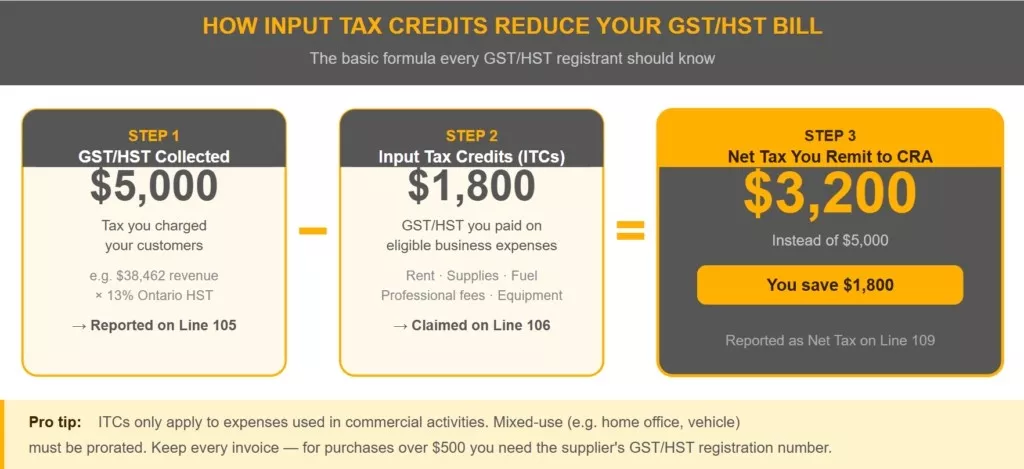
Here’s the simplest way to think about it:
- You charge your customers GST/HST and that goes to the CRA
- You pay GST/HST on your own business purchases, you get that back through ITCs
- You remit only the difference to the CRA
So if your business collected $5,000 in GST/HST this quarter and paid $1,800 in GST/HST on business expenses, your net remittance is just $3,200, not $5,000.
Input tax credits are claimed on Line 106 of your GST/HST return. This simple mechanism ensures tax is applied only to the value added at each stage of the supply chain, not stacked on top of previous stages.
Who Is Eligible to Claim Input Tax Credits in Canada?
According to the Canada Revenue Agency, you may claim ITCs if all of the following conditions apply:
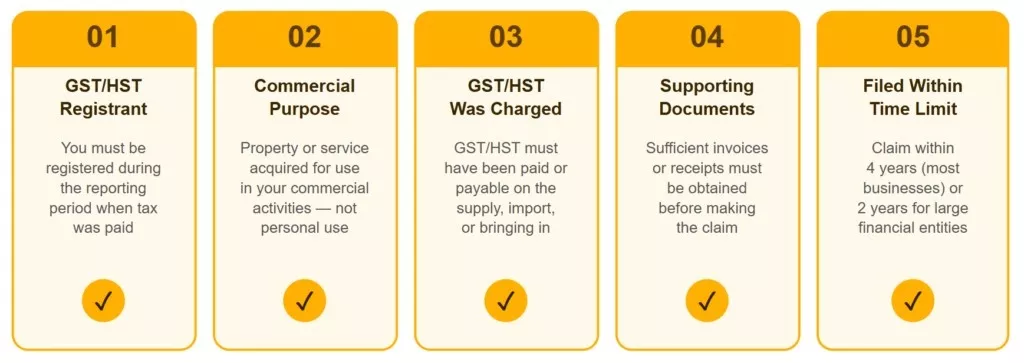
- You are a GST/HST registrant during the reporting period in which the tax was paid or became payable
- The property or service was acquired for use in your commercial activities not for personal use or to make exempt supplies
- GST/HST was actually paid or payable on the purchase
- You have sufficient documentary evidence to support the claim before filing
- You claim the ITC within the applicable time limit
If you fail any one of these conditions, the claim is disallowed. The most common pitfall? Insufficient documentation, more on that below.
What About New Registrants?
If you recently registered for GST/HST and were a small supplier immediately before registering, you may still be able to claim ITCs on capital property, real property, and inventory that you had on hand the day you became a registrant. This is often overlooked by new business owners and can represent a meaningful recovery.
Input Tax Credits and the GST/HST Registration Threshold
You can only claim ITCs if you are registered for GST/HST. Registration becomes mandatory once your business earns more than $30,000 in taxable revenues over four consecutive calendar quarters. Once that threshold is crossed, registration is required and with it, the ability to claim ITCs begins.
As of 2024, the CRA requires GST/HST returns for reporting periods beginning in 2024 or later to be filed electronically. This makes it more important than ever to have your accounting systems set up properly so ITCs are tracked and filed accurately. (Source: Canada.ca)
What Can You Claim ITCs For?
The CRA provides a list of common purchases and expenses for which ITCs are eligible:
- Business start-up costs
- Business-use-of-home expenses (proportionate to business use)
- Delivery and freight charges
- Fuel costs
- Legal, accounting, and other professional fees
- Maintenance and repairs
- Meals and entertainment (the allowable portion, typically 50%)
- Motor vehicle expenses
- Office expenses
- Rent (for commercial space used in your business)
- Telephone and utilities
- Travel expenses
Pro Tip: For mixed-use expenses (used partly for business, partly personal), you can only claim the ITC to the extent the expense relates to your commercial activities. Keep a log for vehicle and home office expenses, the CRA may ask for it.
What You Cannot Claim ITCs For
Not every purchase qualifies. The CRA explicitly excludes:
- Personal consumption, anything bought for personal use, even partially
- Purchases used to make exempt supplies (e.g., most residential rents, health services, financial services)
- Membership fees for recreational clubs (golf clubs, gyms, hunting/fishing clubs), unless reselling those memberships is part of your business
- Certain capital property with specific restrictions
Exempt vs. Zero-Rated: Why It Matters for ITCs
This is a distinction many business owners miss. Both exempt supplies and zero-rated supplies have 0% GST/HST charged to the customer, but they are treated very differently for ITC purposes:
- Zero-rated supplies (e.g., basic groceries, prescription drugs, exports): You charge 0% GST/HST but can still claim ITCs on related inputs
- Exempt supplies (e.g., residential rents, most healthcare, educational services): You charge 0% GST/HST and cannot claim ITCs on related inputs
If your business generates a mix of taxable and exempt revenues, your ITCs must be prorated accordingly.
Vehicle ITC Limits: Updated for 2024 and 2025
The CRA places a cap on the cost of passenger vehicles eligible for ITCs. For the 2024 tax year, the capital cost limitation for regular passenger vehicles was $37,000 (excluding GST/HST and PST). For 2025, this was updated to $38,000.
For zero-emission passenger vehicles, the capital cost limitation was $61,000 for vehicles purchased in 2023 and has been updated in subsequent years. Always check the CRA’s current ITC calculation page for the most current figures before filing.
Pro Tip: If your business purchases a vehicle, keep the sticker price, GST/HST paid, and business-use percentage documented. The ITC is calculated only on the lesser of the actual cost or the capital cost ceiling.
How to Calculate Your Input Tax Credit
Calculating an ITC is straightforward for most purchases: if the purchase is 100% for commercial use, claim 100% of the GST/HST paid.
Quick example:
- You rent office space for $2,000/month
- Ontario HST is 13% → HST paid = $260/month
- You use the office 100% for your business
- Your ITC for the month = $260
Where it gets more complex:
Mixed-use example:
- You pay $500/month for a phone plan, used 70% for business
- HST paid = $65
- Eligible ITC = $65 × 70% = $45.50
For capital property and more complex situations, the CRA uses an ITC eligibility percentage tied to the actual commercial use of the asset. If the use changes over time, adjustments may be required.
Quick Method vs Standard Method: Which Affects Your ITC Claims
If you use the quick method of accounting, you cannot claim ITCs for most operating expenses. Instead, you remit a fixed percentage of your taxable revenues to the CRA. However, you can still claim ITCs for:
- Purchases of land
- Capital property eligible for capital cost allowance (e.g., computers, vehicles, major equipment)
For most businesses under $400,000 in annual taxable revenues, the quick method can simplify filing, but it may not always result in lower tax. A qualified accountant can model both scenarios for your business.
Time Limits for Claiming Input Tax Credits
This is one of the most underappreciated rules in the ITC framework. You cannot claim ITCs indefinitely; there are strict deadlines:
| Type of Business | ITC Claim Deadline |
|---|---|
| Most registrants | 4 years from the end of the reporting period the ITC first became available |
| Listed financial institutions | 2 years |
| Businesses with threshold amounts exceeding $6 million (in most cases) | 2 years |
| Charities | 4 years |
Practical example: If you’re a quarterly filer and missed an ITC from the October–December 2022 reporting period, you have until January 31, 2027 to claim it (the due date of the return for the last reporting period ending within four years of December 31, 2022). Don’t leave money on the table.
What Documentation Do You Need to Support an ITC Claim?
This is where many businesses run into trouble during a CRA audit. According to the CRA, the documentation required depends on the total amount of the purchase:
| Purchase Amount | Required Information |
|---|---|
| Under $100 | Supplier name, date, total amount paid |
| $100 to $499.99 | Above + GST/HST amount shown, supplier’s GST/HST registration number |
| $500 or more | All of the above + buyer’s name, description of goods/services, terms of payment |
Key requirement: Always verify a supplier’s GST/HST registration number before claiming an ITC. The CRA provides a free GST/HST registration number confirmation tool. If you pay HST to a supplier who is not actually registered, you cannot claim the ITC, even if you paid the tax in good faith.
NEW: Digital Economy Purchases and Non-Resident Suppliers (2024 to 2025 Update)
This is a section most other resources miss. Since 2021 and with updates continuing into 2024–2025, non-resident suppliers of cross-border digital products and services may register under Canada’s simplified GST/HST framework and collect GST/HST.
If you’re purchasing digital services (SaaS subscriptions, cloud storage, online advertising, etc.) from non-resident suppliers:
- If your supplier is registered under the simplified framework, you must provide proof of your own GST/HST registration to them
- Failing to do so may result in the supplier charging GST/HST, and you may not be able to claim an ITC or rebate for it
- This is particularly relevant for businesses using U.S.-based software platforms, digital marketplaces, and short-term accommodation platforms
Always confirm whether your digital suppliers are registered under Canada’s standard or simplified GST/HST framework, as they are treated differently for ITC purposes. (CRA GST/HST Notice 322)
Common ITC Mistakes That Trigger CRA Attention
- Claiming ITCs on exempt purchases is especially common in businesses that provide both taxable and exempt services
- Missing or incomplete invoices, particularly for purchases over $500 where full documentation is required
- Claiming 100% on mixed-use expenses, vehicle and home-office expenses are frequently miscalculated
- Not verifying supplier GST/HST registration numbers
- Claiming ITCs outside the time limit, forgetting that missed claims can’t be picked up forever
- Using the quick method and still claiming operating expense ITCs, these are mutually exclusive
Real-World ITC Scenario: A Small Business Example
Scenario: Sarah runs a small consulting firm in Ontario. In Q1 2025, she has the following expenses:
| Expense | Amount (excl. HST) | HST (13%) | Business Use | Eligible ITC |
|---|---|---|---|---|
| Office rent | $2,000 | $260 | 100% | $260.00 |
| Phone plan | $100 | $13 | 70% | $9.10 |
| Professional fees (lawyer) | $1,500 | $195 | 100% | $195.00 |
| Gym membership | $50 | $6.50 | 0% (personal) | $0 |
| Laptop | $1,200 | $156 | 100% | $156.00 |
| Total | $620.10 |
Sarah also collected $8,450 in HST from her clients during Q1. Her net remittance to the CRA:
$8,450 − $620.10 = $7,829.90
Without claiming her ITCs, she’d overpay by $620.10 every quarter, or nearly $2,480 per year.
Need Help Managing Your GST/HST Returns and ITCs?
Tracking, calculating, and claiming input tax credits correctly takes time, and errors can result in denied claims, penalties, or CRA audits.
At Bestax, our team of certified accountants and tax professionals in Mississauga handles GST/HST compliance end-to-end, including:
- ITC review and optimization making sure you’re not leaving any eligible credits unclaimed
- GST/HST return preparation and filing, accurate, on-time, every period
- CRA audit support, if the CRA comes knocking, we’re with you
Clients like Lisa Richards put it well: “They made setting up my business a breeze and took care of everything from the HST registration to setting up my corporate tax filings.”
Our team has over 10 years of experience, serves 20+ nationalities, and has helped more than 1,000 companies stay compliant and financially confident in Canada.
👉 Get a free consultation with Bestax today
Quick FAQs
What is the input tax credit meaning in simple terms?
An input tax credit is a refund mechanism in Canada’s GST/HST system. It lets businesses recover the GST/HST they paid on business-related purchases by reducing the amount of tax they owe to the CRA.
Can I claim ITCs if I’m not registered for GST/HST?
No. ITCs are only available to businesses that are registered for GST/HST. If your annual taxable revenues are below $30,000, registration is optional, but you would not be eligible to claim ITCs unless you voluntarily register.
What if I forgot to claim an ITC in a previous period?
You can claim previously missed ITCs on a future return, as long as you’re within the applicable time limit, generally four years for most businesses, two years for financial institutions and large businesses above the $6 million threshold.
Can I claim an ITC on a purchase made before I registered?
In some cases, yes. New registrants may claim ITCs on capital property, real property, and inventory on hand at the time of registration, based on the basic tax content of that property.
Do I need the original receipt to claim an ITC?
For purchases under $100, minimal documentation is required. For purchases of $100 to $499.99, you need an invoice showing the supplier’s GST/HST registration number. For purchases of $500 or more, you need full documentation including your name as the buyer and a description of the property or service.
Can I claim ITCs on meals and entertainment?
Yes, but only on the allowable portion. Generally, meals and entertainment expenses are 50% deductible for income tax purposes, and the same 50% restriction applies to ITCs.
Are ITCs the same as the GST/HST credit?
No. The GST/HST credit is a benefit paid to lower-income individuals to offset the sales tax they pay on everyday purchases. Input tax credits are a business mechanism to recover GST/HST paid on business expenses.
Disclaimer: The information provided in this blog is for general informational purposes only. For professional assistance and advice, please contact experts.