
Trust Setup
Employee Ownership Trust in Canada: Sell Your Business to Your Team
Sell your business to your employees through an EOT and shelter the first $10 million of the gain, now permanent under Bill C-30. How the sale works, the tax breaks, the conditions and when an EOT fits.


An Employee Ownership Trust (EOT) lets you sell your Canadian business to the people who already run it, your employees, without asking them to find the cash up front. Even better, the first $10 million of your capital gain on that sale can now be completely tax free, and as of 2026 that exemption is permanent.
For thousands of business owners heading toward retirement, this is one of the most owner friendly exit routes the Canadian tax system has ever offered.
What is an Employee Ownership Trust?
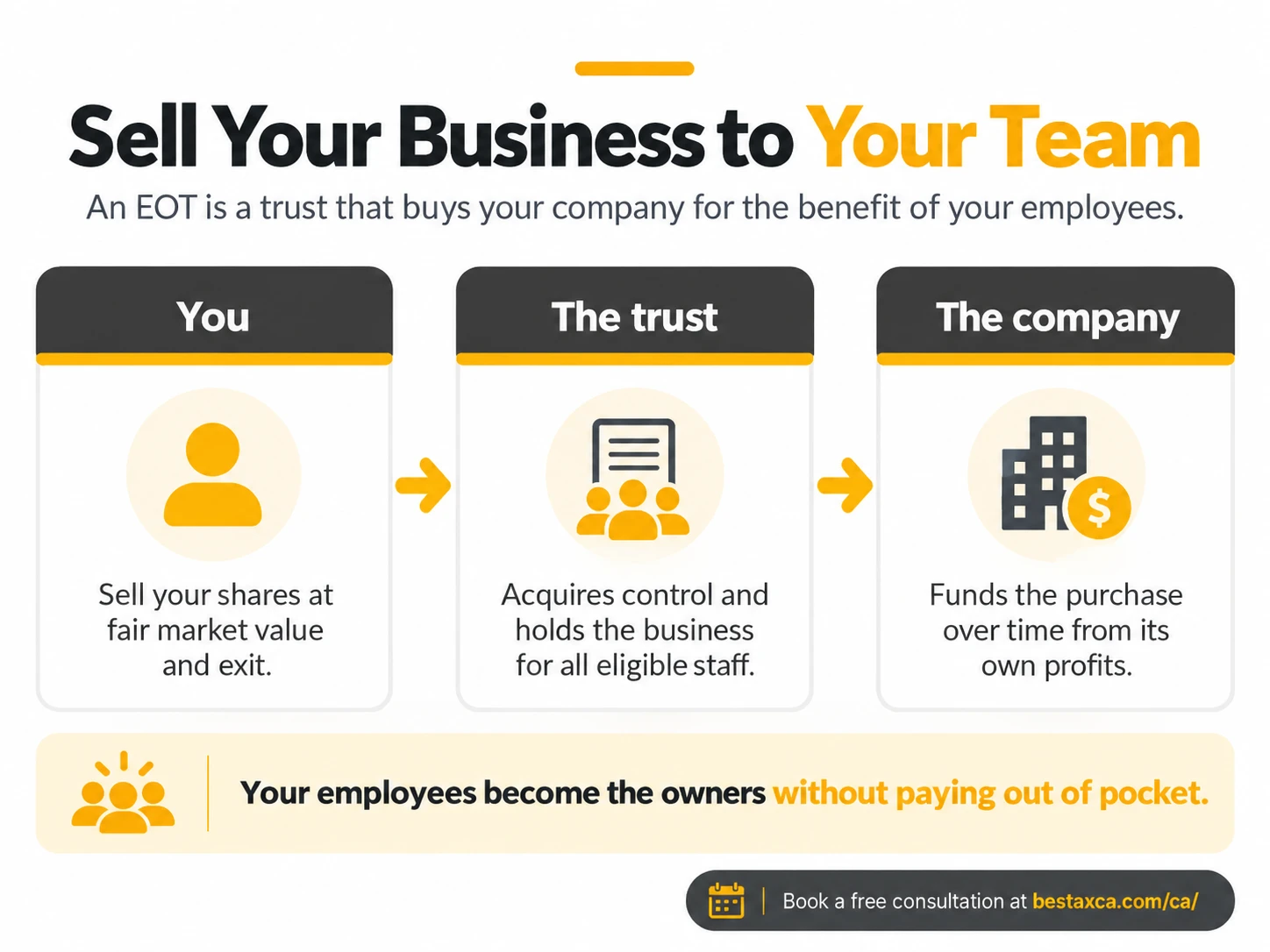
An Employee Ownership Trust is a special kind of trust that buys and holds the shares of your company for the benefit of your employees. Instead of selling to a competitor, a private equity buyer, or a family member, you sell to a trust that holds the business on behalf of your whole team.
The employees do not each buy shares with their own savings. The trust acquires control of the company, and the business itself funds the purchase over time out of its future profits. Your staff become the ultimate owners as a group, and they share in the profits going forward.
Think of it as a structured, tax assisted way to hand your company to the people who helped you build it, while you still get paid a fair market price for what you created.
In short, an EOT gives you three things at once:
- A ready made buyer, your own team, so you avoid a stressful search for an outside purchaser.
- A gradual, self funding payout, because the company pays for itself over several years.
- A large tax break on your gain, which we cover in detail below.
Why Employee Ownership Trusts matter right now
Canada is entering a huge wave of business transitions. Many founders built their companies decades ago and are now thinking about slowing down, but far fewer have a clear plan for who takes over.
Two official numbers show why this is urgent. Innovation, Science and Economic Development Canada reports that there were about 1.10 million employer businesses in Canada as of December 2024, and 98.2 percent of them were small businesses. At the same time, Statistics Canada found that the entry rate into business ownership fell from over 15 percent in 2006 to 12 percent in 2020, a sign that fewer new owners are stepping in to replace those who leave.
Put simply, a very large number of owners will want to exit over the coming years, while the pool of outside buyers is thinning. An EOT solves this by turning your existing employees into the buyer, keeping the business, the jobs, and the local knowledge intact.
The big 2026 update: the $10 million exemption is now permanent
This is the change every Canadian owner needs to know about. When EOTs first arrived, the headline $10 million capital gains exemption was only temporary, meant to apply to sales in the 2024, 2025, and 2026 tax years, and then disappear.
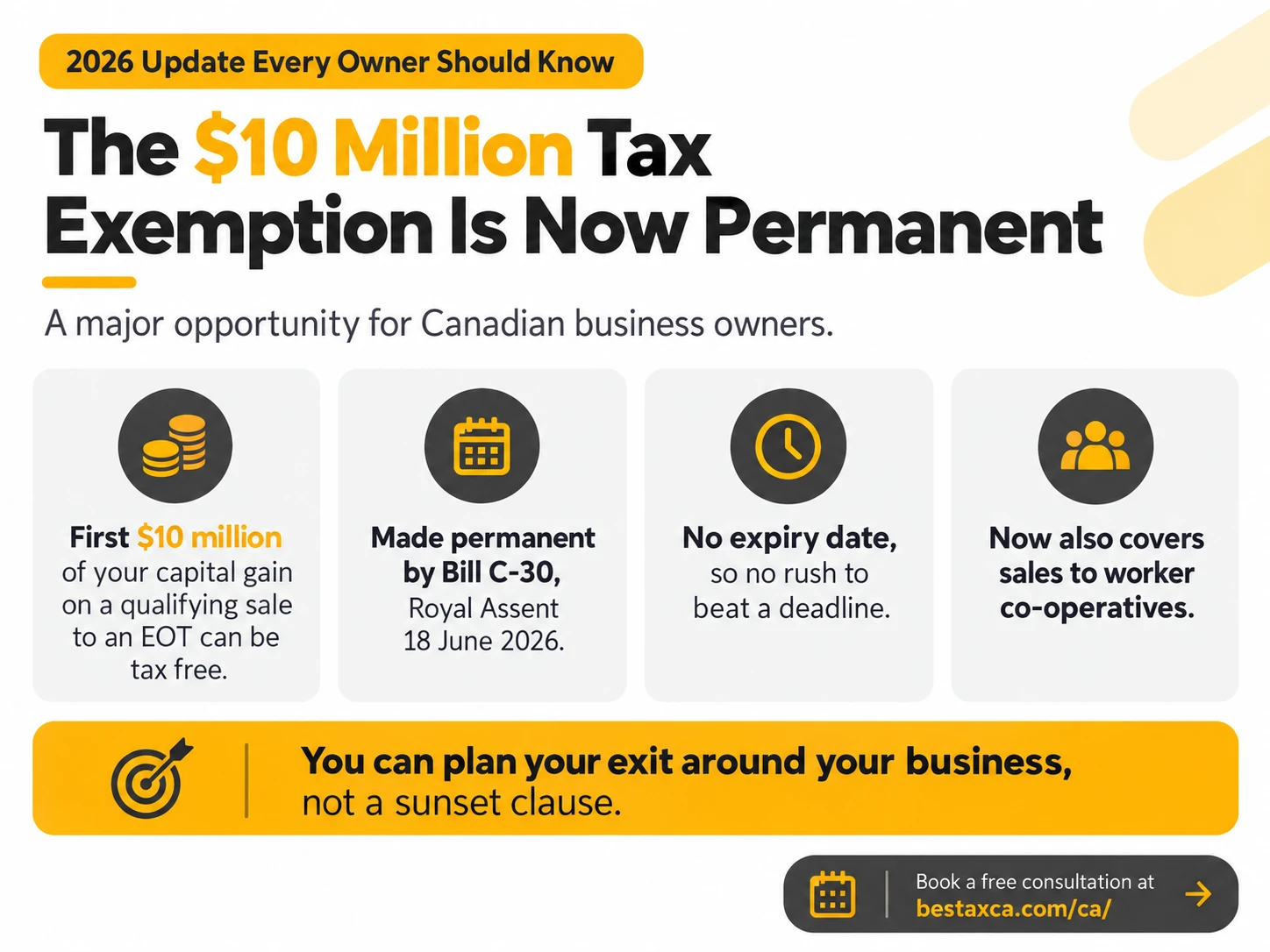
That has changed. In the Spring Economic Update tabled in Parliament on April 28, 2026, the federal government announced it would make the exemption permanent. That promise became law when Bill C-30 received Royal Assent on June 18, 2026.
Here is what the permanent status means for you:
- The $10 million exemption no longer has an expiry date, so you are not forced to rush a sale to beat a deadline.
- The same permanent exemption covers qualifying sales to worker co-operative corporations, which Bill C-15 brought into the regime in March 2026.
- You can plan your exit around what is right for your business and your family, rather than around a sunset clause.
The EOT rules themselves have applied to transactions since the start of 2024. The permanent exemption simply removes the time pressure and gives owners long term certainty.
How selling your business to an EOT works
The mechanics are more straightforward than most owners expect. Here is the typical path from start to finish.
Step 1: Confirm your company qualifies. Your business must be a Canadian-controlled private corporation carrying on an active business. Most owner operated companies in trades, services, manufacturing, and professional fields fit this profile.
Step 2: Set up the trust. We help establish an irrevocable, Canadian resident trust that will hold the shares for your employees. The trust must be run for the benefit of all eligible employees, not just a favoured few.
Step 3: The trust buys your shares. The trust acquires control of your company at fair market value. This is the qualifying business transfer. You must deal at arm's length with the trust and give up control and influence over the company after the sale.
Step 4: The business funds the purchase over time. Rather than a single lump sum, the company usually pays you over a number of years out of its earnings. The tax rules are specifically designed to make this affordable, as explained next.
Step 5: Employees become the owners. Going forward, your team shares in the profits through the trust, using a fair and transparent distribution formula based on factors such as length of service and pay.
The tax benefits of an EOT, explained simply
The EOT rules stack several powerful tax advantages. Together they can save an owner a very large amount of tax compared with an ordinary share sale.
1. The $10 million capital gains exemption
The first $10 million of capital gain you realize on a qualifying sale of your shares to an EOT can be exempt from income tax. Where several owners sell together as part of the same transfer, they share one $10 million exemption in an agreed proportion.
One caution on alternative minimum tax. The exempt portion is not ignored for AMT purposes. It is included at a 30 percent rate, the same treatment given to gains sheltered by the lifetime capital gains exemption, so AMT can still apply on a very large gain and should be modelled before you sell.
2. A ten year capital gains reserve
Normally, when you are paid for a business over time, you must report at least 20 percent of the gain each year, which limits your deferral to five years. For a qualifying sale to an EOT, that minimum drops to 10 percent a year, stretching your maximum deferral to ten years.
This is a genuine cash flow benefit, because the company is paying you gradually and you can match your tax to when you actually receive the money.
3. A fifteen year loan repayment window
If the trust borrows from the company to fund the buyout, the usual rule would force repayment within one year to avoid a tax hit. The EOT rules extend that repayment period to fifteen years, and provide relief from the deemed interest benefit for up to fifteen years. This is what makes a self funding, employee friendly buyout realistic.
4. Relief from the 21 year deemed disposition rule
Most trusts face a deemed sale of their assets every 21 years, which can trigger tax. A qualifying EOT is exempt from this rule for as long as it keeps meeting the conditions, so the trust can hold the business for the long term.
Here is how the tax treatment compares at a glance.
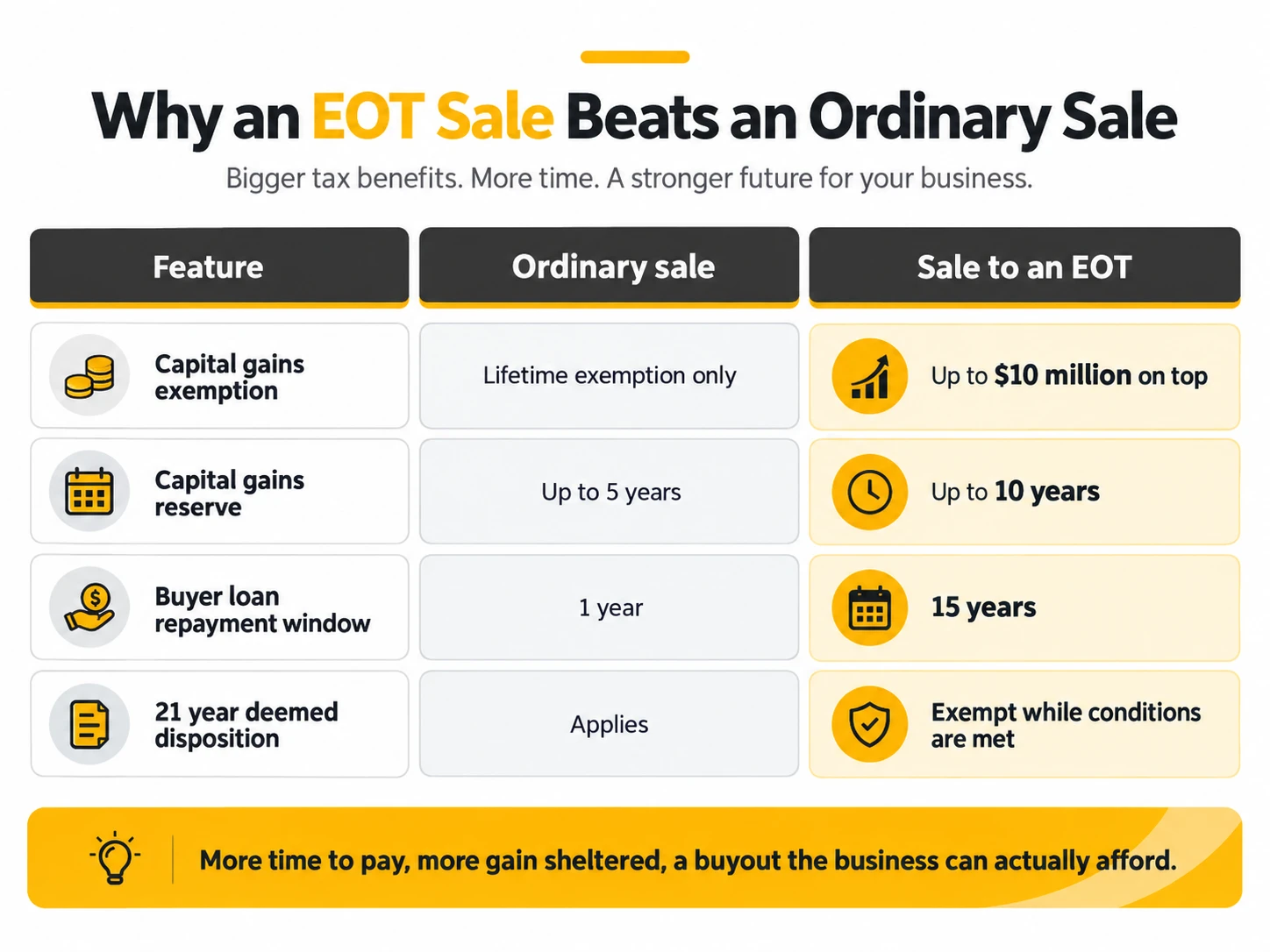
| Feature | Ordinary deferred share sale | Sale to a qualifying EOT |
|---|---|---|
| Capital gains exemption | Lifetime capital gains exemption only | Up to $10 million, plus the lifetime exemption |
| Capital gains reserve | Up to 5 years | Up to 10 years |
| Loan repayment period for the buyer | 1 year | 15 years |
| 21 year deemed disposition | Applies | Exempt while conditions are met |
The conditions you need to meet
An EOT is generous, but it is not a loophole. The rules are specific, and getting a condition wrong can undo the tax benefits. Here are the main requirements, grouped so they are easy to follow.
Your company must be a qualifying business
- It is a Canadian-controlled private corporation.
- Substantially all of its value comes from assets used in an active business in Canada.
- It deals at arm's length with the previous major owners.
The trust must be a genuine Employee Ownership Trust
- It is an irrevocable trust resident in Canada.
- It exists for the benefit of all eligible employees, decided by fair criteria such as hours worked, pay, and length of service.
- At least one third of the trustees must be employee beneficiaries.
- Substantially all of the trust's value must be shares of the qualifying business it controls.
- More than half of the employee beneficiaries must approve certain major events, such as a winding-up, amalgamation or merger of the business.
The sale must be a qualifying business transfer
- The trust acquires control of your company.
- You deal at arm's length with the trust before and after the sale.
- You do not keep any right or influence that would let you keep controlling the company.
Extra conditions to claim the $10 million exemption
- The seller is an individual, generally aged 18 or older, who was actively engaged in the business on a regular, continuous and substantial basis for at least 24 months before the sale.
- A joint election is filed to claim the exemption.
- The exemption can be claimed only once for a given business.
- A disqualifying event, meaning the trust loses its EOT status or the business stops being mainly an active business, can reverse the benefit. If it happens within 24 months of the sale, your exemption is denied retroactively. If it happens after 24 months, the trust is deemed to realize a gain equal to the exempt amount. Technical amendments enacted in March 2026 through Bill C-15 cap this exposure at ten years after the sale, so the trust must be maintained properly throughout that period.
This is where professional guidance earns its keep. A single missed condition can turn a tax free exit into a taxable one, so the trust deed, the transfer agreement, and the elections all need to be drafted and filed correctly.
How an EOT compares to your other exit options
An EOT is one route among several. Here is how it lines up against the common alternatives so you can see where it fits.
- Selling to a third party. Often the highest headline price, but you may not find a buyer, the process can be slow and intrusive, and new owners may cut jobs or move the business. Our guide to selling your business in Canada covers that route.
- Passing it to family. Works only if a family member wants the business and is ready to run it. Many owners have no willing successor, and those who do still need a succession plan.
- A management buyout. Your managers buy in, but they usually need to raise significant financing personally, which can stall the deal.
- Selling to an EOT. Keeps the business independent and locally owned, rewards the whole team, and gives you the $10 million exemption and a self funding, staged payout.
The right answer depends on your goals. If price is your only priority and a strong outside buyer exists, a third party sale may win. If you care about legacy, jobs, and a tax efficient exit with a buyer already in place, an EOT is hard to beat.
Is an Employee Ownership Trust right for your business?
An EOT is not for every company. It tends to work best when the following are true.
An EOT is often a strong fit when:
- You have a profitable, stable business that can fund the buyout from its own earnings.
- You have a capable management team and engaged employees who can run the company without you.
- You value keeping the business independent and rewarding your staff.
- You want a tax efficient exit and are willing to be paid over time.
An EOT may not fit when:
- The business depends almost entirely on you and would struggle without you.
- Profits are thin or unpredictable, making a self funded buyout difficult.
- You need a single large lump sum on closing rather than staged payments.
- A third party is offering a price and terms you simply cannot match.
If you are unsure which camp you are in, that is exactly the conversation to have with an accountant before you commit to any path.
How Bestax helps you sell to your team
Bestax has supported businesses for more than 10 years, with offices in Canada and Dubai and a team of 35+ professionals. From our Canadian office we help owners plan and carry out tax efficient exits, and an EOT sits squarely within our succession and corporate tax work.
When you work with us on an EOT, we:
- Review whether your company qualifies and model the tax outcome before you decide.
- Coordinate the trust setup, the qualifying business transfer, and the financing so every condition is met.
- Prepare and file the elections, the trust returns, and your personal return so the exemption holds up.
- Agree your fee in writing before any work starts, so there are no surprises.
Every engagement is prepared by a specialist and reviewed by a senior professional before anything is filed. If you are even considering handing your business to your employees, a short planning call now can save you a great deal of tax later. Book a free consultation.
Frequently asked questions
What is an employee ownership trust in simple terms?
It is a trust that buys and holds your company's shares for the benefit of your employees. You sell the business to the trust, the company funds the purchase over time from its profits, and your staff become the collective owners without paying out of their own pockets.
How do I sell my business to my employees in Canada?
You set up a qualifying Employee Ownership Trust, transfer control of your company to it at fair market value, and let the business fund the payment over several years. Done correctly, the first $10 million of your gain can be exempt from tax. An accountant handles the trust setup, the transfer, and the tax elections.
Is the $10 million capital gains exemption still available?
Yes, and it is now permanent. The exemption was originally temporary, but the government made it permanent through Bill C-30, which received Royal Assent on June 18, 2026, so there is no longer an expiry date.
Do my employees have to pay to buy the business?
No. That is the key advantage of an EOT. The employees do not buy shares with their own money. The trust acquires the company and the business itself repays the purchase price over time out of future earnings.
How much tax can I save with an EOT?
The first $10 million of your capital gain can be exempt from income tax. The exempt amount is still included at 30 percent for alternative minimum tax, the same treatment as the lifetime capital gains exemption, so AMT can apply on a very large gain. Your exact saving depends on your province and your gain, so it is worth having the numbers modelled before you sell.
Who qualifies to sell shares to an EOT?
Generally an individual owner of a Canadian-controlled private corporation that runs an active business. The seller must deal at arm's length with the trust, give up control after the sale, and meet the active engagement and election conditions to claim the exemption.
How long does the company have to repay the loan used to buy the shares?
Up to fifteen years. Normally an inter company loan like this would need repaying within one year, but the EOT rules extend the window to fifteen years, which is what makes a self funding buyout affordable.
Can more than one owner use the exemption on the same sale?
Yes. When several owners sell together as part of one qualifying business transfer, they share a single $10 million exemption between them in an agreed proportion, rather than each getting a separate $10 million.
What is the difference between an EOT and a management buyout?
In a management buyout, a small group of managers personally finances and buys the business. In an EOT, a trust buys the company for the benefit of all eligible employees, the business funds the purchase, and the owner gets access to the $10 million exemption.
What happens if the trust stops meeting the rules after the sale?
A disqualifying event can reverse the tax benefits. Within 24 months of the sale it denies your exemption outright, and after 24 months the trust is taxed on the exempt amount instead. Since Bill C-15 in March 2026 the exposure is capped at ten years after the sale. This is why the trust must be set up and maintained correctly, and why ongoing professional support matters as much as the initial deal.
Is an EOT better than selling to an outside buyer?
It depends on your goals. An outside buyer may offer a higher headline price, but an EOT keeps the business independent, rewards your team, gives you a large tax exemption, and provides a buyer who is already in place. For many owners focused on legacy and tax efficiency, that combination wins.
How do I get started with an employee ownership trust?
Start with a planning conversation. An accountant reviews whether your company qualifies, models the tax outcome, and maps the steps. You can book that first review with Bestax at no cost.


