


An RRSP lets you put up to 18% of last year's earned income into a registered account, deduct it against this year's tax, and let the investments grow untaxed until you take the money out. For the 2026 tax year the dollar ceiling is $33,810.
When you withdraw, the amount is added to your income and your financial institution holds back 10% to 30% on the spot, unless you are withdrawing under the Home Buyers' Plan or the Lifelong Learning Plan. This guide covers the limits, the deadlines, the withdrawal rules and the traps, with every figure taken from the Canada Revenue Agency.
New to RRSPs? Start here
An RRSP, or Registered Retirement Savings Plan, is a savings and investment account registered with the government that helps you save for retirement while lowering your tax bill today. You put money in, claim it as a deduction to reduce your taxable income, and your investments grow without being taxed each year. You only pay tax when you take the money out, usually in retirement when your income and tax rate are often lower.
Think of it as a deal with the Canada Revenue Agency: pay less tax now, in exchange for paying tax later on the money you withdraw.
The words you need
- Contribution - money you deposit into your RRSP.
- Contribution room, also called your deduction limit - the most you are allowed to put in this year. The CRA works it out for you.
- Earned income - mainly your salary, wages and self-employment income from the previous year. It is the base used to build new RRSP room.
- Deduction - the amount you subtract from your income at tax time. RRSP contributions are deductible, which is what lowers your tax.
- Marginal tax rate - the tax rate on your next dollar of income. It decides how much a contribution saves you and how much a withdrawal costs you. Our guide to how the marginal tax rate works in Canada walks through the arithmetic.
- Withholding tax - tax your financial institution takes off the top of a withdrawal and sends to the CRA on your behalf. It is a prepayment, not your final tax.
- Notice of Assessment - the summary the CRA sends after it processes your return. Your exact RRSP room is printed on it, and we cover what to do when yours arrives separately.
- RRIF - a Registered Retirement Income Fund, the account most people convert their RRSP into to draw a retirement income.
The numbers at a glance
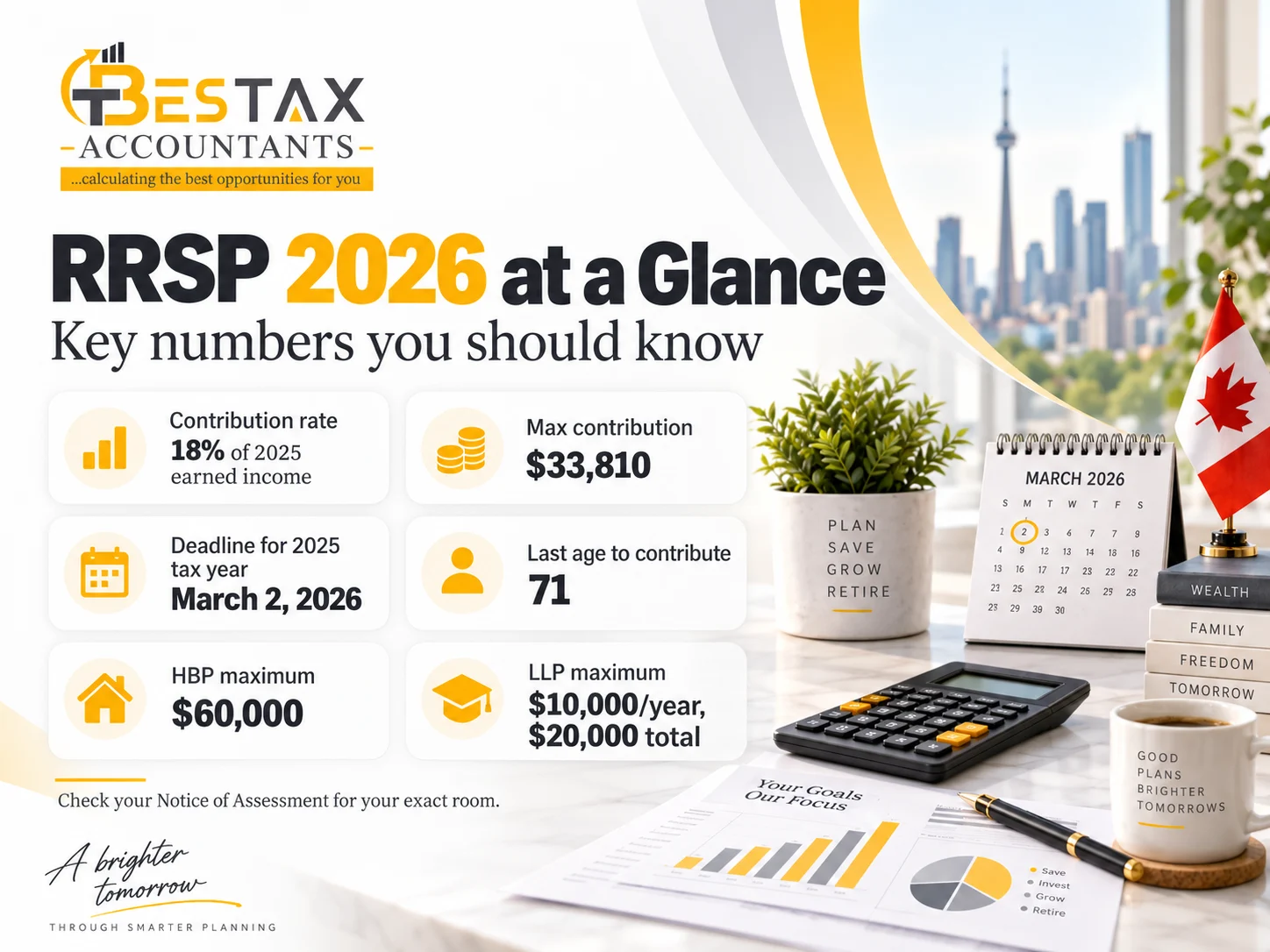
| What | 2026 figure |
|---|---|
| Contribution rate | 18% of your 2025 earned income |
| Maximum contribution (dollar limit) | $33,810 |
| Deadline for the 2025 tax year | March 2, 2026 (now passed) |
| Last age you can contribute | End of the year you turn 71 |
| Withdrawal tax withheld (residents outside Quebec) | 10% to 30%, depending on the amount |
| Home Buyers' Plan maximum | $60,000 |
| Lifelong Learning Plan maximum | $10,000 per year, $20,000 in total |
Each of these is explained below, along with how to use it.
How an RRSP works, step by step
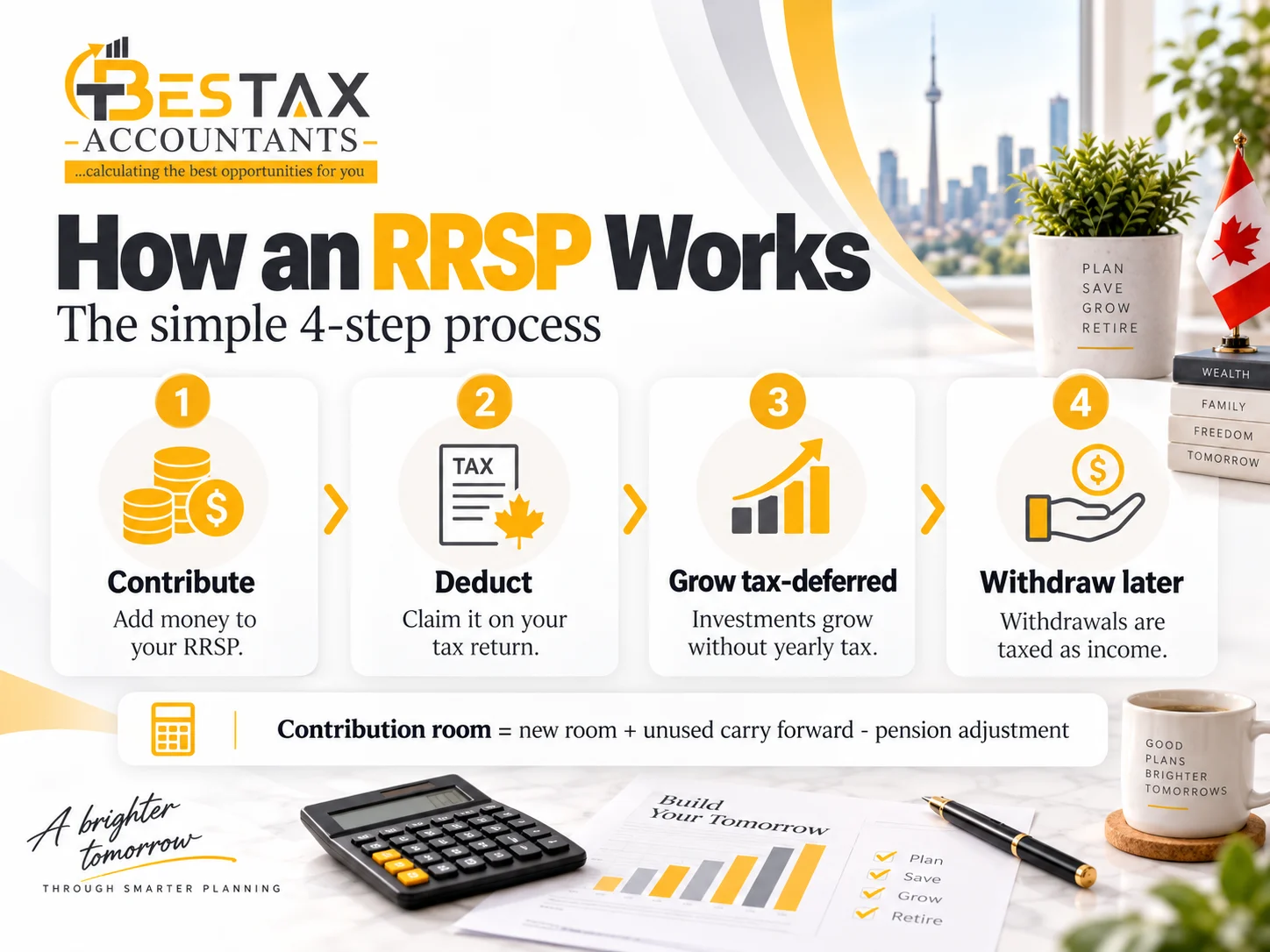
- You contribute. You deposit money into your RRSP, either as a lump sum or through regular deposits during the year.
- You deduct. You claim the contribution on your tax return, which lowers your taxable income and can produce a refund.
- It grows tax deferred. Interest, dividends and capital gains inside the RRSP are not taxed year to year. Tax deferred means the tax is delayed, not erased.
- You withdraw later. When you take money out it is added to your income for that year and taxed at your rate at that time.
The power of an RRSP is that step three runs for decades. Money that is never taxed along the way compounds faster than money in a regular account, where capital gains and investment income are taxed as they arise.
The RRSP contribution limit for 2026
Your RRSP contribution limit is the lower of two numbers:
- 18% of the earned income you reported for the previous year, or
- the annual dollar limit set by the CRA.
For the 2026 tax year the RRSP dollar limit is $33,810. To reach that full amount through the 18% rule you would need about $187,833 of 2025 earned income, because $33,810 divided by 0.18 is $187,833. If you earned less than that, the 18% figure is your cap. If you earned more, the dollar limit is your cap.
Here is how the limit has moved, straight from the CRA's table.
| Tax year | RRSP dollar limit |
|---|---|
| 2024 | $31,560 |
| 2025 | $32,490 |
| 2026 | $33,810 |
| 2027 | $35,390 |
The limit rises most years because it is tied to average wage growth. That is why the figure you used last year is not the figure to use this year, and why it pays to check the current number every season.
A quick example. If you earned $80,000 in 2025 and have no workplace pension, your new 2026 room from the 18% rule is roughly $14,400. If you earned $250,000, the 18% rule would allow more than the ceiling, so your new room is capped at $33,810.
Contribution room, and how to find yours
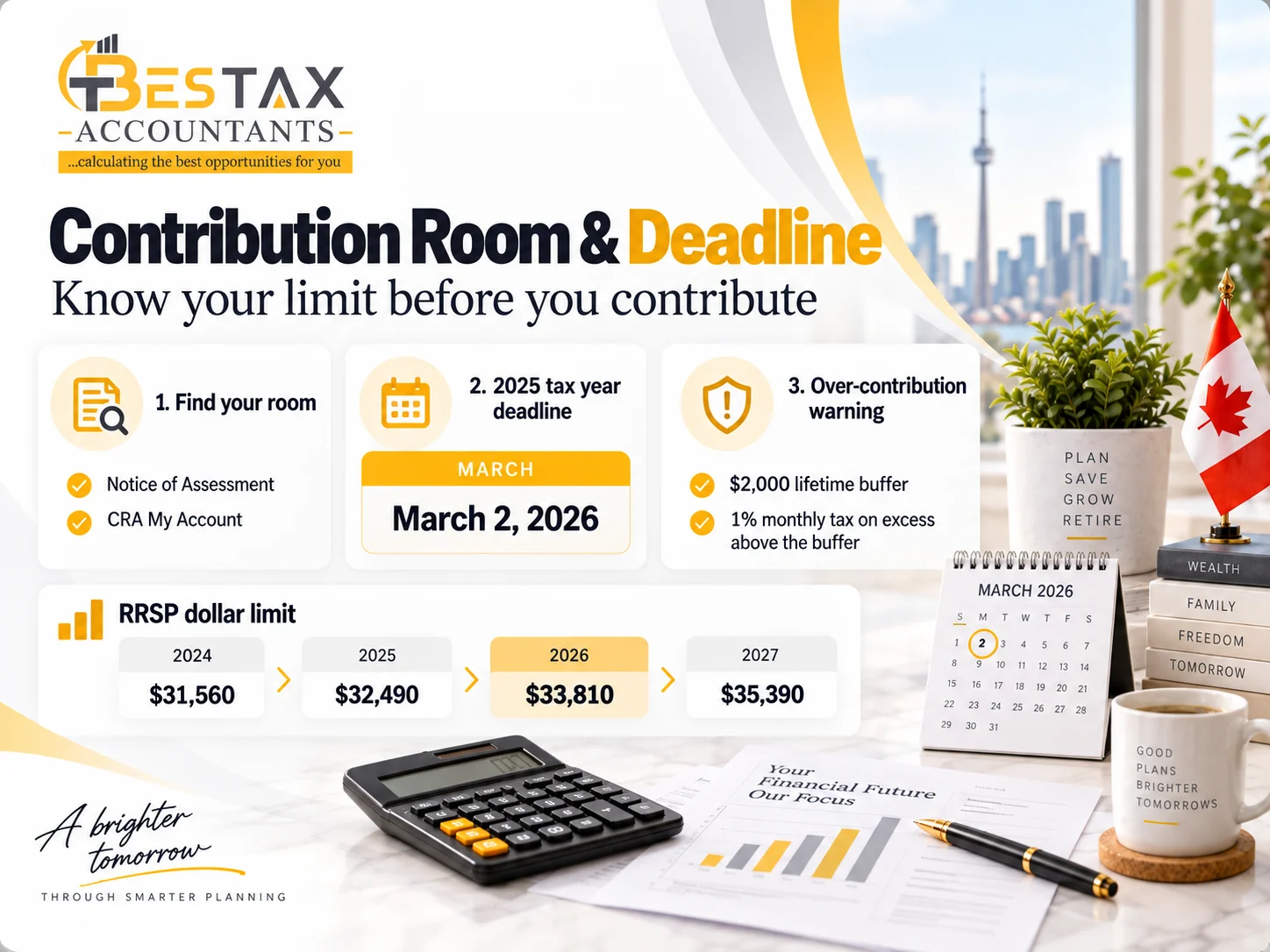
Your total room is not just this year's number. It is this year's new room plus any unused room carried forward from past years, adjusted for a couple of items.
- Carry forward. If you did not use all your room in earlier years it does not disappear. It carries forward and adds to your limit. Many Canadians have tens of thousands of dollars of unused room built up.
- Pension adjustment. If you belong to a workplace pension plan, the CRA reduces your RRSP room by a pension adjustment shown on your T4 slip, so the same retirement saving is not counted twice.
The most reliable way to find your exact room is to look it up rather than calculate it:
- check the RRSP deduction limit line on your latest Notice of Assessment, or
- sign in to CRA My Account and open the RRSP and TFSA section.
Both show the precise amount you can contribute, which removes the guesswork and is the simplest way to avoid going over.
The RRSP deadline
Contributions count against a tax year if you make them during that year or in the first 60 days of the next one. That is the rule behind the shifting date people find confusing.
For the 2025 tax year the deadline was March 2, 2026, and it has now passed. Sixty days after December 31, 2025 landed on Sunday March 1, so the deadline moved to the next business day.
For the 2026 tax year the deadline falls on Monday, March 1, 2027, which is 60 days after December 31, 2026 and a business day. Because the date moves by a day or two depending on where the weekend falls, it is worth confirming against the CRA's own important dates page before you rely on it.
Two timing points that catch people out:
- A contribution made in the first 60 days of a year can be claimed against either the previous year or the current one, but you must report it either way, so keep your receipts.
- The last year you can contribute to your own RRSP is the year you turn 71. December 31 of that year is your final contribution date, and after that the account must be converted.
If deadlines are the part you struggle with, our roundup of every Canadian tax deadline puts the RRSP date alongside the rest of the year.
RRSP withdrawal rules
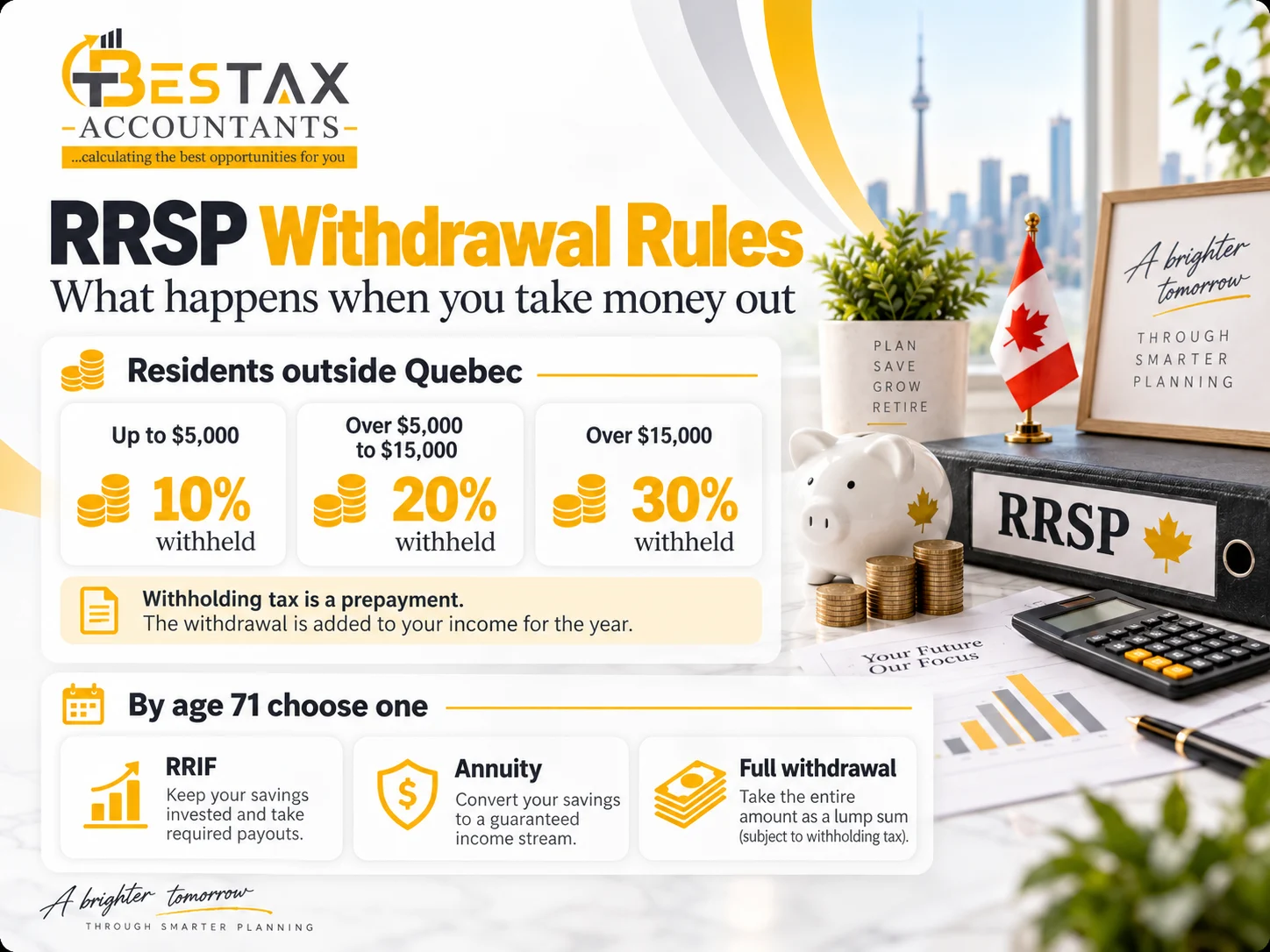
The core rule is simple to state: money you take out of an RRSP is added to your income for that year and taxed at your marginal rate. On top of that, your financial institution withholds tax at the moment of withdrawal and sends it to the CRA.
How much tax is withheld
| Amount you withdraw | Withheld outside Quebec | Withheld in Quebec (federal portion) |
|---|---|---|
| Up to $5,000 | 10% | 5% |
| Over $5,000, up to $15,000 | 20% | 10% |
| Over $15,000 | 30% | 15% |
For funds held in Quebec, provincial tax is withheld as well. For non-residents of Canada the rate is 25% unless a tax treaty reduces it, which is one of the questions our non-resident tax team is asked most often.
Two things everyone should understand about that table:
- The rate applies to the whole withdrawal, not only the part above a threshold. A single withdrawal of $16,000 has 30% withheld on the full $16,000.
- Withholding is only a prepayment. When you file, the withdrawal is added to your total income. If your actual rate is higher than what was withheld you will owe the difference; if it is lower, some may come back.
At tax time you report the withdrawal on line 12900 of your return, and you claim the tax already withheld, shown in the income tax deducted box of your T4RSP slip, on line 43700.
What happens to your RRSP at 71
You cannot hold a regular RRSP forever. By the end of the year you turn 71 you must do one of three things:
- Convert it to a RRIF and draw a yearly income. This is what most people do.
- Buy an annuity, which pays a set income for life or for a set period.
- Withdraw the full balance as a lump sum, which is fully taxable in that one year and is rarely the best choice.
A RRIF keeps your money invested and growing, but it carries a minimum withdrawal each year that rises with age. Planning that transition early is what keeps the tax on those future withdrawals manageable, which is why many people draw smaller amounts across several years rather than one large sum. Our personal income tax service exists for exactly this kind of sequencing.
Two ways to withdraw without tax
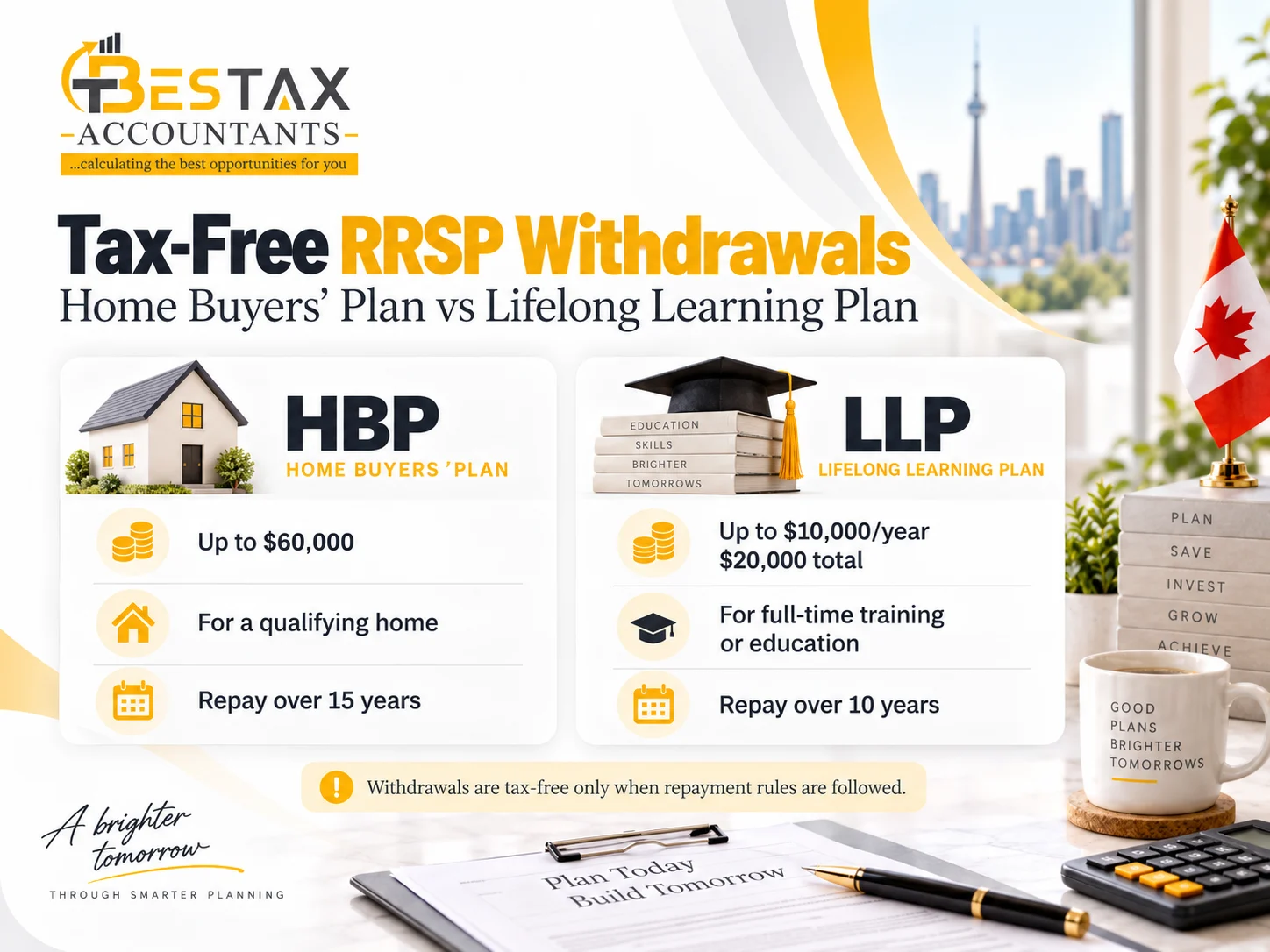
Two government programs let you take money out of an RRSP without immediate tax, provided you pay it back on schedule.
The Home Buyers' Plan
The Home Buyers' Plan lets you withdraw up to $60,000 from your RRSP to buy or build a qualifying home.
- You must generally be a first-time home buyer.
- Your RRSP issuer does not withhold tax on withdrawn amounts of $60,000 or less.
- You must buy or build the qualifying home before October 1 of the year after the year of your first withdrawal.
- You repay the amount to your RRSP over 15 years.
- A couple who both qualify can withdraw up to $60,000 each.
When repayments start has changed, and this catches people out. The old rule, that repayments begin the second year after the withdrawal, now applies only to first withdrawals made before January 1, 2022. The CRA defers the start of the 15-year period by a further three years for anyone making a first withdrawal between January 1, 2022 and December 31, 2028, so the repayment period begins in the fifth year after the withdrawal instead. Withdraw for the first time in 2026 and your first repayment year is 2031, not 2028. Miss a required yearly repayment once it has started and that portion is added to your income for the year.
The Lifelong Learning Plan
The Lifelong Learning Plan lets you withdraw up to $10,000 in a calendar year, to a lifetime total of $20,000, to pay for full-time training or education for you or your spouse or common-law partner.
- No tax is withheld on LLP withdrawals.
- You and your spouse can each withdraw up to $10,000 in the same year.
- You repay the amount to your RRSP, generally within 10 years. Anything not repaid when it is due is included in your income for that year.
- The student has to still be enrolled in the program at the end of March of the year after the withdrawal, or to have received a written offer to enrol by then.
- You cannot use locked-in RRSPs for the LLP.
Both plans are borrowing from your own future. Weigh the cash today against the retirement growth you give up until you have repaid it.
Over-contributions and the penalty
Putting in more than your limit is expensive, so the rule is worth knowing. The CRA gives every contributor aged 18 or older a lifetime buffer of $2,000. You can exceed your deduction limit by up to that amount without penalty, although the buffer does not give you an extra deduction.
Go beyond the buffer and you generally pay a tax of 1% per month on the excess, for every month it stays in the account. A common cause is forgetting that employer contributions to a group RRSP count toward your limit.
If it happens, the fastest fix is usually to withdraw the excess as soon as you notice, which stops the monthly tax from accumulating. You may also need to file the CRA's excess contribution return, the T1-OVP. Checking your Notice of Assessment before you contribute is the simplest way to never need any of this.
RRSP, TFSA or FHSA
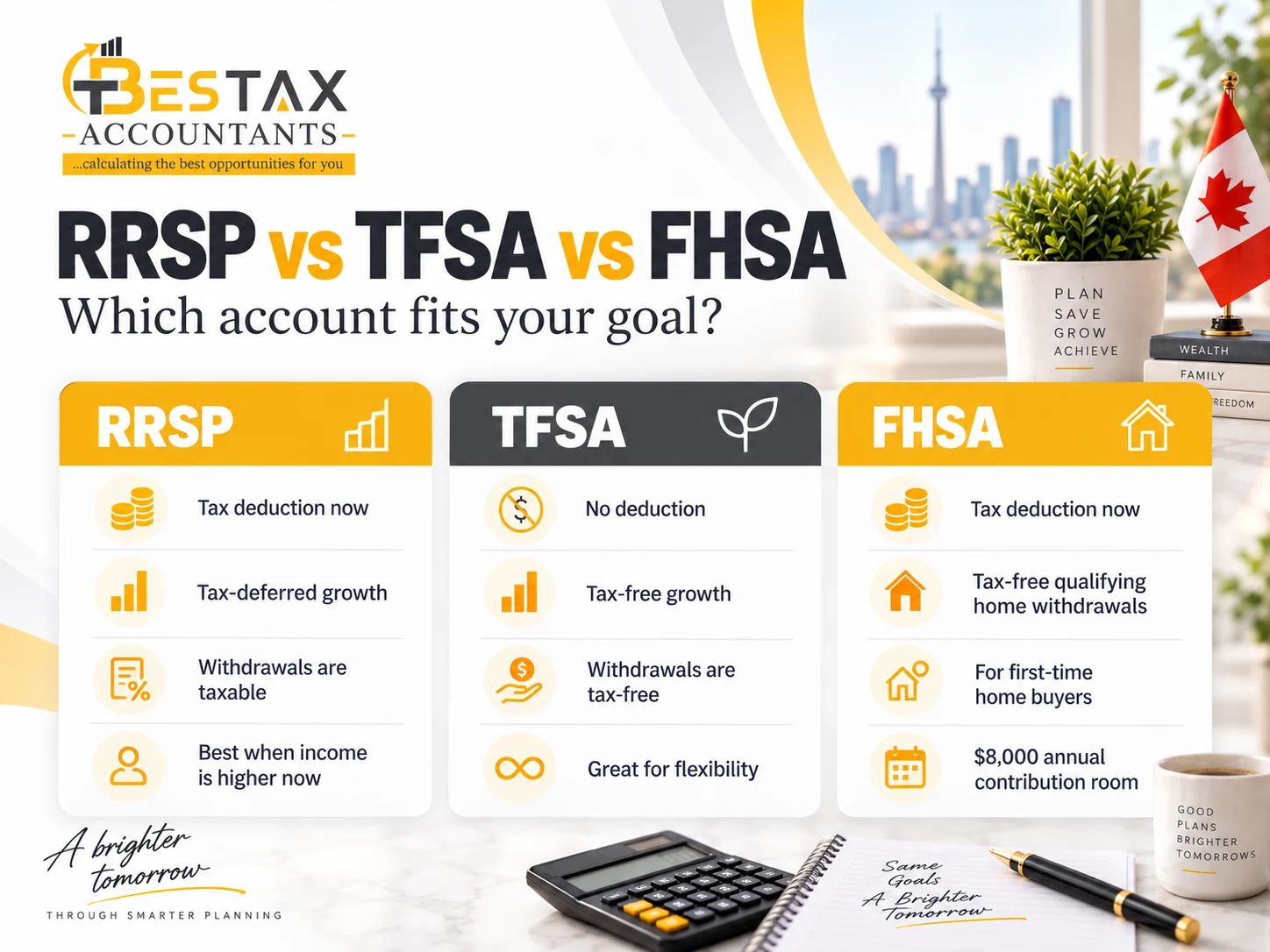
Many people ask which account to fill first. The plain version:
- RRSP - best when your income and tax rate are high now and likely to be lower in retirement. You get a deduction today and pay tax on withdrawal.
- TFSA - no deduction going in, but withdrawals are completely tax free. Good for flexibility and for lower-income years. Our TFSA guide covers the limits and the rules.
- FHSA - built for first-time buyers, with a deductible contribution of up to $8,000 a year and tax-free withdrawals for a home.
These accounts usually work best together rather than as either-or choices. The right mix depends on your income, your goals and your stage of life.
How Bestax helps with your RRSP and personal taxes
RRSP rules are straightforward on the surface and full of small traps underneath: the shifting deadline, the pension adjustment, the withholding surprise, the repayment schedules that have quietly changed. Getting them right can mean a larger refund now and a smaller tax bill later.
Bestax is an accounting and tax firm with offices in Canada and Dubai, more than ten years of experience and a team of over 35 professionals. We help individuals and business owners plan contributions, time withdrawals and file accurately with the CRA. The services that touch RRSPs most often are:
- Personal income tax services for return preparation and RRSP planning.
- Guidance for the self-employed, whose RRSP room is built from business income rather than a T4.
- Cross-border and international tax and non-resident tax services for clients with ties abroad.
- Departure tax planning for anyone leaving Canada while holding registered accounts.
Frequently asked questions
An RRSP is a Registered Retirement Savings Plan, a government-registered account that lets you save for retirement while lowering your tax now. You contribute, claim the contribution as a deduction to reduce your taxable income, and your investments grow without yearly tax. You pay tax only when you withdraw, usually in retirement when your rate is often lower.
For the 2026 tax year the limit is 18% of your 2025 earned income, up to a dollar maximum of $33,810. Your personal limit is the lower of those two figures, plus any unused room carried forward from past years.
The deadline for the 2025 tax year was March 2, 2026. For the 2026 tax year it falls on Monday, March 1, 2027. The date sits 60 days after December 31, so it moves by a day or two each year depending on the weekend.
Check the RRSP deduction limit shown on your latest Notice of Assessment, or sign in to CRA My Account and open the RRSP and TFSA section. Both show your exact room, so you do not have to calculate it yourself.
Yes, at any age. The amount is added to your income for the year and taxed at your rate, and your financial institution withholds 10% to 30% up front. The main exceptions are the Home Buyers' Plan and the Lifelong Learning Plan, which are tax free as long as you repay on schedule.
For residents outside Quebec, 10% is withheld on amounts up to $5,000, 20% on amounts over $5,000 up to $15,000, and 30% on amounts over $15,000. That is only a prepayment. Your final tax depends on your total income for the year, so you may owe more or get some back when you file.
By the end of the year you turn 71 you must convert your RRSP to a RRIF, buy an annuity, or withdraw the full balance. Most people convert to a RRIF and draw a yearly income. A lump sum is fully taxable in that single year, so it is rarely the best option.
Yes. Under the Home Buyers' Plan you can withdraw up to $60,000, tax free, to buy or build a qualifying first home, and a qualifying couple can withdraw up to $60,000 each. You repay it over 15 years, and for first withdrawals made between 2022 and 2028 those repayments do not begin until the fifth year after the withdrawal.
Yes. The Lifelong Learning Plan lets you withdraw up to $10,000 a year, to a lifetime maximum of $20,000, for full-time training or education for you or your spouse or common-law partner. It is tax free provided you repay it to your RRSP, generally within 10 years.
With an RRSP you get a deduction when you contribute and pay tax when you withdraw. With a TFSA you get no deduction, but withdrawals are completely tax free. An RRSP usually wins when your tax rate is high now and lower in retirement, while a TFSA offers more flexibility.
The CRA gives you a lifetime buffer of $2,000 to exceed your limit without penalty, provided you are 18 or older. Beyond that buffer you generally pay 1% per month on the excess for each month it stays in the account. Withdrawing the excess quickly stops the penalty growing.
Yes. Any room you do not use carries forward to future years and adds to your limit, so it is not lost by waiting. Your accumulated room appears on your Notice of Assessment and in CRA My Account.
Yes. Almost every RRSP withdrawal is added to your taxable income for the year and taxed at your marginal rate. The exceptions are amounts taken under the Home Buyers' Plan or the Lifelong Learning Plan, which are not taxed as long as you repay them on time.
Make your contribution room work harder
A contribution made in the right year, at the right size, against the right income is worth considerably more than the same money moved on the last day before a deadline. If you want your RRSP planned around your actual tax position rather than a round number, talk to our Canadian team. We are available 24/7.

