


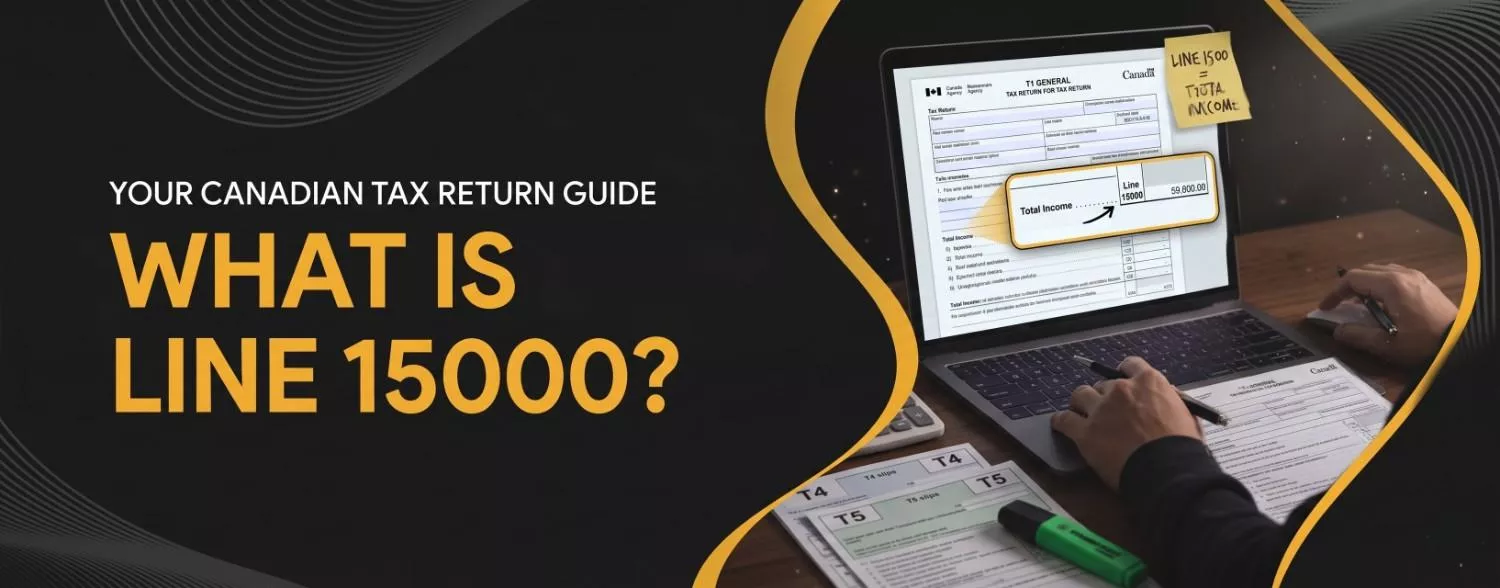
Line 15000, formerly known as line 150, this field was expanded to five digits in 2019. It’s a crucial figure because it determines your eligibility for government benefits and credits and is used to verify your identity when contacting the Canada Revenue Agency (CRA). In this 2026 guide, we’ll explain what line 15000 on tax return means, how to calculate it, how to find it on your Notice of Assessment and why it matters for your financial planning.
What Is Line 15000 on a Canadian Tax Return?
Line 15000 (formerly 150) is your total income before deductions. The CRA uses this amount, along with other lines, to calculate your net income (line 23600) and taxable income (line 26000). On a Notice of Assessment, you’ll see a summary of these lines, total income (line 15000), net income (line 23600) and taxable income (line 26000), which the CRA uses to compute your final balance or refund. Because the 2019 tax package converted three‑ and four‑digit line numbers to five digits, older instructions referring to line 150 now apply to line 15000.
Total Income vs. Net Income vs. Taxable Income
- Total income (Line 15000): Sum of all reportable income sources before any deductions.
- Net income (Line 23600): Calculated by subtracting the total of lines 20700 to 23500 (such as RRSP deductions, union dues, childcare expenses) from your total income. Net income is used to determine federal and provincial credits, such as the Canada child benefit and GST/HST credit.
- Taxable income (Line 26000): Net income minus additional deductions like capital losses or Northern residents deductions.
Sources of Income Included in Line 15000
The CRA’s tax guide outlines the types of income you must include in your total income. Step 2 of the T1 guide lists the lines that flow into line 15000. Common income sources include:
- Employment income (Line 10100): Salaries, wages and vacation pay.
- Other employment income (Line 10400): Tips, occasional earnings and taxable allowances.
- Employment insurance and other benefits (Line 11900) and EI maternity and parental benefits (Line 11905): These amounts are already included in line 11900, so do not add them again when calculating total income.
- Pension and retirement income (Lines 11300–11600): Old Age Security (OAS), Canada Pension Plan/Quebec Pension Plan (CPP/QPP), private pensions, superannuation and split‑pension amounts.
- Dividends from Canadian corporations (Lines 12000 and 12010).
- Interest and other investment income (Line 12100).
- Net partnership income (Line 12200).
- Registered disability savings plan (RDSP) income (Line 12500).
- Taxable capital gains (Line 12700).
- Registered retirement savings plan (RRSP) income (Line 12900).
- Taxable first home savings account (FHSA) income (Lines 12905, 12906).
- Other income (Line 13000) and taxable scholarships, fellowships, bursaries and grants (Line 13010).
- Self-employment income from business, profession, commissions, farming and fishing (Lines 13499–14300).
- Social assistance payments (Line 14500).
For more information about income sources included in line 15000, visit the official Canada Revenue Agency (CRA) website
Each type of income has its own line on the T1 return. When you calculate your total income, you add up all these amounts. For example, commissions included on line 10100 should not be added again on line 15000, because they are already part of your employment income. The same rule applies to maternity and parental benefits.
Non-Taxable Income and Exemptions
Some amounts are not included in total income. Tax‑exempt income under section 87 of the Indian Act should not be reported in Step 2 of your tax return. Other examples of non-taxable income include certain lottery winnings, gifts, federal and provincial social assistance benefits, and child support (depending on court orders). Always consult the CRA instructions for the specific lines to see whether amounts must be reported.
How to Find Line 15000 on Your Tax Return or Notice of Assessment
On a Paper or PDF Return
If you file your T1 return on paper, line 15000 is located in the Step 2 – Total income section. It’s the final line of that section, after you’ve added all your income amounts. The CRA updated line numbers to five digits in 2019, so if you’re referencing older forms or guides, remember that line 150 is now line 15000.
In Certified Tax Software
Most tax software automatically calculates line 15000 as you enter your slips. To view it, check the summary or review sections labeled “Total income.” It may also appear in the pre‑file summary you can print or save for your records.
On Your Notice of Assessment
After the CRA processes your return, you receive a Notice of Assessment. This document summarizes the key lines of your return, including:
- Line 15000 – Total income
- Line 23600 – Net income
- Line 26000 – Taxable income
In the CRA’s education portal, a sample notice shows Line 15000 Total income: 18,000, Line 23600 Net income: 17,050, and Line 26000 Taxable income: 17,050. If the CRA reassesses your return, these amounts may differ from what you originally reported.
When the CRA Asks for Line 15000
The CRA often asks for the amount on line 15000 to verify your identity when you call or when you use the automated phone service to request a proof of income statement. The proof of income statement page lists the items you need to verify your identity, including your Social Insurance Number, full name, date of birth, complete address and line 15000 from your most recent assessment. Keep your Notice of Assessment in a secure place so you can provide this number when required.
Calculating Line 15000 Manually
If you need to calculate your total income manually, for example, to check your eligibility for benefits or to estimate your tax liability you can follow these steps:
- Gather all your slips (T4s for employment income, T4A for pensions and other income, T5 for investment income, T3 for trusts, T5013 for partnerships, etc.).
- List each income amount under its corresponding line number. For example, salaries from T4 slips go to line 10100, interest to line 12100, and capital gains to line 12700. Use the CRA guide or tax software to confirm the correct lines.
- Add all the amounts. The total is your line 15000 total income.
- Do not double-count items that are already included in another line. For example, commissions in box 42 of your T4 slip are already part of line 10100 and should not be added again; EI parental benefits in box 36 of your T4E slip are already included in line 11900.
Example Calculation
Suppose you earned $60,000 from employment (line 10100), $1,200 in interest (line 12100), and $5,000 in eligible dividends (line 12000). Your total income (line 15000) would be $66,200. If you also received $3,000 in EI parental benefits reported on your T4E slip, you would not add it again because it is already included in line 11900.
Why Line 15000 Matters
Determining Eligibility for Benefits and Credits
Your total income influences many federal and provincial programs. For instance, the CRA uses your net income (derived from line 15000) to determine eligibility and payment amounts for the Canada child benefit (CCB), GST/HST credit and other non-refundable tax credits. Higher total income may reduce your benefits or lead to clawbacks on programs like Old Age Security and employment insurance.
Verifying Identity and Orders
When you call the CRA to request information, set up a payment plan or order a proof of income statement, you must provide your total income amount from line 15000 along with personal information. This requirement helps the CRA confirm your identity and protect your privacy.
Applying for Loans or Subsidies
Banks, mortgage lenders and government agencies may request a proof of income statement that shows your total income. Because it’s drawn from your tax return, line 15000 provides lenders with an accurate measure of your gross income before deductions.
Immigration and Sponsorship
Immigration, Refugees and Citizenship Canada (IRCC) may use your total income (line 15000) when assessing your eligibility to sponsor family members. While IRCC has its own guidelines, they often reference line 15000 on your Notice of Assessment as a measure of your income stability.
Quick (FAQs)
What line is 15000 on tax return?
Line 15000 appears in the Step 2 – Total income section of the T1 general return. It’s the final line in that section and is labelled “Total income”. On your Notice of Assessment, it’s part of the tax summary along with net and taxable income.
What is line 15000 on a tax return on a T4?
A T4 slip lists your employment income in boxes 14, 24, 44 and 46, but it doesn’t have a line 15000. Instead, the amounts from your T4 slip are transferred to line 10100 (employment income) on your T1 return. When you calculate line 15000, your employment income (box 14 on T4) is one of the components. Do not re‑enter your commissions from box 42 again because they’re already included on line 10100.
What is line 15000 on a tax return in Ontario?
Line 15000 is standardized across Canada. Whether you live in Ontario, British Columbia, Quebec or another province, line 15000 still represents your total income before deductions. Provincial taxes and credits are calculated after the federal total income is determined.
How to find line 15000 on my tax return?
Check your Notice of Assessment or the summary page of your T1 return. It will list line 15000 with the amount of your total income. If you don’t have a paper copy, sign in to CRA My Account, go to “Tax returns,” select the year and look for the “Total income” entry. You can also view this amount in certified tax software or on your printed return. It’s not located on individual tax slips like the T4.
Why does the CRA ask for line 15000 from your 2024 income tax and benefit return?
When calling the CRA or using automated services, you must prove your identity. The CRA may ask for the amount from line 15000 of your most recent assessment to confirm you are the taxpayer or an authorized representative. Keep this amount handy when dealing with the CRA.
Is line 15000 the same as my gross salary?
Not necessarily. Line 15000 is your total income from all sources. It includes your gross employment income but also adds investment income, pensions, benefits and self‑employment income. If you only have employment income, your gross salary will be your main contributor. But if you earn income from investments or rental properties, those amounts increase your total income beyond your salary.
What is “ligne 15000 arc”?
“Ligne 15000” is simply the French term for line 15000, and ARC stands for Agence du revenu du Canada (Canada Revenue Agency). It has the same meaning, total income on your Canadian tax return.