


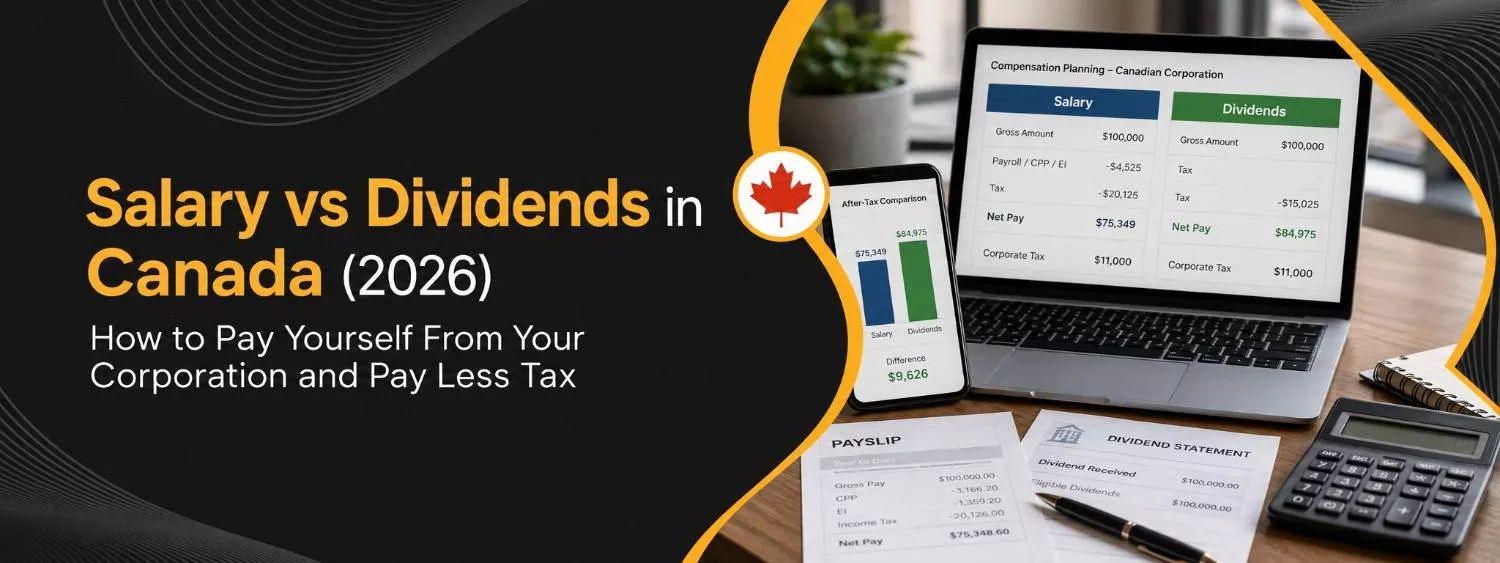
There is no universal winner in the salary-versus-dividends debate. Depending on your province, income, retirement goals and corporation’s tax position, the better approach may be salary, dividends or a carefully planned combination of both.
Salary can create future RRSP contribution room and CPP benefits. Dividends generally avoid CPP contributions and payroll deductions, but they still require proper corporate authorization, accounting records and T5 reporting.
Salary and taxable dividends are the two main ways an owner-manager receives taxable income from a corporation. Other transactions, such as documented expense reimbursements, repayment of an amount genuinely owed to the shareholder or a properly elected capital dividend, may receive different tax treatment. Personal withdrawals recorded as shareholder loans can create taxable income or interest benefits and require careful review.
The Short Answer: Salary vs Dividends
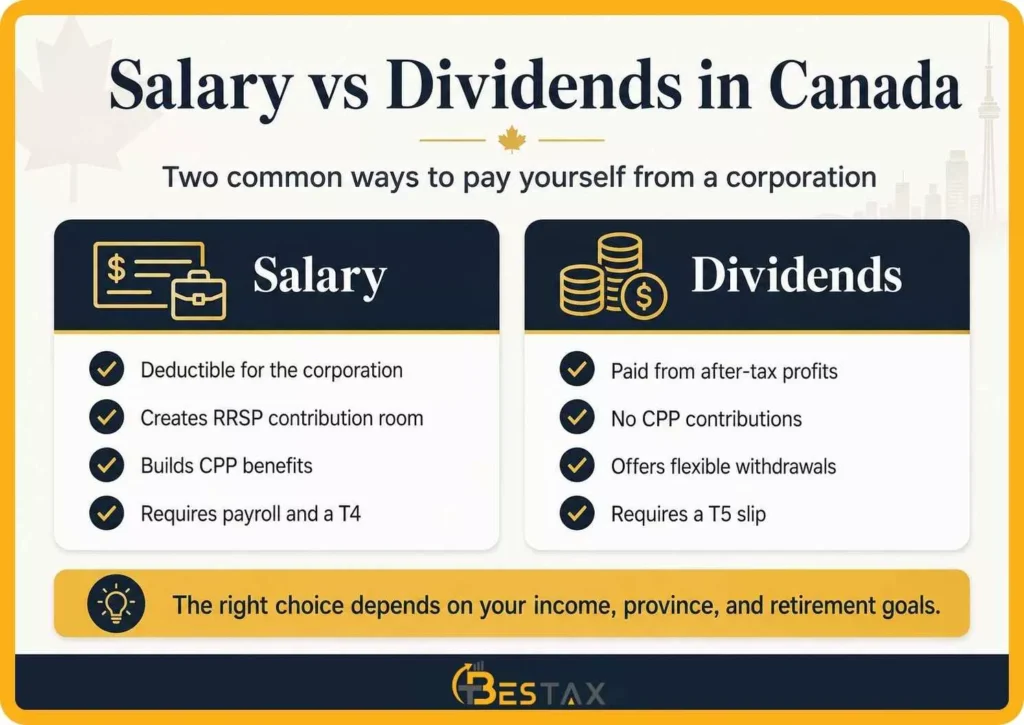
Here is the quick version of salary v dividend, so you do not have to read the whole thing to get the main idea.
- Salary is treated like a job. Your company writes it off as an expense, you pay CPP, and you earn RRSP room. Banks like it when you apply for a mortgage.
- Dividends are your share of the company’s profit after tax. There is no CPP, less payroll paperwork, and the tax rate can be a bit lower at some income levels. But you do not build RRSP room or CPP.
Salary may be easier for some lenders to verify because it appears on a T4. However, many lenders also accept dividend and self-employment income when supported by tax returns and corporate records.
Canada’s tax rules are built so the total tax (company tax plus your personal tax) ends up roughly the same either way. This idea is called integration. Because the totals are close, the choice often comes down to the small extras: CPP, RRSP, cash flow, and how easy you want your year to be.
What It Means to “Pay Yourself” From Your Business
When people ask “how do I pay myself from my business?” the answer depends on how the business is set up.
If you are a sole proprietor (not incorporated), the business profit is already your money. You just pay personal tax on it.
But if you run a corporation, the company is its own legal “person.” The money it earns belongs to the company, not to you, until you move it out. In Canada, you usually move it out in one of two ways:
- A salary: you put yourself on the payroll, like an employee.
- A dividend: the company pays you part of its profit as a shareholder.
You may also hear the words distribution vs dividend. A “distribution” is a general word for money paid out to owners, and it is used a lot in the United States. In a Canadian corporation, the money you take out is normally a salary or a dividend, so “company dividend payments” and “distributions” usually mean the same thing for a small business owner here.
How a Salary Works
A salary (also called employment income) treats you like a staff member of your own company.
On the company side, your salary is a business expense. That lowers the company’s taxable income, which lowers its tax bill.
On your side, you pay personal income tax at the normal rates, plus CPP. Your company also has to set up payroll, take off deductions, and send them to the Canada Revenue Agency (CRA) on time. At year-end, you get a T4 slip.
The good things about a salary:
- It builds RRSP room so you can save for retirement and lower your future tax.
- It builds CPP credits, which become a pension when you retire.
- Banks see salary as steady, “earned” income, which helps when you apply for a mortgage or loan.
- It is a clean write-off for the company.
The downsides of a salary:
- You and your company both pay CPP, which adds cost.
- The full amount is taxed at your personal rate.
- Payroll means more paperwork and deadlines.
How Dividends Work
A dividend is your slice of the company’s profit. The company has already paid corporate tax on that profit, so dividends come out of after-tax dollars. You get a T5 slip for them.
Because the company already paid some tax, the CRA does not want to tax that same money fully again. So it uses two steps called the gross-up and the dividend tax credit:
- First, your dividend is “grossed up” (made a bit bigger on paper) to match the company’s pre-tax income.
- Then you get a tax credit to make up for the tax the company already paid.
There are two kinds of dividends:
- Eligible dividends come from profit taxed at the higher general corporate rate. They get a larger gross-up and a bigger credit.
- Non-eligible dividends come from profit taxed at the lower small business rate. Most small business owners pay themselves these. They get a smaller gross-up and a smaller credit.
The good things about dividends:
- No CPP is taken off.
- Less paperwork, no payroll setup.
- More flexible timing for your cash flow.
- You can leave extra money in the company and take it out later.
The downsides of dividends:
- No RRSP room and no CPP pension is built.
- Family members who get dividends may be hit by special rules (more on that below).
- The total tax can be slightly higher in some provinces.
GRIP, CDA, and RDTOH: Three Accounts That Can Change Your Dividend Plan
Before paying a dividend, your accountant should check whether the corporation has GRIP, CDA or RDTOH balances.
These accounts can affect the type of dividend paid and the total corporate and personal tax.
General Rate Income Pool
The General Rate Income Pool, or GRIP, generally tracks income that was taxed at the higher general corporate tax rate.
A Canadian-controlled private corporation generally needs enough GRIP to pay an eligible dividend without making an excessive eligible-dividend designation.
An eligible dividend receives a larger personal gross-up and dividend tax credit than a non-eligible dividend.
GRIP does not mean the corporation has cash available. It is a tax account, not a bank account.
Capital Dividend Account
The Capital Dividend Account, or CDA, tracks certain tax-free corporate amounts.
It may include:
- The non-taxable portion of net capital gains
- Certain life-insurance proceeds
- Capital dividends received from other corporations
A private corporation may use a positive CDA balance to pay a capital dividend that is generally tax-free to a Canadian-resident shareholder.
The corporation must make the required election. Paying more than the available CDA balance can trigger significant corporate tax.
Like GRIP, the CDA is a tax calculation rather than a separate cash account.
Refundable Dividend Tax on Hand
Refundable Dividend Tax on Hand, or RDTOH, tracks certain refundable corporate taxes.
Private corporations can have two RDTOH accounts:
- Eligible RDTOH, or ERDTOH
- Non-eligible RDTOH, or NERDTOH
When the corporation pays sufficient taxable dividends, it may receive a dividend refund from one of these accounts.
This can make paying a taxable dividend more attractive in a year when the corporation has an RDTOH balance. However, the personal shareholder will still report the dividend and may owe personal tax.
Why These Accounts Matter
Assume two corporations each want to pay a shareholder $50,000.
One corporation may have only small-business income and no special balances. The other may have GRIP, CDA or RDTOH available.
Even though the cash payment is the same, the dividend classification and combined tax result could be very different.
Check these balances before the directors declare the dividend, not after the money has already been transferred.
The 2026 Numbers You Should Know
Here are the official figures for 2026, straight from the CRA. These are the numbers your accountant uses to plan your salary vs dividends mix.
| What it is | 2026 figure (official) |
|---|---|
| Lowest federal tax rate | 14% on taxable income up to $58,523 |
| Other federal rates | 20.5% ($58,523–$117,045), 26% ($117,045–$181,440), 29% ($181,440–$258,482), 33% over $258,482 |
| Basic Personal Amount | Up to $16,452 (income you can earn before paying federal tax) |
| CPP first ceiling (YMPE) | $74,600 (up from $71,300 in 2025) |
| CPP rate | 5.95% you + 5.95% company (11.9% if self-employed) |
| Maximum base CPP (each side) | $4,230.45 |
| CPP second ceiling (YAMPE) | $85,000 (up from $81,200 in 2025); 4% extra rate |
| RRSP dollar limit | $33,810, or 18% of your 2025 earned income (whichever is less) |
| TFSA limit | $7,000 |
| Small business corporate rate | 9% federal on the first $500,000 of active business income |
| General corporate rate | 15% federal |
| Eligible dividend gross-up | 38%, with a federal credit of about 15.02% of the grossed-up amount |
| Non-eligible dividend gross-up | 15%, with a federal credit of about 9.03% of the grossed-up amount |
A few things to notice. The lowest federal tax rate dropped to 14 percent on income up to 58,523 dollars for 2026. The CPP ceiling rose, as the first earnings ceiling, or YMPE, is $71,300 in 2025 and $74,600 in 2026. And the RRSP dollar limit for 2026 is $33,810. Salary is earned income for RRSP purposes. Salary received in 2026 generally helps create RRSP contribution room for 2027. Dividends do not create RRSP room.
Tip: Provincial rates and credits change these results a lot, so the right answer in Ontario can be different from the right answer in Alberta or Quebec. Always check your own province with a tax pro. Quebec employees contribute to QPP rather than CPP.
Dividends vs Salary: A Side-by-Side Look
This table makes the salary versus dividends choice easy to scan.
| Feature | Salary | Dividends |
|---|---|---|
| Lowers the company’s tax | Yes (it is an expense) | No (paid from after-tax profit) |
| CPP required | Yes | No |
| Builds RRSP room | Yes | No |
| Payroll paperwork | Yes (remit to CRA) | Less than salary, but corporate records and T5 reporting are still required. |
| Tax slip you receive | T4 | T5 |
| Helps with a mortgage | Usually yes | Sometimes harder |
| How your tax is figured | Normal personal rates | Gross-up plus dividend tax credit |
Why the Total Tax Is So Close (Integration)
Canada’s system tries to make sure you pay about the same total tax whether you earn money yourself or through a company. This is the idea of integration.
Think of it like two roads to the same town. With a salary, the company skips tax on that money (it is an expense), and you pay the full personal tax. With a dividend, the company pays tax first, then you pay a smaller personal tax because of the dividend tax credit. The CRA sets the gross-up and credit so the totals match up closely. As the CRA explains, the dividend gross-up factors and the dividend tax credit rates are established based on the expected average combined federal and provincial or territorial corporate income tax rates.
Because the totals are so close, the extras, CPP, RRSP, cash flow, and paperwork often decide the winner.
Here is a simplified Ontario example showing how the two payment methods work.
Assume:
- The corporation has $100,000 before paying its owner.
- It is a Canadian-controlled private corporation.
- Its income qualifies for the small business deduction.
- Its tax year starts on or after July 1, 2026.
- The owner is an Ontario resident who is subject to CPP.
- The dividend would be a non-eligible dividend.
- EI, personal deductions and other income are ignored.
This example explains the mechanics. It is not a personal tax quote.
Option 1: Pay a Salary
The corporation has $100,000 available for salary and the employer’s CPP contribution.
At a salary above $85,000, the maximum 2026 employer CPP cost is $4,646.45. That means the corporation could pay approximately:
| Salary calculation | Amount |
|---|---|
| Gross salary | $95,353.55 |
| Employer CPP | $4,646.45 |
| Total corporate cost | $100,000.00 |
The salary and employer CPP are generally deductible by the corporation. This leaves approximately no taxable corporate income from the original $100,000.
The owner would also pay up to $4,646.45 of employee CPP. Personal income tax would apply to the salary at normal federal and Ontario rates.
The $95,353.55 salary could also create approximately $17,164 of new RRSP room for 2027, before pension adjustments and other CRA calculations.
Option 2: Pay a Non-Eligible Dividend
For a qualifying Ontario small business with a tax year beginning on or after July 1, 2026, the assumed combined small-business corporate rate is:
- 9% federal
- 2.2% Ontario
- 11.2% combined
The calculation would look like this:
| Dividend calculation | Amount |
|---|---|
| Corporate income before tax | $100,000 |
| Estimated corporate tax at 11.2% | $11,200 |
| Cash available for a dividend | $88,800 |
| Taxable dividend after the 15% gross-up | $102,120 |
The owner receives an actual dividend of $88,800 but reports a taxable dividend of $102,120. The owner can then claim the applicable federal and Ontario dividend tax credits.
No CPP is payable on the dividend, but it does not create RRSP room.
What Does This Example Show?
The salary route produces a larger gross payment because salary is deductible to the corporation. However, the employee and corporation together could pay up to $9,292.90 of CPP.
The dividend route avoids CPP, but the corporation pays corporate tax before distributing the remaining profit.
Neither result is automatically better. The final answer depends on personal tax brackets, Ontario surtax, the Ontario health premium, other income, available credits, retirement goals and the corporation’s tax accounts.
A corporation with a tax year that crosses July 1, 2026, may have to prorate Ontario’s small-business corporate rate. Its calculation may therefore differ from this example.
How to Pay Yourself Dividends From Your Corporation (Canada)
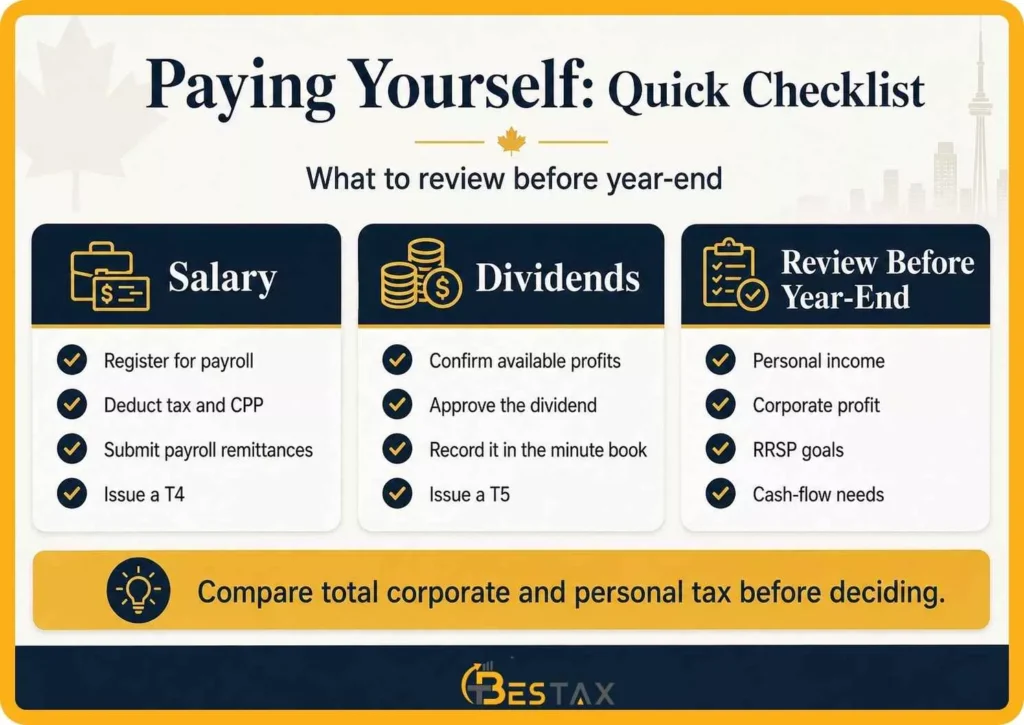
If you have decided on dividends, here is how to pay yourself dividends the right way. These are the basic steps; your accountant can handle the details.
- Make sure there is profit. Dividends come from after-tax profit. The company needs enough retained earnings to pay them.
- Hold a directors’ meeting and write a resolution. The directors must formally approve the dividend. A short written resolution proves it was legal and dated.
- Move the money. Transfer the cash from the company account to your personal account.
- Record it properly. Note the amount, the date, and whether it is an eligible or non-eligible dividend.
- File a T5 slip. The company prepares a T5 slip for you and files it with the CRA. The deadline is usually the end of February for dividends paid the year before.
- Report it on your personal return. You include the grossed-up dividend on your tax return and claim the dividend tax credit.
Doing the resolution and the T5 correctly matters. If you skip these steps, the CRA can ask questions or charge penalties.
How to Pay Yourself a Salary
If you choose a salary, the steps look like this:
- Register a payroll account with the CRA (a payroll program account number).
- Decide on a reasonable amount. The salary must make sense for the work you do.
- Run payroll. Each pay period, take off income tax, CPP, and any other deductions.
- Send the deductions to the CRA by the due dates.
- File T4 slips at year-end and give a copy to yourself.
Payroll has more rules than dividends, so many owners use a payroll service or accountant to stay on time and avoid penalties.
The Hybrid Approach: Best of Both Worlds
Many advisors in 2026 suggest a hybrid plan: take some salary and some dividends. This is one of the most popular ways to pay yourself from your corporation in Canada.
A common idea is to pay yourself a salary up to a useful point, for example, enough to hit the CPP ceiling of $74,600 or enough to max out your RRSP room, and then take the rest as dividends. This lets you build retirement savings and a pension while still enjoying the flexibility of dividends.
The “perfect” split depends on your income, your province, your retirement plans, and whether you want to qualify for a loan. There is no universal salary-and-dividend split that produces the lowest tax. Depending on your province, income, retirement goals and corporation’s tax position, the better approach may be salary, dividends or a combination of both.
Watch-Outs and Common Mistakes
Before you decide, keep these traps in mind.
- Tax on Split Income (TOSI). If you pay dividends to a spouse, child, or other family member who is not truly active in the business, those dividends can be taxed at the top rate. This wipes out the benefit. Be careful with family dividends; this matters a lot for a family-owned business.
- “Reasonable” salaries. A salary must match the real work done. If the CRA thinks the pay is too high for the job, it can deny the expense.
- Passive income can shrink your small business rate. The federal small business tax rate is 9% on qualifying active business income eligible for the small business deduction. The usual federal business limit is $500,000, but it may be shared with associated corporations or reduced under passive-income and taxable-capital rules.
- Missing slips and deadlines. Late T4s or T5s lead to penalties. Mark the dates or let your accountant handle them.
- Forgetting the long game. Dividends feel simple now, but skipping CPP and RRSP for years can hurt your retirement. Think past this tax season.
Taking Money as a Shareholder Loan
A shareholder loan is not a simple, tax-free way to withdraw corporate money.
A shareholder loan can arise when you use corporate money for personal expenses without recording the amount as salary, a dividend, an expense reimbursement or repayment of money the corporation already owes you.
Depending on the facts, the outstanding amount may have to be included in your personal income. A taxable interest benefit may also apply when the loan carries little or no interest.
One commonly discussed exception may apply when the loan is repaid within one year after the end of the corporation’s tax year in which the loan arose. However:
- The repayment cannot be part of a continuing series of loans and repayments.
- Other conditions may apply.
- Re-borrowing the same money can create problems.
- Recording a withdrawal as a loan does not automatically make it tax-free.
For example, assume your corporation has a December 31, 2026 year-end and you borrow money during that corporate tax year. The one-year repayment test may require repayment by December 31, 2027, subject to all the applicable rules.
Do not wait until personal tax returns are being prepared to classify owner withdrawals. Review the shareholder loan account throughout the year and document every payment.
What Has a Tax Advantage Over a Cash Dividend?
Here is a bonus tip many owners miss. A capital dividend has a significant tax advantage over a regular cash dividend. A private corporation may pay a capital dividend that is generally tax-free to a Canadian-resident shareholder when it has sufficient CDA balance and files the required election correctly. Electing an amount above the available CDA can trigger significant corporate tax.
A capital dividend is paid from a special account called the Capital Dividend Account (CDA), which builds up from things like the tax-free half of capital gains. If your company has a balance in this account, paying a capital dividend can move money to you with no personal tax at all. The rules are strict, so this is one to plan with an accountant.
So, Which Should You Choose?
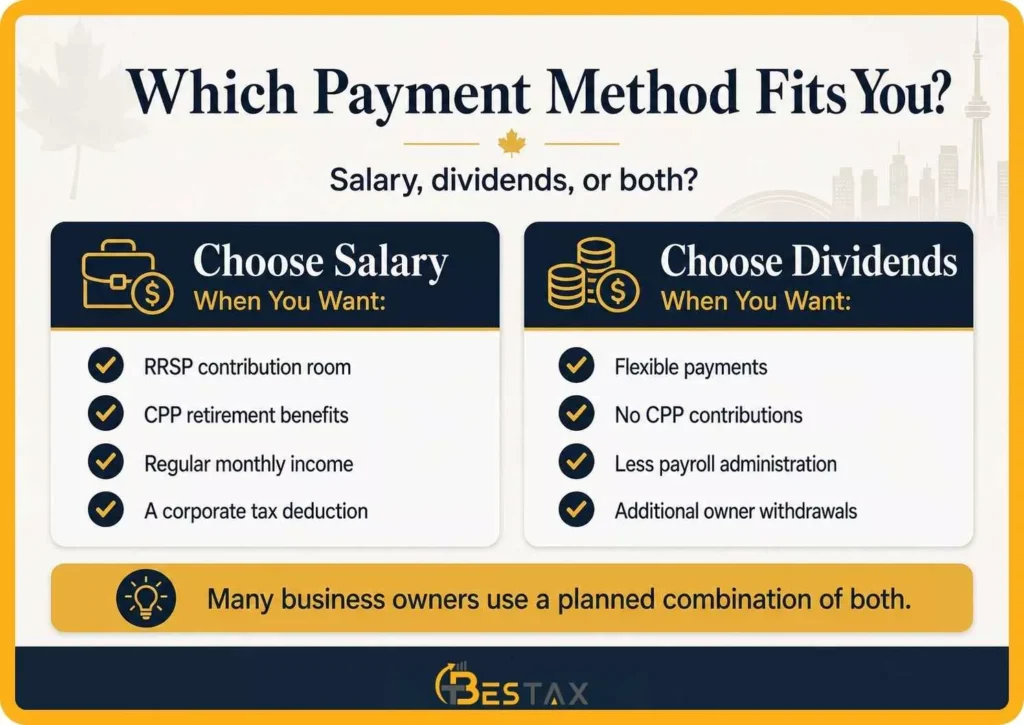
Here is a simple way to think about dividends vs salary in Canada:
- Lean toward salary if you want to build RRSP room, want CPP for retirement, plan to apply for a mortgage, or like the structure of payroll.
- Lean toward dividends if you want to skip CPP, keep paperwork light, need flexible cash flow, or want to leave money in the company for now.
- Use a hybrid if you want a bit of both, which is what works for many owners in 2026.
Because the total tax is so close, the best plan is the one that fits your goals, your province, and your numbers.
Quick FAQs
Is it better to pay yourself salary or dividends in Canada?
Neither one is always better. There is no universal salary-and-dividend split that produces the lowest tax. Depending on your province, income, retirement goals and corporation’s tax position, the best approach may be salary, dividends or a carefully planned combination of both. A salary builds RRSP room and CPP and helps with a mortgage. Dividends skip CPP and need less paperwork. The right blend depends on your income, your province, and your goals.
How do you pay yourself dividends from your corporation in Canada?
You pay yourself dividends in a few simple steps. Make sure the company has after-tax profit, have the directors approve the dividend with a written resolution, transfer the money to your personal account, file a T5 slip with the CRA, and report the dividend on your personal tax return.
How do I pay myself from my business?
If your business is incorporated, you pay yourself by salary, by dividends, or by both. If you are a sole proprietor, the profit is already yours and you simply pay personal tax on it. Incorporated owners often use a mix of salary and dividends.
Do you pay less tax on dividends than on salary in Canada?
Sometimes, but not by much. Dividends often have a slightly lower personal tax rate because of the dividend tax credit.
Disclaimer: The information provided in this blog is for general informational purposes only. For professional assistance and advice, please contact experts.