

Since October 1, 2025, a taxpayer who tells the CRA about unfiled returns or unreported income before the CRA raises it can have every penalty cancelled. Three quarters of the interest goes with it. The CRA voluntary disclosure program was rewritten on that date, and the relief under VDP Canada rules is now larger and the door wider than before.
If you have years of returns unfiled, HST never remitted or payroll deductions that never reached the CRA, the exposure grows every month you wait. The program is the one route that removes the penalties.
The guide below covers who qualifies and what each relief tier gives.
CRA Voluntary Disclosures Program: Who Qualifies and What Relief You Get
The Voluntary Disclosures Program cancels penalties and part of the interest on tax you owed and did not pay, in exchange for coming forward with everything before the CRA finds it. Two tiers of relief exist, and which one you get depends on whether the CRA had already contacted you.
The Voluntary and Complete Test
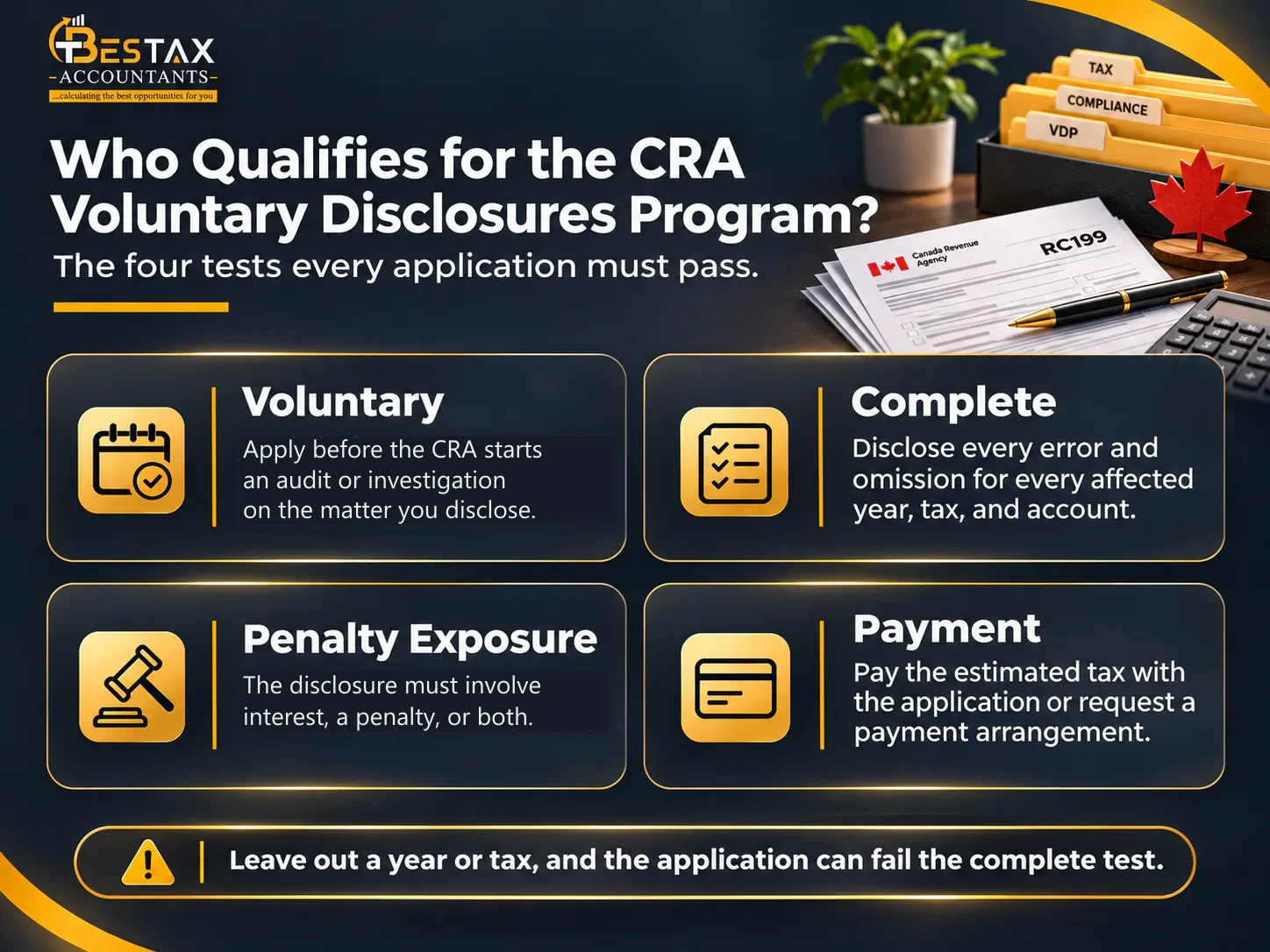
Every application has to pass the voluntary and complete test, and the CRA applies it before it looks at relief.
- Voluntary: you apply before the CRA has started an audit or investigation on the matter disclosed, against you or a related person.
- Complete: you disclose every error and omission for every affected year and tax, not only the one that worries you.
- Interest or penalty: the disclosure involves interest, a penalty or both. A return that would only produce a refund has nothing to relieve.
- Payment: you pay the estimated tax with the application or request a payment arrangement for it.
An application that leaves out a year, a tax or an account fails the complete test. The CRA can reject it and use what you disclosed, and a second application on the same facts is not accepted.
General vs Partial Relief
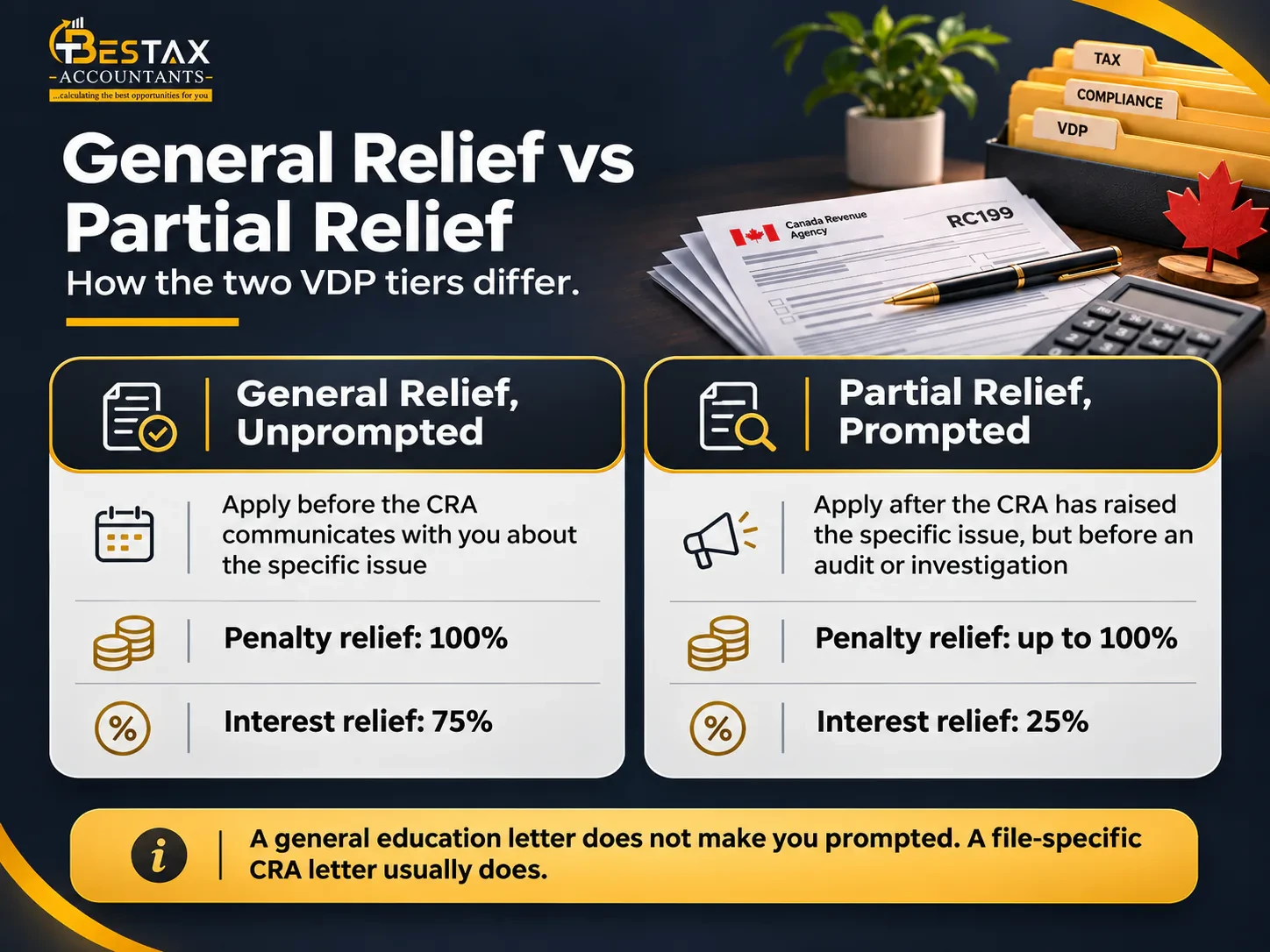
The two tiers replaced the old general and limited programs, and both now offer full penalty relief.
| Tier | When it applies | Penalty relief | Interest relief |
|---|---|---|---|
| General relief, unprompted | You apply before the CRA has communicated with you about the specific issue | 100 percent | 75 percent |
| Partial relief, prompted | You apply after the CRA has raised the specific issue, short of an audit or investigation | Up to 100 percent | 25 percent |
An education letter from the CRA, or a notice with general filing guidance, does not make you prompted. A letter naming a specific error on your file, a deadline to correct one, or information the CRA has received from a third party about you does. The difference is worth 50 percentage points of interest on every year disclosed, so the day you receive a letter is the day the general tier closes.
What Stays Outside the Program
The program does not cover everyone, and it does not cover everything.
- Anyone under audit or investigation on the matter disclosed, including one started against a related person
- Disclosures the CRA judges egregious, such as deliberate schemes to evade tax
- The tax itself, which is always payable in full
- The remaining 25 or 75 percent of interest, which is charged from the original due date
Relief is discretionary within the tiers, and a disclosure that meets the test is normally granted it. The tax and the residual interest are owed whichever tier applies, and they are the reason the payment condition exists.
How to Come Forward to the CRA: Form RC199 and the Supporting Filings
The application is one form, one set of documents and one payment. Each has to be right, because the CRA reviews the package once.
Form RC199
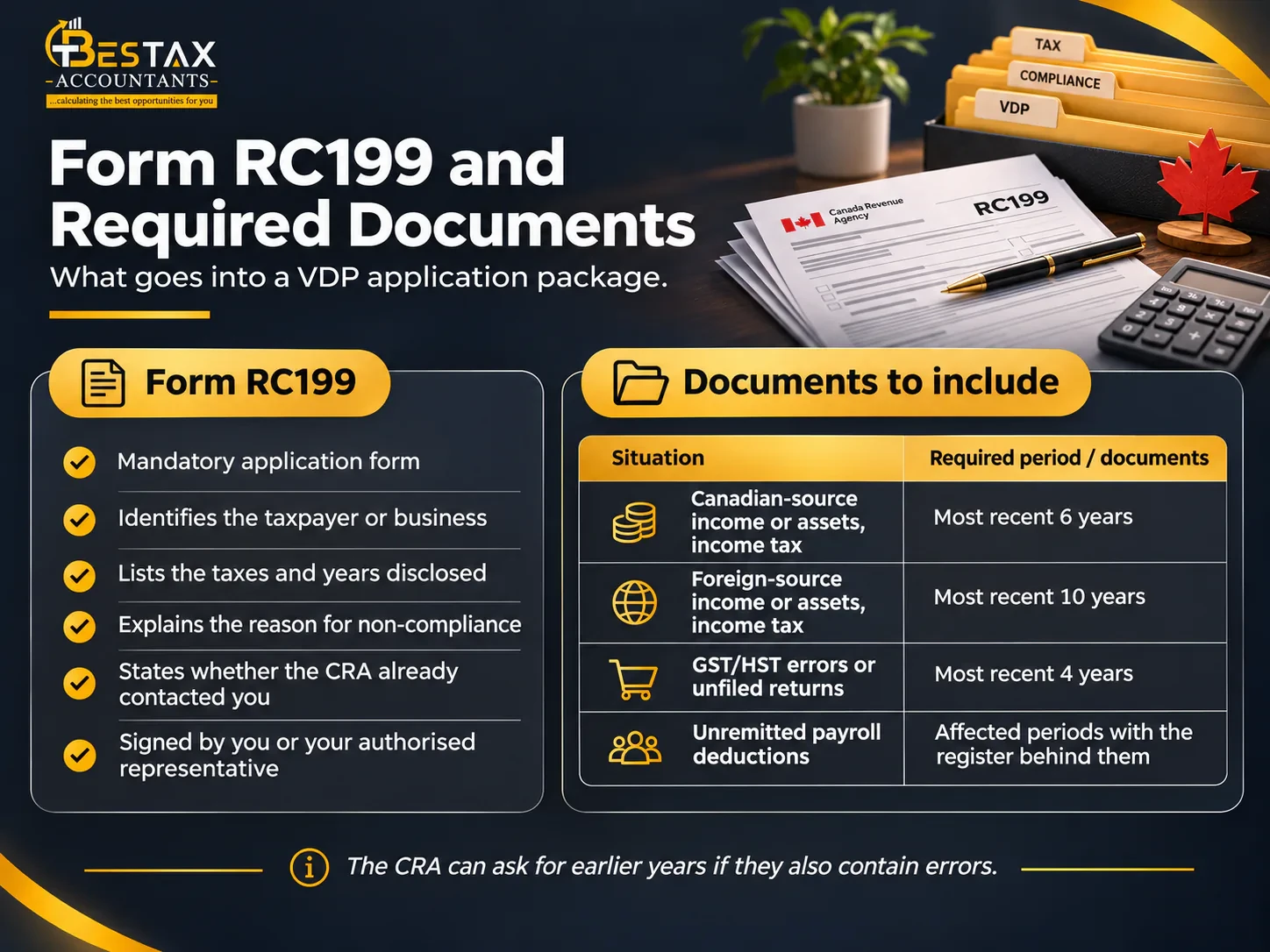
Form RC199 is the mandatory application, simplified in October 2025. The form identifies you or your business, the taxes and years disclosed, the reason for the non-compliance, and whether the CRA has communicated with you about it. You or your authorised representative sign it. It is submitted through My Account, My Business Account or Represent a Client, or by mail or fax to the VDP at the Shawinigan National Verification and Collections Centre.
Two fields decide the tier. The question on prior CRA communication has to be answered accurately. A prompted application filed as unprompted is treated as incomplete when the letter is found in your file. The reason for non-compliance has to be explained rather than left blank, because the CRA weighs it when it exercises its discretion on partial relief.
Documents for the Most Recent Years
The application has to include the returns, schedules and supporting documents for the years disclosed, within limits the CRA set in October 2025.
| Type of non-compliance | Documentation required with the application |
|---|---|
| Canadian-source income or assets, income tax | The most recent six years |
| Foreign-source income or assets, income tax | The most recent ten years |
| GST/HST errors or unfiled returns | The most recent four years |
| Unremitted payroll deductions | No set period: the affected periods, with the payroll register behind them |
Years inside those periods with no errors do not need to be included. The CRA can ask for earlier years, and the disclosure has to cover them if they contain errors, but the application package is built on the years above. The returns inside it are the returns that were due, prepared as if on time, and the tax on them is what you pay or arrange.
Unfiled GST/HST and Payroll
Unfiled GST/HST and payroll are disclosed under the same program, and they carry the penalties that make it worth doing. An unfiled HST return carries a penalty of 1 percent of the balance plus 0.25 percent a month. Unremitted payroll deductions carry a penalty from 3 to 10 percent on each late remittance. Both are cancelled under a valid disclosure, and payroll deductions withheld from staff and never remitted are the case where the CRA's tolerance for delay is shortest.
GST/HST wash transactions are the exception. Where the customer would have recovered the tax in full as an input tax credit, a valid application receives 100 percent relief of both penalties and interest. That is the one case where the interest goes as well.
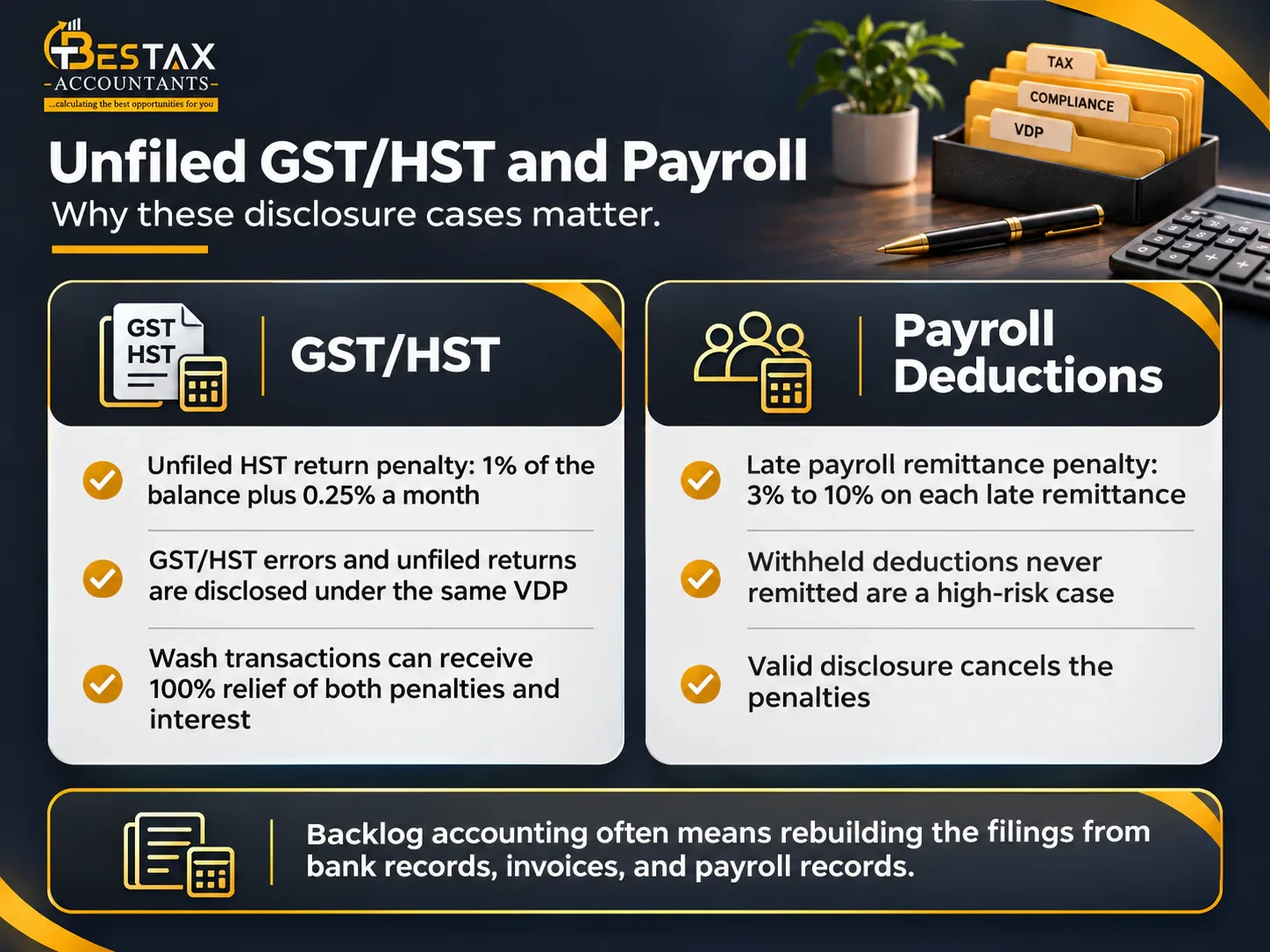
Our backlog accounting services in Canada prepare the unfiled income tax, HST and payroll filings for every year the disclosure covers. Where the ledger was never kept, the returns are built from bank records and invoices. The package then passes the complete test the first time.
Unreported Income and the CRA: The Backlog Filings Behind a Disclosure
A disclosure is only as good as the returns inside it. Most applications that fail do so on the filings, not on the form.
Backlog Filings Prepared to Pass the Complete Test
Backlog filings for a disclosure are prepared year by year, from the earliest year with an error to the current one. Each is prepared on the rules in force for that year. Income is reconstructed from bank deposits, sales records and third-party slips the CRA already holds, because a figure the CRA can match is a figure it accepts. Expenses are claimed only where the receipt exists, because a disclosure is not the place to test a deduction. The result is a set of returns that agree with each other and with what the CRA can see.
- Every year with an error, on that year's rules and rates
- Income reconciled to bank deposits and to the slips on file with the CRA
- Expenses supported by receipts, with unsupported claims left out
- HST and payroll reconciled to the same ledger as the income tax returns
What Unreported Income Costs Without the Program
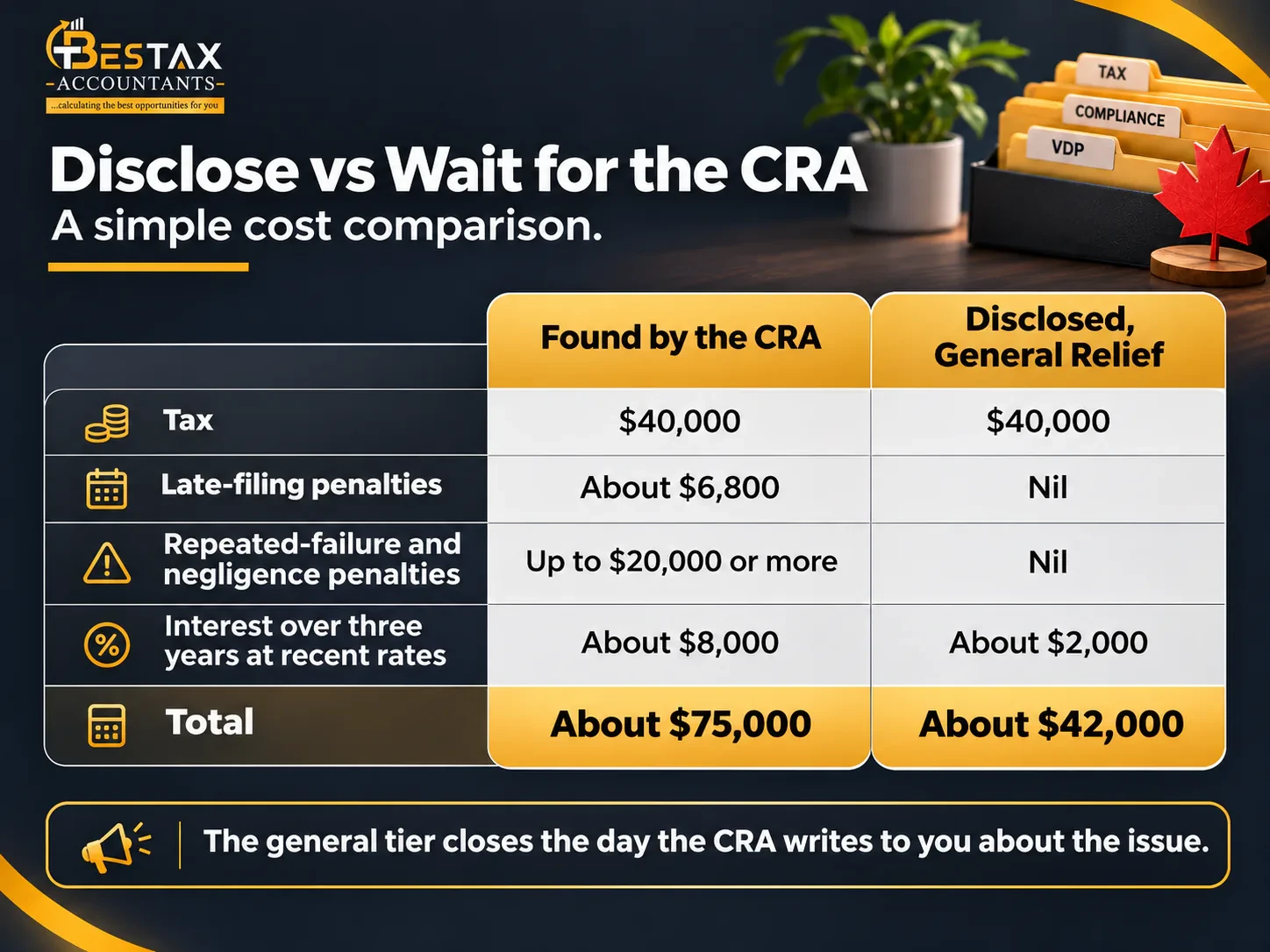
Unreported income found by the CRA carries the tax and the interest from the original due date. Where it happened in a prior year as well, a repeated-failure penalty of 10 percent of the unreported amount is added. Gross negligence adds 50 percent of the understated tax. A penalty for late tax filing in Canada of 5 percent plus 1 percent a month sits on top for each unfiled return, doubling for a repeat. Under the general tier, every one of those penalties is cancelled and the interest is cut by three quarters.
| Three unfiled years, $40,000 of tax owing | Found by the CRA | Disclosed, general relief |
|---|---|---|
| Tax | $40,000 | $40,000 |
| Late-filing penalties | About $6,800 | Nil |
| Repeated-failure and negligence penalties | Up to $20,000 or more | Nil |
| Interest over three years at recent rates | About $8,000 | About $2,000 |
| Total | About $75,000 | About $42,000 |
Timing the Application
The general tier closes the day the CRA writes to you about the issue, and the whole program closes the day an audit starts. A missed deadline that is a month old is a late-filing problem, and the fix is to file your taxes after the deadline. One that is three years old with HST and payroll behind it is a disclosure, and the application has to be filed before the CRA's matching systems reach it.
The returns take longer to prepare than the form takes to complete, so the preparation starts first. A three-year backlog with bank records available is usually ready to file within four to six weeks, and the RC199 goes in with it.
Frequently Asked Questions
Yes, unless the letter announces an audit or investigation. A letter raising the specific issue makes your application prompted, so you receive partial relief, up to 100 percent of penalties and 25 percent of interest. A general education letter does not make you prompted, and the general tier still applies.
Every year with an error, and every tax affected. The complete test is failed by a disclosure that leaves something out, and the CRA can reject the whole application and use what it has learned. If you are unsure whether a year is wrong, it is checked before the application, not after.
Only at the CRA's discretion, where the second disclosure concerns a different matter from the first or the circumstances were beyond your control. A second disclosure on the same facts is not accepted. That is why the backlog review covers every account before the first application goes in.
A valid disclosure gives protection from criminal prosecution for the matters disclosed, and gross negligence penalties do not apply to them, along with the penalty and interest relief. Cases the CRA judges egregious are kept out of the program, which is a judgment made on the facts rather than on the amount.
You request a payment arrangement with the application, and the CRA considers the application on that basis. The arrangement covers the tax and the residual interest, and the CRA's collections staff have to approve it. Relief is not withdrawn because the balance is paid over time, provided the arrangement is kept.
Yes. The CRA holds pre-disclosure discussions on an anonymous basis, so you or your representative can describe the situation before filing. They are informal and do not bind the CRA, and they do not stop the CRA from contacting you in the meantime.
File the Disclosure Before the CRA's Letter Arrives
The program rewards the taxpayer who moves first, and every part of the application is within your control.
- Confirm nothing has started: no audit or investigation on the matter, and no CRA letter naming it.
- List every year, every tax and every account with an error, because a partial disclosure fails the complete test.
- Prepare the backlog returns on each year's rules, reconciled to bank records and to the slips the CRA holds.
- Complete Form RC199 accurately, including any prior CRA contact and the reason for the non-compliance.
- Pay the estimated tax with the application or request a payment arrangement for it.
Send us a list of the years and accounts you believe are unfiled or wrong. We will tell you within two business days which tier you qualify for, what the disclosure will cost after relief, and how long the backlog will take to prepare.
Disclaimer: The information provided in this blog is for general informational purposes only. For professional assistance and advice, please contact experts.


Fact checked by
Haseeb Hamdani
Lead Advisor · Director Accounting & Taxation
With over a decade of cross-border experience spanning Canada, the UAE, and beyond, Haseeb Hamdani leads the Bestax team of qualified professionals with one clear goal - to make sure your business is compliant, protected, and positioned to grow. His international credentials and real-world expertise across tax, compliance, and business structuring mean clients always receive precise, reliable, and commercially sound financial guidance.
Learn More About Haseeb