


If you pay someone as a contractor who works your hours, uses your equipment and serves no one else, the CRA will treat them as your employee. The contract does not change that.
Whether a worker is an employee or an independent contractor in Canada is decided on the working relationship, not the label. A wrong answer lands on the payer, not the worker.
In this guide, we cover the test the CRA applies and the cases behind it, how a CPT1 ruling settles a doubtful case, and what misclassification costs. The payroll figures are 2026 rates.
How the CRA decides if a worker is an employee or a contractor
The CRA asks one question: is the worker in business on their own account, or working in yours? The answer comes from what you and the worker intended and six factors drawn from the courts, weighed together rather than counted.
The CRA sets out the test in its guide RC4110, Employee or Self-employed.
Intent comes first, then the facts of the relationship
The CRA begins with what the parties intended. A written contract for services, invoices rather than pay stubs, and a GST/HST number all show an intent to contract.
Intent is not decisive. Where the facts of the relationship contradict it, the facts win. A contract that calls a worker a contractor while the payer controls everything about the work is set aside.
The CRA's six factors
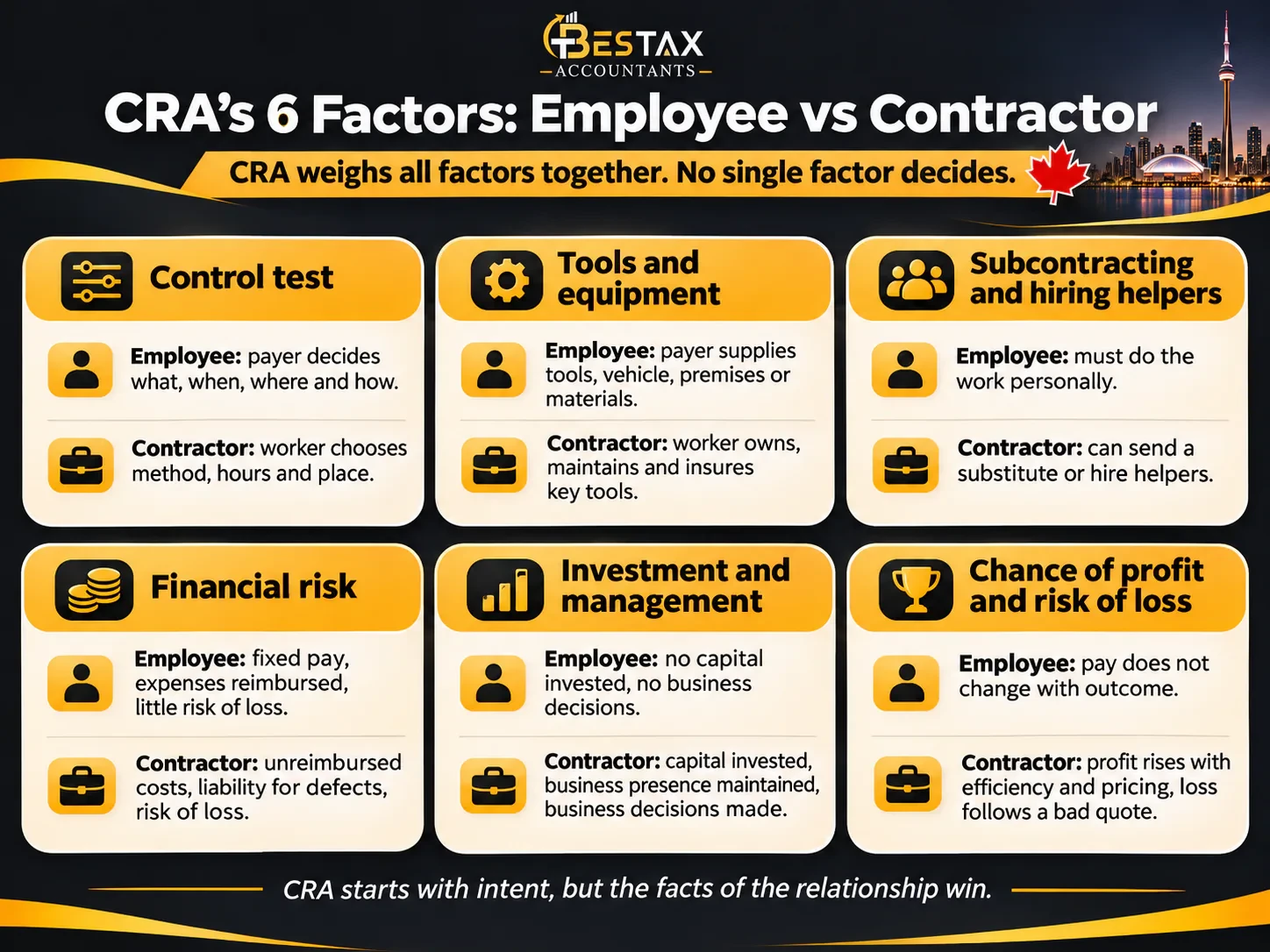
| Factor | Points to employee | Points to contractor |
|---|---|---|
| Control | The payer decides what is done, how, when and where, and supervises it | The worker decides the method, the hours and the place, and accepts or declines work |
| Tools and equipment | The payer supplies the computer, the vehicle, the premises and the materials | The worker owns, maintains and insures the significant tools, at their own cost |
| Subcontracting and hiring helpers | The worker has to do the work personally | The worker can send a substitute or hire help, and pays them |
| Financial risk | Fixed pay, expenses reimbursed, no exposure to loss | Unreimbursed costs, fixed-price work, liability for defects |
| Investment and management | No capital in the work, no business decisions | Capital invested, business decisions made, a business presence maintained |
| Chance of profit and risk of loss | Pay does not change with efficiency or outcome | Profit rises with efficiency and pricing, loss follows a bad quote |
No single factor decides. A worker who owns a van but takes every instruction from you is usually an employee. A worker you pay by the hour who sets the hours, carries the risk of a bad job and serves five clients is usually a contractor.
The court cases behind the test: Wiebe Door and Sagaz
The factors come from Wiebe Door Services Ltd. v. M.N.R., the 1986 Federal Court of Appeal decision. That case replaced the old control-only test with control, tools, chance of profit and risk of loss, and integration.
In 671122 Ontario Ltd. v. Sagaz Industries Canada Inc. (2001), the Supreme Court of Canada confirmed there is no single formula and framed the central question as whose business it is.
The Tax Court applies that framework to every CPP and EI appeal, and the CRA's factors are its working version of it. Quebec applies its Civil Code, with a similar result through a different route.
Provincial employment standards use their own test
A CRA decision covers CPP, EI and income tax only. Minimum wage, overtime, vacation pay and termination pay fall under provincial employment standards, which apply their own definition of an employee.
In Ontario, the Employment Standards Act, 2000 bars an employer from treating an employee as if they were not an employee, and the Ministry of Labour decides status under the Act. A CPT1 ruling does not bind the Ministry, and a Ministry finding does not bind the CRA, so one worker can be assessed under both.
CPT1 rulings and setting up the right payroll
Where the answer is not clear, you or the worker can ask the CRA to decide. Where it is clear, the answer sets what you withhold, what you file and which slip the worker receives.
Request a CPT1 ruling by June 29 of the following year
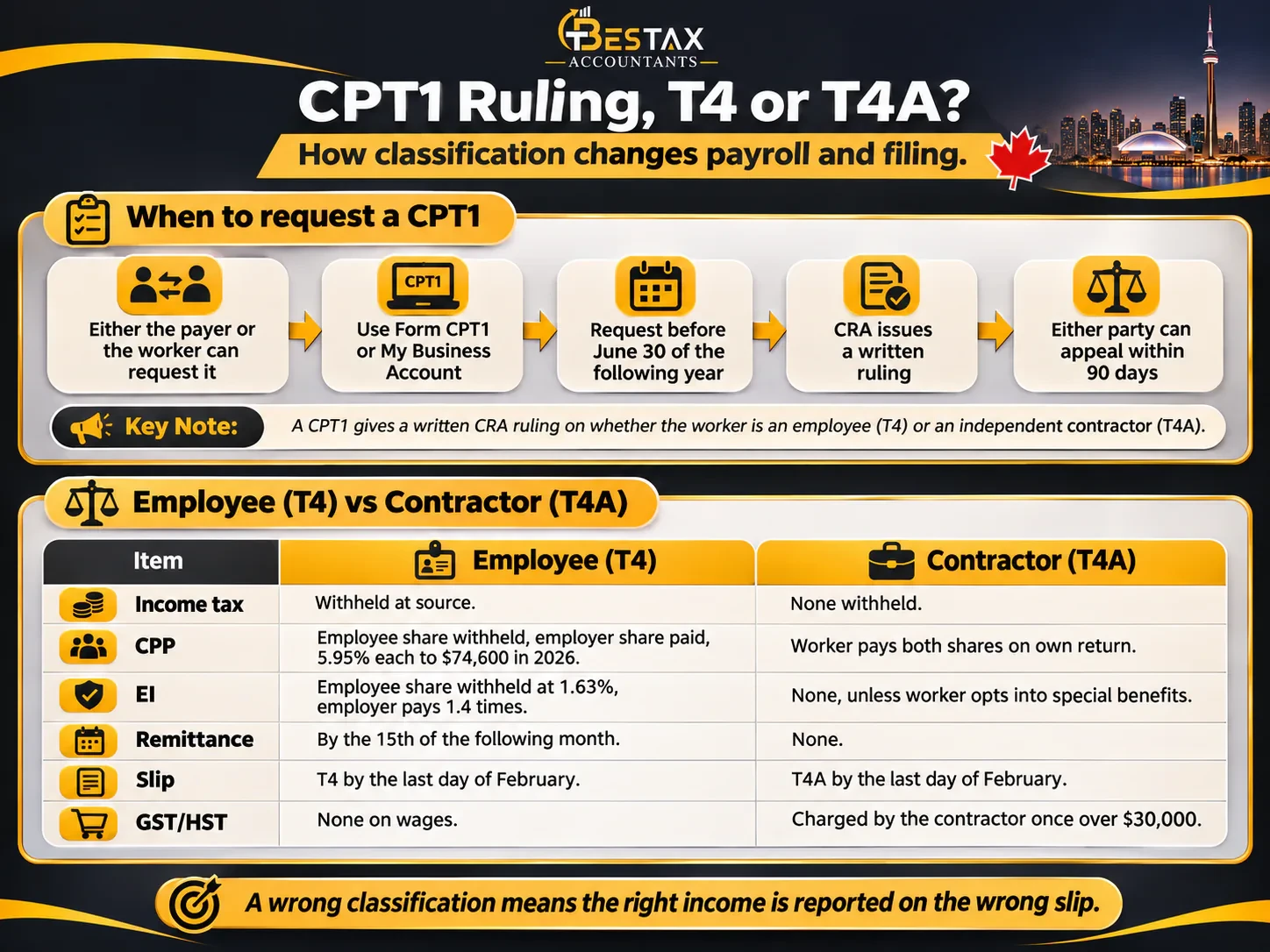
A CPT1 ruling is a request to the CRA to decide whether a worker is an employee or self-employed for CPP and EI purposes. Either the payer or the worker can request it, on Form CPT1 or through My Business Account.
The request is due by June 29 of the year after the year in question. The CRA reviews the relationship against the factors and issues a written ruling, which sets the payer's CPP and EI treatment. Either party can appeal it within 90 days.
- Request it before you build a roster of contractors on an assumption.
- Request it when a worker's role has changed, because the ruling applies to the facts as they were.
- Expect one when a contractor wants EI or CPP coverage, because they can request it themselves.
- File by June 29 of the following year.
Our team prepares your CPT1 with the facts set out against each factor. A request that answers the CRA's questions in its own order is ruled on faster and more predictably than a bare form.
T4 vs T4A: which slip the classification calls for
Your classification decides the slip. An employee receives a T4, with income tax, CPP and EI deducted and remitted, and your share paid on top.
A contractor receives a T4A, with fees for services reported in box 048 where they are more than $500 in the year, and nothing withheld. The contractor files their own return and pays both shares of CPP as a self-employed contributor.
| Employee, T4 | Contractor, T4A | |
|---|---|---|
| Income tax | Withheld at source | None withheld |
| CPP | Employee share withheld and employer share paid, 5.95% each up to $74,600 in 2026 | Worker pays both shares, 11.9%, on their own return |
| EI | Employee share withheld at 1.63% up to $68,900, employer pays 1.4 times | None, unless the worker opts into special benefits |
| Remittance | By the 15th of the following month for most employers | None |
| Slip | T4 by the last day of February | T4A by the last day of February |
| GST/HST | None on wages | Charged by the contractor once they pass the $30,000 small supplier threshold |
In Quebec, the payroll figures differ. Employers deduct QPP instead of CPP, and the 2026 EI rates are $1.30 per $100 for employees and $1.82 per $100 for employers.
Where a worker is an employee, our payroll services in Canada set them up on payroll with the deductions and the employer's share from the first pay. The first remittance and the first T4 are then right.
Preparing T4 and T4A slips correctly
A T4 carries the employment income, the CPP and EI deducted, and the pensionable and insurable earnings, in boxes the CRA matches against your remittances. A T4A carries fees for services in box 048.
If you issue a T4A to a worker who was an employee, you have reported the right income on the wrong slip, and the CRA's matching picks it up. The steps to prepare a T4 slip in Canada start from a correct classification.
When a contractor is reclassified as an employee, the T4A you filed is amended or cancelled, and an original T4 is filed in its place.
What misclassifying a worker costs
Misclassification is assessed against you as the payer. When the CRA finds that a contractor was an employee, it goes back through the years the relationship existed. You are charged what should have been withheld, with penalties and interest on top.
CPP, EI, penalties and interest
An employer who fails to deduct CPP and EI has to pay both the employee's and the employer's share for the period.
You can recover the employee's share from later payments to the worker, but only up to the amount that should have been deducted from each payment. You cannot recover an amount that has been outstanding for more than 12 months. Penalties then apply.
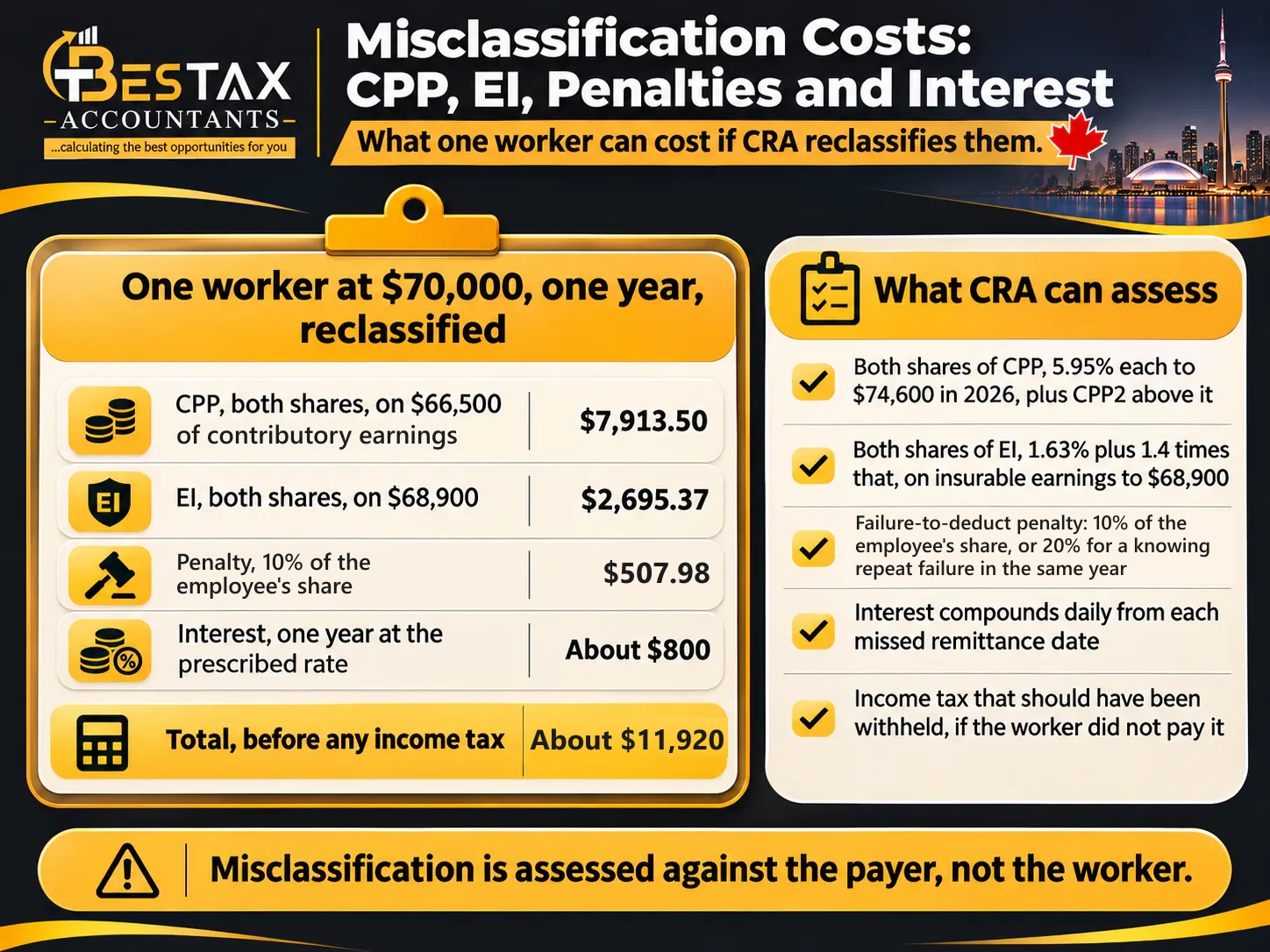
- Both shares of CPP, 5.95% each on earnings up to $74,600 in 2026, plus CPP2 above it.
- Both shares of EI, 1.63% plus 1.4 times that, on insurable earnings up to $68,900.
- A failure-to-deduct penalty of 10% of the amounts that were not deducted, which is the employee's share. It rises to 20% for a second or later failure in the same calendar year made knowingly or through gross negligence.
- Interest at the prescribed rate, compounded daily, from each remittance date that was missed.
- Income tax that should have been withheld, where the worker did not pay it.
| One worker at $70,000, one year, reclassified | Amount |
|---|---|
| CPP, both shares, on $66,500 of contributory earnings ($70,000 less the $3,500 basic exemption) | $7,913.50 |
| EI, both shares, on $68,900 of insurable earnings | $2,695.37 |
| Penalty, 10% of the employee's share ($3,956.75 CPP and $1,123.07 EI) | $507.98 |
| Interest, one year at the prescribed rate | About $800 |
| Total, before any income tax | About $11,920 |
Multiply that across a roster and the years the relationship ran, and you have the figure the CRA assesses. The late payroll remittances in Canada that follow a reclassification carry their own penalties, so settle the assessment on a payment arrangement rather than letting it accrue.
The personal services business trap for incorporated contractors
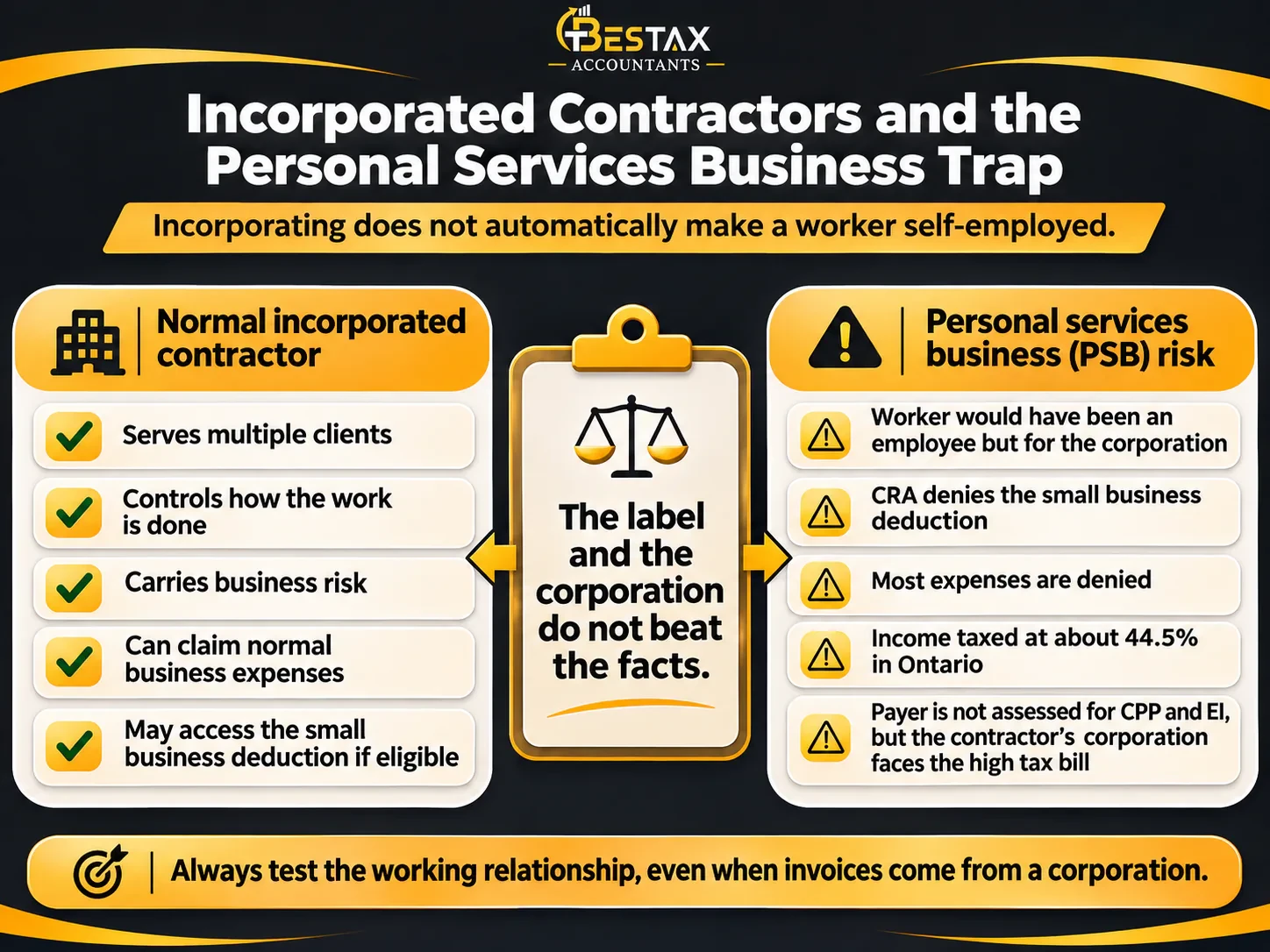
A worker who incorporates and invoices you through a company does not escape the test. Where the individual would have been an employee but for the corporation, the CRA treats the corporation as a personal services business.
The CRA then denies the small business deduction and most expenses, and taxes the income at about 44.5% in Ontario, 33% federal plus 11.5% provincial. That is the highest corporate rate. You are not assessed for CPP and EI as the payer in that case, but the contractor's corporation pays that rate on the income.
Reviewing your contractor roster before the CRA does
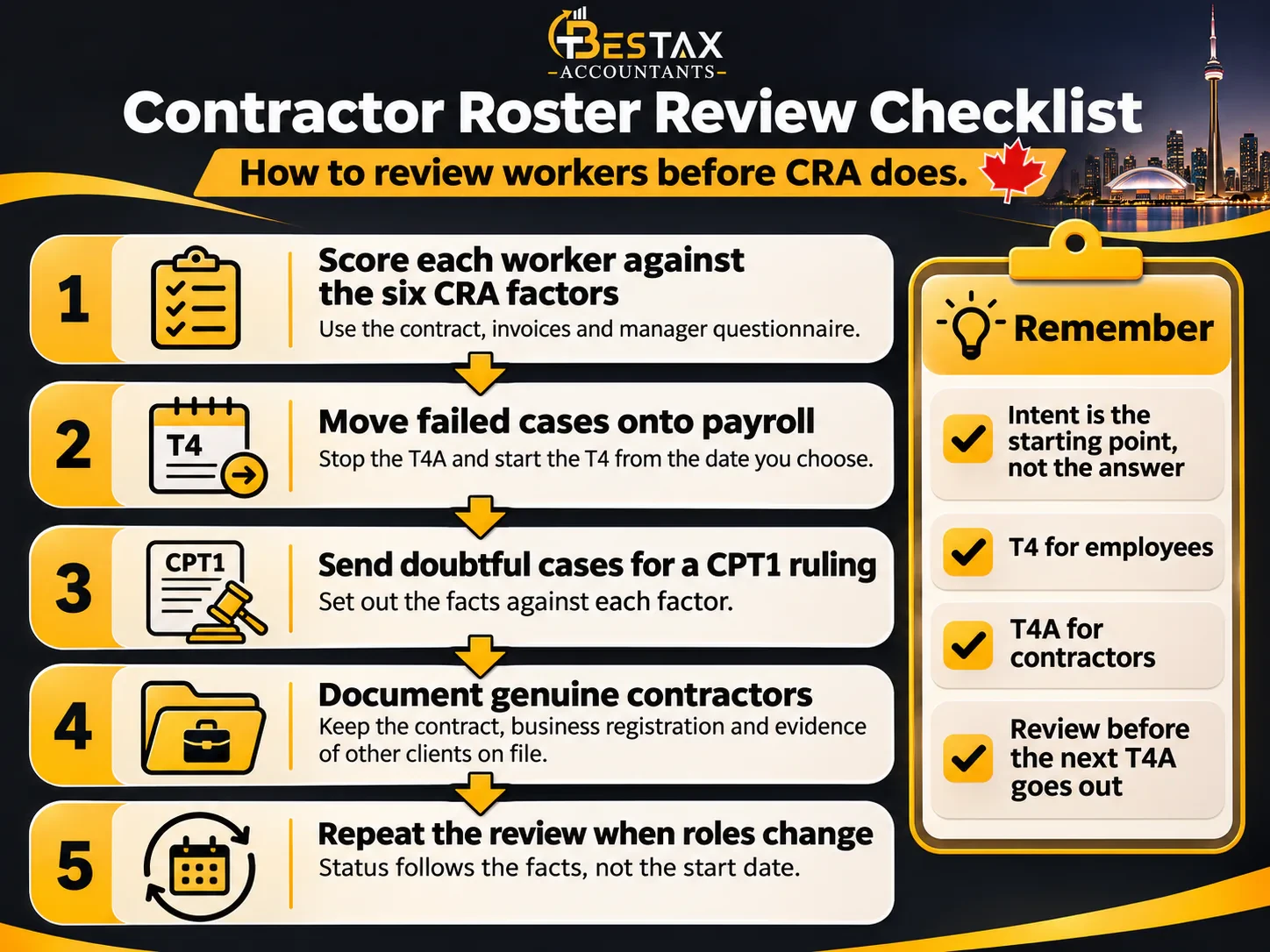
A review before the CRA's is the only one that costs you nothing. Our team runs it for every payroll client with contractors, and on request if you have built a roster on assumptions.
- Each contractor's working relationship is scored against the six factors, using the contract, the invoices and a short questionnaire to the manager.
- Contractors who fail the test move onto payroll from a date you choose, with the T4A stopped and the T4 started.
- Doubtful cases go to the CRA on a CPT1, with the facts set out against each factor.
- Genuine contractors are documented, with the contract, the business registration and evidence of other clients kept on file.
- The review is repeated when a contractor's role changes, because the status follows the facts, not the start date.
Frequently asked questions
No. A GST/HST number and invoices show an intent to contract, and intent is where the CRA starts, not where it ends. If you control the work, supply the tools and the worker serves only you, the facts point to employment, and the CRA follows the facts.
You can, but it changes nothing. CPP and EI status is decided by the law and the facts, and a worker cannot contract out of it. The waiver is evidence of intent, which is one input, and the CRA sets it aside where the working relationship contradicts it.
Only partly. You can deduct it from later payments to the worker, no more per payment than should have been deducted, and not for any amount outstanding for more than 12 months. Anything older is your cost, which is why the assessment is larger than your own contributions would have been.
No. Length of engagement is not one of the factors. A fixed-term worker who is controlled, equipped and paid like staff is an employee for the term. A genuine contractor on a one-year engagement sets their own method, carries their own risk and can work for others during it.
Yes. Either party can request it, and a worker who wants EI or CPP coverage often does. The CRA contacts the payer for its side of the facts during the review, and the ruling applies to both. A payer whose contractor file already answers the six factors is in a better position.
Classify each worker on the facts, then build the payroll
The CRA decides employee or contractor status on how the work is done, and every dollar of exposure follows from a classification made in the first week.
- Test each contractor against control, tools, subcontracting, risk, investment and profit, with intent as the starting point rather than the answer.
- Request a CPT1 ruling by June 29 of the following year on any case that is not clear.
- Issue a T4 with deductions to an employee and a T4A with nothing withheld to a contractor, never the reverse.
- Budget the cost of reclassification, both shares of CPP and EI, a 10% failure-to-deduct penalty and interest, before you settle a doubtful case the cheap way.
- Review the roster when roles change, not when the CRA writes.
Send us your contractor list and the contracts behind it. Our team will score each one against the CRA's factors, tell you which to move onto payroll, and prepare the CPT1 for the ones that need a ruling. Book a contractor review.
Disclaimer: The information provided in this blog is for general informational purposes only. For professional assistance and advice, please contact experts.

