


A section 85 rollover is a joint election under the Income Tax Act that lets you transfer property to a taxable Canadian corporation for shares and defer the tax on the gain.
Normally, selling or giving property to your company counts as a sale at fair market value. Section 85 lets you defer that tax instead of paying it at the time of transfer.
In this guide, we'll cover what you can transfer, how to choose the elected amount, how to file Form T2057 on time and the mistakes that cost owners the most.
Section 85 rollover basics: who can use it
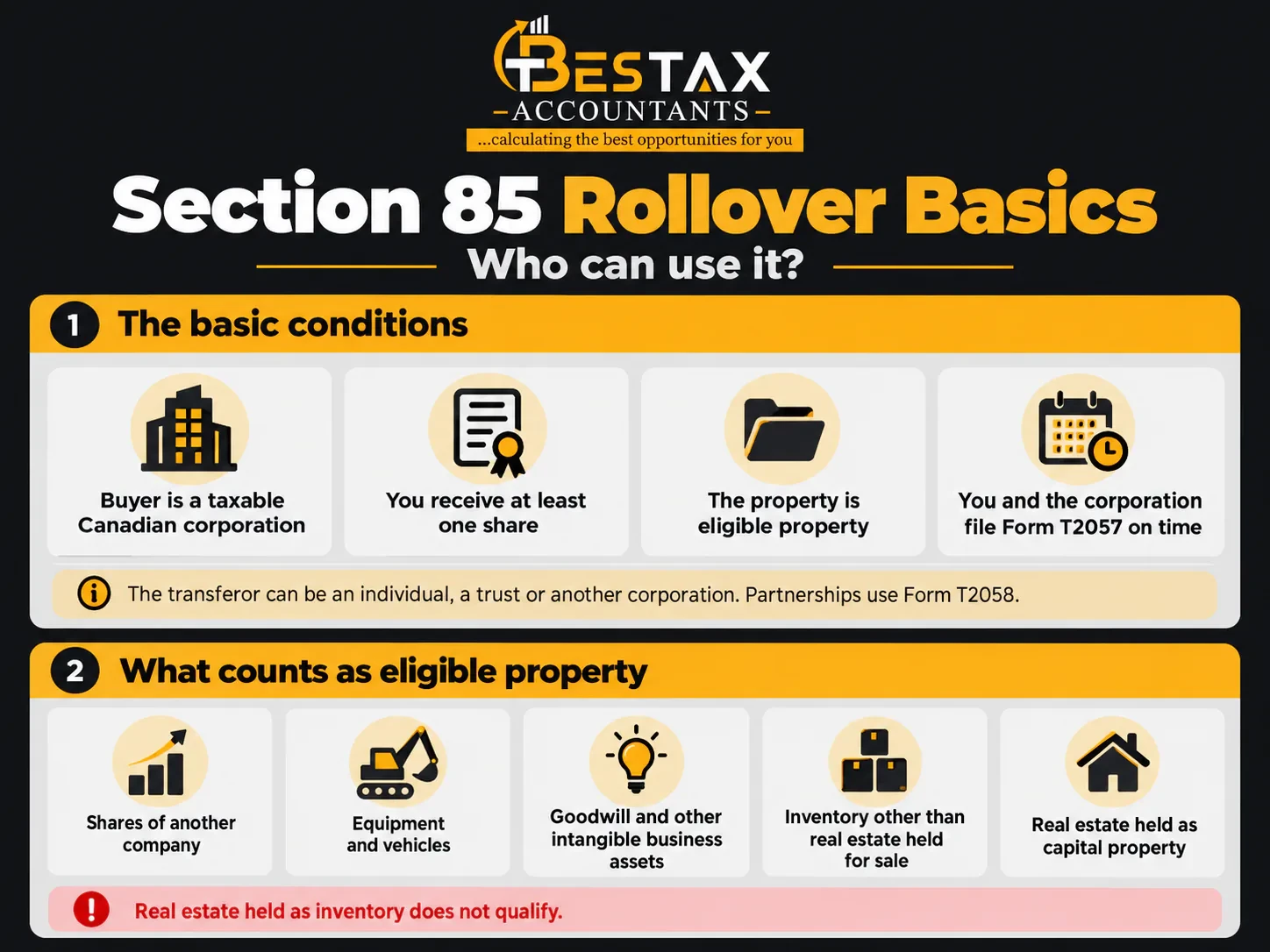
Section 85 of the Income Tax Act allows a joint election between you and a corporation. Together, you pick the price at which the property changes hands for tax purposes.
If you elect at your cost, you report no gain. The corporation takes over your cost, and the tax is deferred until the corporation sells the asset or you sell your shares.
The CRA's main guidance on these transfers is Information Circular IC76-19R3, Transfer of Property to a Corporation Under Section 85.
The basic conditions
A section 85 election in Canada works only when these conditions are met:
- The buyer is a taxable Canadian corporation.
- You receive at least one share of the corporation in return.
- The property is eligible property.
- You and the corporation file Form T2057 together, on time.
The transferor can be an individual, a trust or another corporation. A partnership uses Form T2058 instead.
What counts as eligible property
Most business and investment assets qualify. Common examples include:
- Shares of another company, such as your operating company
- Equipment, vehicles and other depreciable property
- Goodwill and other intangible business assets
- Inventory, other than real estate held for sale
- Real estate held as capital property, with extra limits for non-residents
Real estate held as inventory doesn't qualify. If you build or flip properties for profit, section 85 won't shelter that transfer.
Choosing the elected amount and boot
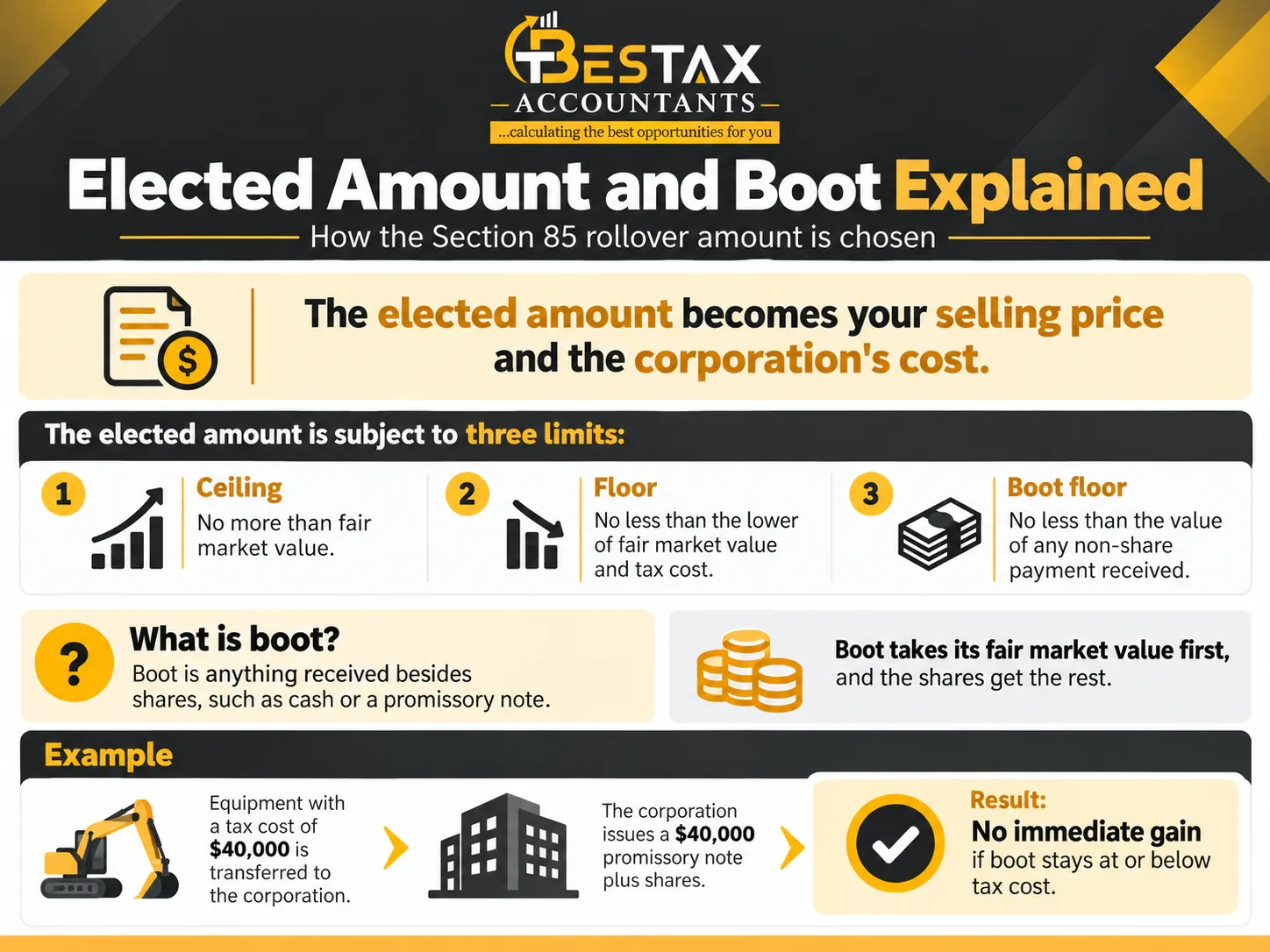
The elected amount becomes your selling price and the corporation's cost. It decides how much gain, if any, you report.
The limits on the elected amount
You can't pick any number you like. The elected amount has to stay within these limits:
| Limit | Rule |
|---|---|
| Ceiling | No more than the property's fair market value |
| Floor | No less than the lower of fair market value and your tax cost |
| Boot floor | No less than the value of any non-share payment you receive |
Your tax cost is usually the adjusted cost base for capital property. For depreciable property, the floor is the lowest of three amounts: the undepreciated capital cost (UCC) of the class, the property's original cost and its fair market value. UCC can be much lower than what you paid. Electing at UCC, or the original cost if lower, avoids recapture of the depreciation you've already claimed.
What boot is
Boot is anything you receive besides shares, such as cash or a promissory note from the corporation. You can take boot up to your tax cost and still report no gain.
This is how many owners pull money out tax-free. If equipment has a tax cost of $40,000, the company can give you a $40,000 note plus shares. When the company pays off that note later, you receive the money tax-free.
Your cost and paid-up capital in the new shares
The elected amount also sets your cost for what you receive. Boot takes its fair market value first, and the shares get the rest. If you elect $100 and take no boot, your new shares have a total cost of $100.
The paid-up capital of the new shares is usually reduced in the same way. That limits how much the company can later return to you tax-free as a return of capital.
Which shares to take
Many rollovers use preferred shares that the company can redeem at a fixed value. That makes it easier to show the shares are worth exactly what you transferred.
How to transfer assets to a corporation tax-free: an example
You own shares of an operating company with a cost of $100 and a fair market value of $800,000. You transfer them to a new holding company.
You elect $100. You report no gain. The holding company owns the shares with a $100 cost, and the $799,900 gain waits until a future sale.
Sometimes you elect higher on purpose. Electing above cost can use up capital losses you've carried forward, or trigger a gain covered by your lifetime capital gains exemption. The exemption is $1.25 million for dispositions after June 24, 2024, indexed to inflation from 2026. It applies only if the shares qualify as qualified small business corporation (QSBC) shares.
Filing Form T2057 on time
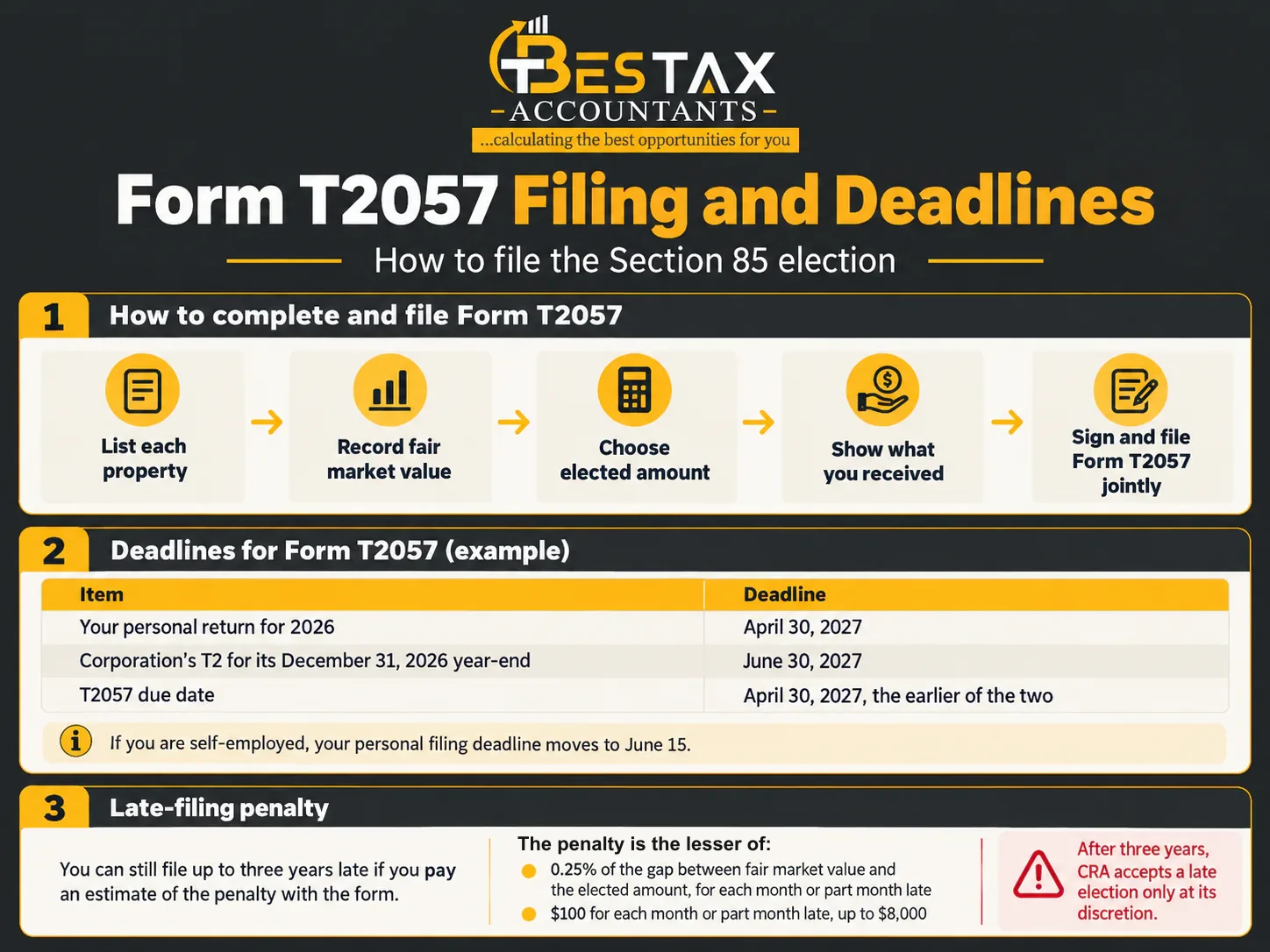
The rollover only works if the CRA receives the election. You and the corporation both sign Form T2057, which lists each property, its fair market value, the elected amount and what you received in return.
The CRA accepts the form on paper or electronically through its special elections service. Use a separate form for transfers made on different dates.
The T2057 deadline
The form is due on the earliest filing deadline of either party, for the tax year in which the transfer happened.
| Example | Filing deadline |
|---|---|
| Your personal return for 2026 | April 30, 2027 |
| Corporation's T2 for its December 31, 2026 year-end | June 30, 2027 |
| T2057 due date | April 30, 2027, the earlier of the two |
If you're self-employed, your personal deadline moves to June 15. Always check both dates, because the earlier one wins.
Filing late and the penalty
You can still file up to three years late if you pay an estimate of the penalty with the form. The penalty is the lower of:
- 0.25% of the gap between fair market value and the elected amount, for each month or part month late
- $100 for each month or part month late, to a maximum of $8,000
The penalty applies to each election, meaning each Form T2057, not to each property listed on it.
After three years, the CRA accepts a late election only at its discretion. You need a written explanation, and approval isn't guaranteed. If it's refused, the transfer is taxed at fair market value. The CRA explains the process on its page on the penalty for accepting a late, amended or revoked election.
Common uses for business owners
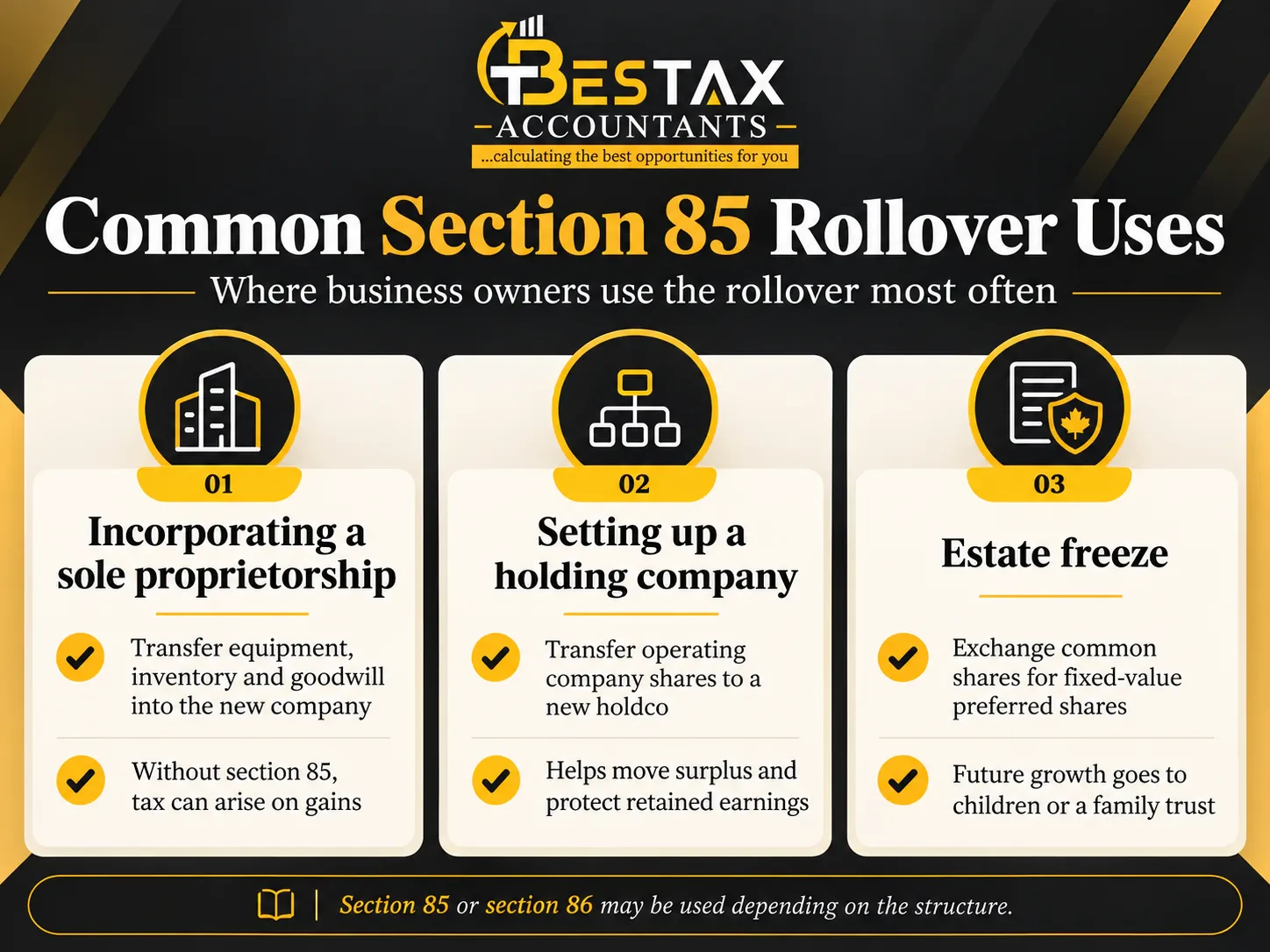
Most section 85 rollovers fall into one of three situations.
Incorporating a sole proprietorship
When you convert a sole proprietorship to a corporation, the business assets have to move into the new company. Without section 85, you'd pay tax on any gain in your equipment, inventory and goodwill.
Goodwill is often the biggest item. A business with loyal clients can have significant goodwill even though it never appears on your books.
Setting up a holding company
Many owners transfer their operating company shares to a new holding company. The holdco can then receive dividends from the opco and invest the surplus, keeping retained earnings away from business creditors.
Section 85 lets you register a holding company and move your shares into it without triggering the gain. The rules on dividends between related companies are complex, so plan this with an advisor.
Estate freeze
An estate freeze locks in today's value of your business for tax on death. You exchange your common shares for preferred shares with a fixed value, using section 85 or section 86. New common shares go to your children or a family trust.
Future growth then belongs to the next generation. The tax on your shares at death is based on the frozen value. A freeze is usually one step in wider family business succession planning.
Common mistakes that cancel the deferral
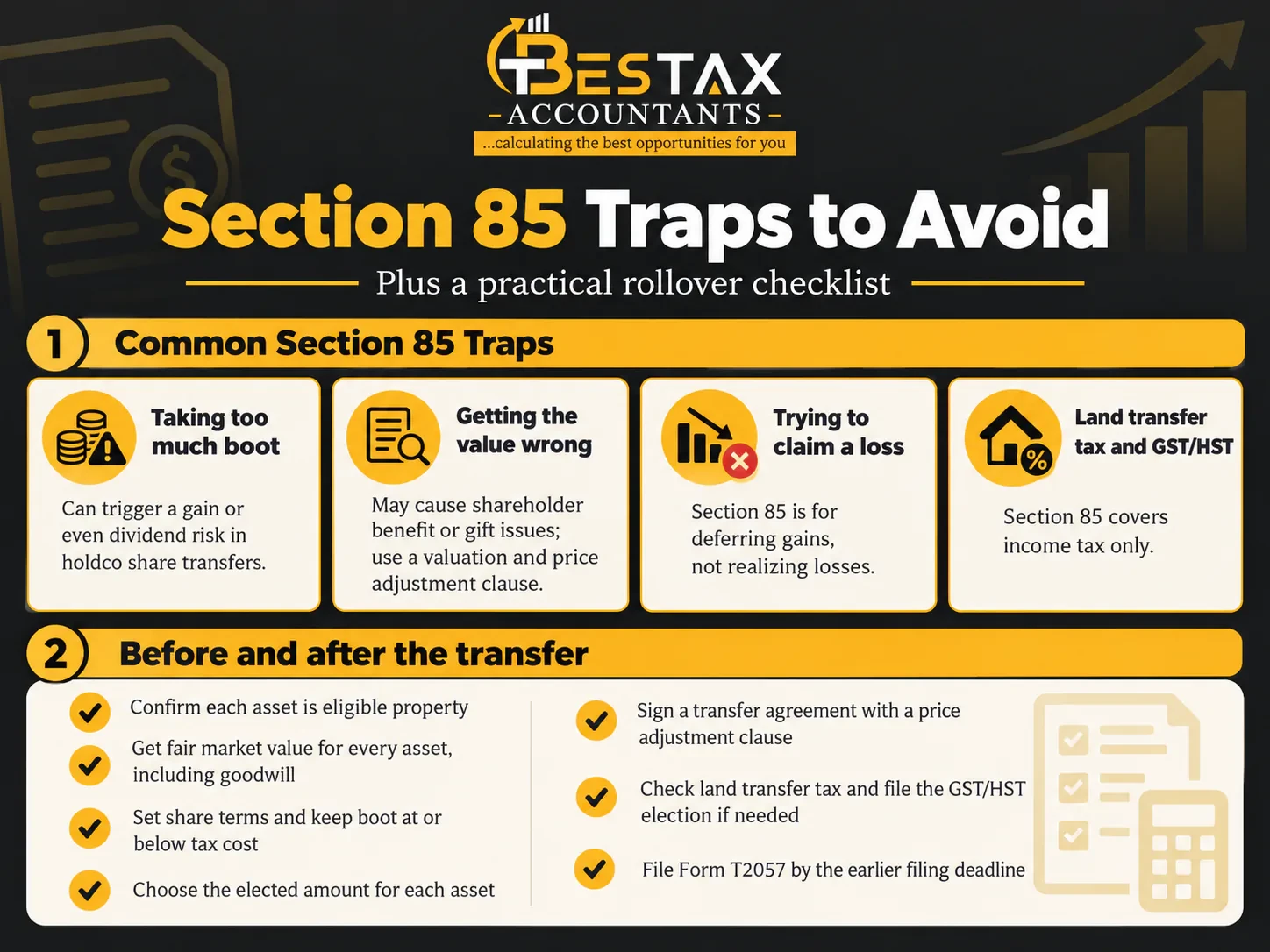
The election defers income tax. It doesn't protect you from every other rule, and small mistakes can undo the deferral.
Taking too much boot
If your boot exceeds your tax cost, the elected amount rises to match it. You report a gain on the difference.
Transfers of shares to your own holding company carry an extra risk under section 84.1. If the boot is more than the greater of the shares' paid-up capital and their adjusted cost base (as modified by that section), the excess can be treated as a taxable dividend.
Getting the value wrong
The shares and boot you receive should equal the fair market value of what you transfer. If you get too much, it can be a taxable shareholder benefit. If you get too little and a family member benefits, the CRA can treat it as a gift and increase your gain.
Use a proper valuation, and include a price adjustment clause in the transfer agreement. That clause lets you fix the value if the CRA disagrees.
Trying to claim a loss
Section 85 is for deferring gains. If the property is worth less than your cost, transferring it to a company affiliated with you, such as one you or your spouse control, generally won't let you claim the loss right away.
Land transfer tax and GST/HST
Section 85 covers income tax only. Moving real estate into a corporation can still trigger provincial land transfer tax.
GST/HST can also apply to the assets you transfer. When you transfer substantially all of a business's assets, you and the corporation can usually file a joint section 167 election on Form GST44 so no GST/HST is charged on the transfer.
Section 85 rollover checklist
Work through these steps before and after the transfer:
- Confirm each asset is eligible property.
- Get a fair market value for every asset, including goodwill.
- Set the share terms and any boot, and keep boot at or below your tax cost.
- Choose the elected amount for each asset.
- Sign a transfer agreement with a price adjustment clause.
- Check land transfer tax and file the GST/HST election if needed.
- File Form T2057 by the earlier of the two filing deadlines.
Bestax prepares section 85 rollovers and the corporate tax returns that follow them. Book a call before you transfer anything, so the elected amounts are set right from the start.
Section 85 FAQs
Section 85 covers transfers of property to a corporation, and you must file an election. Section 86 covers exchanging your shares for new shares of the same company, often in an estate freeze. It applies automatically, with no form.
Technically, yes, but it rarely makes sense. The home loses the principal residence exemption on future growth. If you keep living there, you may also have a taxable benefit.
Only with the CRA's permission. You file an amended election with a written reason and pay the penalty for an amended election. The CRA approves changes for real errors, not for planning you regret later.
Not if you're within the filing deadline or the three-year late-filing window. Document the transfer properly and file Form T2057 as soon as possible, since the penalty grows each month.
It depends on how many assets you transfer and whether you need a business valuation. Goodwill usually needs one. The fees are small next to the tax on a gain triggered by a missed or invalid election.
Section 85 can defer the gain, but it doesn't remove the other costs. You may pay land transfer tax, and your lender usually has to approve the move.
Rental income inside a corporation is passive income, which is taxed at a high corporate rate. For many landlords, the move saves little or no tax. Our guide to the taxation of rental income in Canada covers the trade-offs.
When you incorporate a business, receivables usually move under a separate election, Form T2022. Using section 85 for them can turn future bad debts into capital losses instead of full deductions.
No. You can roll property into an existing corporation, as long as it's a taxable Canadian corporation and you receive at least one share.
Yes, for most property. Real estate in Canada owned by a non-resident generally doesn't qualify, unless it's used in a business carried on in Canada. Non-residents may also need a clearance certificate from the CRA.
Disclaimer: The information provided in this blog is for general informational purposes only. For professional assistance and advice, please contact experts.

