
Tax
Medical Expense Tax Credit in Canada: What Counts, Thresholds and How to Maximize It
Paying medical bills in Canada? Claim eligible costs above the 2026 threshold of $2,890 or 3% of net income. Book a free tax review with Bestax.


The Medical Expense Tax Credit is a non-refundable tax credit that gives you back part of what you spend on eligible health costs for yourself, your spouse or common-law partner, and your dependants.
You claim it on your federal return once your total eligible expenses pass a set threshold. Many people miss part of it because they overlook expenses that qualify or claim them on the wrong return.
What the Medical Expense Tax Credit actually is
A tax credit reduces the tax you owe. The Medical Expense Tax Credit is non-refundable, which means it can lower your tax bill to zero but does not, on its own, create a cash refund beyond that. It works by taking your eligible medical costs, subtracting a threshold amount, and applying a credit rate to what is left.
There are two parts to the credit for most families:
- A federal credit, applied at the lowest federal personal income tax rate. That rate was cut to 14.5 percent for 2025 and to 14 percent for 2026 onward.
- A matching provincial or territorial credit, at your province's own lowest rate.
The two stack, so the real value of your claim is higher than the federal portion alone. Quebec runs its own system through Revenu Québec, so Quebec residents follow slightly different rules.
Large claims keep a 15 percent rate. When the lowest rate dropped, the government added a temporary Top-Up Tax Credit for the 2025 to 2030 tax years, enacted through Bill C-15. It effectively keeps a 15 percent rate on non-refundable credit amounts above the first tax bracket threshold, so a large one-time medical claim is not worth less because of the rate cut.
The threshold: the number your expenses have to beat
You do not get a credit on the first dollar of medical spending. You only get credit on the amount above a threshold. The threshold is the lower of two numbers:
- 3 percent of your net income (the figure on line 23600 of your return), or
- a fixed dollar ceiling set by the Canada Revenue Agency each year.
Whichever of those two is smaller is the amount you subtract from your total eligible expenses. The fixed ceiling is indexed to inflation every year. Here are the official figures.
| Tax year | Fixed dollar ceiling | 3 percent of net income applies below this income |
|---|---|---|
| 2026 | $2,890 | About $96,333 |
| 2025 | $2,834 | About $94,467 |
| 2024 | $2,759 | About $91,967 |
How to read this: if your net income is below about $96,333 in 2026, your threshold is 3 percent of your income, not the full dollar ceiling. That is why lower-income earners reach the threshold faster and get a larger claim.
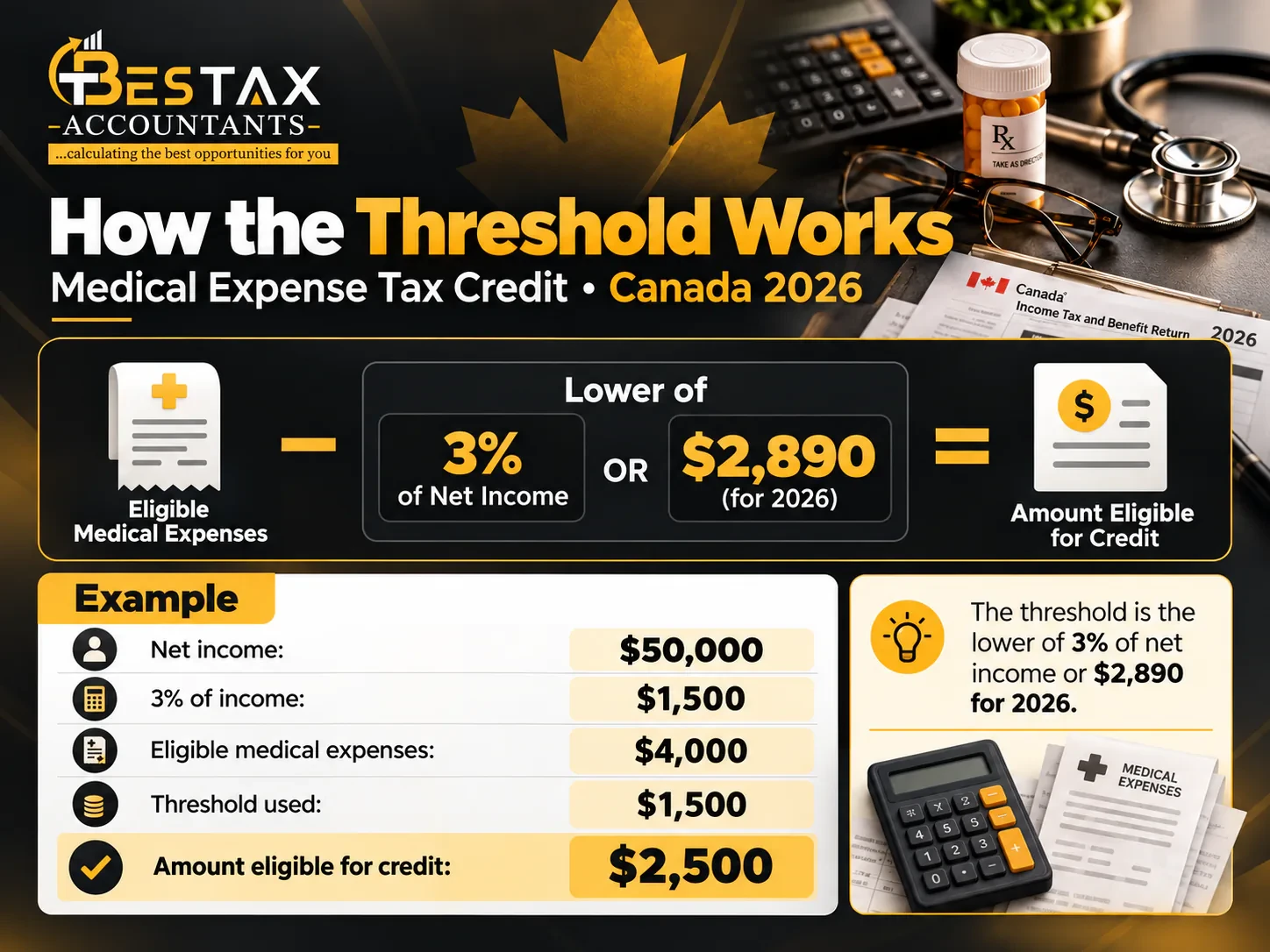
A quick example. Say your net income is $50,000 and you paid $4,000 in eligible expenses in 2026. Three percent of $50,000 is $1,500, which is lower than the $2,890 ceiling, so your threshold is $1,500. You subtract $1,500 from $4,000, leaving $2,500 that qualifies for the credit.
At the 2026 federal rate, that is $2,500 × 14% = $350 off your federal tax. Your province adds its own credit on top. In Ontario, for example, the lowest provincial rate of 5.05 percent adds about $126, for a combined saving of roughly $476.
What counts: eligible medical expenses
The list of eligible expenses is long, and this is where most missed claims happen. Below are common costs that qualify. Some need a prescription, a written certification from a medical practitioner, or an approved Form T2201, so keep your paperwork.
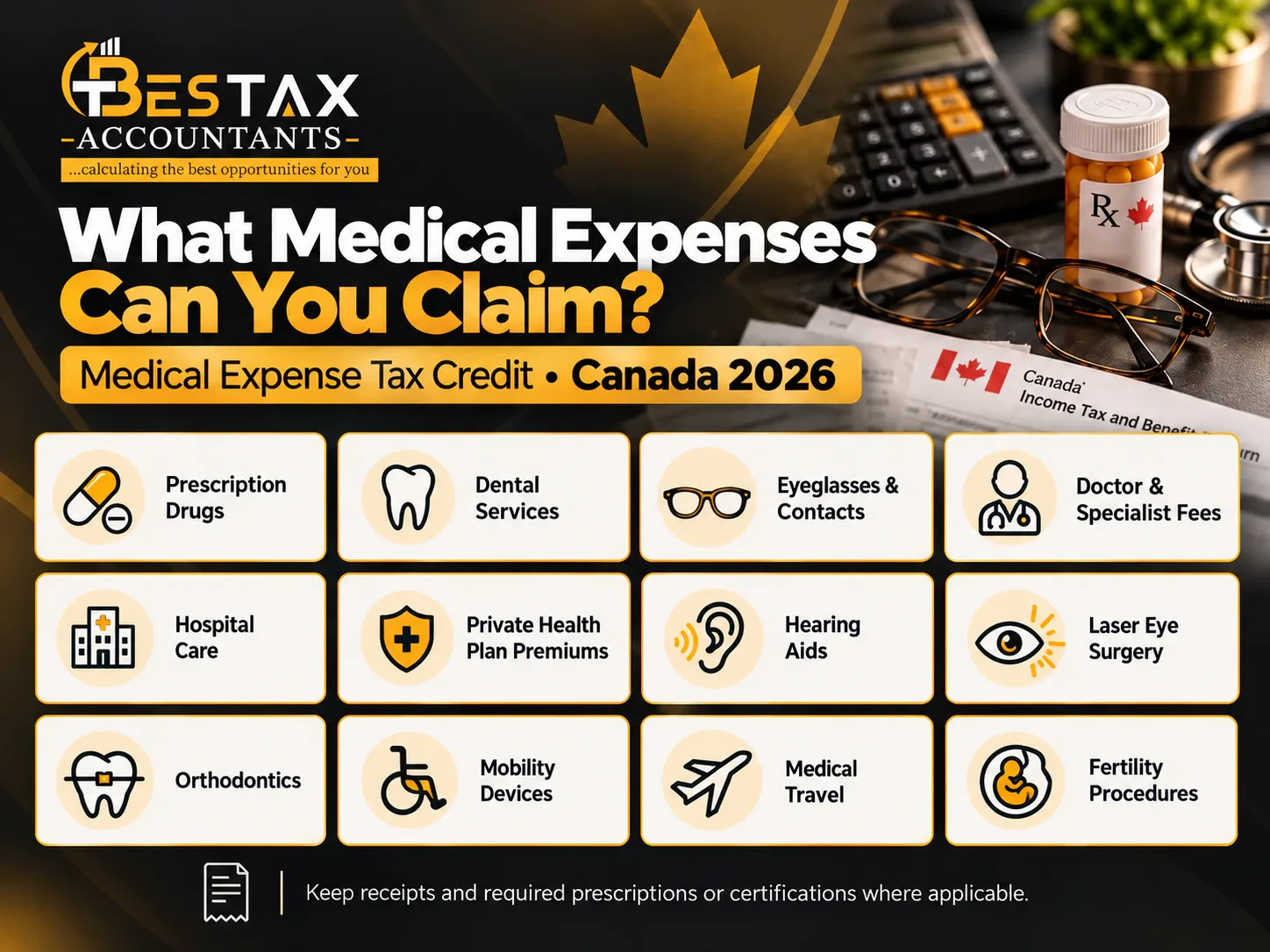
Commonly claimed and often forgotten:
- Prescription drugs and medications dispensed by a pharmacist
- Dental services, dentures, and dental implants
- Eyeglasses, contact lenses, and prescription vision devices
- Fees paid to doctors, specialists, and many other authorized medical practitioners
- Hospital services and licensed private hospital care
- Premiums you pay to a private health services plan, including many extended health and travel medical plans. Premiums your employer paid that were not included in your income do not count.
- Hearing aids, batteries, and repairs
- Laser eye surgery and other vision correction procedures
- Orthodontic work
- Attendant care and care in a nursing home or group home, subject to conditions
- Wheelchairs, walkers, canes, and scooters
- Insulin, needles, syringes, and injection pens
- Vaccines, lab tests, and diagnostic procedures
- Medical cannabis purchased under the federal framework
- Fertility-related procedures, including certain in vitro costs
- Renovations or construction to make a home accessible, subject to conditions. From the 2026 tax year, an expense you claim as a medical expense can no longer also be claimed under the Home Accessibility Tax Credit, so you choose one credit for each renovation cost.
- Travel costs to get medical care not available closer to home
Medical travel is a frequently missed claim. It applies only when substantially equivalent medical services were not available near your home and you took a reasonably direct route. The distance decides what you can claim:
- At least 40 kilometres one way: public transportation costs such as a taxi, bus, or train. You can claim vehicle expenses instead only where public transportation is not readily available.
- At least 80 kilometres one way: accommodation, meals, and parking as well as the transportation costs.
Keep receipts and a simple log of each trip.
For anything unusual, check the CRA's detailed list of eligible medical expenses rather than assume an item does not count. It runs to dozens of items.
What does not count
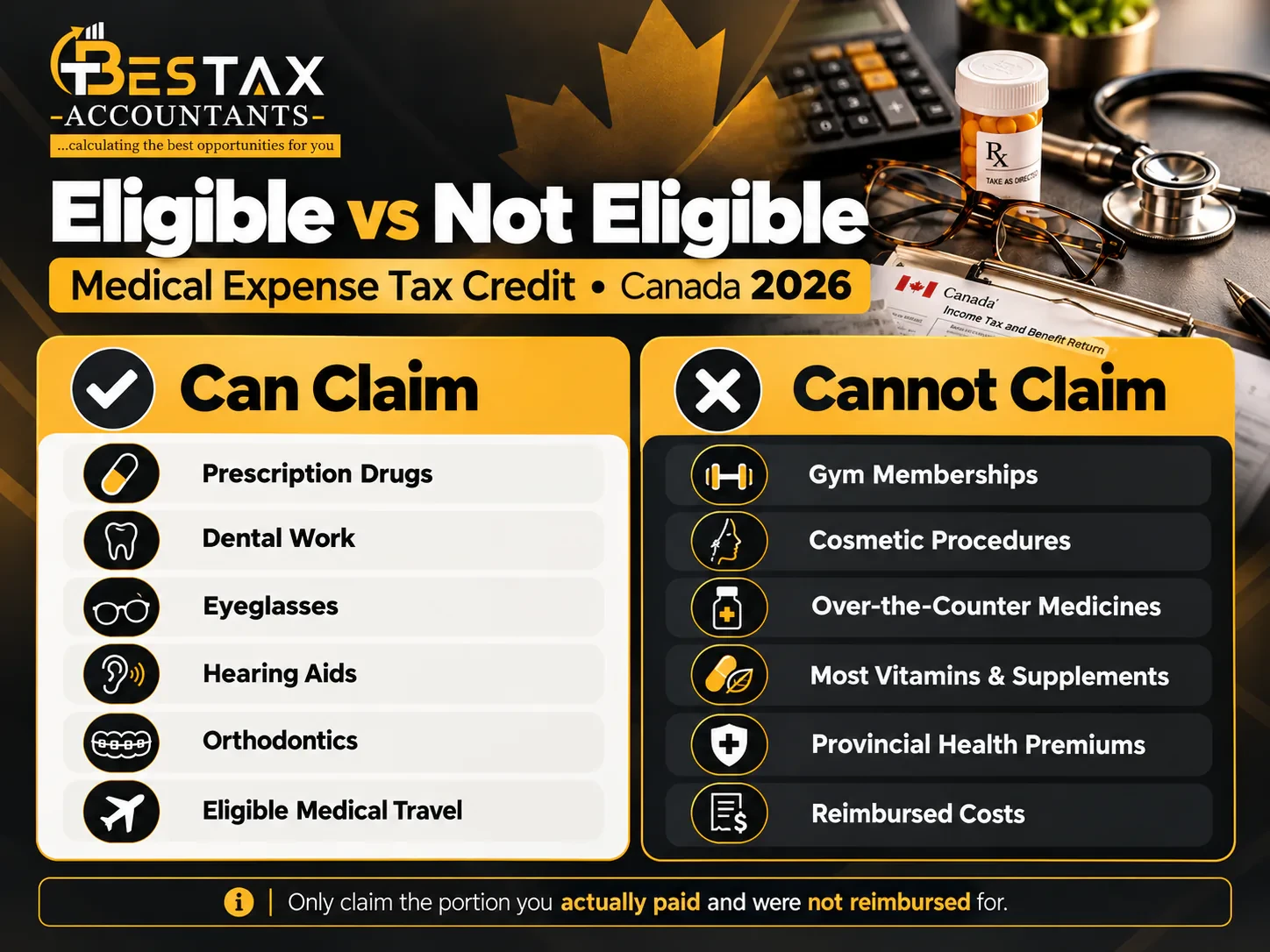
Knowing what is excluded saves you from a denied claim and a possible review. These are not eligible:
- Gym and fitness club memberships
- Cosmetic procedures done purely for appearance, such as teeth whitening, liposuction, hair replacement, and wrinkle fillers
- Over-the-counter medicines, even if a pharmacist suggested them
- Vitamins and supplements, even with a prescription, except Vitamin B12 therapy for pernicious anaemia, with a prescription
- Provincial or territorial health plan premiums
- Blood pressure monitors
- Organic food, and gluten-free food bought for general health rather than for a certified medical condition
- Personal response systems such as basic medical alert services
- Non-prescription birth control devices
If part of an expense was reimbursed by insurance or an employer plan, you can only claim the portion you actually paid and were not reimbursed for.
Who you can claim for: lines 33099 and 33199
The credit is not limited to your own bills. You can pool the family's eligible expenses, and where they go depends on who the expense was for.
Line 33099 is for expenses paid for:
- yourself
- your spouse or common-law partner
- your or your partner's children who were under 18 at the end of the year
Line 33199 is for expenses paid for other dependants who relied on you for support, such as:
- your or your partner's children who were 18 or older, or your grandchildren
- your or your partner's parents, grandparents, brothers, sisters, aunts, uncles, nieces, and nephews who were residents of Canada at any time in the year
The threshold calculation on line 33199 uses the dependant's net income, not yours, and is done separately for each dependant. If the dependant has a severe and prolonged impairment, the Disability Tax Credit may also apply, and it is worth checking both together.
The 12-month rule: your most powerful timing tool
Many people assume medical expenses must fall inside the calendar year. They do not. You can claim eligible expenses paid in any 12-month period that ends in the tax year, as long as you did not already claim them on a previous return.
This is the single most useful planning move for anyone with uneven medical spending. By choosing the right 12-month window, you can pull two years of heavy costs into one claim so they clear the threshold together instead of being split and partly wasted.
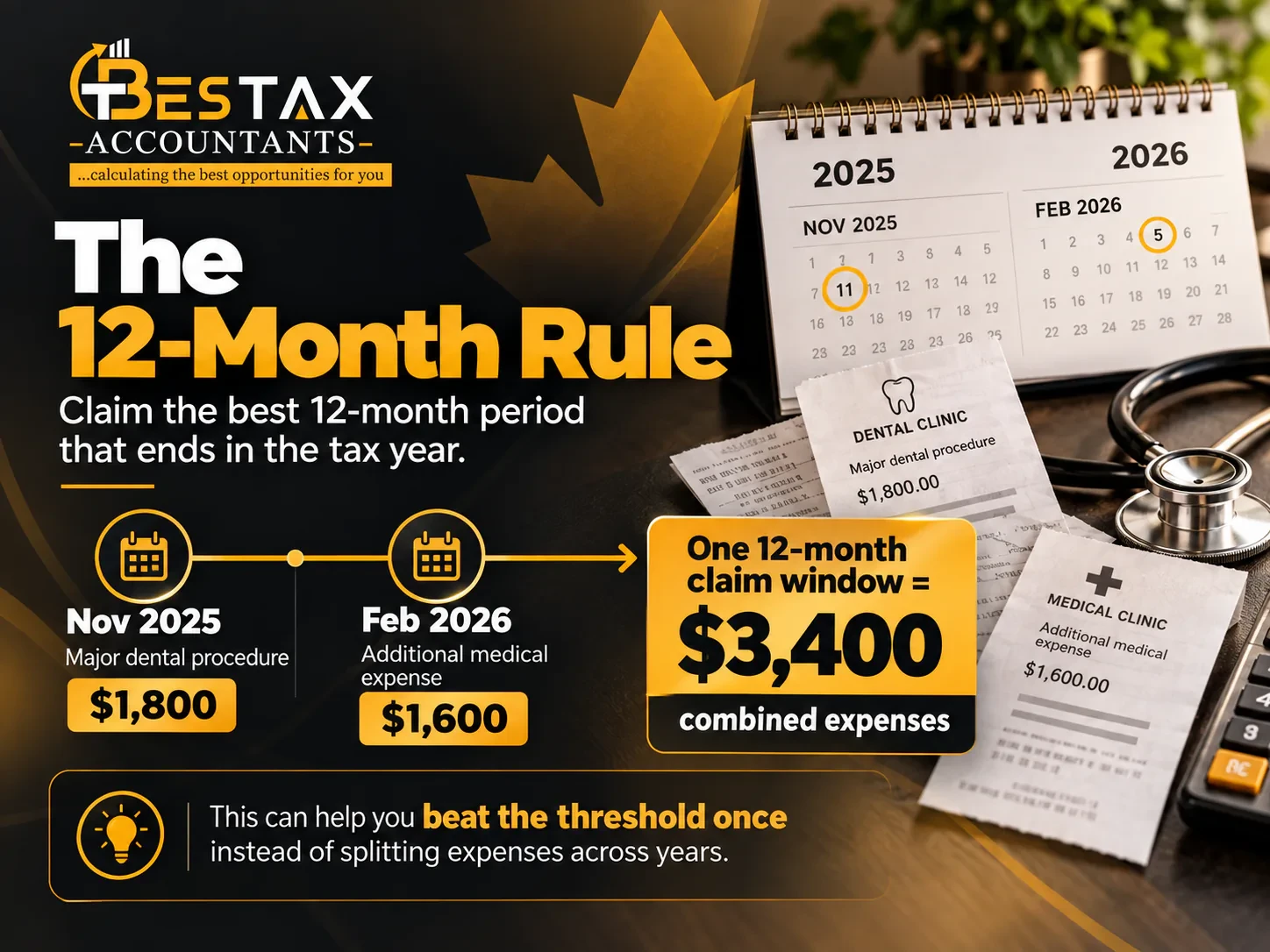
Example. You paid $1,800 for a major dental procedure in November 2025 and another $1,600 in February 2026. Claimed in two separate calendar years, each amount might barely clear or fall short of your threshold. If you choose a 12-month period ending in 2026 that captures both, you claim the full $3,400 against one threshold. You only have to beat the threshold once.
Pick your window before you file, not after. As a practical tip, using the same window for everyone on a family claim makes it easier to track which receipts have already been used.
How to maximize your claim: what our accountants do
Here is the checklist we work through when medical expenses appear on a return, in order.
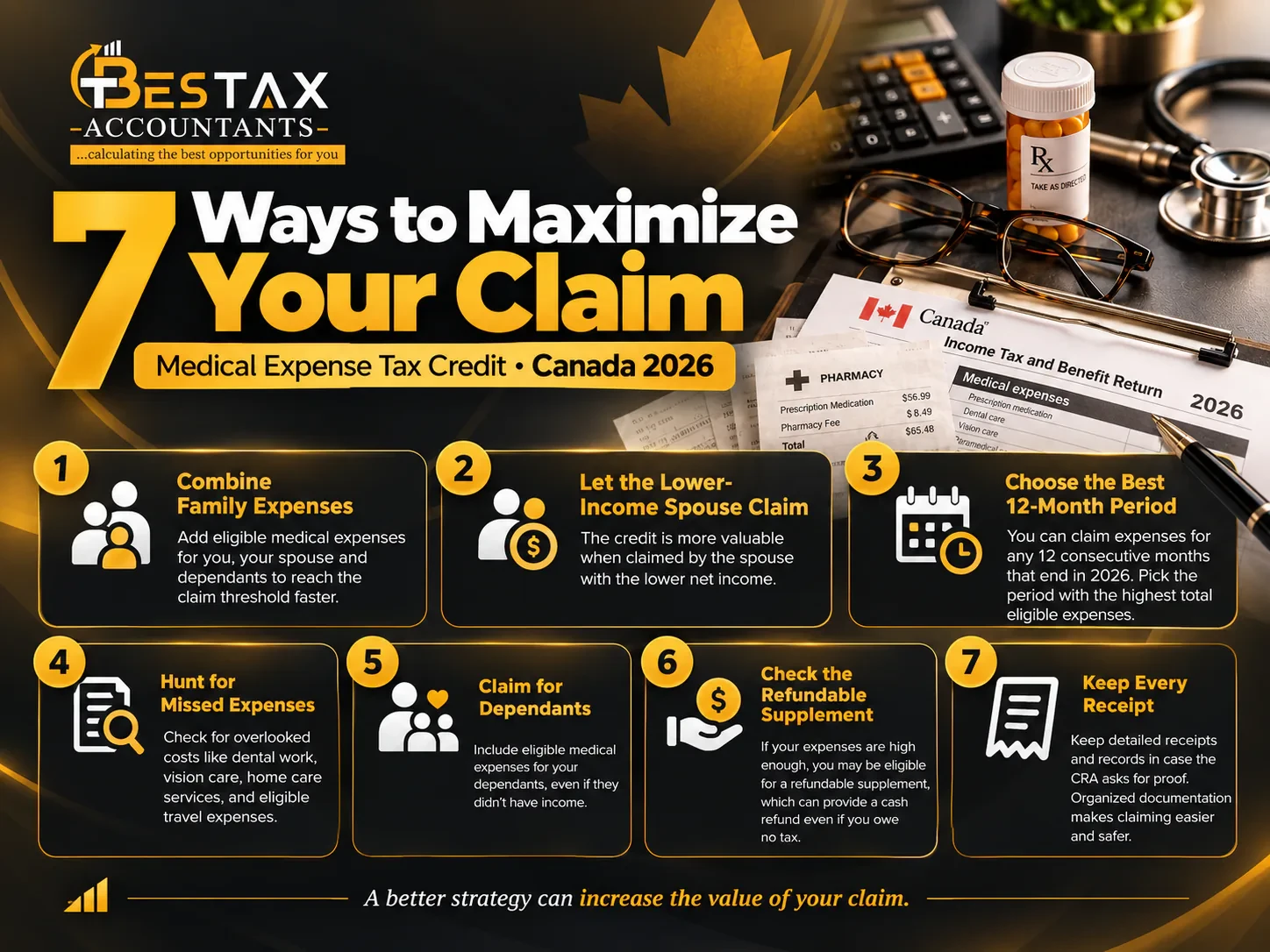
1. Combine the whole family onto one return. Add up eligible expenses for you, your spouse or partner, and your minor children, then claim them together.
2. Let the lower-income spouse claim. Because the threshold is 3 percent of net income, the spouse with the lower income has a lower threshold, so more of the expenses survive the subtraction. Compare both ways before you decide. It is not always obvious, and the tax owing on each return matters too, since a non-refundable credit is only useful if there is tax to reduce. Our guide to income splitting in Canada covers other ways couples can lower their combined tax.
3. Choose the best 12-month period. Bunch large one-time costs, such as surgery, dental work, or fertility treatment, into a single window.
4. Hunt for the missed expenses. Private health plan premiums, medical travel, and orthodontics are easy to overlook.
5. Claim for dependants on line 33199. Adult children, aging parents, and other supported relatives are frequently overlooked.
6. Check the refundable supplement. If you are a lower-income worker, you may also qualify for the refundable medical expense supplement described below, which can produce an actual refund.
7. Keep every receipt. You do not send them with your return, but the CRA can ask to see them later. Receipts must show who was paid. For expenses that require a prescription, a written certification, or Form T2201, keep those too. Our guide on how long to keep tax records in Canada sets out how long.
The refundable medical expense supplement
The regular credit is non-refundable, but there is a separate refundable supplement for working Canadians with lower incomes and high medical costs. Refundable means it can put money in your pocket even if you owe no tax.
To claim it, all of these must apply:
- You were resident in Canada throughout the year.
- You were 18 or older at the end of the year.
- You had employment or self-employment income above the minimum earnings threshold.
- Your adjusted family net income was low enough. The supplement is reduced by 5 percent of family net income above the reduction threshold, so it reaches zero at $63,374 for 2025 and $64,640 for 2026.
The supplement is the lesser of the yearly maximum or 25 percent of your allowable medical expenses, before that income reduction. Here are the official amounts.
| Item | 2026 | 2025 |
|---|---|---|
| Maximum supplement | $1,534 | $1,504 |
| Minimum earnings threshold | $4,478 | $4,390 |
| Family net income where reduction begins | $33,960 | $33,294 |
You claim this supplement on line 45200 of your return. It is easy to miss, because it sits in a different spot from the main credit.
Provincial credits and special situations
Your province adds to the claim. After the federal calculation, you claim the matching provincial or territorial credit on your provincial Form 428, for example on lines 58689 and 58729 of Ontario's Form ON428. Quebec residents follow Revenu Québec's separate rules.
Claiming for someone who has died. When you file for a person who has died, you can claim eligible expenses paid in any 24-month period that includes the date of death, as long as they were not claimed on another return.
Impairment in physical or mental functions. Some costs can be claimed either as a medical expense or as the disability supports deduction on line 21500. You can even split them between the two, as long as you do not double count. Take whichever gives the better result. This is worth professional review, because the deduction and the credit behave differently on your return.
Why work with Bestax
Bestax prepares Canadian personal and corporate tax returns, and medical expenses are one of the places where a careful review most often changes the result.
We check the lower-income spouse strategy, the best 12-month window, the dependant claims, and the refundable supplement on every file where medical expenses appear. If the credit does not help you this year because you have little tax to reduce, we tell you, and we plan the timing so it helps next year instead. See our personal income tax services for what a full T1 review covers.
Book a free consultation and we will review your medical expenses before anything is sent to the CRA. Get started here.
Frequently asked questions
What is the medical expense tax credit in Canada?
It is a non-refundable tax credit that returns part of what you spend on eligible health costs for yourself, your spouse or common-law partner, and your dependants. You claim it on your federal return, and your province adds a matching credit. It reduces the tax you owe once your eligible expenses pass a set threshold.
What medical expenses can I claim on my taxes in Canada?
You can claim prescription drugs, dental work, eyeglasses and contacts, fees to doctors and many other practitioners, hospital care, private health plan premiums, hearing aids, wheelchairs, laser eye surgery, orthodontics, attendant care, and eligible medical travel, among many others. The list is long, so check the CRA's detailed list before assuming an item does not qualify.
What is the medical expense tax credit threshold for 2026?
For the 2026 tax year the threshold is the lower of 3 percent of your net income or $2,890. For the 2025 tax year the fixed ceiling is $2,834. You only get credit on the eligible expenses above that threshold.
How much medical expenses can I claim on my tax return?
There is no upper dollar limit on eligible expenses for the regular credit. You claim everything eligible, subtract your threshold, and the credit applies to the rest at the lowest federal rate, 14 percent for 2026, plus your provincial rate. The refundable supplement, which is separate, is capped at $1,534 for 2026.
Can I claim medical expenses for my spouse and children?
Yes. You can pool eligible expenses for yourself, your spouse or common-law partner, and your children under 18, and claim them together on line 33099. Expenses for other supported dependants, such as adult children or parents, go on line 33199.
What medical expenses are not eligible for the tax credit?
Gym memberships, purely cosmetic procedures such as teeth whitening and liposuction, over-the-counter medicines, vitamins and supplements, provincial health premiums, and organic or gluten-free food for general health do not qualify. The one vitamin exception is Vitamin B12 therapy for pernicious anaemia, with a prescription. You also cannot claim any part of an expense that was reimbursed.
Do I need receipts to claim medical expenses?
Yes, keep every receipt, but do not mail them with your return. The CRA can ask to see them later, and each receipt must show who was paid. Some expenses also need a prescription, a written certification, or an approved Form T2201.
Should my spouse or I claim the medical expenses?
Usually the spouse with the lower net income should claim, because the 3 percent threshold is smaller, so more of the expenses qualify. Always compare both returns first, since the credit only helps if that spouse has tax to reduce.
Can I claim medical expenses from a previous year?
You can claim eligible expenses paid in any 12-month period that ends in the tax year, as long as you did not claim them before. This lets you group two years of heavy costs into one window so they clear the threshold together.
What is the refundable medical expense supplement?
It is a separate refundable credit for lower-income working Canadians with high medical costs, claimed on line 45200. You must have been resident in Canada all year, be 18 or older at year-end, and meet the earnings and family income limits. Unlike the regular credit, it can produce a refund even if you owe no tax. The maximum is $1,534 for 2026.
Can I claim medical travel expenses?
Yes, if substantially equivalent services were not available near your home. From 40 kilometres one way, you can claim public transportation such as a taxi, bus, or train, or vehicle expenses where public transportation is not readily available. From 80 kilometres one way, you can also claim accommodation, meals, and parking. Keep receipts and a log of each trip.
How do I claim medical expenses on lines 33099 and 33199?
Add up your eligible expenses, subtract the lower of 3 percent of net income or the yearly ceiling, and enter the result on line 33099 for yourself, your spouse, and children under 18, or line 33199 for other dependants. Then claim the matching provincial credit on the related line of your provincial form.
Disclaimer: The information provided in this blog is for general informational purposes only. For professional assistance and advice, please contact experts.


