
Accounting
ASPE vs IFRS: Which Accounting Standard Does Your Canadian Company Need?
Private companies default to ASPE and publicly accountable enterprises must use IFRS. The key differences, when a private company should elect IFRS, the 2025 to 2026 updates, and how to switch.


Most private companies in Canada use ASPE, and publicly accountable enterprises such as public companies and banks must use IFRS. If your business is privately owned and does not hold money or assets in trust for the public, ASPE is almost certainly the accounting standard you need. If your shares or debt trade on a public market, you are required to use IFRS.
That is the short answer. The longer answer matters, because the standard you pick shapes how your profit looks, how much your year end costs, what your bank and investors see, and how ready you are to grow or go public.
An accountant's view. The expensive mistakes run in both directions. One company adopts IFRS because a template said so and pays for years of disclosure work nobody reads. Another stays on ASPE until twelve months before a listing and then has to restate everything in a rush. A short conversation at the start avoids both.
Quick answer: who uses ASPE and who uses IFRS
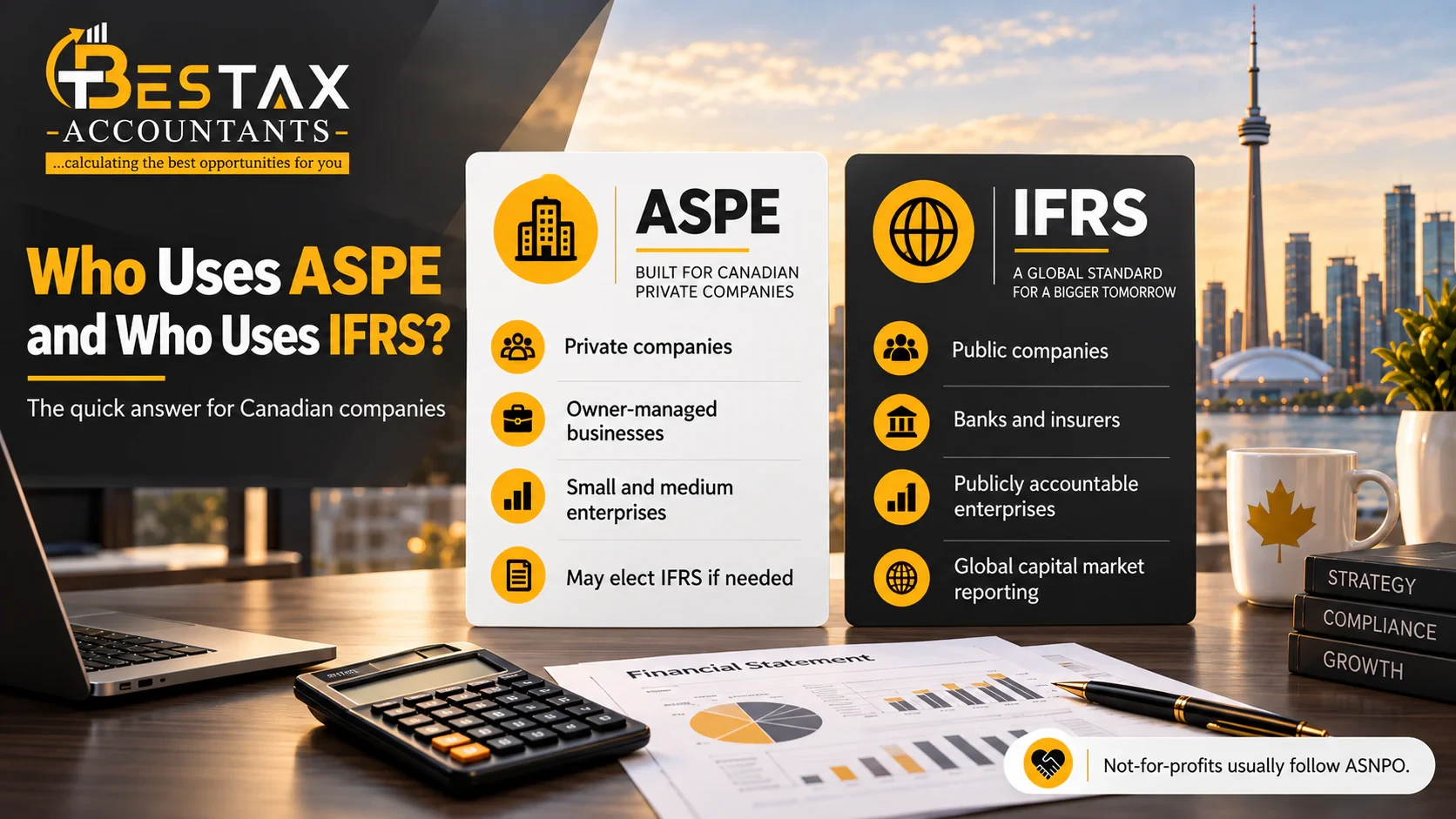
| Your situation | The standard you need |
|---|---|
| Private Canadian company, owner managed, not on a stock exchange | ASPE (you may elect IFRS if you have a reason to) |
| Public company with shares or debt trading on a market | IFRS (required) |
| Bank, credit union, insurer, or other business holding assets in trust for the public | IFRS (required) |
| Private company planning to go public or raise foreign capital soon | IFRS is worth considering now |
| Subsidiary of a foreign parent that reports under IFRS | Often IFRS, to match the group |
| Not-for-profit organization | A separate standard (ASNPO), not covered in depth here |
Still unsure where your company sits? Send us your ownership structure and who reads your financial statements, and we will tell you which standard applies at no cost.
What are accounting standards, and why does Canada have more than one?
Accounting standards are the rulebook for how a business records its transactions and presents its financial statements. They exist so that a lender, an investor, the tax authority, or an owner can read a set of statements and trust that the numbers were prepared consistently and fairly.
In Canada, these rules are set by the Accounting Standards Board, known as the AcSB. The AcSB is one of the independent boards operating under Financial Reporting & Assurance Standards Canada. The standards it sets are published in the CPA Canada Handbook.
Canada does not use a single rulebook for every entity. It uses a multi-framework model, and the framework you follow depends on what kind of organization you are. The main parts of the CPA Canada Handbook are:
- Part I: IFRS, for publicly accountable enterprises.
- Part II: ASPE, for private enterprises.
- Part III: ASNPO, for not-for-profit organizations.
- Part IV, for pension plans.
Governments and most public sector bodies follow a separate set of Public Sector Accounting Standards. All of these frameworks sit under the umbrella of Canadian GAAP. For a normal for-profit business, the real choice comes down to two options, ASPE or IFRS, and the rest of this guide focuses on those.
What is ASPE (Accounting Standards for Private Enterprises)?
ASPE stands for Accounting Standards for Private Enterprises. It is Part II of the CPA Canada Handbook, and the AcSB built it specifically for Canadian companies that are privately held. It has applied to fiscal years beginning on or after January 1, 2011.
A private enterprise, in simple terms, is a profit-oriented business that is not publicly accountable. That means your company does not have shares or debt traded on a public market, and it does not hold assets in trust for a broad group of outsiders the way a bank or insurer does.
ASPE was designed to be simpler and cheaper to apply than IFRS, because the people who read a private company's statements are usually a small, known group: the owners, the bank, and the tax authority. Its main advantages are:
- Fewer disclosures. Your notes to the financial statements are shorter, which saves preparation time and cost.
- More accounting policy choices. ASPE lets you choose treatments that suit a smaller business, such as how you account for investments in subsidiaries.
- Lower cost. Because it is less complex, a typical ASPE year end takes less time than an IFRS one.
- Relevance to real users. It focuses on what owners, lenders, and the CRA actually need to see.
For the large majority of small and medium-sized Canadian businesses, ASPE meets their needs comfortably.
What is IFRS (International Financial Reporting Standards)?
IFRS stands for International Financial Reporting Standards. It is Part I of the CPA Canada Handbook, and it is developed by the International Accounting Standards Board, an independent body within the IFRS Foundation.
IFRS is a global language for financial reporting. According to the IFRS Foundation, companies in more than 140 jurisdictions are required to use IFRS, and the Foundation maintains complete profiles for 170 jurisdictions. Canada adopted IFRS for publicly accountable enterprises for financial years beginning on or after January 1, 2011.
In Canada, IFRS is mandatory for publicly accountable enterprises. A publicly accountable enterprise is a business that either has debt or equity instruments traded on a public market, or holds assets in a fiduciary capacity for a broad group of outsiders as one of its primary activities. Public companies, banks, credit unions, and insurance companies are the classic examples.
IFRS is a rigorous, comprehensive framework. It carries far more detailed disclosure requirements than ASPE, which is exactly what large capital markets need, and exactly why it takes more time and resources to apply. Private companies are also allowed to use IFRS if they choose to, and later in this guide we explain when that choice makes sense.
ASPE vs IFRS: the key differences that actually affect your business
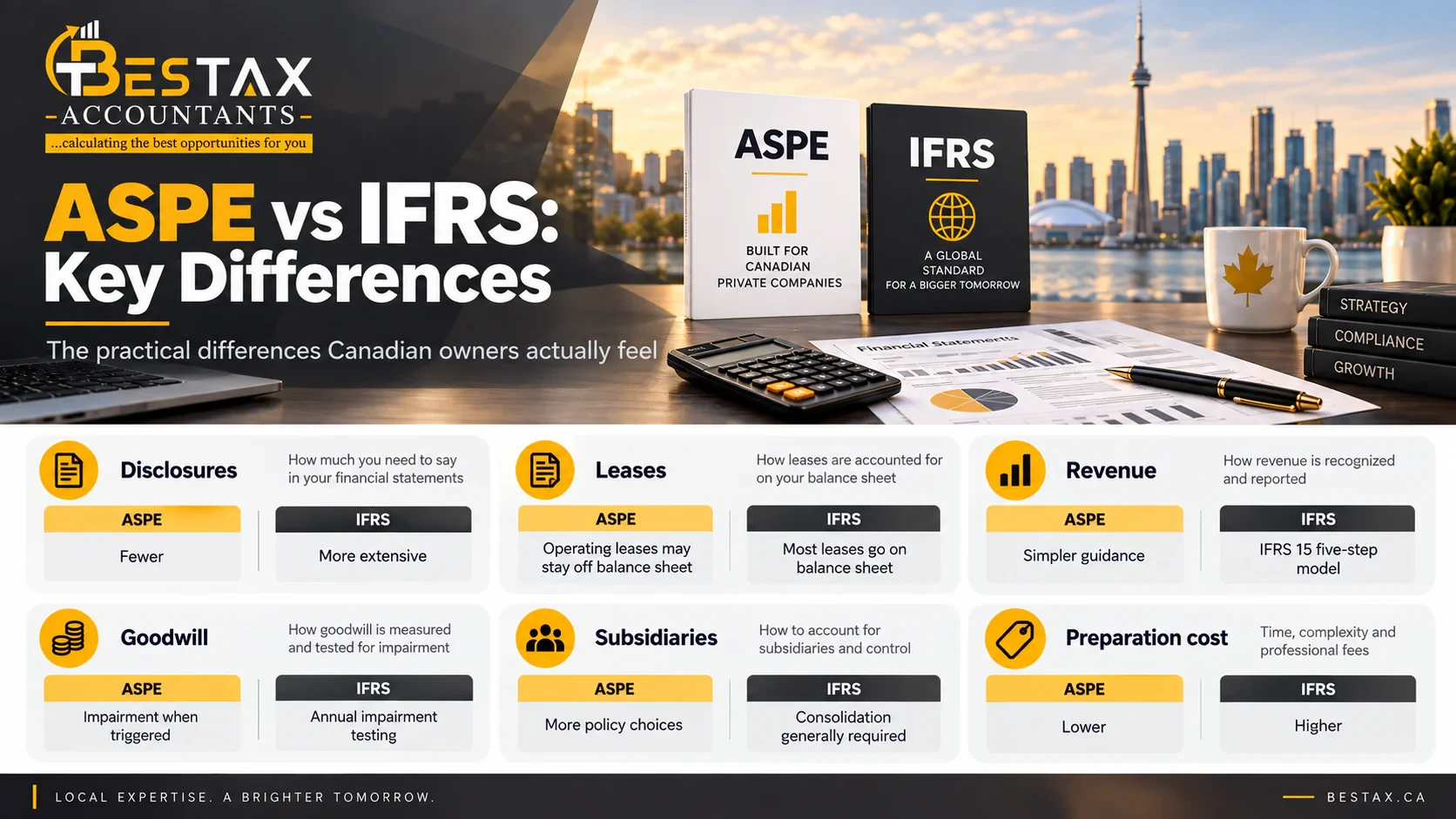
Both ASPE and IFRS are part of Canadian GAAP, so both are fully accepted. The differences are in how detailed they are and in how specific transactions are measured. Here are the differences owners feel most.
| Topic | ASPE (Part II) | IFRS (Part I) |
|---|---|---|
| Who uses it | Private enterprises | Publicly accountable enterprises must; private companies may elect |
| Overall approach | Simpler, fewer disclosures, more policy choices | Comprehensive, extensive disclosures |
| Leases | Classified as capital or operating; operating leases stay off the balance sheet | Most leases go on the balance sheet as a right-of-use asset and a liability |
| Goodwill | Not amortized today; tested for impairment only when events signal a problem | Not amortized; tested for impairment at least once a year |
| Financial instruments | Mostly measured at cost or amortized cost | Fair value categories and a forward-looking expected credit loss model |
| Revenue | Section 3400, a more principles-based approach | IFRS 15, a detailed five-step model |
| Subsidiaries and investments | Policy choice, including cost, equity, or consolidation | Consolidation is generally required |
| Preparation cost | Lower | Higher |
The lease difference is the one that surprises owners most. Under IFRS, a long office or equipment lease usually adds a large asset and a large liability to your balance sheet, which changes your debt ratios. Under ASPE, an operating lease is simply an expense as you pay it. If your bank covenants are tight, this difference is not academic. It is real money.
Which accounting standard does your Canadian company need?
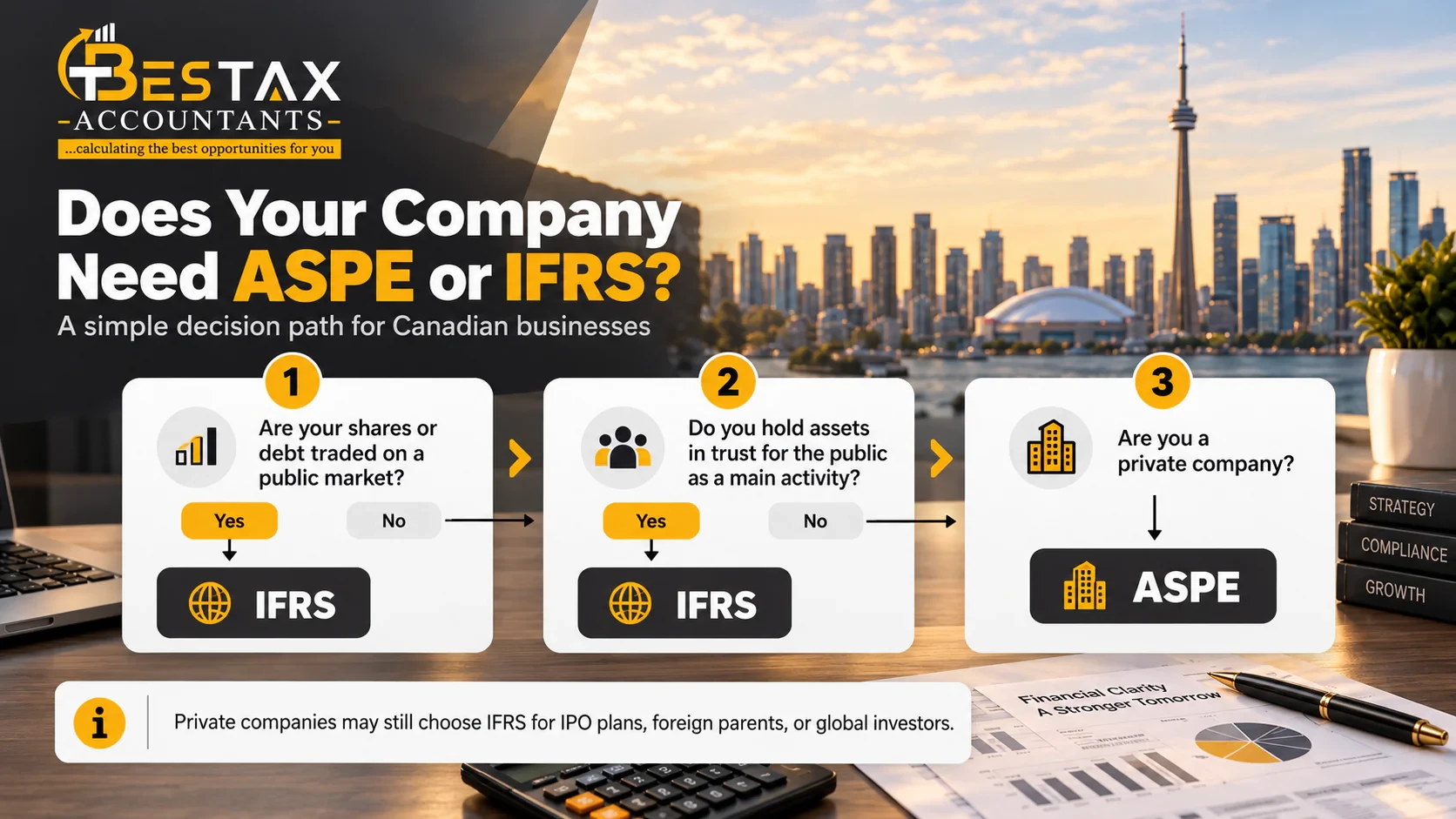
For most owners the decision is straightforward once you answer three questions.
- Are your shares or debt traded on a public market? If yes, you must use IFRS.
- Do you hold assets in trust for the public as a main part of your business, like a bank or insurer? If yes, you must use IFRS.
- If both answers are no, are you a private enterprise? Then ASPE is your default, and you may still elect IFRS if you have a business reason.
If you are a typical owner-managed corporation, a family business, a professional practice, or a growing small or medium enterprise, the answer is almost always ASPE. It is designed for you, it costs less, and it gives your bank and the CRA everything they need.
The wrong move is choosing IFRS by accident, or because a template said so, and then paying for years of extra disclosure work you never needed. The second wrong move is choosing ASPE when you are one year away from a transaction that will force IFRS on you anyway. That is where a short conversation with an accountant pays for itself.
Reasons a private company might still choose IFRS
ASPE is the default for private companies, but IFRS is a legitimate choice in specific situations. You should seriously consider IFRS if any of these apply to you:
- You plan to go public. If an initial public offering is on the horizon, adopting IFRS early avoids a rushed, expensive conversion right before listing.
- You are raising capital from global investors or lenders. IFRS is understood everywhere, which makes your statements easier to compare and trust.
- Your parent company reports under IFRS. Matching the group's standard makes consolidation and group reporting far smoother.
- A major contract, lender, or regulator requires it. Some agreements specify IFRS financial statements.
If none of these apply, the extra complexity of IFRS is usually cost without benefit. This is a decision to revisit from time to time, because your circumstances change as your business grows.
What changed in 2025 and 2026: updates you should know
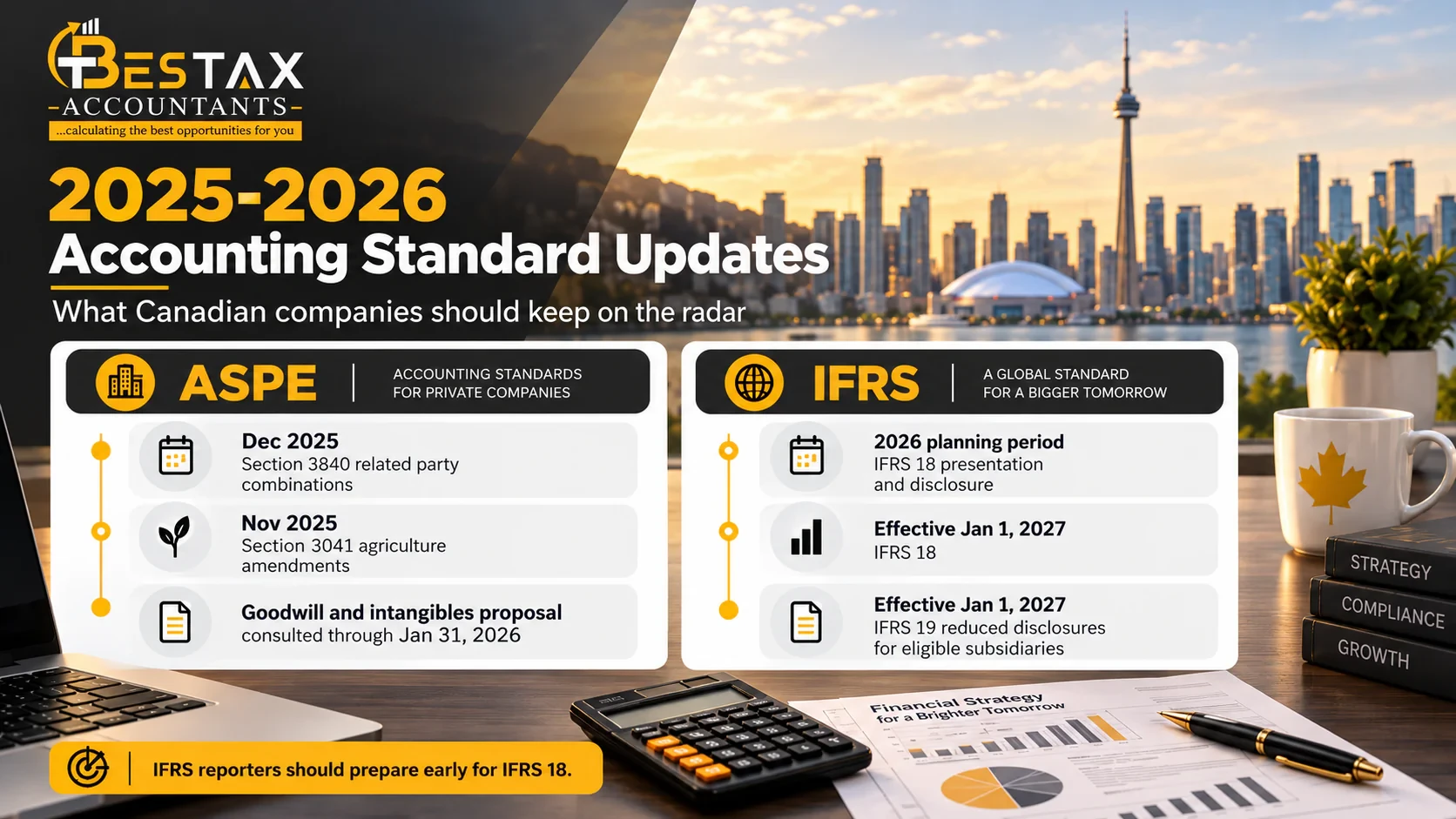
Accounting standards are living rules, and both ASPE and IFRS saw meaningful activity in 2025 and 2026. Here is what a Canadian business owner should have on the radar.
On the ASPE side
- Related party combinations. The AcSB issued amendments to Section 3840, Related Party Transactions, on December 1, 2025, dealing with combinations of businesses under common control. They are effective for fiscal years beginning on or after January 1, 2026, with earlier application permitted.
- Agriculture. The AcSB issued amendments to Section 3041, Agriculture, in November 2025, removing certain disclosure requirements for agricultural inventories and clarifying the accounting for productive biological assets. They are effective for fiscal years beginning on or after January 1, 2027, with earlier application permitted.
- Goodwill and intangibles proposal. In October 2025 the AcSB proposed letting private enterprises amortize goodwill and take relief from separately recognizing some acquired intangible assets. The comment period closed on January 31, 2026, and the Board expects to issue final amendments in the first half of 2027. Until then it remains a proposal, not a rule. If it becomes final, it would be one of the most practical ASPE changes in years for companies that make acquisitions.
- A wider review. The AcSB is consulting on its next strategic plan and continues to review ASPE, so more refinements are likely in the coming years.
On the IFRS side
- IFRS 18 is a major new standard on how the income statement and disclosures are presented. It replaces IAS 1 and introduces new defined subtotals such as operating profit. It is effective for annual reporting periods beginning on or after January 1, 2027, with earlier application permitted, which means companies reporting under IFRS need to prepare during 2026.
- IFRS 19 was issued in May 2024 and lets eligible subsidiaries that do not have public accountability apply reduced disclosures. It is also effective for annual reporting periods beginning on or after January 1, 2027.
If your company uses IFRS, IFRS 18 is the change to plan for now, because it applies retrospectively and will reshape how your results are presented.
Can you switch between ASPE and IFRS?
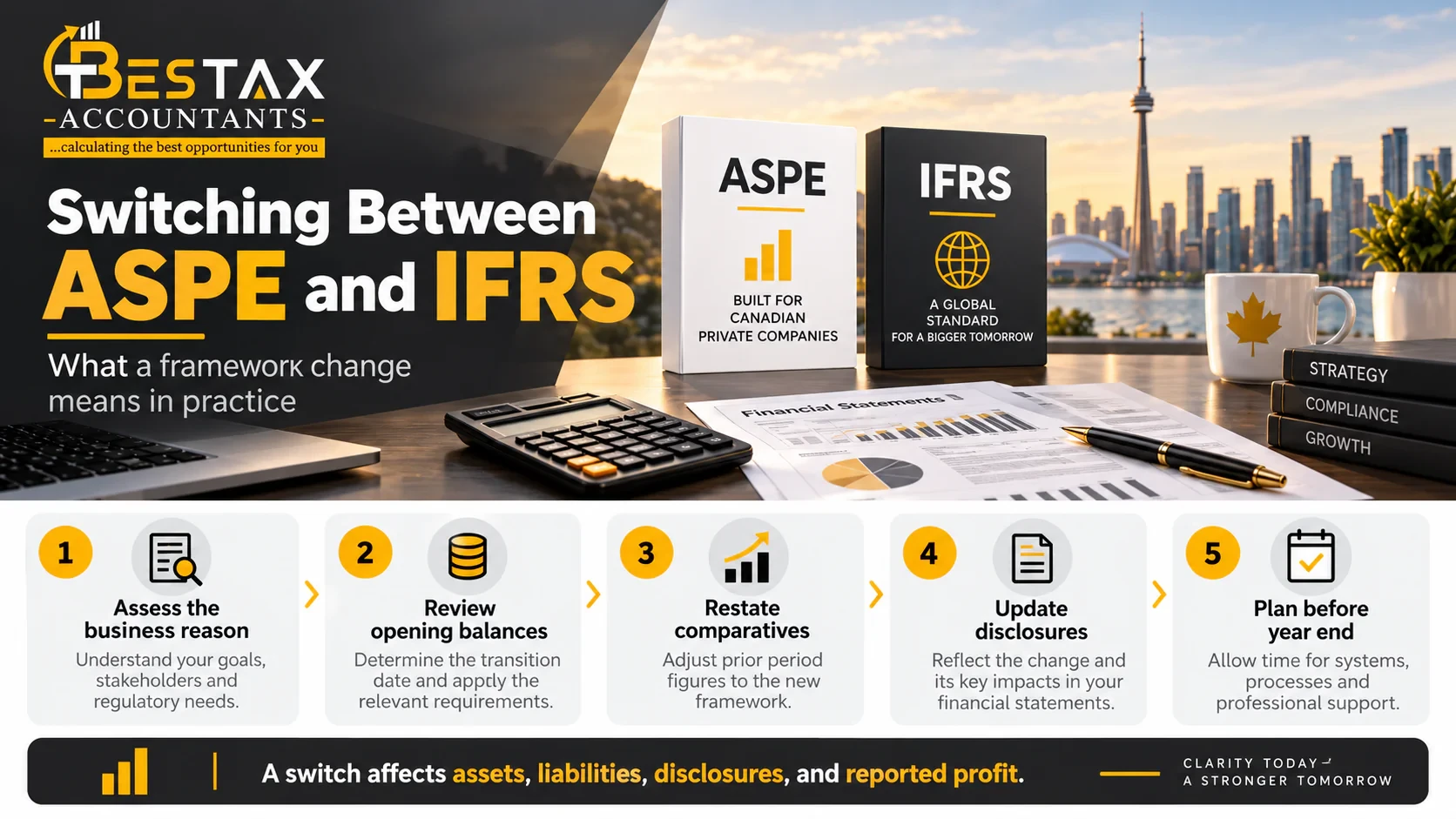
Yes. Companies move between frameworks as their needs change, and ASPE contains a specific section, Section 1500, First-time Adoption, for a company applying ASPE for the first time, including a company that previously used IFRS.
The most common moves are:
- A private company adopting IFRS because it is preparing to go public or align with a foreign parent.
- A company returning to ASPE after a plan to go public was shelved, to cut down on reporting cost.
A switch is not just a label change. It affects how your assets, liabilities, and past results are measured and restated, and it changes your disclosures. It should be planned with your accountant well before your year end, never in a last-minute rush, so your comparatives and opening balances are prepared correctly.
What the right standard means for your time and cost
The framework you use flows straight into your year end effort. ASPE statements have shorter notes and fewer measurement complexities, so they are faster to prepare and cost less. IFRS statements demand more detailed disclosures and more judgment, so they take more time and usually a higher fee.
There is also the assurance angle. Whether your statements are audited, reviewed, or compiled, applying a new or amended standard changes the work your accountant has to do. Getting the framework right the first time, and staying current with amendments, keeps both your financial reporting clean and your costs predictable.
This is why the choice is not a one-time box to tick. It is a decision to make deliberately at the start, and to revisit as your business grows, takes on investors, or approaches a transaction.
How Bestax helps Canadian companies choose and apply the right standard
At Bestax, we help business owners across Canada answer this exact question and then apply the answer correctly, year after year. We have supported businesses for more than 10 years, with offices in Canada and the UAE and a team that keeps current with every AcSB and IFRS change as it happens.
Our work in this area includes:
- Confirming whether your company is a private enterprise or a publicly accountable enterprise, so you use the right framework from day one.
- Preparing your financial statements under ASPE, from monthly and quarterly financial reporting through to year end.
- Managing a switch between ASPE and IFRS, with the first-time adoption work planned properly around your year end.
- Keeping your reporting aligned with the latest 2025 and 2026 amendments, including preparing IFRS reporters for IFRS 18.
- Setting up your accounting software, including QuickBooks, Xero, Zoho, or Sage, so your books support your chosen standard.
If you want a straight answer on which accounting standard your company needs, and a team to handle the reporting once you have it, talk to us. We are available Monday to Saturday.
Frequently asked questions
What is the difference between ASPE and IFRS?
ASPE and IFRS are both part of Canadian GAAP, but they serve different companies. ASPE, in Part II of the CPA Canada Handbook, is a simpler framework built for private enterprises, with fewer disclosures and more policy choices. IFRS, in Part I, is a comprehensive global framework required for publicly accountable enterprises, with far more detailed disclosures. The practical differences show up in areas like leases, goodwill, and financial instruments.
Which accounting standard should a small business in Canada use?
Almost every small business in Canada should use ASPE. If your company is privately owned, is not on a stock exchange, and does not hold money in trust for the public, ASPE is your default standard. It was designed for exactly this kind of business, and it keeps your reporting simpler and less expensive than IFRS. If you are just starting out, we can handle your company registration in Canada and set your books up under the right standard from day one.
Can a private company in Canada use IFRS?
Yes. A private company is allowed to choose IFRS even though it is not required to. Owners usually do this when they plan to go public, want to raise capital from global investors, or need to match a foreign parent company that reports under IFRS. If none of those apply, most private companies are better served by ASPE.
Is ASPE still part of Canadian GAAP?
Yes. ASPE is Part II of the CPA Canada Handbook and remains a full part of Canadian GAAP for private enterprises. Together, ASPE and IFRS make up generally accepted accounting principles for for-profit companies in Canada.
Who is required to use IFRS in Canada?
Publicly accountable enterprises are required to use IFRS. That includes companies with shares or debt traded on a public market, and businesses such as banks, credit unions, and insurers that hold assets in trust for a broad group of the public. These entities have been required to use IFRS for financial years beginning on or after January 1, 2011.
What is a publicly accountable enterprise?
A publicly accountable enterprise is a business that either has debt or equity trading on a public market, or holds and manages financial assets for a broad group of outsiders as a primary part of its business. If neither of those describes you, your company is a private enterprise and can use ASPE.
Is ASPE easier than IFRS?
For most private companies, yes. ASPE has fewer disclosure requirements, simpler measurement in several areas, and more accounting policy choices. That makes it faster and cheaper to apply than IFRS, which is why it is the standard of choice for the majority of Canadian small and medium businesses.
Does the CRA require ASPE or IFRS for my corporate tax return?
The Canada Revenue Agency does not force you to pick one framework. It expects your financial statements to follow the accounting standard that applies to your company, and then your taxable income is calculated by applying tax rules on top of your accounting profit. Some accounting differences, such as how leases are treated, can change your starting point, but the tax rules ultimately govern what you pay. Either way, we prepare your statements and your corporate tax return so the two always line up.
Can I switch from IFRS to ASPE, or from ASPE to IFRS?
Yes, and companies do this as their needs change. ASPE has a dedicated section, First-time Adoption, for moving onto ASPE, including from IFRS. A switch changes how your results are measured and disclosed, so it should be planned with your accountant well ahead of your year end rather than at the last minute.
How does goodwill differ between ASPE and IFRS?
Under both frameworks today, goodwill is not amortized. Under IFRS it must be tested for impairment at least once a year, while under current ASPE it is tested only when events or circumstances signal a possible problem. The AcSB has proposed letting private enterprises amortize goodwill under ASPE, with final amendments expected in the first half of 2027, but as of 2026 that remains a proposal.
Do leases show up differently under ASPE and IFRS?
Yes, and this is one of the biggest practical differences. Under IFRS, most leases go onto your balance sheet as a right-of-use asset and a matching liability. Under ASPE, an operating lease usually stays off the balance sheet and is simply expensed as you pay it. This can meaningfully change your reported assets, liabilities, and debt ratios.
What happens if my company uses the wrong accounting standard?
Using the wrong framework can produce financial statements that do not comply with the standard your company is required to follow, which can create problems with lenders, investors, auditors, and future transactions. It can also mean paying for expensive IFRS reporting you never needed, or scrambling to convert to IFRS right before going public. A quick review with an accountant prevents both outcomes.
What are IFRS 18 and IFRS 19, and do they affect me?
IFRS 18 is a new IFRS standard that reshapes how the income statement and disclosures are presented, effective for annual periods beginning on or after January 1, 2027. IFRS 19 lets eligible subsidiaries without public accountability apply reduced disclosures, also effective from January 1, 2027. These matter only if your company reports under IFRS. If you use ASPE, they do not apply to you.
Get a straight answer on your accounting standard
If you are not sure whether your company should be reporting under ASPE or IFRS, or you are planning a transaction that might change the answer, talk to us. We will confirm which framework applies, prepare your statements under it, and keep them current as the standards change. We are available Monday to Saturday, 9am to 8pm.


