


A payroll remittance is the payment an employer sends to the Canada Revenue Agency for the income tax, Canada Pension Plan (CPP) and Employment Insurance (EI) it withholds from employees, together with the employer's own share of CPP and EI.
It is due on a schedule set by your remitter type, and it has to reach the CRA on or before your due date, which is how you avoid penalties and daily interest.
What is a payroll remittance?
Every time you pay an employee, you hold back part of their pay for the government. You then add your employer portion and send the combined amount to the CRA. That payment is the remittance.
A payroll remittance always bundles three things:
- Income tax you withheld from the employee, based on the TD1 forms they filled out and their province of work
- CPP contributions (and CPP2 for higher earners), where you match the employee's amount dollar for dollar
- EI premiums, where you pay 1.4 times what the employee pays
You are not sending your own money in full. Most of a remittance is money that already belonged to your employees and to the CPP and EI programs. Your job as the employer is to hold it, add your share, and pass it on by the deadline.
The CRA treats these withheld amounts as funds held in trust. That is why late remittances are taken seriously, and why the penalty ladder below starts on day one rather than after a grace period.
Payroll deductions in Canada: what you actually withhold
Before you can remit, you have to deduct the right amounts. Payroll deductions in Canada come down to three mandatory items on every regular paycheque, and these are set federally, so they are the same in every province except Quebec, which runs its own pension and parental plans.
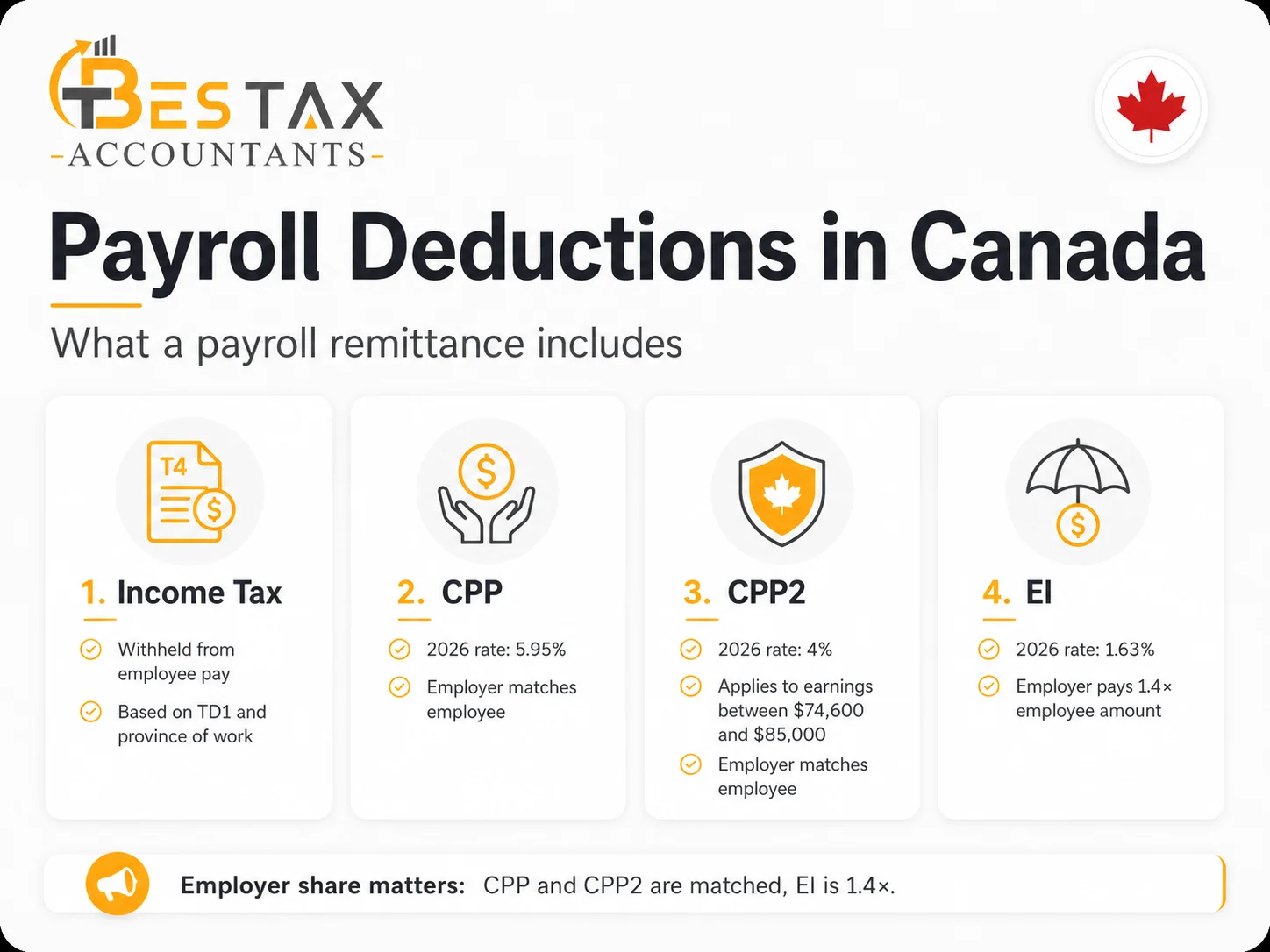
Here are the 2026 figures you use when you calculate Canadian payroll deductions:
| Deduction | 2026 rate | Applies to | Employer share |
|---|---|---|---|
| CPP | 5.95% | Pensionable earnings from the $3,500 basic exemption up to $74,600 | Employer matches, up to $4,230.45 per employee |
| CPP2 | 4% | Earnings between $74,600 and $85,000 | Employer matches, up to $416.00 per employee |
| EI | 1.63% | Insurable earnings up to $68,900 | Employer pays 1.4 times, up to $1,572.30 per employee |
| Income tax | Graduated | Employee's taxable pay by province and TD1 claims | None (withheld from the employee only) |
The employee's maximum CPP for 2026 is $4,230.45, plus up to $416.00 in CPP2. Their maximum EI premium is $1,123.07. You match the CPP and CPP2 in full and pay 1.4 times the EI, so your own cost per employee is real and worth budgeting for before you hire.
Get the deduction right first. A remittance can only be correct if the amounts you withheld were correct, and under-deducting CPP or EI leaves you on the hook for the shortfall. If your books are behind, our backlog accounting service is the place to start.
The four payroll remitter types
Not every employer pays the CRA on the same schedule. Your remittance frequency depends on which remitter type you fall into. The CRA assigns your type, reviews all payroll accounts every November, and tells you in writing if your type changes.
Your type is based on your average monthly withholding amount (AMWA) from two calendar years ago. In plain terms, the CRA looks at how much you remitted, on average, each month. For your 2026 remittances, the CRA looks at your 2024 numbers.
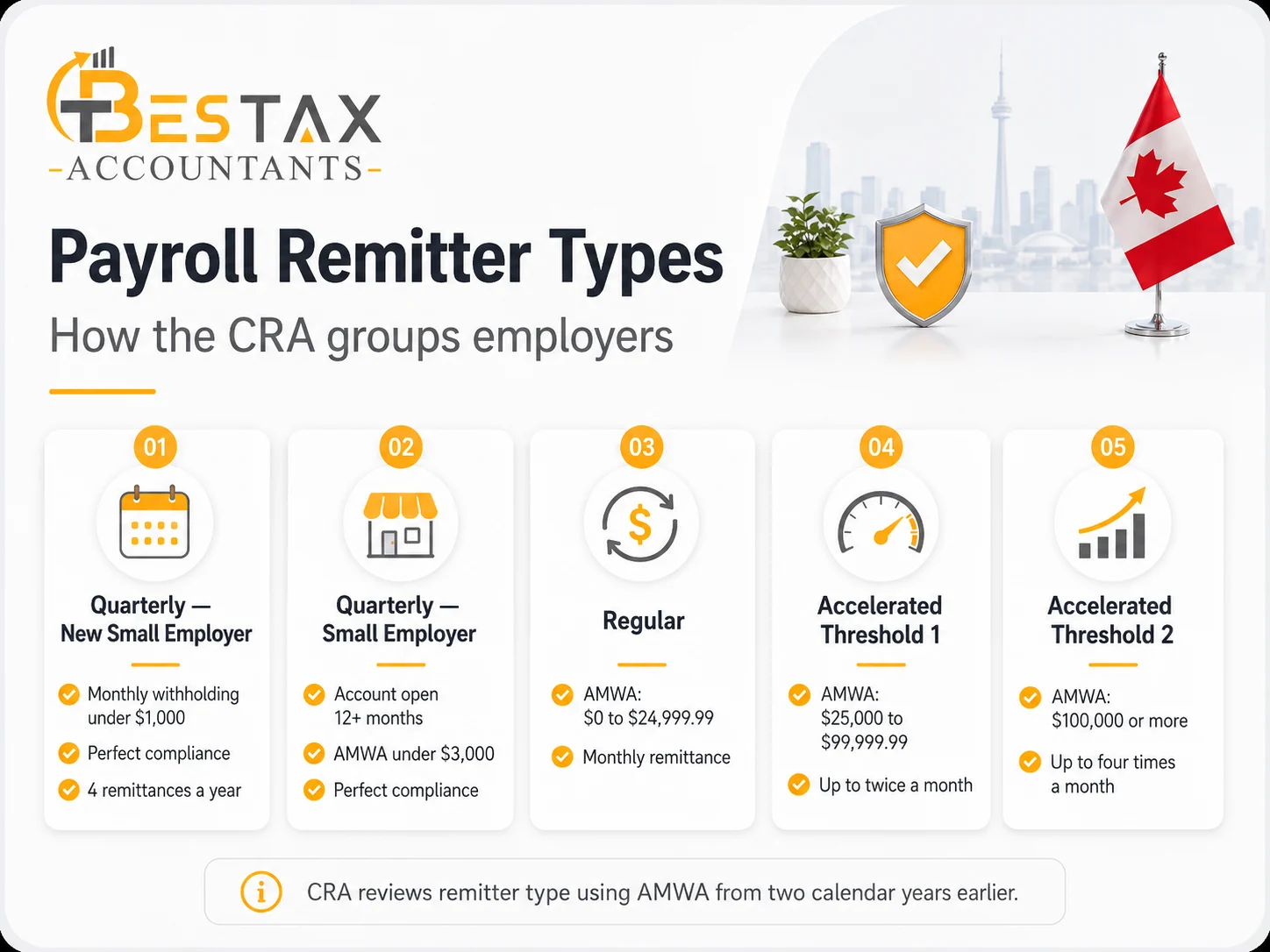
The AMWA is worked out like this:
- Total of all required remittances in a calendar year
- Divided by the number of months (up to 12) that required a remittance
- Equals your average monthly withholding amount
| Remitter type | AMWA (two years ago) | Remittance frequency |
|---|---|---|
| Quarterly, new small employer | Monthly withholding under $1,000, perfect compliance | Four times a year |
| Quarterly, small employer (account open 12+ months) | Under $3,000, perfect compliance | Four times a year |
| Regular | $0 to $24,999.99 | Monthly |
| Accelerated, Threshold 1 | $25,000.00 to $99,999.99 | Up to twice a month |
| Accelerated, Threshold 2 | $100,000 or more | Up to four times a month |
Most small businesses in Canada are regular remitters. New businesses usually start as quarterly remitters, which gives you breathing room in your first year, as long as your monthly withholding stays under $1,000 and you keep a clean compliance record on your payroll and GST/HST accounts.
A quick worked example
Say your business remitted $180,000 to the CRA across all 12 months of 2024. Your AMWA is $180,000 divided by 12, which is $15,000. Because that sits under $25,000, you are a regular remitter for 2026 and you pay monthly.
If your AMWA had been $30,000, you would be a Threshold 1 accelerated remitter and would pay up to twice a month instead. Your remitter type does not change how often you pay your staff. It only changes how often you pay the CRA.
Payroll remittance due dates by remitter type
This is the part most employers get wrong, so here are the payroll remittance due dates spelled out for each type. The date that matters is the date the CRA receives your money, not the date you send it.
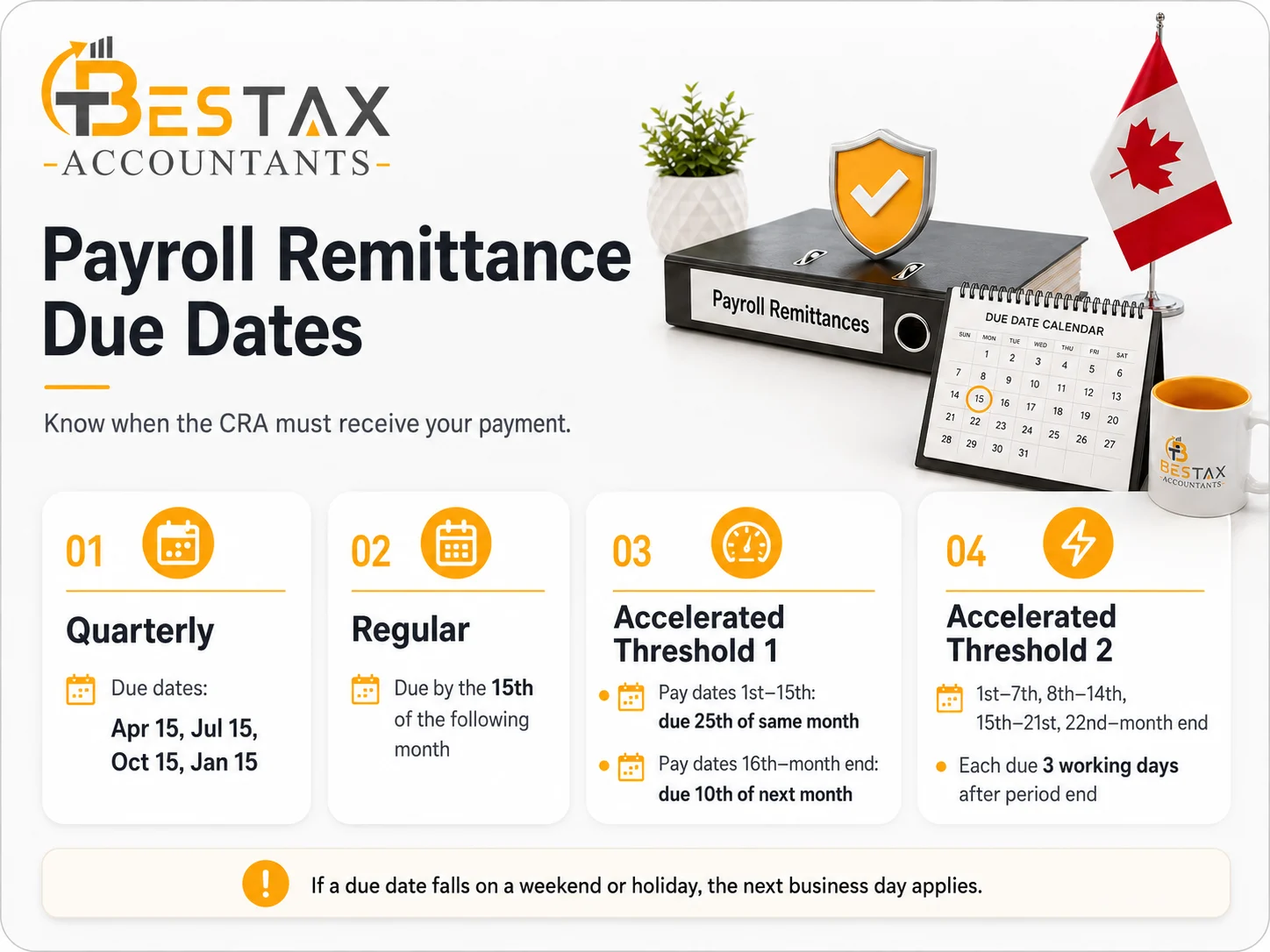
Quarterly remitters
- Remitting periods: January to March, April to June, July to September, October to December
- Due dates: April 15, July 15, October 15 and January 15
Regular remitters
- Remitting period: the calendar month
- Due date: the 15th day of the following month. Deductions from June pay are due July 15.
Accelerated remitters, Threshold 1
- Pay dates from the 1st to the 15th of the month are due by the 25th of that same month
- Pay dates from the 16th to the end of the month are due by the 10th of the next month
Accelerated remitters, Threshold 2
- The month is split into four periods: the 1st to 7th, 8th to 14th, 15th to 21st, and 22nd to the last day
- Each remittance is due by the third working day after the end of its period
If a due date falls on a Saturday, Sunday or public holiday recognized by the CRA, your payment is on time if the CRA receives it, or it is processed at a Canadian financial institution, on or before the next business day. Our guide to corporate tax deadlines in Canada sets out how payroll dates sit alongside your other filings.
The T4 timing trap
Your remittance deadline and your T4 filing deadline are two separate dates. If you file your T4 information return after a remittance due date and pay an outstanding balance with it, that balance is normally treated as late.
There is an exception worth knowing about. The CRA operates a Payment on Filing (PoF) reconciliation payment for source deductions, using remittance voucher PD7R, which lets eligible remitters settle a reconciliation amount at filing time. Whether your account qualifies, and what the cut-off is, depends on your remitter type, so check your PD7R correspondence or ask us before you assume a balance paid with the T4 will be treated as late.
How to remit payroll deductions to the CRA
Once you know your amount and your due date, the last question is the practical one. You have several approved options, and for most businesses the simplest and safest is online.

- Online banking. Add the CRA as a payee in your business bank account, choose the payroll source deductions option, and send the payment like any other bill. This is the most common method.
- CRA My Payment. Pay directly from your bank account through the CRA website using a bank access card, meaning Visa Debit or Debit Mastercard, at no fee. Credit cards are not accepted, and Interac Debit stopped being an option in My Payment on 10 September 2024.
- Pre-authorized debit (PAD). Set up an agreement in My Business Account so the CRA pulls the amount on a date you choose.
- At your Canadian financial institution. Pay in person or through your bank using an original paper remittance voucher. Photocopies and faxes are not accepted because the voucher has special encoding.
- Third-party providers. Some services let you pay by credit card for a fee.
Remitting online through My Business Account or online banking gives you a record and a clear payment date, which protects you if a payment is ever questioned. A payment through your bank is usually credited to the CRA within one to two business days, so send it early enough to land on time. If you want the fundamentals across every CRA program, our guide on how to pay CRA tax covers the options.
Threshold 2 remitters have fewer choices
The list above is not open to everyone. If you are an accelerated remitter at Threshold 2, the CRA requires you to remit either electronically or in person at a Canadian financial institution. Paying on the due date by any other method draws a penalty of 3% of the amount due, even though the money arrived on time.
That is a separate rule from the penalty ladder further down, and it catches larger employers who assume a cheque in the post is fine because it always was.
The $10,000 electronic payment rule
Since 1 January 2024, any single payment to the Receiver General over $10,000 must be made electronically, unless you genuinely cannot pay that way. A $100 penalty can apply for each payment that breaks the rule. In June 2025 the CRA told CPA Canada it is not enforcing this penalty yet and will give advance notice before it starts, so the current focus is on encouraging electronic payments rather than charging the fee. Even so, moving to electronic payments now is the smart move.
The payroll remittance form: understanding the PD7A
The payroll remittance form most employers see is the PD7A, Statement of Account for Current Source Deductions. The CRA sends it to regular and quarterly remitters, and it is a running statement of your payroll account.
A few things to know about the PD7A:
- It shows your account balance and the CRA's record of your remittances. It is a statement, not the payment itself.
- You do not need the paper voucher to pay online. You do need an original voucher to pay in person at a bank.
- If you have no employees for a period, you can use the PD7A to report a nil remittance by mail, or report it faster by phone or online.
- If you have lost your voucher, you must still remit by the due date. You can order new vouchers through the CRA or call to request them, but a missing form is never a reason to pay late.
What happens if you remit late
The CRA applies a penalty and charges interest when a remittance is late. There is no warning and no grace period, which is why this is worth reading twice.
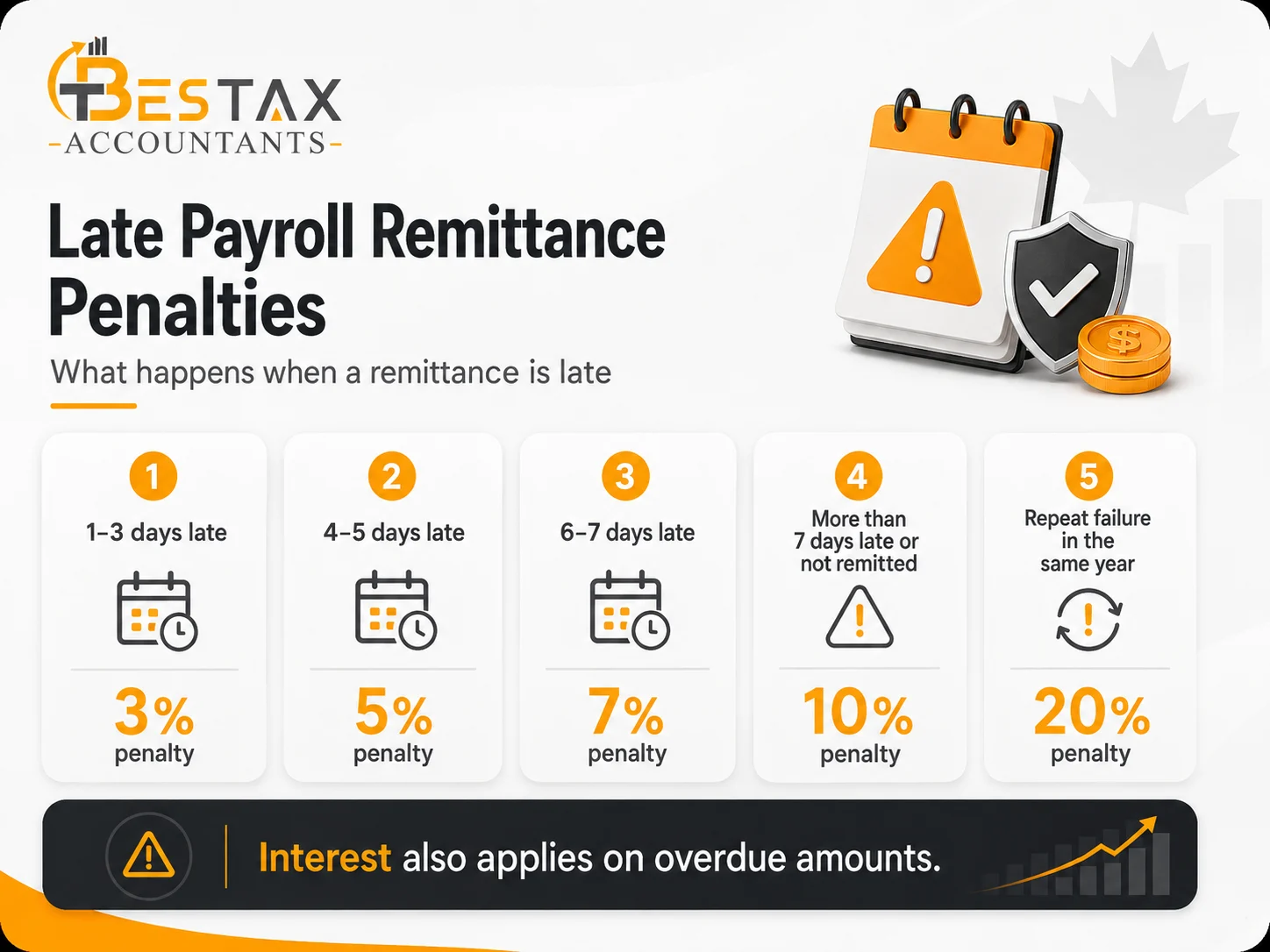
First, the threshold. The penalty applies where you deducted amounts over $500 and either did not send them or sent them late. Where the amount is under $500, the CRA charges the penalty only if the failure was knowing or the result of gross negligence. Very small employers are not automatically penalised for being a few days out, though the interest still runs.
Where the penalty does apply, it is graduated:
- 3% if the amount is one to three days late
- 5% if it is four or five days late
- 7% if it is six or seven days late
- 10% if it is more than seven days late, or if you do not remit at all
- 20% if this is the second or later time you are penalised in the same calendar year and the failure was made knowingly or through gross negligence
On top of the penalty, the CRA charges interest on the unpaid amount from the day it was due. That interest rate is set every quarter and, for the third quarter of 2026, the rate on overdue amounts is 7%, compounded daily. Interest even applies to unpaid penalties, so the cost climbs quickly. Our guide to penalties for late filing in Canada covers how this works across return types.
There is also a smaller trap to watch. If a cheque bounces because of insufficient funds, a closed account or a stopped payment, the CRA can charge a fee of up to $25 per returned item.
Notice that the penalty is the same 10% whether you are one week late or three months late. So if you have missed a deadline, the priority is to pay as soon as you can to stop the interest, not to wait until you have the paperwork perfect.
Nil remittances and special situations
Having an open payroll account comes with reporting duties even in the quiet months.
- No employees this period. If you paid no one and made no deductions, you still report a nil remittance by your normal due date. You can do this online, or by phone using the CRA's automated TeleReply service at 1-800-959-2256.
- Seasonal business. Report your nil remittance and tell the CRA when you expect to pay staff again. If you do not give a date, the CRA will expect you to resume the following month or quarter.
- Closing, selling or restructuring. If your business stops operating, changes legal status, or is sold or amalgamated, you must send your final remittance within seven calendar days of the change.
Reporting a nil remittance keeps your account in good standing and stops the CRA from chasing a payment that was never owed.
Where payroll fits among your other CRA obligations
A payroll remittance is one of several payments a Canadian business makes to the CRA. It helps to see the full picture, because paying one program does not cover another.
- Payroll source deductions, the subject of this guide
- GST/HST, the tax you remit on your taxable sales once you pass the $30,000 small supplier threshold, handled through our GST/HST return filing service
- Corporate income tax, including instalments, covered in our guide to filing a T2 corporate tax return and handled through our corporate tax return filing service
Each of these has its own deadlines, and the CRA keeps a separate account for each one. Keep payroll money separate from any balance owing from an assessment, and never combine an arrears payment with a current remittance, because the CRA applies them to different places.
How Bestax handles your payroll remittances
Payroll is a calendar problem more than an accounting problem. The rules are not hard, but the deadlines are unforgiving and they arrive every month. We take care of your obligations to the CRA — formerly Revenue Canada — so the dates never sneak up on you, which is where a dedicated team earns its keep.
Our payroll services in Canada cover the full cycle so you never miss a date:
- We calculate CPP, CPP2, EI and income tax correctly for every employee and every province
- We confirm your remitter type and track every due date for you
- We remit to the CRA on time, electronically, with a record of every payment
- We file your T4 and T4A information returns and reconcile them to your remittances
- We handle nil remittances, CRA letters and any catch-up if you have fallen behind
We have supported businesses for more than 10 years, with offices in Canada and Dubai and a team of 35 or more professionals. Thousands of businesses across Canada and the UAE rely on us to keep their filings clean and their deadlines met.
What our clients say
These folks know their accounting. I run a small IT consultancy and they helped streamline my invoices, CRA reports and year-end tax filings. No more spreadsheets and late nights for me.
— Lisa Wilson
They explained everything in simple language, no jargon, and the filing was done on time. I felt confident leaving it in their hands.
— Kim Angelo
The whole process was smooth, and they even gave some good tips for naming conventions and tax planning.
— Thomas Dawkins
Frequently asked questions
What is payroll remittance?
It is the payment an employer sends to the CRA that combines the income tax, CPP and EI withheld from employees with the employer's own CPP and EI share. You deduct the amounts on payday, add your portion, and send the total to the CRA by a due date set by your remitter type.
Who has to make a payroll remittance?
Every employer with an open payroll account, including an owner who pays themselves a salary through their own corporation. If you deduct source amounts from anyone's pay, you must remit them, even for a single employee.
How do I remit payroll deductions to the CRA?
The easiest way is online. Add the CRA as a payee in your business online banking, or use CRA My Payment or pre-authorized debit through My Business Account. You can also pay in person at a Canadian financial institution with an original remittance voucher. If you are a Threshold 2 accelerated remitter, electronic payment or paying in person at a Canadian financial institution are your only options.
Can I make a payroll remittance online?
Yes, and for most employers it is the recommended method. Any single payment over $10,000 must be made electronically. Online payments usually reach the CRA within one to two business days, so send yours a few days before the deadline.
What are the payroll remittance due dates?
It depends on your type. Regular remitters pay by the 15th of the following month. Quarterly remitters pay by April 15, July 15, October 15 and January 15. Threshold 1 accelerated remitters pay up to twice a month, and Threshold 2 remitters pay up to four times a month.
Who decides my remittance frequency?
The CRA does, based on your average monthly withholding amount from two calendar years ago. It reviews accounts every November and writes to you if your frequency changes. You do not choose it yourself, though you can ask the CRA to review your account.
What happens if my payroll remittance is late?
Where you deducted more than $500 and sent it late, the CRA charges a penalty of 3% to 10% depending on how many days late you are, rising to 20% for a repeat failure in the same year. Amounts under $500 are penalised only where the failure was knowing or grossly negligent. Interest applies either way, at 7% on overdue amounts for the third quarter of 2026, compounded daily.
What is the payroll remittance form called?
It is the PD7A, the Statement of Account for Current Source Deductions. The CRA sends it to regular and quarterly remitters as a running statement of your payroll account. You do not need it to pay online, but you do need an original voucher to pay in person at a bank.
Do I have to send a payroll remittance if I paid no one that month?
Yes, you report a nil remittance by your normal due date. You can do this online or by calling the CRA's automated TeleReply line at 1-800-959-2256. Reporting nil keeps your account in good standing.
Is a payroll remittance the same as a GST/HST remittance?
No. A payroll remittance covers source deductions from wages. GST/HST is a separate remittance on your sales, and corporate tax is a third. Each has its own CRA account and its own deadlines, so keep them separate.
How is my average monthly withholding amount calculated?
Take the total of all required remittances in a calendar year and divide it by the number of months (up to 12) that needed a remittance. The result is your AMWA, and the CRA uses the figure from two years ago to set your current remitter type.
When can I remit quarterly instead of monthly?
New employers can usually remit quarterly if their monthly withholding stays under $1,000 and they keep a perfect compliance record. Existing employers can remit quarterly if their account has been open at least 12 months, their AMWA was under $3,000, and their compliance record is clean.
Get your payroll remittances off your plate
Every CRA deadline is easier when someone tracks it for you, and every penalty is cheaper to prevent than to appeal. If you want your payroll deductions calculated correctly and remitted on time, every month, talk to our Canadian team. We are available 24/7.

Written by
Neha Ghauri

Fact checked by
Haseeb Hamdani
Lead Advisor · Director Accounting & Taxation
With over a decade of cross-border experience spanning Canada, the UAE, and beyond, Haseeb Hamdani leads the Bestax team of qualified professionals with one clear goal - to make sure your business is compliant, protected, and positioned to grow. His international credentials and real-world expertise across tax, compliance, and business structuring mean clients always receive precise, reliable, and commercially sound financial guidance.
Learn More About Haseeb