
Accounting
Bookkeeper Vs Accountant Vs CPA In Canada: Who To Hire
Compare bookkeepers, accountants and CPAs in Canada, including roles, costs, deadlines and when your business needs each one.


Most Canadian businesses need a bookkeeper for the monthly work and an accountant or a CPA for the year end and the tax return. A bookkeeper records your day to day transactions, an accountant turns those records into financial statements and filed returns, and a CPA is a licensed accountant who can also sign off on audits, assurance and complex tax planning.
The three titles get used as if they mean the same thing. They do not. They describe three different jobs, and hiring the wrong one, or skipping one, is where most small business owners quietly lose money. This guide explains each role in plain language, shows you who owns which deadlines, and helps you match your own situation to the right person, even if you have never hired any of them before.
The quick answer, if you only have a minute
- Bookkeeper: keeps your records accurate and current every month. Recording, reconciling, invoicing, payroll runs, GST/HST tracking.
- Accountant: takes the finished record and prepares year end statements, files your tax returns, and advises on tax and structure.
- CPA (Chartered Professional Accountant): a regulated, licensed accountant who does everything an accountant does and is also authorised to perform audits, reviews and assurance work, and to sign reports that a bank or buyer can rely on.
If you can only afford one right now, start with the bookkeeper. An accountant working from messy records spends your money rebuilding the year instead of lowering your tax.
What a bookkeeper does
A bookkeeper records what happened, in the month it happened, with the paperwork attached. The work is operational and it never stops, because the transactions never stop.
Typical bookkeeping tasks in a Canadian business:
- Recording income and expenses and categorising every transaction
- Reconciling bank and credit card accounts so the books match reality
- Managing invoices, bills, and accounts receivable and payable
- Running payroll and tracking source deductions
- Tracking GST/HST on sales and purchases
- Producing the monthly reports you use to make decisions
Modern bookkeeping is mostly cloud based now, using tools like QuickBooks, Xero, Zoho and Sage, with automated bank feeds and digital receipt capture. That makes it faster, but it does not remove the need for a person who checks that the numbers are right.
A bookkeeper does not prepare formal financial statements, give tax planning advice, or exercise the professional judgement that sits inside an accountant’s work. Their job is a clean, reliable record. Everything else is built on top of it.
What an accountant does
An accountant takes that finished record and does the work that depends on it. Where the bookkeeper lives in the current month, the accountant works on the closed year and on what comes next.
Typical accounting work:
- Preparing year end financial statements
- Filing the corporate T2 return, or the T2125 business statement inside a personal return
- Personal and corporate tax preparation and compliance
- Budgeting, forecasting and cash flow analysis
- Advising on decisions that carry real money, such as timing a large purchase or choosing salary versus dividends
The valuable part of accounting is the advice. None of it is possible without a clean set of books underneath it, which is exactly why the two roles run in sequence rather than competing.
What a CPA does, and why the title matters in Canada
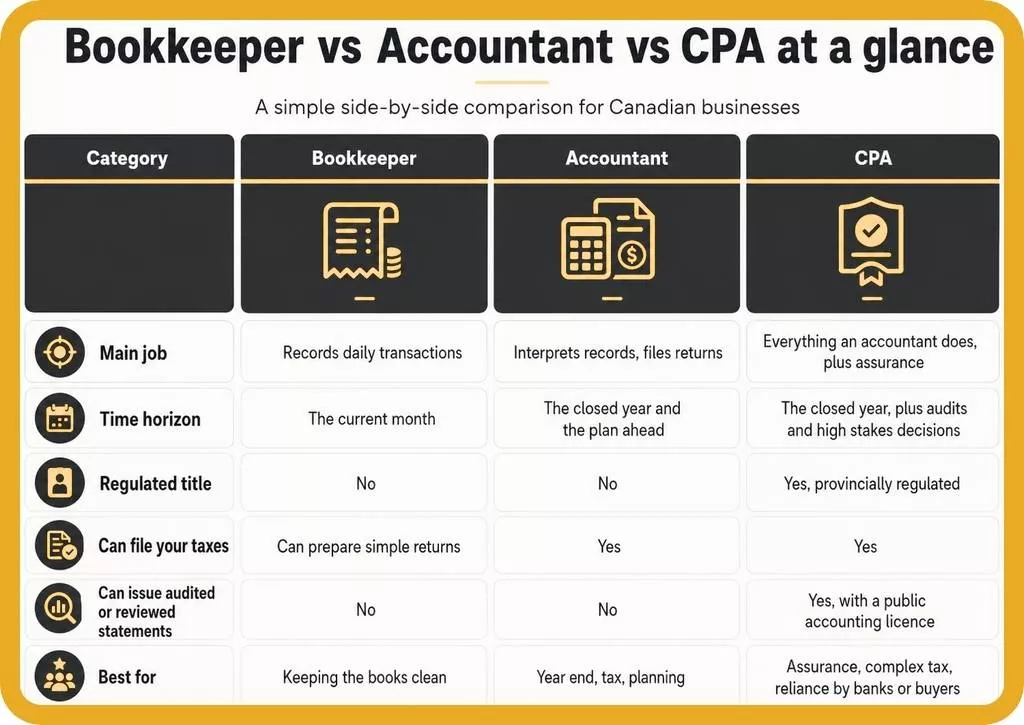
CPA stands for Chartered Professional Accountant. It is the regulated accounting designation in Canada, earned through advanced education, examinations, practical experience and ongoing professional development. A CPA is held to professional standards, ethical rules and a discipline process by a provincial body.
A CPA can do everything an accountant does, and some things only a CPA can do. In Canada, certain reports and regulated services, including formal assurance work, can only be issued by a licensed professional. That distinction matters the moment a bank, an investor or a buyer asks for financial statements they can rely on.
Typical CPA work, beyond standard accounting:
- Audit and review engagements, and other assurance work
- Complex corporate and personal tax planning
- Financial statements a third party can rely on
- Strategic advisory on structure, growth and risk
The part that surprises most owners: what is protected and what is not
This is the piece almost no one explains, and it changes how carefully you should choose.
- Bookkeeper is not a protected title. Anyone in Canada can call themselves a bookkeeper and start charging tomorrow. Many are excellent and some hold voluntary designations, but the title alone guarantees nothing, so you have to assess the person.
- Accountant, on its own, is also not a protected title. Someone can call themselves an accountant without being a CPA. The regulated designation is the CPA.
- CPA is protected and regulated. It carries entry requirements, mandatory professional development and a discipline process behind it.
- Assurance work needs a licence on top of the designation. Audits and review engagements, and compilation work a third party will rely on, require a public accounting licence. This is what matters if your bank or a buyer asks for reviewed or audited statements.
- Anyone can prepare your return, but not everyone can file it for you. To transmit a return to the Canada Revenue Agency electronically on your behalf, a preparer has to be approved for the CRA’s EFILE service. Ask whoever files for you what their EFILE status is.
One thing does not change, no matter who you hire. When the CRA has a question about a number, it comes to you, the owner. That alone is a good reason to keep the record clean from the start.
Who owns which deadlines
The cleanest way to divide the work is by the calendar. Here is the typical split for a Canadian business.
Usually the bookkeeper’s calendar
- Payroll source deductions, remitted on the CRA’s schedule for your remitter type
- T4 and T4A information returns, due by the last day of February for the prior year
- GST/HST returns for monthly and quarterly filers, filed and paid after each reporting period
- Monthly reconciliation and reporting, which has no CRA deadline and quietly decides whether everything else is correct
Usually the accountant’s or CPA’s calendar
- The corporate T2 return, filed within six months of your fiscal year end
- The balance of corporate tax, generally due two months after year end, or three months for many small Canadian controlled private corporations
- Self employed personal returns, with the filing date and the payment date falling on different days, which catches people every year
- Year end statements, tax planning and anything structural
Miss a filing with a balance owing and the CRA charges a late filing penalty of five percent of the balance, plus one percent of the balance for each full month the return is late, up to twelve months. Reconciling monthly is what keeps you clear of all of it.
What each one costs
Think of it in two shapes.
- Bookkeeping is usually an ongoing monthly fee, because the work is ongoing. The price scales with your transaction volume, whether you run payroll, and how many accounts need reconciling.
- Accounting and CPA work is usually priced per engagement, such as a year end and a T2, and it climbs with complexity and with the condition of your records.
The most expensive way to buy bookkeeping is to pay an accountant’s rate to rebuild a year that was never kept properly. Keeping the monthly record clean is almost always the cheaper path, and both bookkeeping and accounting fees are generally deductible business expenses.
Which one do you actually need right now
Find the line that sounds like you.
- Small side business, low volume, no payroll, under the GST/HST threshold. You can keep the records yourself if you are disciplined, and see an accountant at tax time. Once your taxable sales pass the CRA’s 30,000 dollar registration threshold over four consecutive quarters, the calendar tightens fast.
- Sole proprietor, registered for GST/HST, no employees. A bookkeeper monthly or quarterly, and an accountant at year end. This is where most owners first feel the filing calendar become a real job.
- Sole proprietor with employees. A bookkeeper, without much argument. Payroll has the least forgiving deadlines a small business touches.
- Incorporated. Both. A corporation needs proper double entry books, files its own T2, and has a shareholder relationship that must be tracked. The accountant or CPA handles the T2 and the planning, and the bookkeeper makes that work possible.
- Behind, messy, or dreading the software. A bookkeeper first, for a proper cleanup, then the accountant once there is something worth handing over. Doing it in the other order means paying premium rates for data entry.
How the three work together
These are not competing roles. They are a chain, and the chain only works in order.
The bookkeeper builds the foundation, keeping records accurate and current. The accountant turns that foundation into statements, filed returns and decisions. The CPA adds the licensed layer on top, for assurance and for the moments when a number has to stand up to outside scrutiny. Skip the bottom of the chain and everything above it gets slower, less reliable and more expensive.
Where the numbers stand in Canada
A quick reality check on why this matters to so many owners.
As of December 2024 there were about 1.10 million employer businesses in Canada, and 98.2 percent of them were small businesses. Micro businesses with one to four employees alone make up 59.1 percent of all Canadian employer businesses. Small businesses also employed 5.8 million people in 2024, which is 46.6 percent of the private sector workforce.
Those are the owners facing exactly this decision. On the professional side, Canada’s accounting profession is represented by more than 210,000 Chartered Professional Accountants, so there is no shortage of qualified help. The task is simply matching the right level of help to where your business is today.
Why Canadian businesses work with Bestax
At Bestax, you do not have to figure out the bookkeeper, accountant and CPA split on your own. We cover the whole chain under one roof, so the monthly record, the year end and the tax filing all line up instead of falling through the gaps between three separate people.
- More than ten years of combined experience, with offices in Canada and the UAE and a team of 35 plus professionals.
- Clean, current bookkeeping in the software you already use, including QuickBooks, Xero, Zoho and Sage.
- Behind on your books? Our backlog and cleanup service brings your records back in order and makes you audit ready.
- T2 corporate tax, personal tax, GST/HST filing and payroll, all tracked against their deadlines so nothing slips.
- Business setup for owners starting fresh, from registration to a first year that is organised from day one.
Our clients tend to notice the same things. One owner came to us for corporate taxes and told us the process was easier than expected, explained in simple language with no jargon, and filed on time. Another, running a small IT consultancy, had us streamline the invoices, CRA reporting and year end filings so the late nights over spreadsheets stopped. A client incorporating a second business valued that we do not oversell, and pointed to practical help with naming and tax planning along the way.
Get the right level of help for where your business is today
You do not need to become an expert in the difference between a bookkeeper, an accountant and a CPA. You need someone to look at your situation and tell you honestly which one you need first. Tell us your structure, whether you run payroll, and where your records stand, and we will map it out with you at no cost. We are available 24/7.
1470 Hurontario St #100, Mississauga, ON L5G 3H4, Canada | +1 416 991 0900 | info@bestax.ca
Reviewed by the Bestax Canada accounting team. Last updated: August 2026.
Frequently asked questions
What is the difference between a bookkeeper and an accountant in Canada?
A bookkeeper records and maintains your financial transactions month by month, including reconciliations, invoicing, payroll and GST/HST tracking. An accountant takes that finished record and prepares year end statements, files your tax returns, and advises on tax and structure. The bookkeeper builds the record and the accountant interprets it.
What is the difference between an accountant and a CPA in Canada?
Every CPA is an accountant, but not every accountant is a CPA. CPA is the regulated Chartered Professional Accountant designation, held to provincial standards and a discipline process. A CPA can also perform audits, reviews and other assurance work, which a non designated accountant cannot.
Do I need both a bookkeeper and an accountant?
Most incorporated businesses and most sole proprietors registered for GST/HST benefit from both, because the monthly work and the year end work are genuinely different jobs. A very small side business with few transactions and no payroll can often manage with self kept records and an accountant at tax time. If you can only afford one, hire the bookkeeper first.
Do I need a CPA for a small business in Canada?
Not always. Many small businesses are well served by a bookkeeper for the monthly work and an accountant for the tax return. You specifically need a CPA when you require assurance work, such as reviewed or audited financial statements, or when your tax and structure become complex enough to need regulated professional advice.
Can a bookkeeper file my taxes in Canada?
Anyone can prepare a Canadian tax return for a fee, so many bookkeepers prepare simple personal and self employed returns. To transmit that return to the CRA electronically on your behalf, the preparer must be approved for the CRA’s EFILE service. Corporate T2 returns and real tax planning are normally accountant or CPA work.
Is a bookkeeper cheaper than an accountant?
Per hour, yes, usually by a wide margin, which is why paying an accountant to do bookkeeping is such an expensive habit. Bookkeeping is normally a monthly fee, while accounting is usually priced per engagement at year end. They are not really substitutes, so the better question is who owns which work.
Is a bookkeeper cheaper than an accountant?
A CPA is a specific, licensed type of accountant, not a separate profession. The word accountant on its own is not protected in Canada, so someone can use it without holding the CPA designation. When you need regulated assurance or reports a third party will rely on, the CPA is the one who can provide them.
When should I hire an accountant instead of a bookkeeper?
Hire an accountant when the work shifts from recording to interpreting and filing, such as year end statements, a corporate T2, or tax planning decisions. You do not replace the bookkeeper with the accountant. You add the accountant on top, because the accountant needs the bookkeeper’s clean record to do the job.
Is accountant a protected title in Canada?
No. On its own, accountant is not a protected title, so it does not guarantee any particular qualification. The protected, regulated designation is CPA, or Chartered Professional Accountant. If a qualification matters to you, ask directly whether the person holds the CPA designation.
Do I need a CPA to get audited or reviewed financial statements?
Yes. Audits and review engagements are assurance work, and in Canada they require a licensed professional with a public accounting licence. If your bank, investor or a buyer asks for reviewed or audited statements, that request can only be met by a qualified CPA.
Can one firm do bookkeeping, accounting, and CPA work?
Yes, and many owners prefer it. When the same firm owns the monthly record, the year end and the filing, the numbers stay consistent and nothing falls through the gap between separate providers. That single point of ownership is exactly how we structure our work at Bestax.
If I can only afford one, which should I hire first?
Hire the bookkeeper first. An accountant working from disorganised records spends your fee reconstructing the year rather than reducing your tax, so you pay more and get less. A clean monthly record makes every later step cheaper, faster and more useful.
Disclaimer: The information provided in this blog is for general informational purposes only. For professional assistance and advice, please contact experts.


