
Did you know the quick method for GST/HST lets some small businesses legally keep part of the tax they collect? An Ontario consultant billing $90,000 a year can keep about $2,000 more of her HST, and stop tracking the tax on every receipt.
The catch is that the same method can cost a retailer thousands. In this guide, we'll cover who qualifies, the remittance rates, how to report it, two worked examples and how to elect in or out.
How the GST/HST quick method works
Under the regular method, you remit the GST/HST you collect minus the input tax credits (ITCs) on your purchases. The quick method skips most of that.
You multiply your sales, including the tax, by a remittance rate set by the CRA. The rate is lower than the tax you charge. The difference you keep stands in for the ITCs you'd otherwise claim.
You still charge the full GST/HST
Your customers see no change. You still charge 5% GST, or HST at your province's rate, on every taxable sale. Only the amount you send to the CRA changes.
Who can use the GST/HST quick method
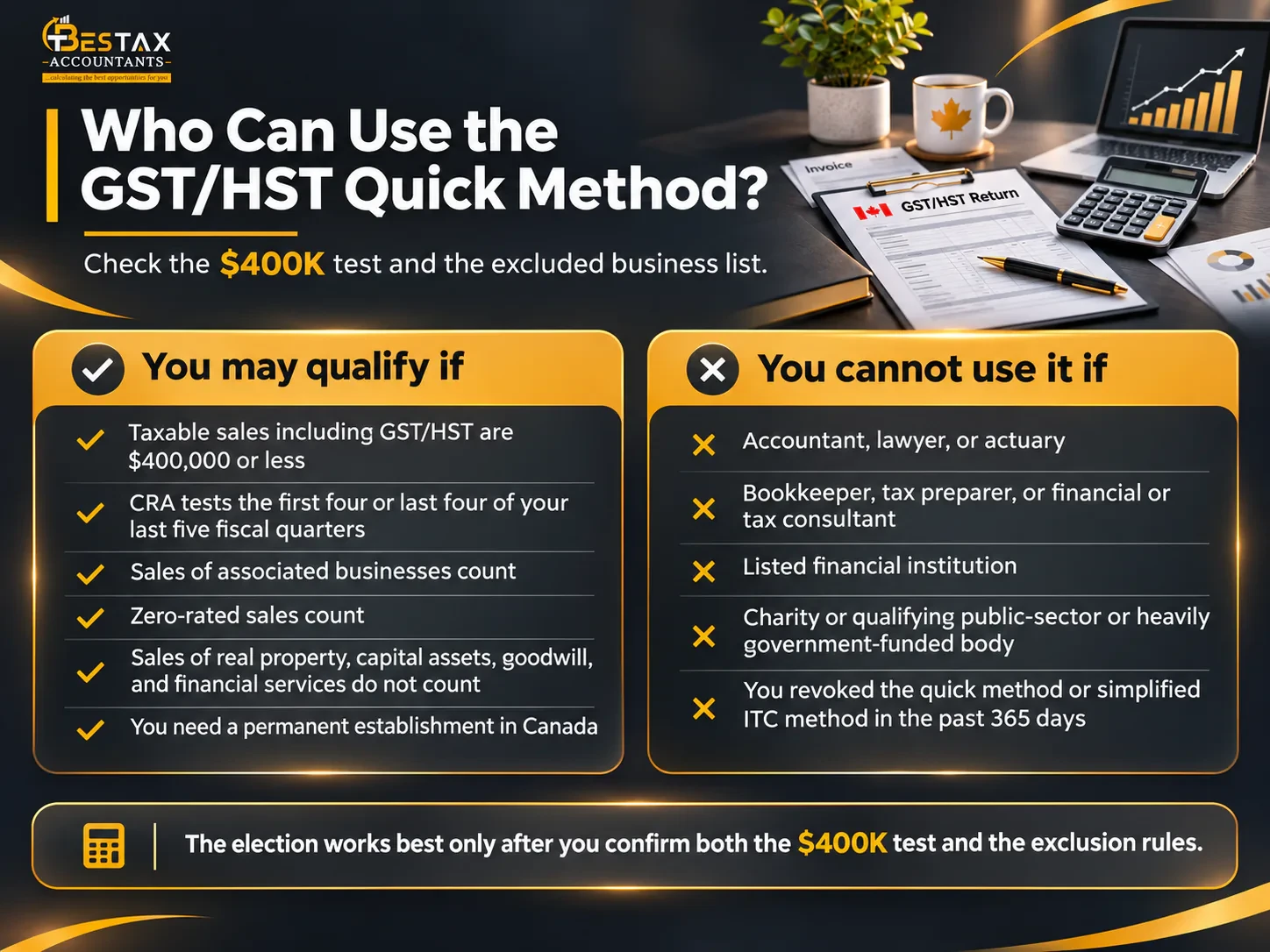
The $400,000 taxable sales limit
Under the CRA's quick method of accounting, your taxable sales including GST/HST can't exceed $400,000 a year. That limit includes the sales of any associated businesses and zero-rated sales.
The CRA tests two periods: the first four or the last four of your last five fiscal quarters. If either one is $400,000 or less, you qualify. Sales of real property, capital assets, goodwill and financial services don't count toward the limit.
You also can't elect if you revoked the quick method, or the simplified method for claiming ITCs, at any point in the past 365 days.
Businesses that can't use the quick method
Some businesses can't use the quick method at all:
- Accountants, lawyers and actuaries
- Bookkeepers, tax preparers and financial or tax consultants
- Listed financial institutions
- Charities, non-profits with at least 40 percent government funding, municipalities, hospitals and public colleges or universities
You also need a permanent establishment in Canada. Charities and qualifying non-profits have a separate special quick method.
GST/HST quick method remittance rates
Your remittance rate depends on two things: the province where your business is based, and whether you mainly sell services or resell goods.
Service rates vs goods rates
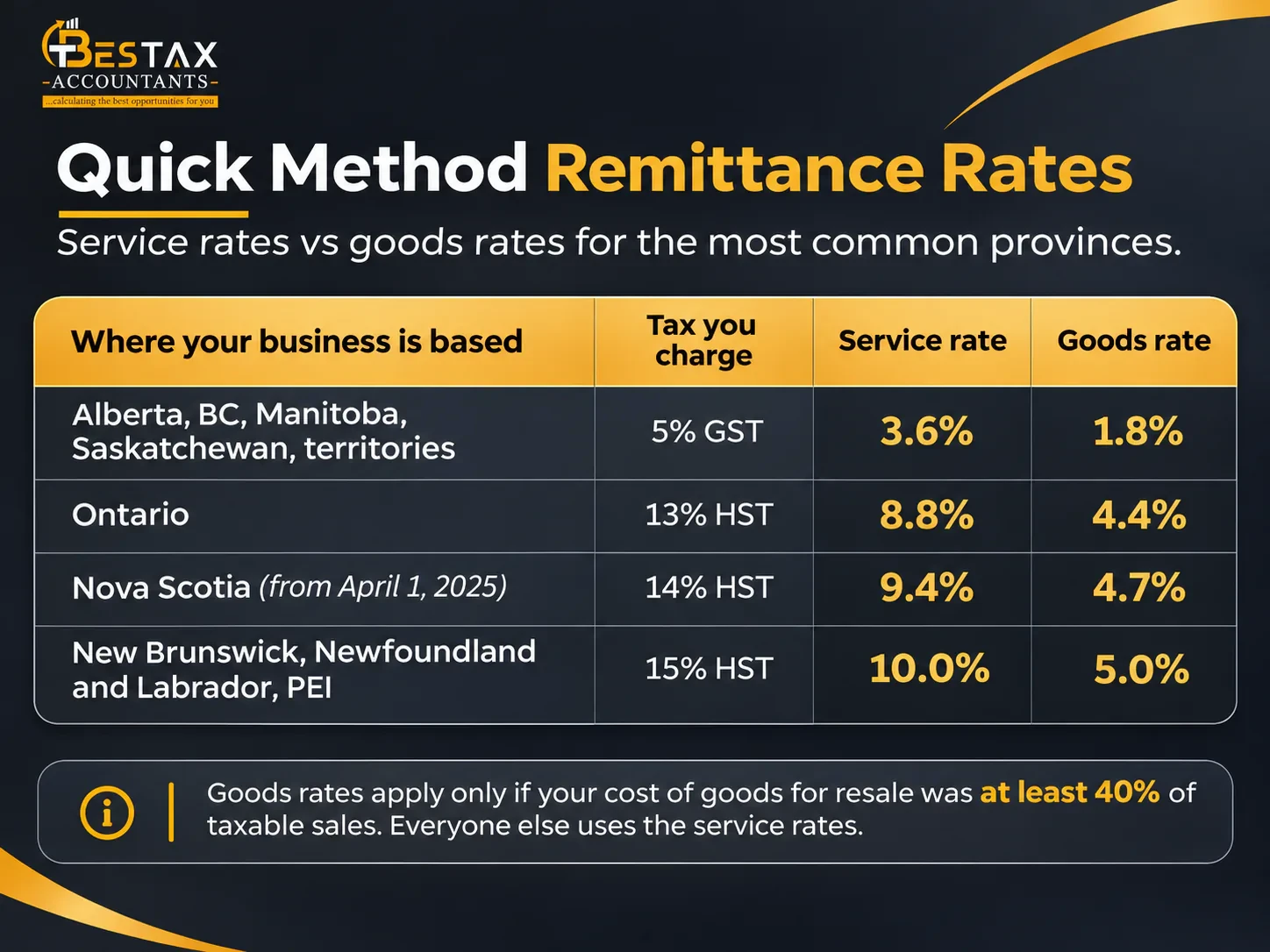
The lower goods rates apply only if your cost of goods bought for resale, including tax, was at least 40% of your taxable sales in the previous year. Retailers, wholesalers, gas stations and grocery stores usually pass.
A few details decide the 40% test:
- Leave out purchases of basic groceries and purchases with no tax on them.
- Leave out sales of basic groceries, financial services, real property, capital assets and goodwill, plus goods you auction for someone else.
- Include goods an auctioneer sells on your behalf.
- Use only your own figures, not your associates'.
- If you're electing for the first time this year, use the first four or last four of your last five quarters instead of last fiscal year.
Everyone else uses the service rates. That includes consultants, contractors, photographers, cleaners, restaurants, auto repair shops and small manufacturers.
Remittance rates by province
These are the rates for sales made in the same province as your business:
| Where your business is based | Tax you charge | Service rate | Goods rate |
|---|---|---|---|
| Alberta, BC, Manitoba, Saskatchewan, territories | 5% GST | 3.6% | 1.8% |
| Ontario | 13% HST | 8.8% | 4.4% |
| Nova Scotia (from April 1, 2025) | 14% HST | 9.4% | 4.7% |
| New Brunswick, Newfoundland and Labrador, PEI | 15% HST | 10.0% | 5.0% |
If you sell into other provinces, a different rate can apply to those sales. When 90% or more of your eligible sales in a period are in one rate zone, or in HST provinces that share the same rate, you can use just that zone's rate.
Rates for out-of-province sales
When you sell into a province with a different tax rate, the rate depends on both locations. These are the most common combinations:
| Business based in | Selling to customers in | Service rate | Goods rate |
|---|---|---|---|
| A GST-only province | Ontario (13% HST) | 10.5% | 8.8% |
| A GST-only province | NB, NL or PEI (15% HST) | 12.0% | 10.4% |
| Ontario | A GST-only province | 1.8% | 0%, plus a 2.8% credit |
| Ontario | Nova Scotia (14% HST) | 9.6% | 5.3% |
| Ontario | NB, NL or PEI (15% HST) | 10.4% | 6.1% |
Businesses that give the point-of-sale rebate on qualifying books in HST provinces use a separate rate for those sales: 1.8% under the goods rates or 3.6% under the service rates.
The 1% credit on your first $30,000 of sales
You get a credit of 1% on the first $30,000 of eligible sales, including tax, in each fiscal year. That's worth up to $300 a year.
The election has to be in effect at the start of your fiscal year to get the credit. Any unused part can't be carried forward. For Ontario businesses, the credit sits alongside the other lines you fill in when you file an HST return in Ontario.
New registrants get the credit if the election is in effect on the day they register. Monthly and quarterly filers apply it period by period until they reach $30,000 of sales or the fiscal year ends. If your sales qualify for a 0% goods rate, you get the 1% credit on top of that rate's own credit.
How to report the quick method on Form GST34
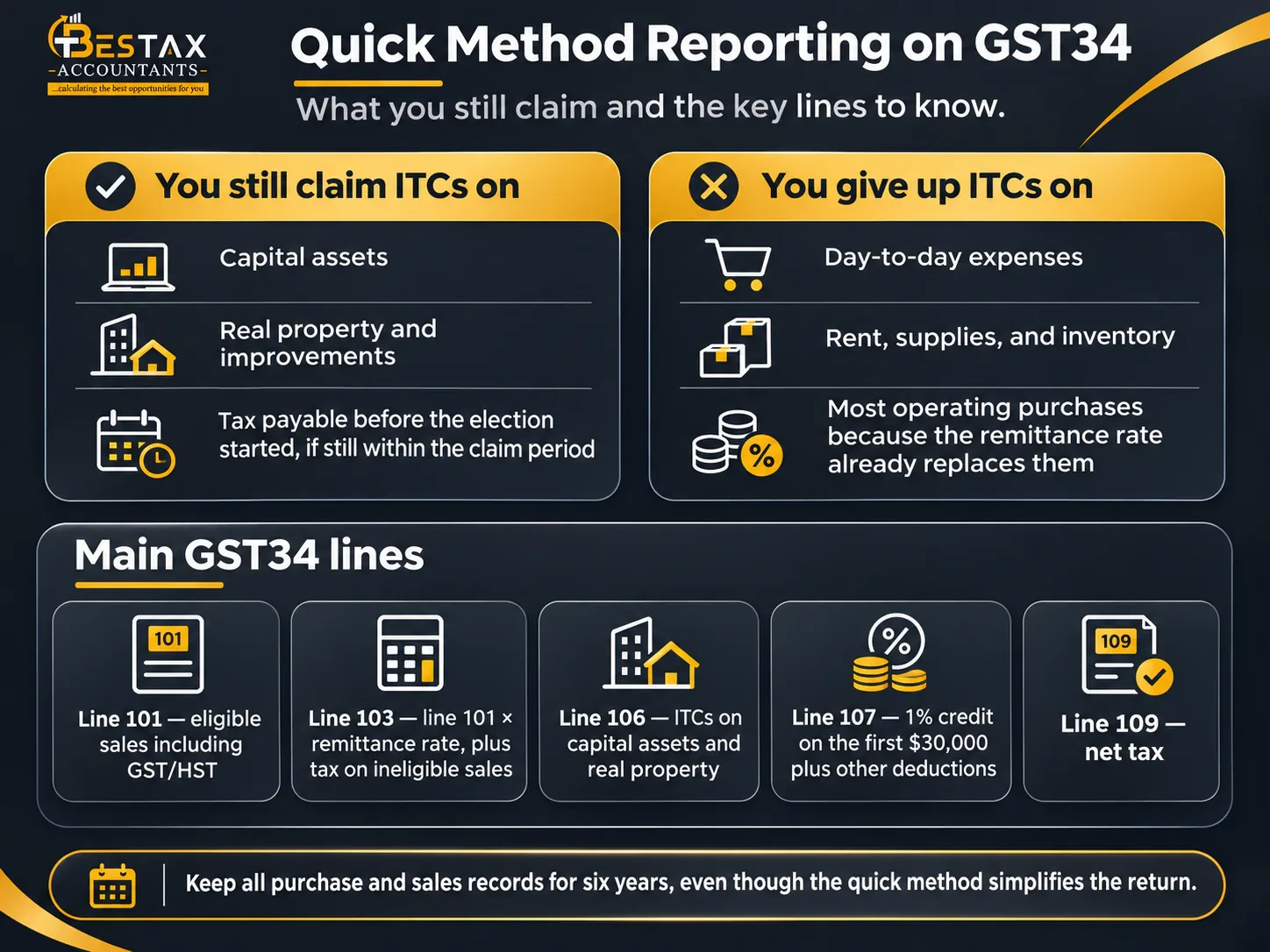
The quick method changes how you fill in your GST/HST return, Form GST34. Most businesses now have to file it electronically through NETFILE, but the line numbers are the same.
Input tax credits you can still claim
You give up input tax credits on day-to-day costs like rent, supplies and inventory. The remittance rate already allows for them.
You still claim ITCs on:
- Capital assets, such as computers, equipment and vehicles
- Real property and improvements to it
- Purchases where the tax became payable before your election started, if the time limit to claim hasn't passed
- Goods an agent or auctioneer sells for you, where they account for the tax
- Goods transferred to you by an unregistered non-resident who paid tax on them, which you service and sell as their agent
Sales that don't use the remittance rate
Some sales don't use the remittance rate. You report them the regular way instead:
- Zero-rated sales, sales made outside Canada and certain sales to First Nations individuals under the Indian Act
- Sales of real property or capital assets
- Taxable benefits to employees or shareholders
- Sales you make as an agent or auctioneer
- Business goods or services taken for personal use, where you self-assess tax
- Warranty reimbursements where you had to self-assess tax
GST34 lines for the quick method
| Line | What goes on it |
|---|---|
| 101 | Eligible sales, including the GST/HST. Leave out ineligible sales, untaxed sales and any PST you charged |
| 103 | Line 101 times your remittance rate, plus tax on any ineligible sales |
| 104 | Adjustments to add, such as a bad debt recovered on an ineligible sale |
| 106 | ITCs on capital assets and real property, plus any 0% rate credit |
| 107 | Your 1% credit on the first $30,000, plus other deductions |
| 109 | Net tax, calculated automatically |
| 110 | Instalments you've already paid, if you file annually |
| 111 | Rebates the rebate form allows you to claim here |
| 205 | GST/HST due on purchases of taxable real property or emission allowances |
| 405 | Other GST/HST you have to self-assess |
When you file through NETFILE on the quick method, don't choose the option to fill in lines 90, 91 and 102. If you use more than one remittance rate, repeat the calculation for each rate.
You still have to keep all your purchase and sales records for six years, even though you don't report most of the tax on them. The CRA can ask you to keep them longer, and you need its written approval to destroy them sooner.
Payments of $10,000 or more to the CRA must be made electronically.
Trade-ins, bad debts, refunds and other special cases
- Self-assessed provincial HST: if you bring goods into an HST province or import services, you self-assess at the full rate on line 405. The quick method rate doesn't apply.
- Trade-ins: include the full selling price in your eligible sales, before deducting the trade-in credit.
- Bad debts: you can't claim a bad debt adjustment on sales calculated under the quick method.
- Refunds and price reductions: subtract them from eligible sales in the period you give them.
- Changes to your business: a new service line, a purchase of another business or a big shift in what you sell means rechecking your eligibility and rate.
Quick method vs regular method: two Ontario examples
The quick method isn't automatically cheaper. These two examples are typical of the businesses accountants see every tax season, with very different results.
Example 1: Ontario marketing consultant
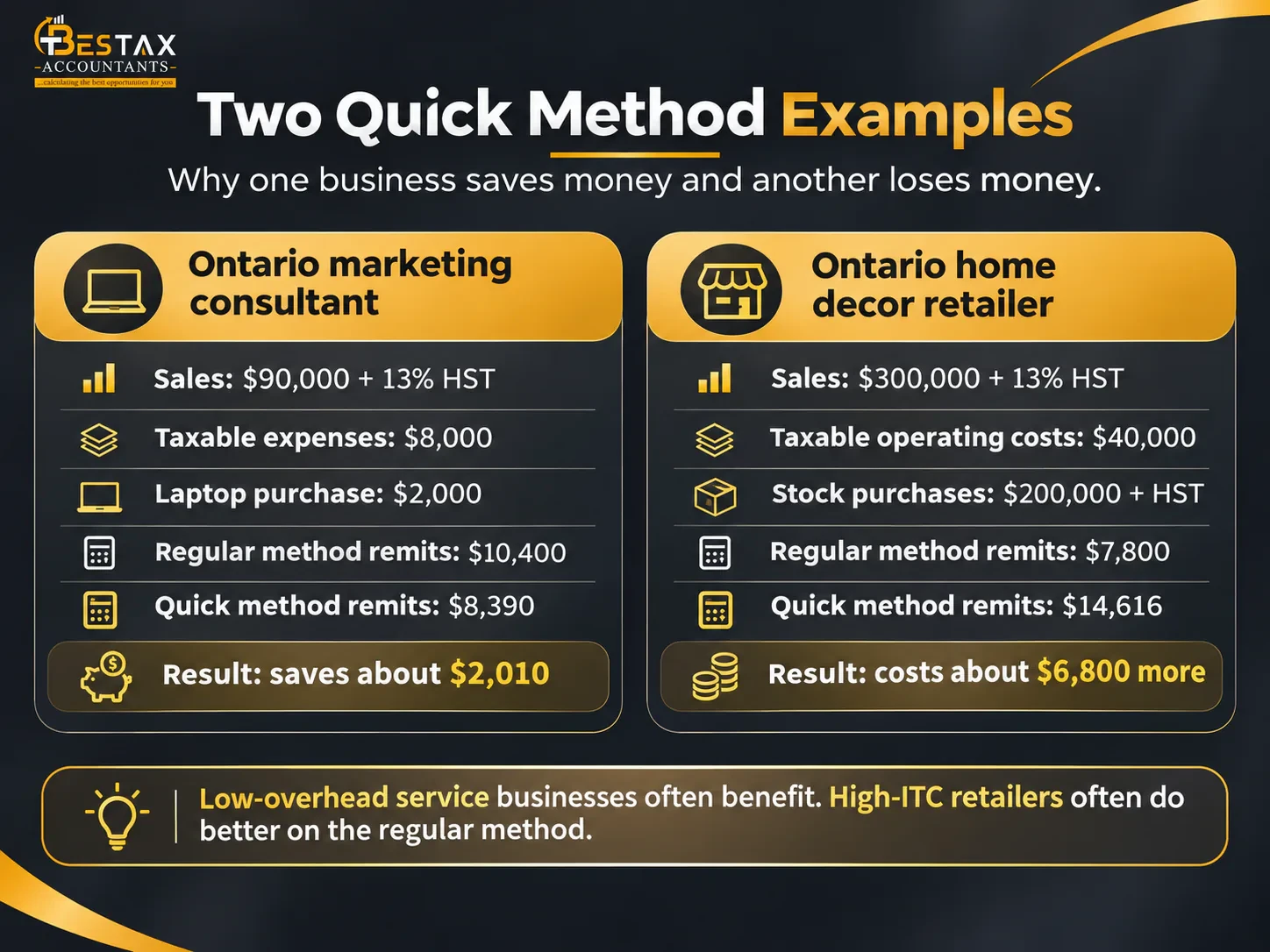
Priya runs a one-person marketing consultancy from home in Toronto. She bills $90,000 a year plus 13% HST. Her taxable expenses are $8,000 a year, and she bought a $2,000 laptop this year.
| Regular method | Quick method | |
|---|---|---|
| HST collected | $11,700 | $11,700 |
| Calculation | $11,700 − $1,040 ITCs on expenses − $260 ITC on laptop | ($101,700 × 8.8%) − $300 credit − $260 ITC on laptop |
| HST remitted | $10,400 | $8,390 |
The quick method saves Priya about $2,010 a year. She also stops tracking HST on every small expense. Low-overhead service businesses are where the quick method shines.
Example 2: Ontario home decor retailer
Marc owns a home decor shop in Ottawa. He sells $300,000 a year plus HST, so $339,000 in total. He buys $200,000 of stock plus HST, and has $40,000 of taxable operating costs like rent and utilities.
His stock costs are well over 40% of sales, so he qualifies for the 4.4% goods rate.
| Regular method | Quick method | |
|---|---|---|
| HST collected | $39,000 | $39,000 |
| Calculation | $39,000 − $26,000 ITCs on stock − $5,200 ITCs on expenses | ($339,000 × 4.4%) − $300 credit |
| HST remitted | $7,800 | $14,616 |
The quick method would cost Marc about $6,800 more each year. His real ITCs are larger than the quick method assumes.
Why one business saves and the other pays more
The quick method builds in an average level of expenses for your type of business. If your taxable costs are below that average, you win. If they're above it, the regular method wins.
That's why the same rule can save one business money and cost another. Run both calculations on your actual numbers before you elect.
How to elect the quick method with Form GST74
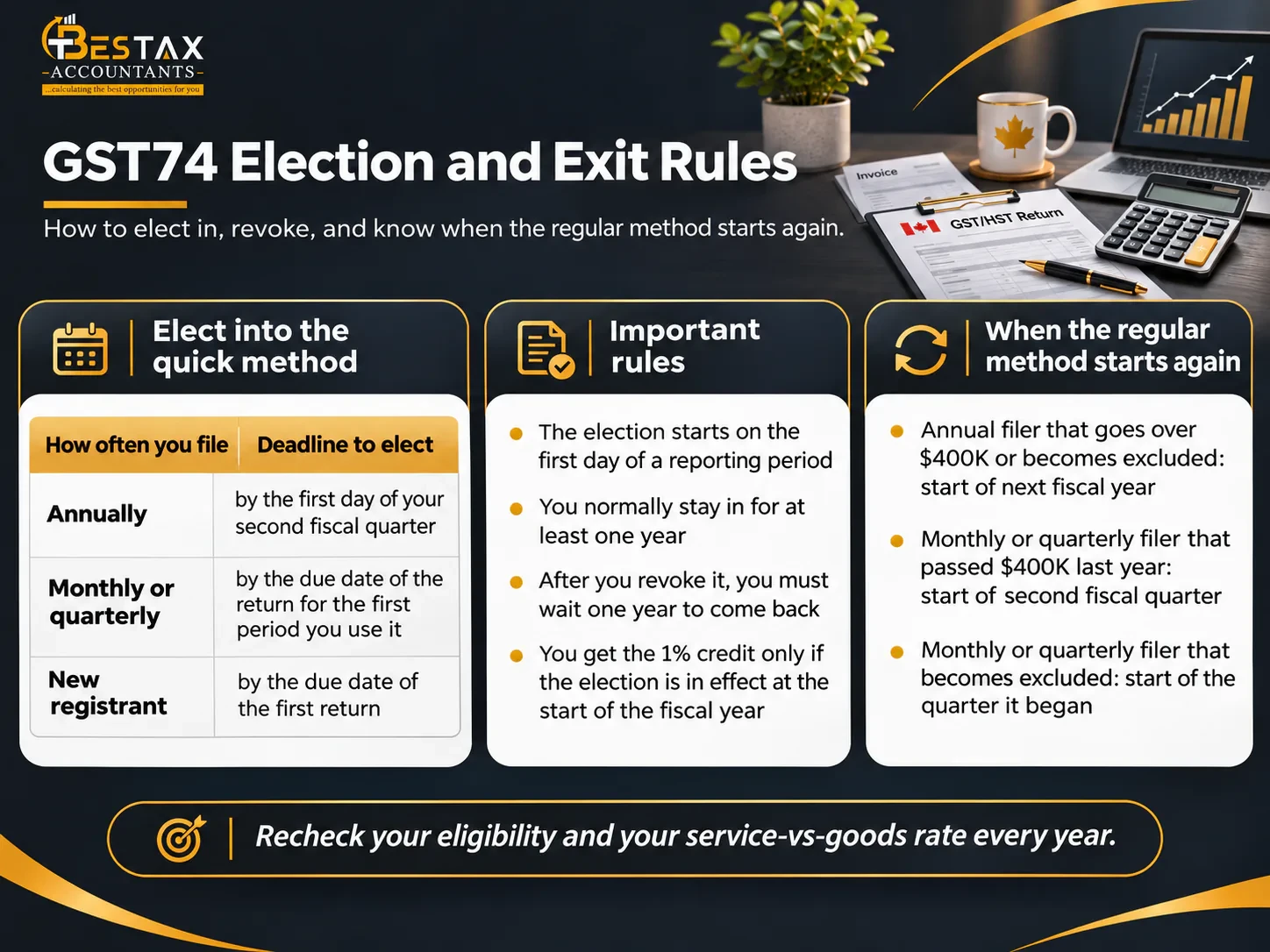
The quick method doesn't apply automatically. You elect into it through My Business Account, Represent a Client or Form GST74, and it starts on the first day of a reporting period. You're responsible for meeting the conditions, and the CRA can disallow the election on audit if you didn't.
GST74 election deadlines
| How often you file | Deadline to elect |
|---|---|
| Annually | By the first day of your second fiscal quarter |
| Monthly or quarterly | By the due date of the return for the first period you use it |
| New registrant, first return not a full year | By the due date of that first return |
You normally need to have been in business for the past 365 days. Businesses that have just registered for HST can elect too, if they expect first-year sales of $400,000 or less.
How to leave the quick method
The election stays in place until you revoke it or stop qualifying. You can revoke it only after it's been in effect for at least one year, and once you leave, you have to wait a year to come back.
To revoke, file by the due date of the return for the last period you want to use the quick method. Once you're back on the regular method, you can't claim ITCs on purchases you made while using the quick method, except capital ITCs you were entitled to but didn't claim.
If your sales go over $400,000, or your business becomes an excluded type, the CRA moves you back to the regular method on a set timetable:
| Your situation | Regular method starts |
|---|---|
| Annual filer that passes $400,000 or becomes excluded this year | Start of your next fiscal year |
| Monthly or quarterly filer, election in effect at the start of the year, passed $400,000 last year | Start of your second fiscal quarter |
| Monthly or quarterly filer, election not in effect at the start of the year, passed $400,000 in both four-quarter periods | Start of your next fiscal quarter |
| Monthly or quarterly filer that starts an excluded type of business | Start of the quarter it began |
Recheck your eligibility and rate every year
At each year-end, confirm that you still qualify and still use the right rate. A business that starts buying more stock, or shifts toward services, can cross the 40% line in either direction.
GST/HST quick method FAQs
Yes. The difference between the tax you collect and the tax you remit is extra business income. You include it in your income for income tax purposes.
Generally, no. You can only adjust for bad debts on sales that aren't eligible for the quick method calculation.
Subtract the refund or credit from your eligible sales before you apply the remittance rate, in the period you give it.
Yes. Sole proprietors, partnerships and corporations can all use it, as long as they meet the sales limit and aren't in an excluded line of business.
Revenu Québec administers the GST for businesses based in Quebec, with its own forms. The quick method is available there too, but you elect and file through Revenu Québec.
You can file a notice of objection if you disagree with an assessment. If circumstances beyond your control caused a late filing or payment, you can ask the CRA to cancel or waive penalties and interest from the last 10 calendar years. For questions about a specific transaction, the CRA also offers free GST/HST rulings.
How Bestax helps you choose the right GST/HST method
Picking the wrong method can cost you thousands a year, and the election locks you in for at least 12 months. Bestax runs the numbers before you commit.
What the Bestax review covers
- Eligibility check: your sales and your associates' sales against the $400,000 test, and a check that your business type isn't excluded.
- Rate category: whether you qualify for the goods rates under the 40% test or use the service rates.
- Side-by-side comparison: last year's actual figures run under both methods, so you see the real difference.
- Election filing: the GST74 election filed through My Business Account by the right deadline.
- Ongoing returns: each return prepared with the correct remittance rate, the 1% credit and any capital ITCs.
- Annual recheck: a year-end review of your eligibility, your rate and whether to stay on the quick method.
Records to send Bestax
- Your last five quarters of sales, including GST/HST.
- Your purchases of stock or materials for resale.
- A list of your taxable operating expenses.
- Any capital purchases planned for the year.
- Sales figures for any associated businesses.
Our GST/HST return filing service includes this comparison. Book a call with our team before your next filing deadline to find out which method saves you more.
Disclaimer: The information provided in this blog is for general informational purposes only. For professional assistance and advice, please contact experts.