


To file a T2 corporate tax return in Canada, you prepare the return from your corporation's financial records, complete the schedules that apply to your business, and submit it to the Canada Revenue Agency within six months of your fiscal year end. Every incorporated business in Canada must file a T2 every single year, even if it earned no income or had no activity at all.
That second point catches many first time business owners by surprise. Incorporating a company creates a separate legal person in the eyes of the CRA, and that person has to report to the tax office annually for as long as it exists. This guide walks you through the whole process in plain language, from what the form actually is to how to file it correctly and on time.
To put the scale in context, the Canada Revenue Agency assessed 2,646,450 corporation income tax returns for the 2022 tax year. Filing a T2 is one of the most common obligations in Canadian business, and it is also one of the most commonly misunderstood.
What is a T2 corporate tax return?
The T2 corporate tax return is the official form that Canadian corporations use to report their income, claim deductions and credits, and calculate the tax they owe to the CRA for a given fiscal year. It is the corporate equivalent of the personal T1 return, but it is longer, more detailed, and built around your company's financial statements rather than employment slips.
A few things make the T2 income tax return different from a personal filing:
- It reports the income of the corporation, not the owner. Money you take out as salary or dividends is dealt with separately on your personal return.
- It is due on your company's schedule, based on your fiscal year end, not on a fixed national date in April.
- It is built from your bookkeeping. The numbers on the return flow from your income statement and balance sheet, entered in a standard CRA format called the General Index of Financial Information, or GIFI.
In short, a T2 return is a full financial summary of your corporation for the year. Lenders, investors and the CRA all rely on it, so accuracy matters as much as timing.
Who has to file a T2 return?
Almost every corporation in Canada has to file. The rule from the CRA is broad. All resident corporations, and some non-resident corporations, must file a T2 corporation income tax return for every tax year, even when there is no tax payable.
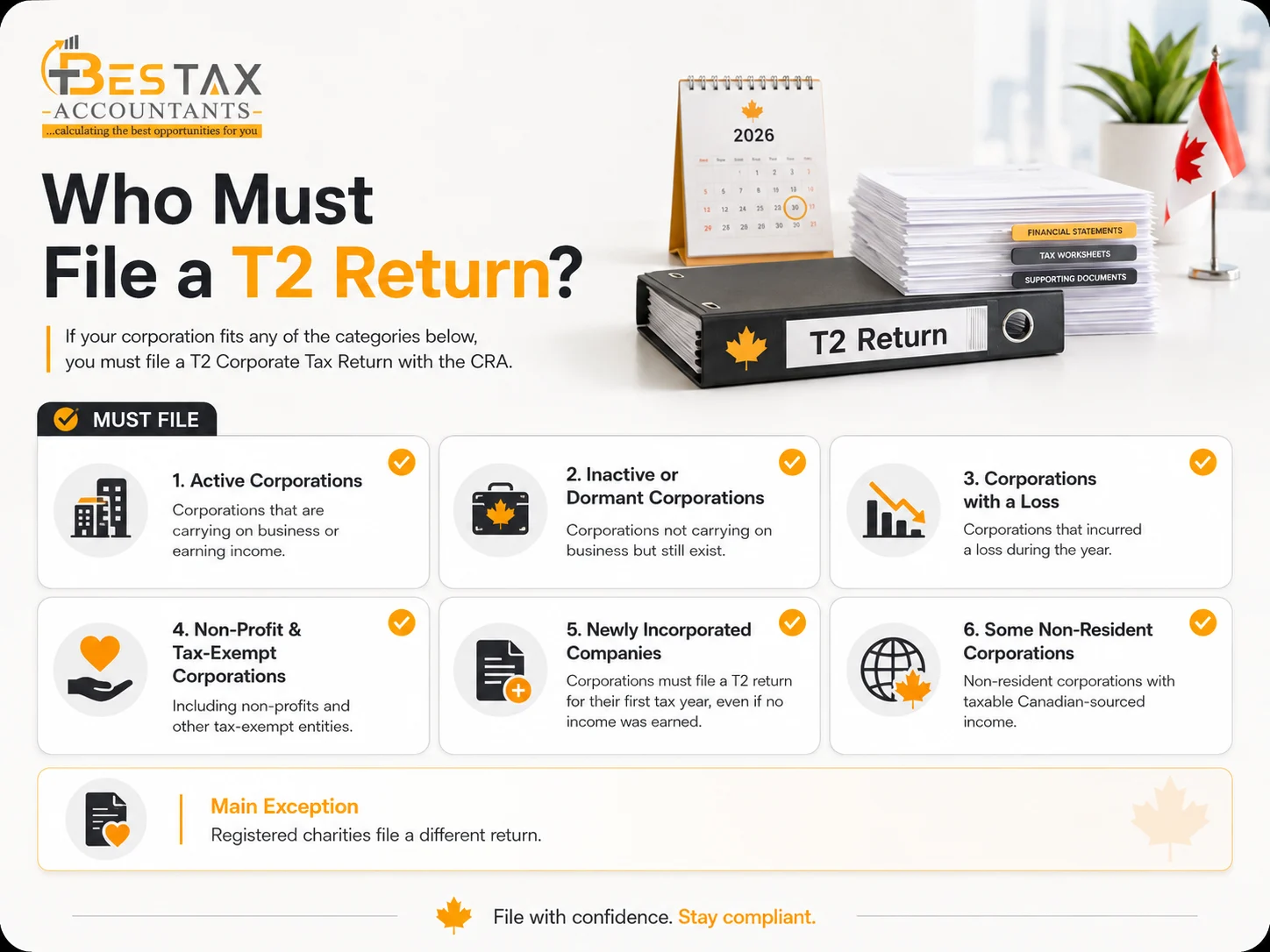
That includes:
- Active companies earning business income.
- Inactive or dormant companies with no activity for the year.
- Companies with a loss that owe no tax.
- Non-profit organizations and tax-exempt corporations.
- New corporations filing for the first time after incorporation.
There is one main exception. A corporation that was a registered charity throughout the year files a Registered Charity Information Return instead of a T2.
Non-resident corporations also need to file a T2 return if they carried on business in Canada, had a taxable capital gain, or sold taxable Canadian property during the year, even when a tax treaty means no Canadian tax is actually payable.
The simplest way to think about it: if your company is incorporated and it is not a registered charity, you file a T2 corporation tax return. Doing nothing is not an option, and a company that skips filing stays permanently open to CRA review.
T2 return vs T2 Short Return: which one do you file?
Most corporations file the full T2 corporation income tax return. A smaller group can use a simplified version called the T2 Short Return.
You may be able to use the T2 Short Return if your corporation falls into one of two categories:
- It is a Canadian controlled private corporation (a CCPC) throughout the tax year and has either a nil net income or a loss for income tax purposes, or
- It is exempt from tax under section 149 of the Income Tax Act, such as certain non-profit organizations.
There are extra conditions attached, including having a permanent establishment in only one province or territory and not claiming certain refundable credits. If your company does not meet every condition, you file the regular T2. When there is any doubt, the full return is the safe choice, because filing the wrong version can lead to a reassessment.
T2 filing and payment deadlines
This is where the most expensive mistakes happen, because a T2 return has two different deadlines and they almost never fall on the same day.
- Filing deadline: your T2 return is due no later than six months after the end of your fiscal year.
- Payment deadline: any balance of tax you owe is due two months after your fiscal year end, or three months for many small CCPCs that claim the small business deduction.
In plain terms, your payment can be due up to four months before your paperwork is. Interest starts adding up on any unpaid balance the day after the payment deadline, even if your return itself is not due for months.
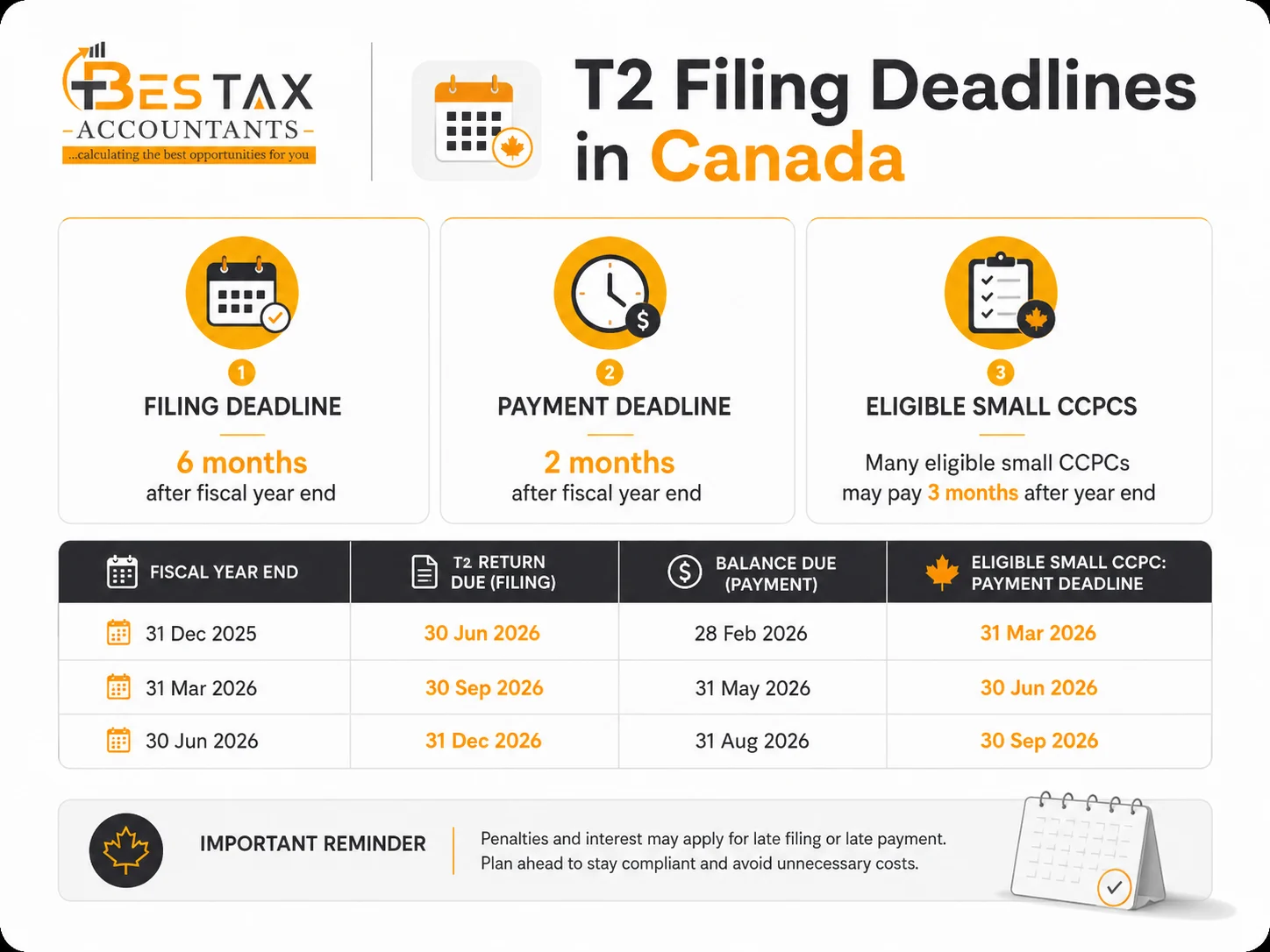
Here is how the two dates line up for common year ends.
| Fiscal year end | T2 return due | Balance owing due (most corporations) | Balance owing due (eligible small CCPCs) |
|---|---|---|---|
| 31 December 2025 | 30 June 2026 | 28 February 2026 | 31 March 2026 |
| 31 March 2026 | 30 September 2026 | 31 May 2026 | 30 June 2026 |
| 30 June 2026 | 31 December 2026 | 31 August 2026 | 30 September 2026 |
| 30 September 2026 | 31 March 2027 | 30 November 2026 | 31 December 2026 |
| 31 December 2026 | 30 June 2027 | 28 February 2027 | 31 March 2027 |
If a deadline falls on a weekend or public holiday, it moves to the next business day. And if your corporation owed more than $3,000 in tax this year or last year, the CRA also expects you to pay by instalments during the year, either monthly or quarterly. Our guide to corporate tax deadlines in Canada sets out how these dates interact with your other filings.
What you need before you start
A T2 filing goes smoothly when your records are in order first. Before you begin, gather:
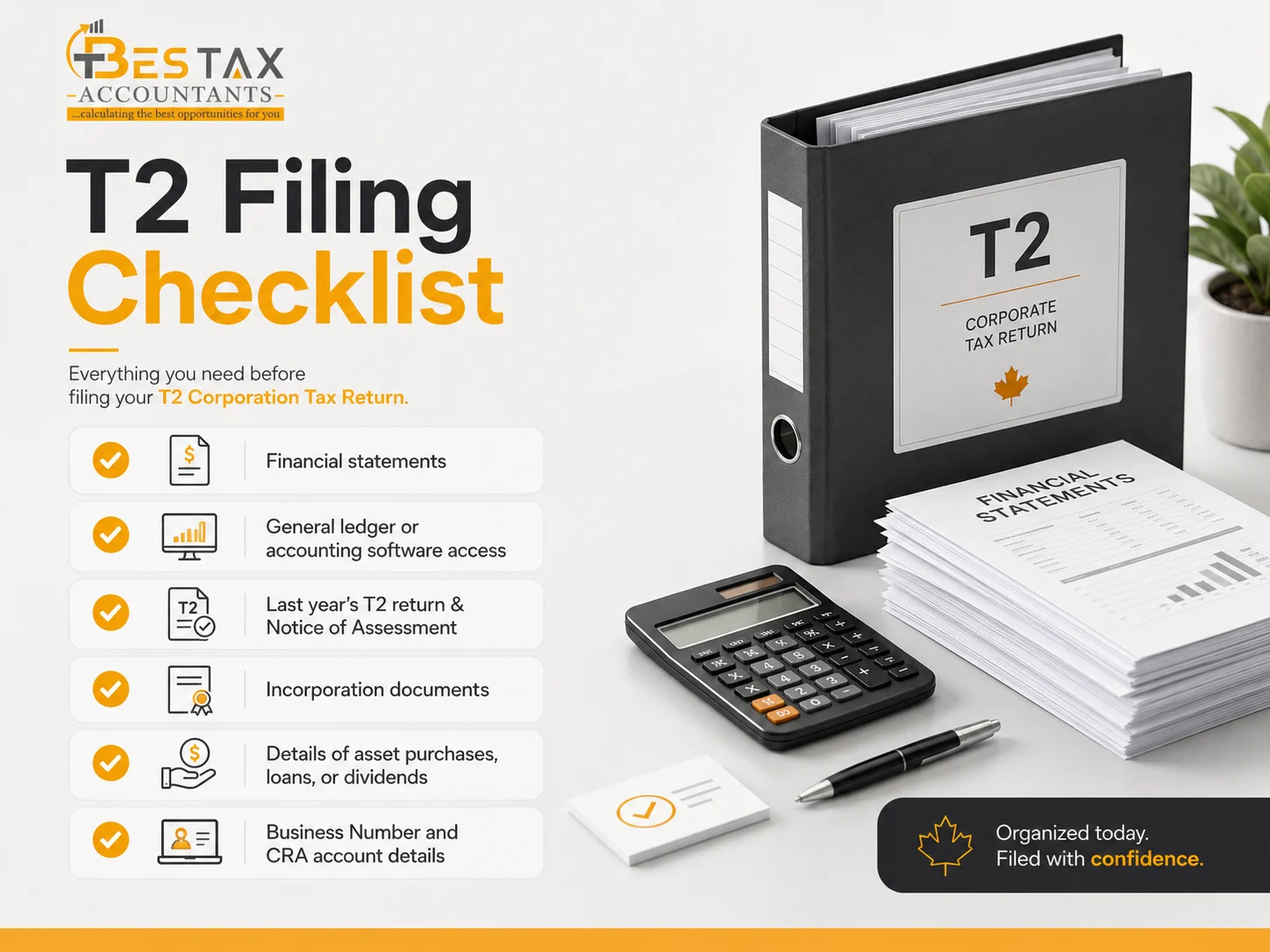
- Your financial statements for the year, meaning your income statement and balance sheet.
- Your general ledger or full access to your accounting software.
- Last year's T2 return and Notice of Assessment.
- Your incorporation documents, if this is your first filing.
- Details of any asset purchases, loans, or dividends during the year.
- Your business number and CRA program account details.
Clean, reconciled books are the foundation of an accurate return. If your bookkeeping is behind, that is the first thing to fix, because the schedules on your T2 are only as reliable as the numbers feeding them. Our backlog accounting service exists for exactly this situation.
How to file a T2 return: step by step
Here is the process an accountant follows to prepare and file a T2 return correctly.
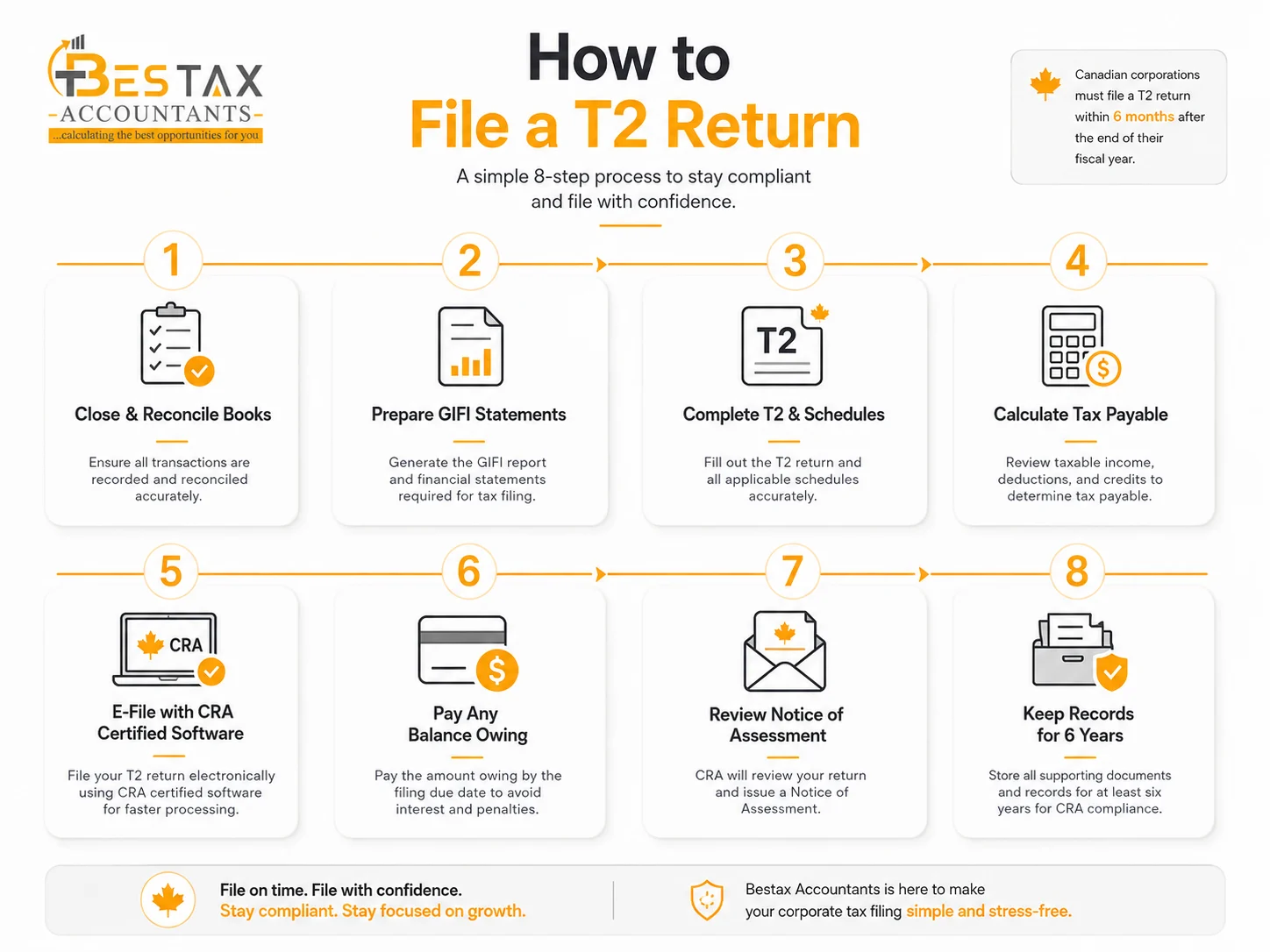
Step 1: Close and reconcile your books
Make sure your general ledger for the fiscal year is complete, your bank and credit accounts are reconciled, and all accruals and adjustments are recorded. Every figure on the return traces back to these numbers.
Step 2: Prepare your GIFI financial statements
The CRA wants your income statement and balance sheet coded into standard GIFI line numbers. This is how the tax office reads financial data in a consistent format across millions of returns.
Step 3: Complete the T2 return and its schedules
Enter your identification details, then work through the schedules that apply to your business. The schedules are where deductions and credits are claimed, so this is the part that decides how much tax you pay.
Step 4: Calculate your tax payable
Apply the federal and provincial rates, claim the small business deduction if your company qualifies, and apply any credits and instalments already paid. The result is either a balance owing or a refund.
Step 5: File the return with the CRA
Almost all corporations must now file electronically using CRA certified software. E-filing gives you same day confirmation that your return was received.
Step 6: Pay any balance owing
Remember that the payment deadline is earlier than the filing deadline. Pay electronically, since any payment of $10,000 or more must be made through an electronic method.
Step 7: Review your Notice of Assessment
When the CRA processes your return it issues a Notice of Assessment. Check it against what you filed, because the window to object to any adjustment is limited.
Step 8: Keep your records
Hold on to all supporting documents for at least six years from the end of the tax year they relate to, in case the CRA asks to verify your figures.
Understanding T2 schedules
The main T2 form is short. The real work, and the real tax savings, live in the T2 schedules attached to it. Schedules are supporting forms that break down specific parts of your return. The ones most corporations touch include:
- Schedule 1 reconciles your accounting profit with your profit for tax purposes.
- Schedule 8 claims capital cost allowance, the tax version of depreciation on your equipment and assets.
- Schedule 50 reports shareholders who own 10 percent or more of the company.
- Schedule 100 and Schedule 125 carry your balance sheet and income statement in GIFI format.
- Schedule 5 allocates income when your corporation operates in more than one province.
Choosing the right T2 returns and schedules for your situation is one of the most common sources of filing errors. Claim too little capital cost allowance and you overpay tax. Miss a schedule and you can trigger a review. This is precisely the judgment a professional preparer adds that tax software on its own does not.
E-filing vs paper: where to send a T2 return
For tax years starting after 2023, the CRA requires almost all corporations to file the T2 electronically. The only exceptions are insurance corporations, non-resident corporations, corporations reporting in a functional currency, and corporations exempt from tax under section 149 of the Income Tax Act. If a corporation that is required to file electronically sends a paper return instead, the CRA charges a $1,000 penalty.
Electronic filing through certified software is faster, safer, and gives instant confirmation, so it is the right choice for almost every business regardless of the rule.
If your corporation is one of the narrow exceptions that can still file on paper, where to send your T2 return depends on where your corporation is located:
- Corporations served by tax offices in Alberta, Manitoba, the Northwest Territories, and several Ontario cities send their return to the Winnipeg Tax Centre.
- Corporations served by the Toronto and Sudbury or Nickel Belt offices send their return to the Sudbury Tax Centre.
- Corporations in British Columbia, the Atlantic provinces, Quebec, the territories, and much of eastern Ontario send their return to the Atlantic Tax Centre in Summerside, Prince Edward Island.
- Non-resident corporations send their return to the Sudbury Tax Centre.
Because these routing rules change from time to time, always confirm the current address on the CRA website before mailing anything. For the vast majority of businesses, though, mailing a T2 is a thing of the past.
Corporate tax rates for 2026
Once your taxable income is calculated, the rate applied depends on the type of income and your province.
At the federal level:
- The general corporate tax rate is 15 percent.
- Eligible Canadian controlled private corporations pay a reduced federal rate of 9 percent on the first $500,000 of active business income, through the small business deduction.
On top of the federal rate, each province and territory charges its own corporate tax, and those provincial rates vary and change from year to year. Several provinces have adjusted their small business rates recently, so it is worth confirming the current combined rate for your province before you rely on last year's number. The $500,000 small business limit also shrinks for corporations with large taxable capital or significant investment income, which is why year end planning matters.
Penalties and interest for filing a T2 late
Filing late has a precise and growing cost. If your corporation owes tax and files after the deadline, the CRA charges:
- 5 percent of the unpaid tax as an immediate penalty, plus
- 1 percent of the unpaid tax for each complete month the return is late, up to a maximum of 12 months.
So a return filed six months late on a $10,000 balance carries a penalty of $500 plus $600, which is $1,100, before interest.
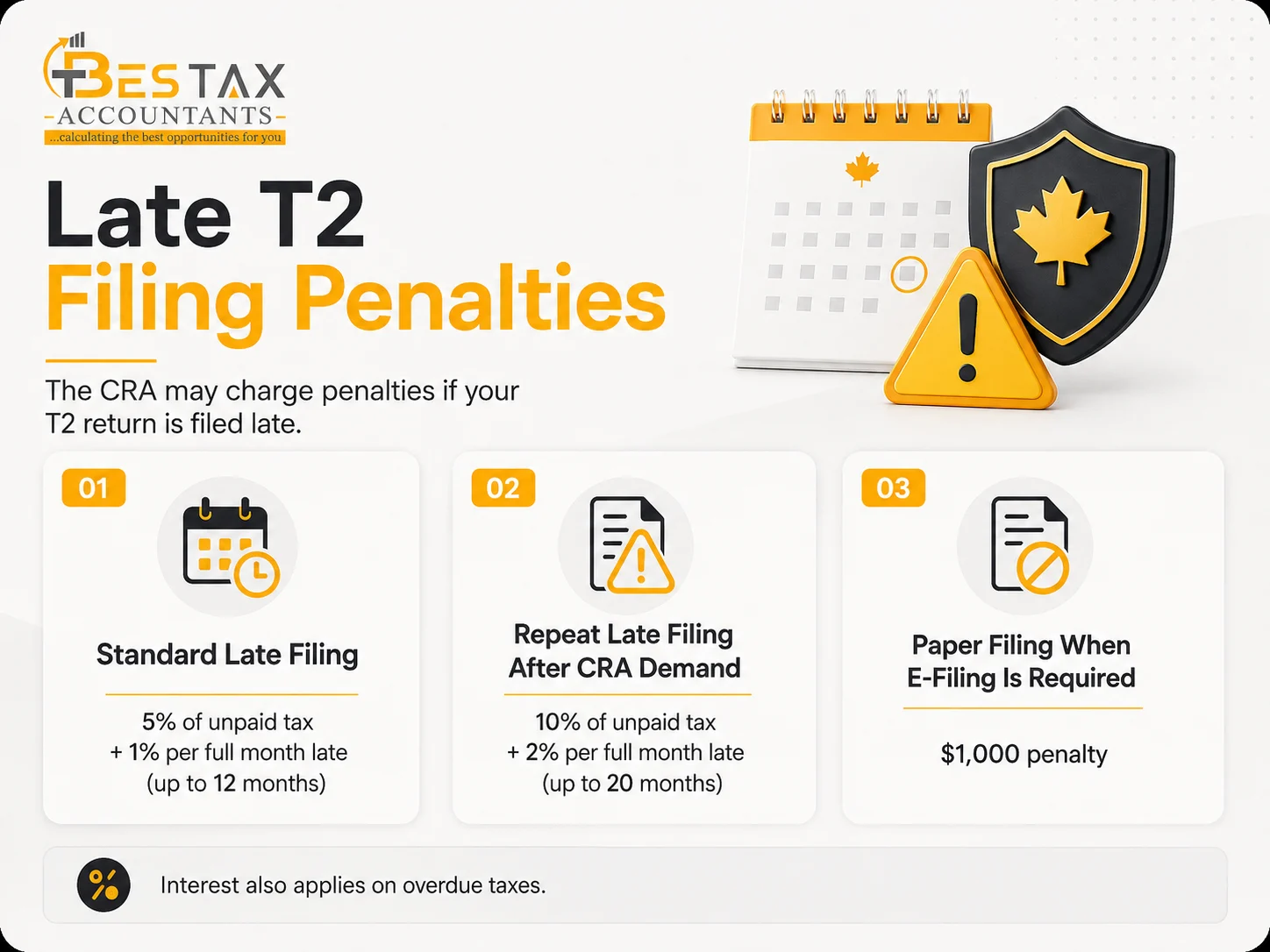
If the CRA formally demanded the return and had already charged you a late-filing penalty in any of the three previous tax years, the rates double to 10 percent plus 2 percent per month, up to 20 months. Our guide to penalties for late tax filing in Canada covers how these are calculated across return types.
On top of any penalty, the CRA charges interest on unpaid balances. For the third quarter of 2026, the interest rate on overdue taxes is 7 percent, and it compounds daily. That daily compounding is what makes a delayed balance grow faster than owners expect.
There is one silver lining. If you owe no tax, the late-filing penalty is zero, because it is calculated as a percentage of an unpaid balance. But the risk is still real. A refund, including a dividend refund, is lost if the return is filed more than three years after the year end, and an unfiled year stays open to CRA review indefinitely. The lesson is simple: even if you cannot pay, file on time, because filing stops the penalty from climbing while a payment plan handles the balance.
Common T2 filing mistakes to avoid
Over years of preparing corporate returns, the same avoidable errors come up again and again:
- Confusing the filing date with the payment date. This single mix-up causes most of the interest charges we see.
- Assuming an inactive company does not need to file. A nil return is still mandatory.
- Claiming the wrong capital cost allowance, leaving deductions on the table or triggering a review.
- Forgetting provincial filings. Quebec requires a separate CO-17 return and Alberta a separate AT1 return, on top of the federal T2.
- Missing related filings such as GST/HST returns, T4 slips for employees, and T5 slips for dividends, each with its own deadline and penalty.
- Ignoring the Notice of Assessment, and missing the window to challenge a CRA adjustment.
Should you file your T2 yourself or hire an expert?
Technically, a corporation can file its own T2 using certified software. For a truly dormant holding company with no activity, that can work. For almost everyone else, the return quickly becomes complex enough that professional help pays for itself.
Tax software files whatever you type into it. It does not tell you whether your capital cost allowance is claimed at the best pace, whether a loss should be carried back for an immediate refund, or whether a shareholder loan is about to become taxable income on your personal return. Those judgment calls are usually worth more than the fee.
That is the difference our clients notice. One business owner told us that filing corporate taxes with us was far easier than expected, because everything was explained in simple language with no jargon and filed on time. An IT consultancy owner came to us tired of handling CRA letters alone, and has had smooth filings ever since. Another client had us file for a second corporation after the first, and described the process as identical and painless: send documents, review, sign, done.
How Bestax helps you file your T2 the right way
At Bestax, filing corporate returns is one of the things we do most. We have supported businesses for more than 10 years, with a team of 35 or more professionals and offices in both Canada and the UAE. Every return is prepared from your books, reviewed by a senior accountant, and e-filed with the CRA before the deadline.
Here is what working with us looks like:
- A free consultation to understand your corporation, your year end, and the state of your records.
- We prepare, you approve. Your return and schedules are prepared and explained in plain language, and nothing is filed until you sign off.
- We e-file and stay with you. Your return goes to the CRA electronically, we confirm acceptance, and we handle any CRA questions all year, not just at filing time.
- Behind on filings? Multi-year catch ups are one of our most requested jobs, and we file every outstanding year in the right order.
Whether you are filing for the first time, catching up on prior years, or simply want your deadlines handled by someone who tracks them for you, our Canadian team is here to help. We also handle small business tax and payroll for the same clients, so the filings stay in step with one another.
Book a free consultation and get your T2 filed on time, every year.
Frequently asked questions
What is a T2 return?
A T2 return is the corporation income tax return that Canadian corporations file with the CRA each year to report their income, deductions, and tax owing. Every incorporated company must file one for every tax year, even if it had no income or activity.
What is the difference between a T2 tax return and a T1?
A T1 is the personal income tax return that individuals file, while a T2 corporation income tax return is filed by a corporation as a separate legal entity. If you own an incorporated business, you file both: a T2 for the company and a T1 for yourself.
How do I file a T2 return in Canada?
To file a T2, you close and reconcile your books, prepare your GIFI financial statements, complete the T2 form and its schedules, calculate your tax, and submit the return electronically to the CRA using certified software. Most corporations are now required to file the T2 electronically rather than on paper.
When is my T2 corporate tax return due?
Your T2 return is due six months after your fiscal year end. So a corporation with a 31 December year end has a filing deadline of 30 June. Keep in mind that any tax you owe is due earlier, usually two months after year end, or three months for eligible small CCPCs.
Do I have to file a T2 if my company had no income?
Yes. Every resident corporation must file a T2 corporation income tax return for every tax year, even with zero income, zero activity, or a loss. A nil return is quick and inexpensive, and filing it protects you from losing refunds and from leaving the year open to CRA review.
What is the T2 Short Return?
The T2 Short Return is a simplified two page version of the return available to certain corporations. You may qualify if your company is a Canadian controlled private corporation with a nil net income or a loss for the year, or if it is tax-exempt under section 149 of the Income Tax Act, and it meets the other conditions. Corporations that do not meet every condition file the regular T2.
What are T2 schedules?
T2 schedules are the supporting forms attached to the main return that break down specific items, such as capital cost allowance, shareholder information, and your financial statements in GIFI format. The right T2 returns and schedules depend on your business, and they are where most deductions and credits are claimed.
Where do I send or mail my T2 return?
Almost all corporations must now file the T2 electronically, so there is nothing to mail. In the narrow cases where paper filing is still allowed, where to send your T2 return depends on your location, going to the Winnipeg, Sudbury, or Atlantic (Summerside) tax centre. Non-resident corporations mail to the Sudbury Tax Centre. Always confirm the current address on the CRA website.
Can I file my T2 corporate income tax return myself?
You can, using CRA certified software, and it may be workable for a simple dormant company. For active businesses with schedules, assets, or shareholder transactions, most owners save money and stress by having an accountant prepare the return, because software does not make the judgment calls that reduce your tax.
What happens if I file my T2 late?
If you owe tax and file late, the CRA charges 5 percent of the unpaid tax plus 1 percent for each complete month the return is late, up to 12 months. Repeat late filers can face double those rates. Interest also applies on any unpaid balance, at 7 percent for the third quarter of 2026, compounded daily. File on time even if you cannot pay, because that stops the penalty from growing.
Do I need to file a paper return, and what is the penalty for filing on paper?
For tax years starting after 2023, most corporations are required to file the T2 electronically. A corporation that must file electronically but sends a paper return instead is charged a $1,000 penalty by the CRA. Only a few types, such as insurance and certain non-resident corporations, are exempt from the e-filing rule.
What is the corporate tax rate for a small business in Canada?
Eligible Canadian controlled private corporations pay a federal rate of 9 percent on the first $500,000 of active business income, thanks to the small business deduction. The general federal rate is 15 percent. Each province adds its own rate on top, so your combined rate depends on where your corporation operates.

Written by
Olivia Chen

Fact checked by
Haseeb Hamdani
Lead Advisor · Director Accounting & Taxation
With over a decade of cross-border experience spanning Canada, the UAE, and beyond, Haseeb Hamdani leads the Bestax team of qualified professionals with one clear goal - to make sure your business is compliant, protected, and positioned to grow. His international credentials and real-world expertise across tax, compliance, and business structuring mean clients always receive precise, reliable, and commercially sound financial guidance.
Learn More About Haseeb