
Accounting
How to Prepare for a Financial Statement Audit: A First-Time Audit Checklist for Canadian Businesses
Reconcile the books, build the PBC list and get the year-end file ready before the auditor starts. Audit vs review vs compilation, when the law requires an audit, the 2026 CAS changes, and a four-phase checklist.


To prepare for a financial statement audit, you reconcile your books, gather every supporting document, and get your year-end file organized before the auditor starts. A first-time audit checklist is simply the list of accounts, schedules, and records the auditor will ask for, prepared in advance so the audit runs faster and costs less.
If a lender, board, funder, shareholder or a law has asked you for audited financial statements for the first time, this guide walks you through the whole process in plain language.
You will learn what an audit actually is, whether you truly need one, exactly what to prepare, the mistakes that trip up first-timers, and what changes in Canadian audit rules take effect for fiscal periods beginning on or after December 15, 2026.
What a financial statement audit actually is
A financial statement audit is an independent examination of your balance sheet, income statement, cash flow statement, statement of retained earnings and the notes that go with them.
At the end, a licensed auditor gives an opinion on whether those statements are free from material misstatement and are presented fairly under the accounting framework you use, usually ASPE for private companies, IFRS for public companies, or ASNPO for not-for-profits.
An audit gives the highest level of assurance of the three engagement types available in Canada. It is called reasonable assurance, which is a high level of confidence but not an absolute guarantee.
Here is what an audit is not.
- It is not a CRA audit. A CRA audit is a tax review by the Canada Revenue Agency. A financial statement audit is an accounting engagement requested by lenders, boards, owners or a statute.
- It is not a guarantee that your numbers are perfect. Auditors test samples, not every single transaction.
- It is not fraud detection on demand. An audit is designed to catch material misstatement, whether from error or fraud, but it is not a forensic investigation.
- It is not something your bookkeeper can sign. In Ontario, only a CPA who holds a Public Accounting Licence, working at a firm registered with CPA Ontario, may sign an audit report.
Audit, review or compilation: which one do you actually need?
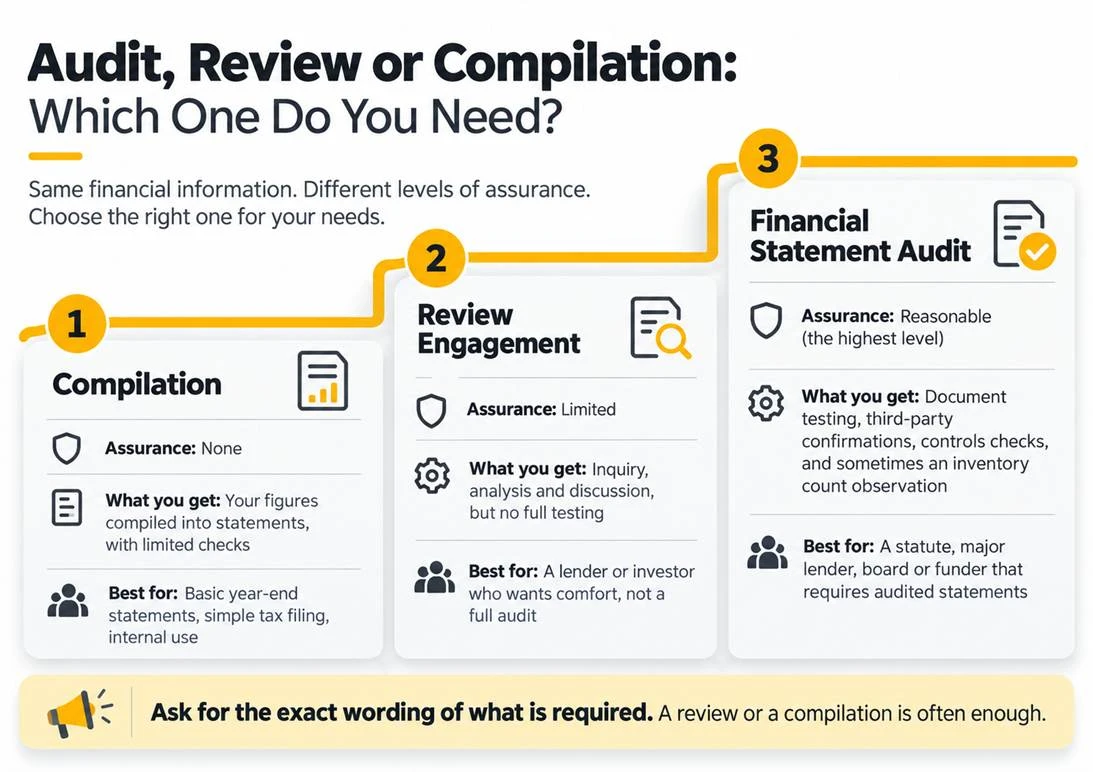
Many first-time auditees are surprised to learn they may not need a full audit at all. Canada has three levels of engagement, and the right one depends entirely on who is asking and what they require.
| Engagement | Level of assurance | What the accountant does | Typical reason |
|---|---|---|---|
| Compilation (formerly notice to reader) | None | Compiles the figures you provide into statements, with limited checks | Basic year-end statements, simple tax filing, internal use |
| Review engagement | Limited | Inquiry, analysis and discussion, but no full testing | A lender or investor wants comfort but not a full audit |
| Financial statement audit | Reasonable (high) | Requests documents, tests balances, confirms with third parties, checks internal controls, may observe an inventory count | A statute, major lender, board or funder requires audited statements |
A review or a compilation is often enough. Before you commit to an audit, ask the person requesting the statements for the exact wording of what they need. Send us that wording and we will tell you which engagement satisfies it, so you never pay for more assurance than the requirement calls for.
Do you even need an audit by law?
Whether an audit is legally required depends on how your organization is set up.
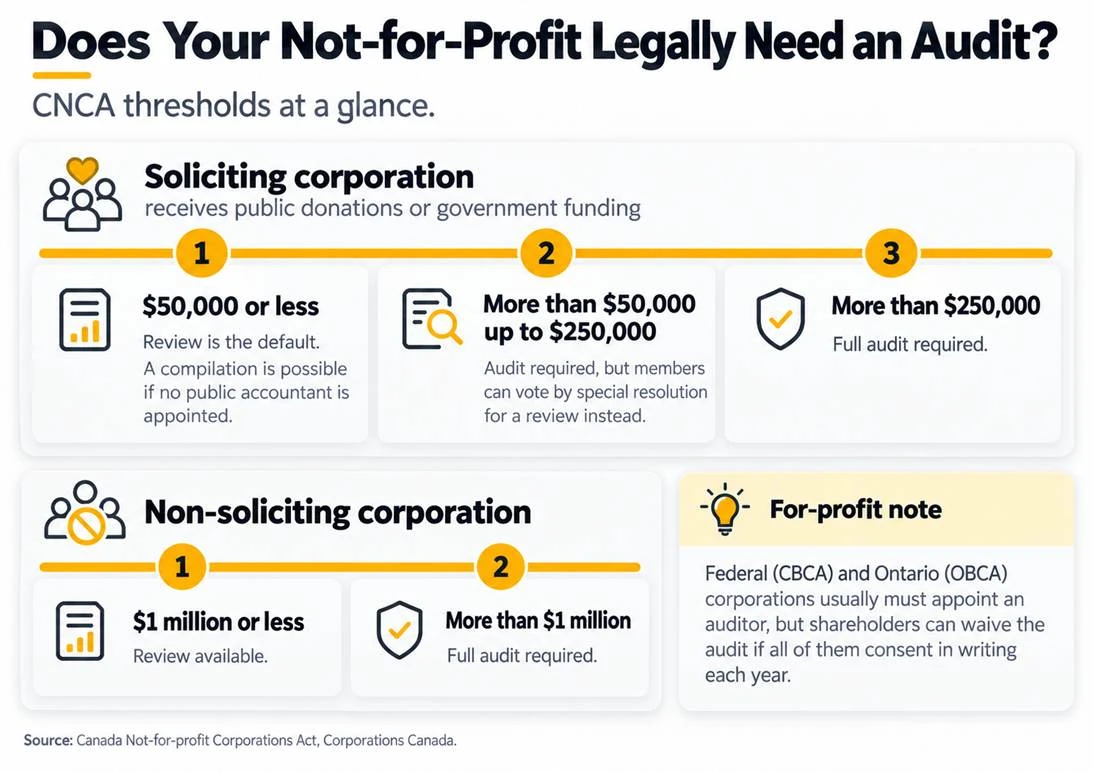
Federal not-for-profit corporations follow revenue thresholds under the Canada Not-for-profit Corporations Act. For a soliciting corporation, one that receives public donations or government funding, the levels are:
- Gross annual revenue of $50,000 or less: a review engagement is the default. Members can waive the appointment of a public accountant by annual unanimous resolution, in which case no one reviews the statements and a compilation is usually all that is prepared.
- More than $50,000 and up to $250,000: an audit is required, but members can vote by special resolution to have a review instead.
- More than $250,000: a full audit is required.
For a non-soliciting corporation, the audit becomes mandatory only above $1 million in gross annual revenue. At or below $1 million a review is the default, and members can again waive the public accountant by annual unanimous resolution and rely on a compilation. At either level, members can also pass an ordinary resolution asking for an audit instead of a review.
Private for-profit corporations federally under the Canada Business Corporations Act, and provincially under acts like the Ontario Business Corporations Act, usually must appoint an auditor. A private company's shareholders can waive the audit if all of them, including non-voting shareholders, consent in writing for that year. Once you take on outside investors, a lender covenant, or a shareholder who will not sign the waiver, the audit requirement often returns.
Charities, condominium corporations, and regulated businesses each have their own rules. Send us your structure and revenue and we will confirm your exact position before you spend anything.
What is changing in Canadian audit rules
Two significantly revised Canadian Auditing Standards, plus a narrow amendment to CAS 620 on using an auditor's expert, take effect for audits of financial statements for periods beginning on or after December 15, 2026. Because the trigger is the start of the period, not the year-end, a calendar-year business first meets them in its audit for the year ending December 31, 2027. Your December 2026 year-end is still audited under the current standards, but the changes are worth preparing for now.
Revised CAS 240 on fraud strengthens what auditors must do to identify and respond to fraud risk, and it reinforces professional skepticism. In practice, expect more pointed questions about how money moves through your business and how you prevent and detect fraud.
Revised CAS 570 on going concern sharpens the auditor's look at whether your business can continue operating, and it changes what management has to prepare. Three things matter for a first-time auditee:
- The auditor must evaluate management's going concern assessment in every audit, not only when there are warning signs, so you need one on file.
- The assessment must cover at least 12 months from the date the financial statements are approved, not from the year-end date. If your statements are signed off in April, your cash flow forecast has to run to the following April.
- Every auditor's report will say something about going concern: a Going Concern section when there is no material uncertainty, or a Material Uncertainty Related to Going Concern section when there is.
Expect requests for cash flow forecasts and support for your assumptions, especially if you carry debt or had a tough year.
One more point matters for smaller businesses. In 2024, Canada's Auditing and Assurance Standards Board decided not to adopt the international standard for audits of less complex entities. That means even a small first-time auditee in Canada gets a full audit under the complete Canadian Auditing Standards. There is no lighter version, which is exactly why preparing well matters so much.
The first-time audit checklist
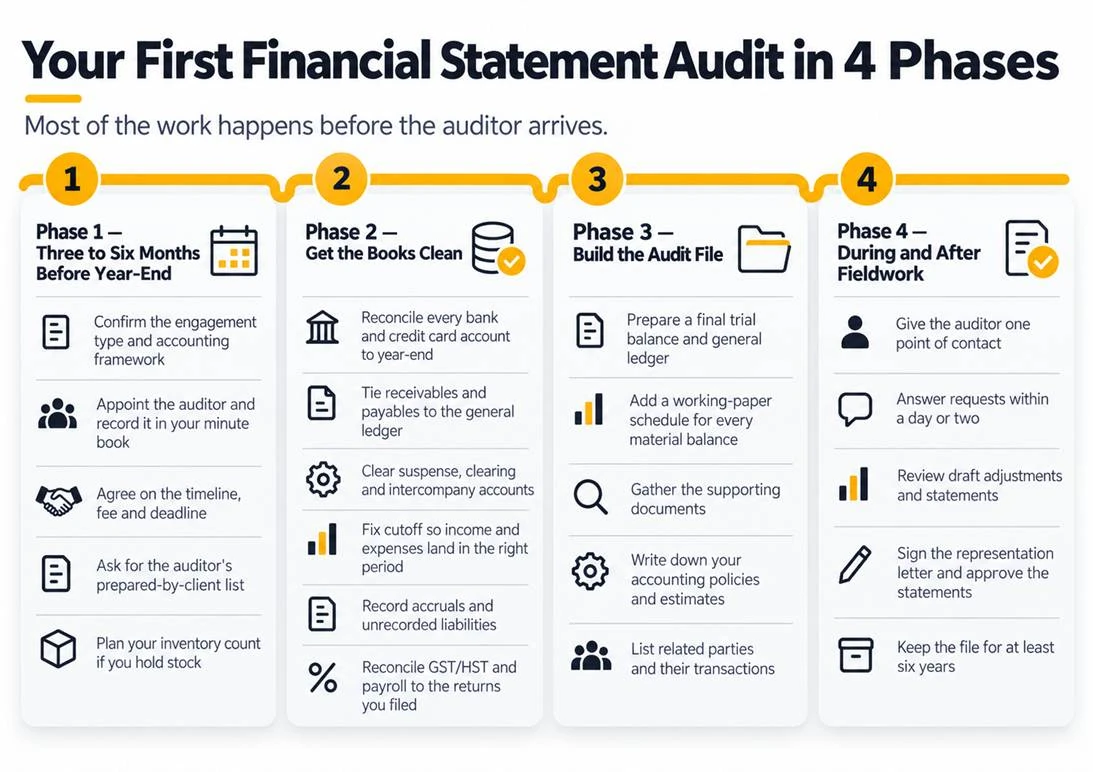
A first audit is mostly a documentation exercise. The better your file, the shorter and cheaper the audit. Work through this audit checklist in four phases.
Phase 1: three to six months before year-end
- Confirm the engagement type in writing (audit, review or compilation) based on the requester's exact wording.
- Confirm the accounting framework you report under, usually ASPE, IFRS or ASNPO.
- Appoint the auditor early. For corporations, this often needs a board or shareholder resolution recorded in the minute book.
- Agree on the timeline, the fee, and the deadline for the finished report.
- Ask the auditor for their prepared-by-client list, known as the PBC list, so you know exactly what to gather.
- Plan your inventory count if you hold stock, because the auditor may need to attend and observe it on the count date.
Phase 2: get the books clean
- Reconcile every bank and credit card account to the statement at year-end.
- Reconcile subledgers, accounts receivable and accounts payable, to the general ledger.
- Clear old, unexplained items in suspense, clearing and intercompany accounts.
- Apply proper cutoff, making sure revenue and expenses land in the correct period.
- Review your capital assets, recording additions, disposals and depreciation.
- Record all accruals and unrecorded liabilities, including unpaid vendor invoices and accrued payroll.
- Reconcile GST/HST and payroll remittances to the returns you filed.
Phase 3: build the audit file
- Prepare a final trial balance and general ledger for the year.
- Prepare a working-paper schedule for every material balance, tied to the trial balance.
- Gather the supporting documents in the table below.
- Write down your significant accounting policies and any estimates or judgments.
- List related parties and any transactions with them.
Phase 4: during and after fieldwork
- Give the auditor a single point of contact who can answer questions quickly.
- Respond to auditor requests within a day or two, since delays are the top cause of overruns.
- Review draft adjusting entries and the draft statements before they are finalized.
- Sign the management representation letter and approve the final statements at the board or shareholder level.
- Keep the full audit file for at least six years, the CRA's general period for keeping books and records.
Documents auditors ask for: the PBC list
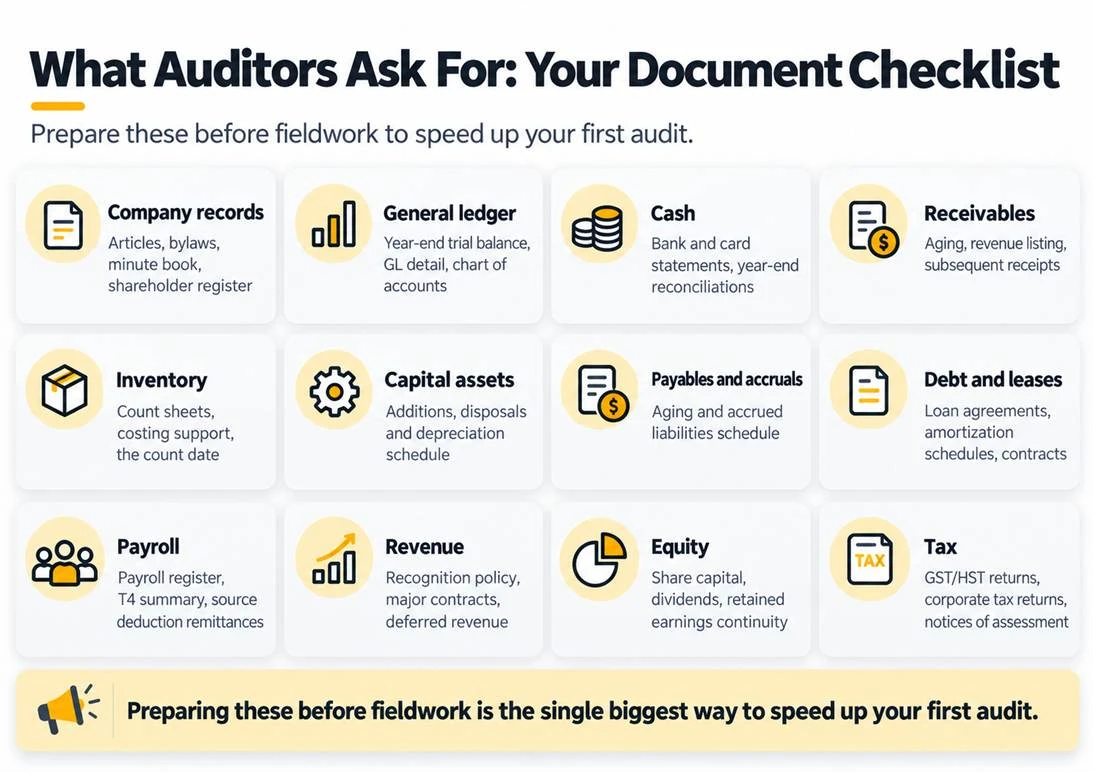
Auditors request supporting evidence by financial statement area. Preparing this before fieldwork is the single biggest thing you can do to speed up your first audit.
| Area | What to have ready |
|---|---|
| Company records | Articles of incorporation, bylaws, minute book, shareholder register, prior statements if any |
| General ledger | Year-end trial balance, general ledger detail, chart of accounts |
| Cash | All bank and credit card statements, year-end bank reconciliations, authorization to send bank confirmations |
| Receivables | Accounts receivable aging, revenue listing, subsequent receipts, allowance for doubtful accounts support |
| Inventory | Count sheets, valuation and costing method support, the physical count date |
| Capital assets | Continuity schedule of additions, disposals and depreciation, invoices for major purchases |
| Payables and accruals | Accounts payable aging, accrued liabilities schedule, list of payments made after year-end |
| Debt and leases | Loan agreements, amortization schedules, lender confirmations, lease contracts |
| Payroll | Payroll register, T4 summary, source deduction remittances, WSIB and EHT records |
| Revenue | Revenue recognition policy, major contracts, deferred revenue schedule |
| Equity | Share capital, dividends, retained earnings continuity |
| Tax | GST/HST returns and reconciliation, corporate tax returns, notices of assessment, instalments |
| Other | Insurance policies, commitments and contingencies, significant contracts, lawyer confirmation details |
Common first-time audit mistakes
Avoiding these saves time, fees and stress.
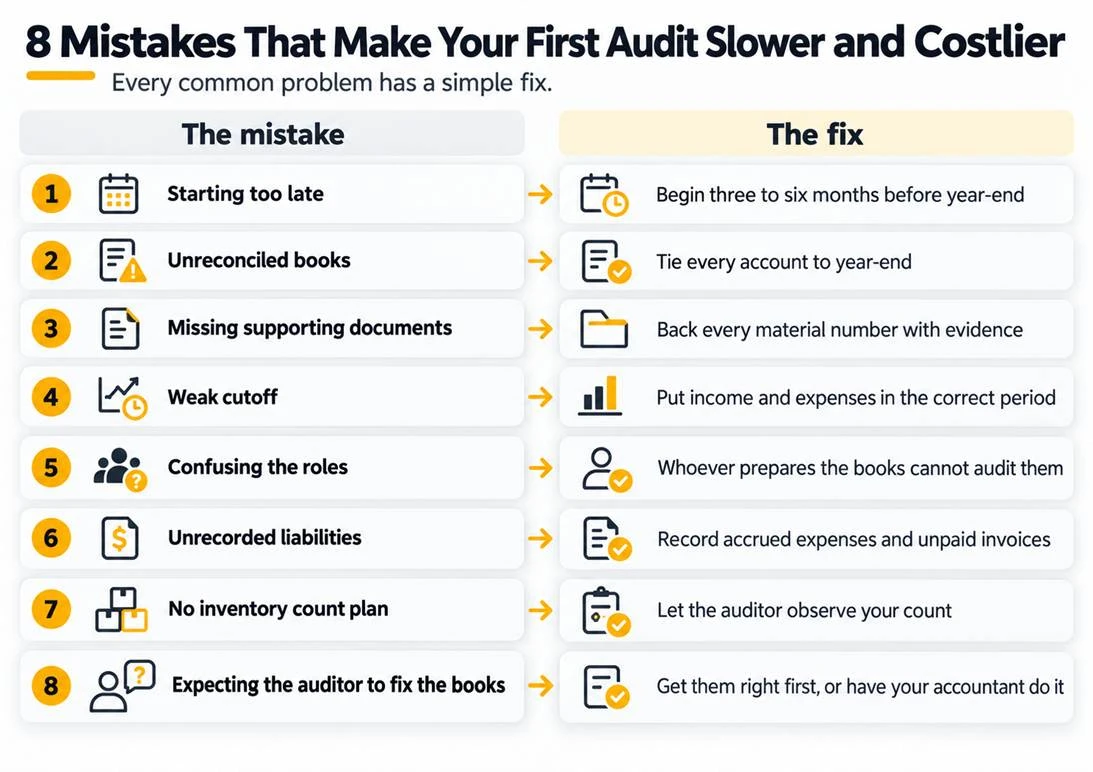
- Starting too late. Waiting until fieldwork begins to reconcile accounts turns a two-week audit into a two-month one.
- Unreconciled books. Bank accounts, subledgers and intercompany balances that do not tie out are the most common source of delay.
- Missing supporting documents. Every material number needs evidence behind it. A balance you cannot support becomes an audit issue.
- Weak cutoff. Recording December revenue in January, or the reverse, creates misstatements the auditor must chase.
- Confusing the roles. The auditor cannot audit statements they also prepared, because that breaks independence. Someone independent must prepare, and the licensed auditor must audit.
- Unrecorded liabilities. Forgetting accrued expenses and unpaid invoices overstates your results and gets corrected during the audit.
- No inventory count plan. If the auditor needs to observe your count and you have already counted without them, it creates extra work.
- Expecting the auditor to fix the books. An audit examines your records. Getting them right first is your job, or your accountant's.
How long a first financial statement audit takes
Timelines vary with size, complexity and how ready your file is. As a rough guide for a first audit of a small or mid-sized business:
- Planning and risk assessment: two to four weeks
- Fieldwork: one to three weeks
- Review, clearing and finalizing: two to four weeks
- Total: often six to twelve weeks from start to signed report
The single biggest factor is readiness. A clean, well-supported file can cut this dramatically. A messy one can double it.
How Bestax gets you audit ready
Here is how we work, and we are upfront about it. Bestax is an accounting and advisory firm, not a CPA Ontario licensed public accounting firm. Where your requirement calls for an audit or review, that report is performed and signed by an independent CPA Ontario licensed auditor.
Our team scopes the requirement, cleans and reconciles your books, prepares your financial statements and the full audit file, and manages the whole process so the audit lands faster and at a lower cost.
What we do for first-time auditees:
- Read the lender letter, funding agreement or board request and tell you whether you need an audit, a review or a compilation.
- Clean up and reconcile your bookkeeping, including backlog years if needed.
- Build the working-paper file and the complete PBC package the auditor asks for.
- Introduce an independent licensed auditor, or work with the one you appoint, and keep our preparation role separate from their audit role so independence is preserved.
- Sit with you through fieldwork so questions get answered fast.
We have supported businesses for more than 10 years, with offices in Canada and the UAE, and our clients tell us the difference is plain language and no surprises.
Frequently asked questions
What is a financial statement audit?
A financial statement audit is an independent examination of your balance sheet, income statement, cash flow statement and notes, ending in a licensed auditor's opinion on whether the statements are fairly presented and free from material misstatement. It gives the highest level of assurance available in Canada, called reasonable assurance.
How do I prepare for a financial statement audit?
To prepare for a financial statement audit, reconcile every account to year-end, gather the supporting documents for each balance, prepare a final trial balance and working-paper schedules, and organize the auditor's prepared-by-client list before fieldwork begins. Starting three to six months before year-end is ideal.
What is on a first-time audit checklist?
A first-time audit checklist covers four things: confirming the engagement type and framework, cleaning and reconciling the books, building the audit file with supporting documents, and managing fieldwork and sign-off. The document list runs across cash, receivables, inventory, capital assets, payables, debt, payroll, revenue, equity and tax.
What documents do auditors ask for?
Auditors ask for your trial balance and general ledger, bank statements and reconciliations, receivable and payable agings, inventory records, a capital asset continuity schedule, loan agreements, payroll records, tax returns, and the corporate minute book. Having these ready is the fastest way to shorten the audit.
How long does a first financial statement audit take?
A first audit of a small or mid-sized business usually takes six to twelve weeks from start to signed report, spread across planning, fieldwork and finalizing. The biggest factor is how ready your file is, so a clean, well-supported file can cut the time significantly.
Do I need an audit, or is a review engagement enough?
It depends on who is asking. A review gives limited assurance and often satisfies a lender or investor, while an audit gives reasonable assurance and is usually required by a statute, a major lender or a board. Ask for the exact wording of what is required, because a review or compilation is frequently enough.
Is a financial statement audit the same as a CRA audit?
No. A CRA audit is a tax review by the Canada Revenue Agency to check your tax filings. A financial statement audit is an accounting engagement requested by lenders, boards, owners or a law, and it results in an opinion on your financial statements, not a tax reassessment.
Can my accountant both prepare and audit my financial statements?
No. The auditor cannot audit statements they also prepared, because that breaks the independence an audit requires. The common and compliant model is that one firm prepares the books and file while a separate licensed firm performs and signs the audit.
Who can sign an audit report in Ontario?
Only a CPA who holds a valid Public Accounting Licence and works at a registered firm may sign an audit or review report in Ontario. Bestax prepares your audit-ready file and coordinates with that independent licensed auditor, who signs the report on their own letterhead.
When do the revised fraud and going concern audit standards apply to my business?
Revised CAS 240 and CAS 570 apply to audits of financial statements for periods beginning on or after December 15, 2026. For a calendar-year company, that is the audit of the year ending December 31, 2027. Under revised CAS 570, management's going concern assessment must cover at least 12 months from the date the statements are approved, so plan your cash flow forecast accordingly.
How much does a financial statement audit cost in Canada?
The cost depends on your size, complexity and how ready your records are, so there is no single price. The most reliable way to lower the fee is to arrive audit ready, because a clean, fully supported file reduces the hours the auditor needs to spend.
What happens if my books are not ready for the audit?
If your books are not ready, the audit stalls, the fee rises, and the auditor may not be able to finish on time. The fix is to reconcile accounts, gather supporting documents and clear unexplained balances first, which is exactly the work our team can handle before the auditor starts.
Does a financial statement audit guarantee there is no fraud?
No. An audit is designed to obtain reasonable assurance that the statements are free from material misstatement, whether caused by error or fraud, but that is high assurance and not an absolute guarantee. If you have a specific fraud concern, a forensic engagement is the right tool.
Get audit ready before the auditor arrives
If a lender, board or funder has asked for audited statements and you are not sure where to start, talk to us. We will confirm which engagement you actually need, get your books and audit file ready, and work alongside the independent licensed auditor through to the signed report. We are available 24/7.


