


If your company spent money this year trying to make something work that standard practice cannot, you are owed part of it back. Bill C-15 received royal assent on March 26, 2026 and doubled what the SR&ED tax credit can return to a private corporation in a year.
In this guide, we cover the SR&ED changes for 2026, whether you qualify, what work and spending count, and how to file the claim.
SR&ED Changes for 2026 and Who Qualifies
The scientific research and experimental development program has paid Canadian companies for eligible research since the 1980s. The program pays a basic rate to everyone and an enhanced refundable rate to smaller private corporations. Budget 2025 and Bill C-15 widened both the ceiling and the door.
The 2026 Rules Under Bill C-15
The changes apply to tax years beginning after December 15, 2024, so most corporations are claiming under them for the first time in 2026.
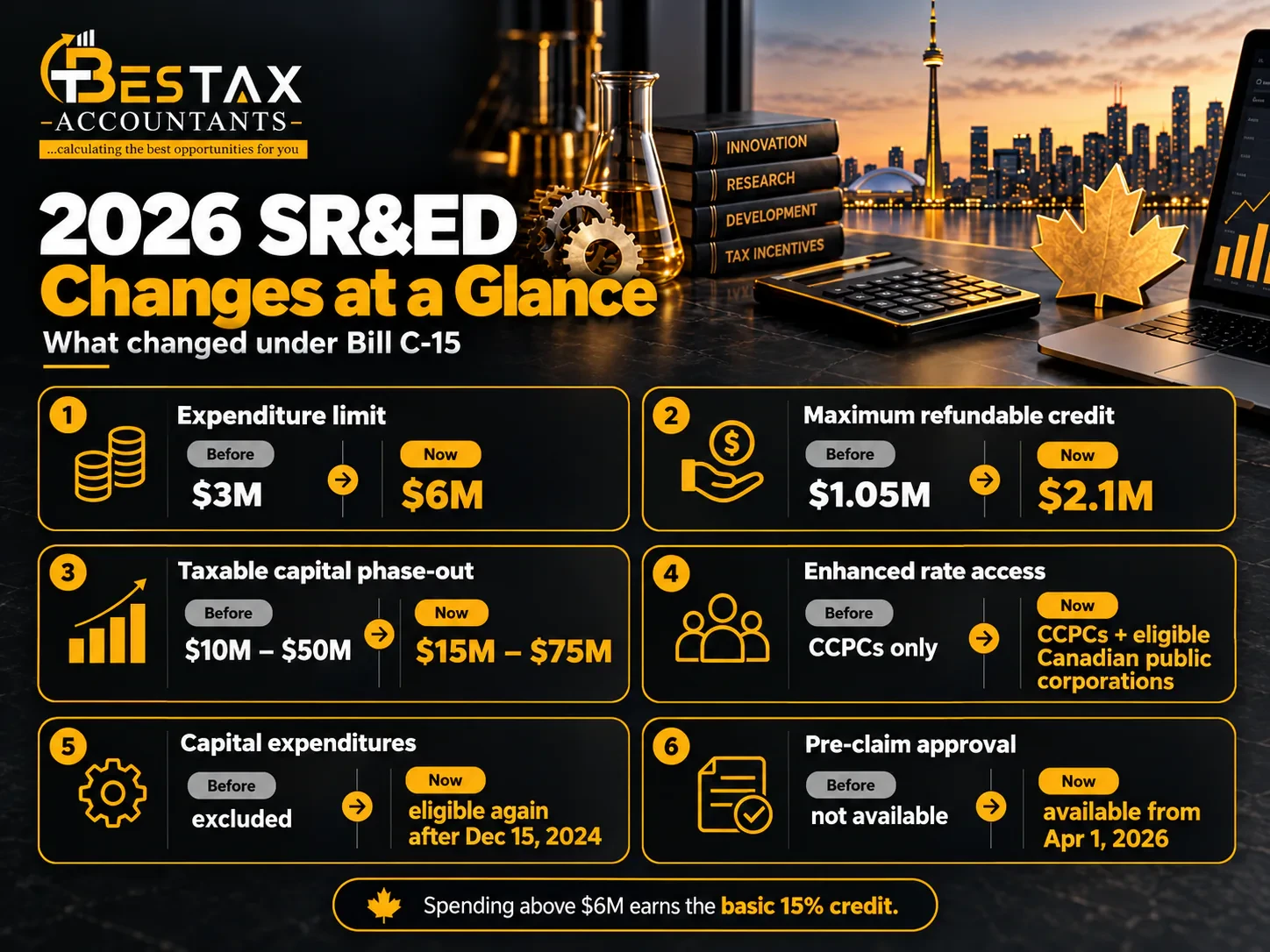
| Rule | Before | From tax years beginning after December 15, 2024 |
|---|---|---|
| Enhanced rate | 35%, refundable | 35% enhanced refundable credit |
| Expenditure limit for the enhanced rate | $3 million | $6M expenditure limit (Budget 2025) |
| Maximum refundable credit | $1.05 million | $2.1 million |
| Taxable capital phase-out | $10 million to $50 million | $15 million to $75 million, or a gross revenue test by election |
| Who gets the enhanced rate | CCPCs only | CCPCs and eligible Canadian public corporations |
| Capital expenditures | Excluded since 2014 | Eligible again for property acquired after December 15, 2024 |
| Pre-claim approval | None | Available from April 1, 2026, with a determination within eight weeks |
Spending above the $6 million limit earns the basic 15 percent credit. A qualifying CCPC can generally get 40 percent of that credit back as a refund. For other corporations, including eligible public corporations on spending above their limit, it is non-refundable. Unused credits can be carried back three years or forward 20 years.
SR&ED Eligibility: Who Can Claim
You can claim the basic credit as a corporation, partnership, trust or sole proprietor carrying on SR&ED in Canada. The enhanced refundable rate is what a CCPC claims, and from 2026 an eligible Canadian public corporation claims it too. Its limit is phased out on average gross revenue over the previous three years rather than on taxable capital.
- Your CCPC has prior-year taxable capital under $15 million: full $6 million limit at 35 percent
- Your taxable capital is between $15 million and $75 million: limit reduced on a straight line, or by the gross revenue test if more favourable
- Your taxable capital is above $75 million, or you are a non-CCPC other than an eligible public corporation: basic 15 percent only
- Eligible Canadian public corporation: $6 million limit at 35 percent, phased out from $15 million to $75 million of average gross revenue

If your corporation is near a threshold, book a free 20-minute call. Our team will run the taxable capital and gross revenue tests on last year's figures and tell you which limit applies.
SR&ED Pre-Claim Approval: Who Can Apply and How It Works
Since April 1, 2026, you can ask the CRA to confirm that planned work qualifies before you spend on it. Pre-claim approval is optional, and it replaced the old pre-claim consultation, which ended on January 1, 2026.
| Requirement | Pre-claim approval rule |
|---|---|
| Who can apply | CCPCs, other Canadian corporations and partnerships |
| Size limit | Gross business income under $25 million |
| Standing | In good standing with the CRA |
| Projects | Up to three planned projects, not already claimed and not under litigation |
| Timing | Before the work begins |
| Decision | Within eight weeks of a complete application |
| How long it lasts | Up to three years |
You request a case number, then upload the application through My Business Account. A CRA research and technology adviser may ask to meet you, and the meeting is mandatory for first-time claimants. Approval covers whether the work qualifies, not the amounts you spend on it. If a later claim on an approved project goes to an expenditure review, the CRA's target drops from 180 to 90 days. There is no formal objection if the CRA says no, but you can reapply with a revised project or claim without approval.
What Work Counts: The Technological Uncertainty Test
The credit is paid for work, not for a product or an industry. The CRA's eligibility policy works through five questions: uncertainty, hypothesis, systematic investigation, advancement and records. Together they come down to three tests, and a claim that cannot meet all three with records is denied on review.
- Was there a technological uncertainty, meaning the outcome could not be known from standard practice or publicly available knowledge
- Was a systematic investigation carried out, with a hypothesis, experiments or analysis, and conclusions, by people qualified to do it
- Was the work undertaken to achieve a technological advancement, whether or not it succeeded
If you developed a new product with known methods, that does not qualify. If you failed to make a known method work in a new setting and ran structured experiments to find out why, it does. Our team reviews your project records against those three tests before any expenditure is counted. The eligibility of the work decides the eligibility of everything you spent on it.
SR&ED Tax Credit Rates and Eligible Expenditures
Once your work qualifies, the claim is a calculation on the expenditures attached to it. The federal investment tax credit applies to a pool of eligible expenditures, and Ontario adds two credits of its own on much the same pool.
Eligible Expenditures
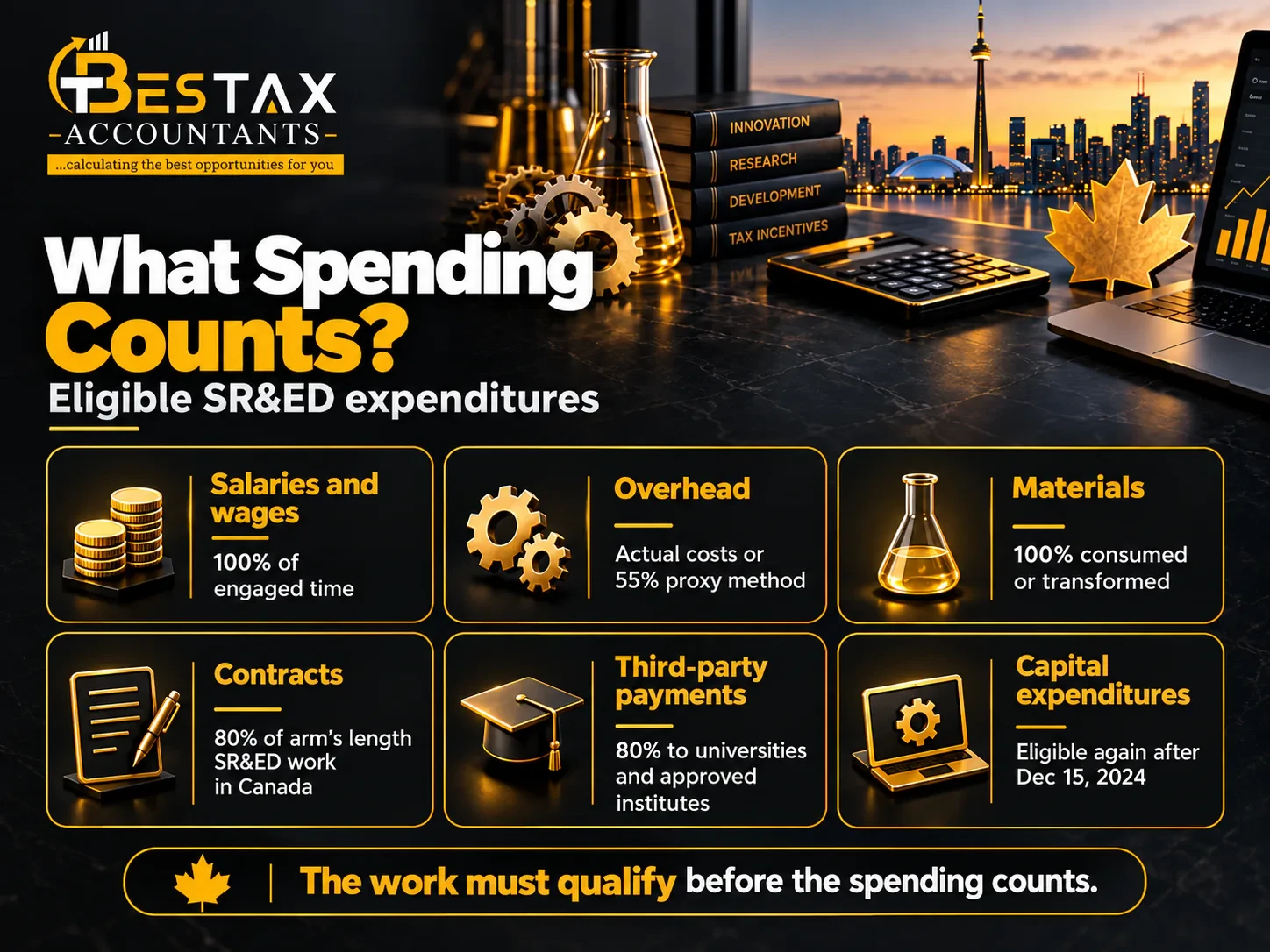
| Expenditure | What counts | Rate of inclusion |
|---|---|---|
| Salaries and wages | Pay of employees directly engaged in the SR&ED, for the time engaged | 100 percent of the engaged portion |
| Overhead | Either the actual overhead attributable, or the proxy of 55 percent of engaged salaries | Proxy or traditional method, elected annually |
| Materials | Materials consumed or transformed in the work | 100 percent |
| Contracts | Payments to arm's length contractors for SR&ED performed in Canada on your behalf | 80 percent |
| Third-party payments | Payments to universities, colleges and approved research institutes | 80 percent |
| Capital expenditures | Equipment and property acquired after December 15, 2024, or lease costs first payable after that date, used all or substantially all for SR&ED | 100 percent. A qualifying CCPC earns the 35 percent credit, but only 40 percent of it is refundable |
The proxy method is the usual choice if your SR&ED is mostly your people's time. Fifty-five percent of engaged salaries is added without tracking a single overhead invoice. The traditional method pays off where your work consumes expensive facilities. Our team runs both before you make the election.
The Federal Calculation
Take a CCPC under the $15 million taxable capital threshold with $1,000,000 of engaged salaries, $150,000 of materials and $200,000 of contract payments. Its pool is $1,000,000, plus $550,000 of proxy overhead, plus $150,000, plus $160,000 for the contracts, which is $1,860,000. At 35 percent the federal credit is $651,000, refundable in full. If your company is a corporation other than a CCPC and outside the enhanced rate, the same pool earns 15 percent, $279,000, as a non-refundable credit against tax.
Provincial R&D Credits: Ontario
If you are in Ontario, two provincial credits stack on the federal one. The Ontario Innovation Tax Credit is 8 percent, refundable, on up to $3 million of eligible expenditures. Its limit phases out once prior-year taxable income passes $500,000 or taxable capital passes $25 million. Ontario has not matched the federal change on capital, so the OITC still applies to current spending only.
The Ontario Research and Development Tax Credit is 3.5 percent, non-refundable, on the same pool. Each provincial credit reduces the federal pool. The combined rate for a small Ontario CCPC therefore runs to about 42 percent of eligible spending rather than the sum of the three.
Other provinces run their own, from British Columbia's 10 percent to Quebec's refundable CRIC, which replaced its older wage-based R&D credits. Our team files the Ontario credits with your T2 corporate tax return, and Quebec claims with the Quebec CO-17 return.
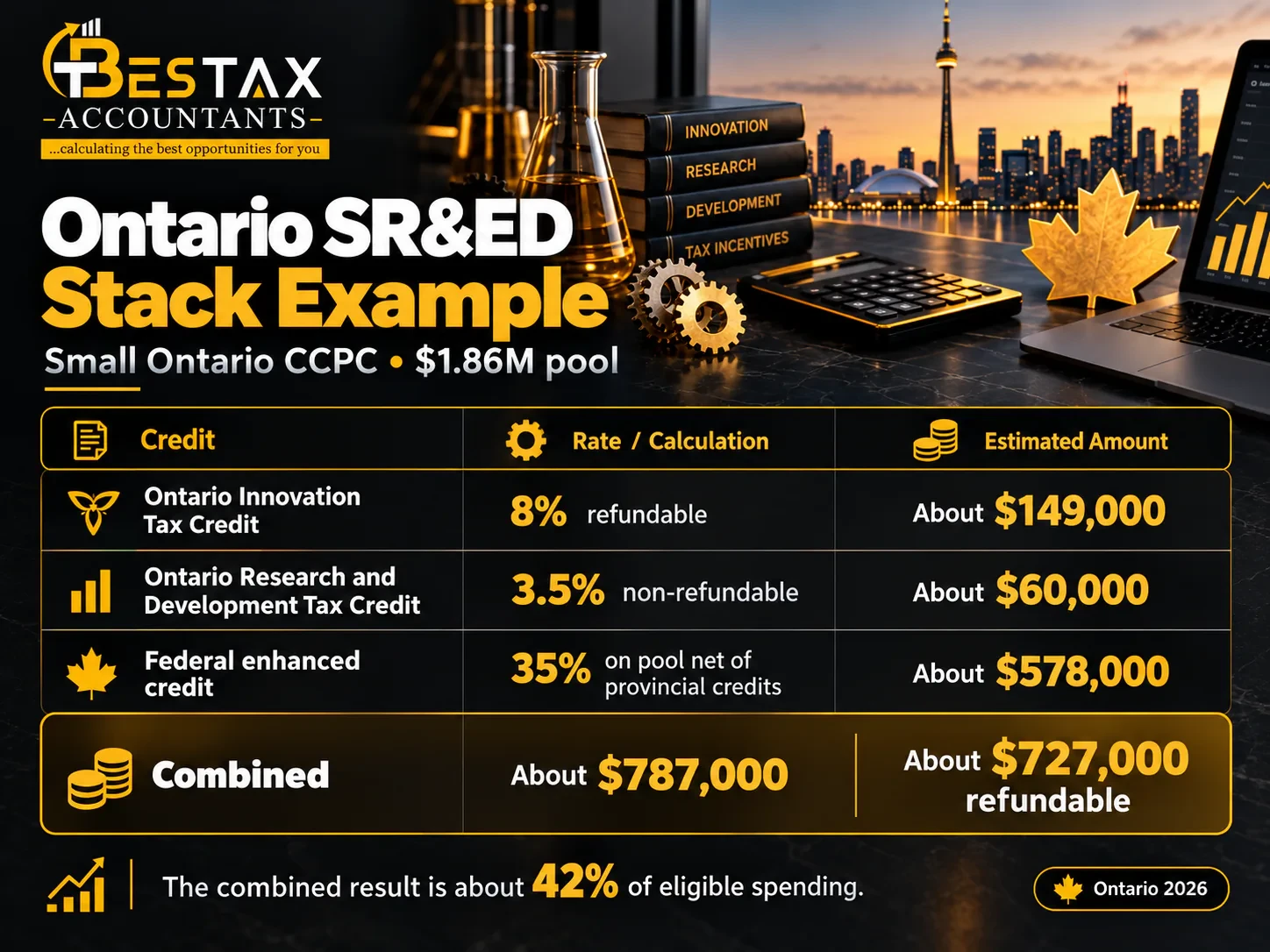
| Small Ontario CCPC, $1,860,000 pool | Rate | Credit |
|---|---|---|
| Ontario Innovation Tax Credit, refundable | 8 percent | About $149,000 |
| Ontario Research and Development Tax Credit, non-refundable | 3.5 percent | About $60,000 |
| Federal enhanced credit on the pool net of provincial credits | 35 percent | About $578,000 |
| Combined | About $787,000, of which about $727,000 is refundable |
The SR&ED credit is also income. The federal credit reduces the following year's pool and is taxable. The net value is therefore modelled against the corporate tax rate in Canada your company pays rather than taken at the headline figure.
SR&ED Claim Process: How Our Team Prepares and Files the Claim
Our team prepares the claim in four stages. You approve the technical narrative and the figures before anything is filed.

Stage 1: Identify the Projects and Test Them
We sort your year's development work into projects and test each against the three tests with your technical lead. Only work that passes counts, and only from the start to the end of the uncertainty. For a planned project with a large spend or uncertain eligibility, we apply for pre-claim approval before the work starts.
Stage 2: Gather the Records and Cost the Work
The CRA expects records made while the work was done, not rebuilt at year-end. We collect what supports each project and choose the proxy or traditional overhead method on the numbers.
- Design documents, test logs and version histories showing the uncertainty, hypotheses and results
- Time records per employee, per project, from timesheets or sprint records
- Invoices for materials, contracts and capital property
- Payroll records supporting the engaged salaries
- Evidence the work was done in Canada. Salary for work abroad by Canadian-resident employees counts only up to 10 percent of your SR&ED salaries in Canada
Stage 3: Prepare Form T661 and Schedule 31
Form T661 is the claim. Its Part 2 narrative, with a word limit per question, is what the CRA's adviser reads first. We write it to the form's three questions in order and reconcile every Part 3 figure to the ledger and payroll.
| Form | What it carries | Where it goes |
|---|---|---|
| T661, Part 2 | Project descriptions answering the uncertainty, investigation and advancement questions | Filed with the T2 |
| T661, Part 3 | Eligible expenditures by category, the proxy election and the pool | Filed with the T2 |
| Schedule 31 | The investment tax credit, the expenditure limit and the refundable amount | Carried to the T2 |
| Schedule 566 and Schedule 508 | Ontario Innovation Tax Credit (566) and Ontario Research and Development Tax Credit (508) | Filed with the T2 |
Stage 4: File Within 18 Months and Manage the Review
The forms must reach the CRA within 18 months of your tax year-end, or the claim is lost. The CRA aims to process a claim accepted as filed within 60 days. A refundable claim selected for review has a 180-day target, or 90 days for an expenditure review on pre-approved projects. First and large claims are more likely to be reviewed. We handle the review, covering both the technical and the financial questions.
Missed a prior year? If the 18 months have not run out, book a free 20-minute call and we will tell you whether it can still be claimed.
Test the Work First, Then Count the Spending
The SR&ED tax credit pays you for technological uncertainty resolved by systematic work, and every dollar in your claim has to attach to that work.
- Confirm each of your projects carried an uncertainty that standard practice could not resolve, with records made at the time
- Confirm which expenditure limit applies to you, on taxable capital or gross revenue, before you model the refund
- Count salaries, proxy overhead, materials, 80 percent of contracts and third-party payments, and capital property acquired after December 15, 2024
- Add the Ontario credits and net them against the federal pool
- File T661 and Schedule 31 with the T2, and never later than 18 months after year-end
Send us a description of your development projects and last year's payroll. Our team will tell you which projects qualify, what the claim is worth at the 2026 rates, and whether a pre-claim approval is worth filing first.
Frequently Asked Questions
Only where the work carried technological uncertainty. Building an application with established languages, frameworks and patterns does not qualify, however complex it is. Developing a new algorithm or resolving a performance limit the existing architecture cannot meet can qualify. Integrating technologies can qualify too, but only where the integration raised a technological uncertainty that standard practice could not resolve. A combination being new is not enough on its own, and structured experiments have to get you there. The test is the uncertainty, not the industry.
Yes. The credit is paid for the attempt to achieve a technological advancement through systematic investigation. A failed experiment that resolved the uncertainty by proving the approach did not work is eligible. The records have to show the hypothesis, the work and the conclusion, including a negative one.
No. The enhanced 35 percent credit on current expenditures is fully refundable, so a CCPC with no taxable income receives it as a cash refund after the return is assessed. The basic 15 percent credit on spending above the limit is 40 percent refundable for a qualifying CCPC. For other corporations it is non-refundable and applied against tax, with unused credits carried back three years or forward 20 years.
It is an optional process the CRA launched on April 1, 2026. You request a case number, then submit the application through My Business Account before the work starts, for up to three planned projects. The CRA gives its decision within eight weeks of a complete application. It is open to Canadian corporations and partnerships with gross business income under $25 million that are in good standing, for projects not already claimed. Approval covers whether the work qualifies, not your expenditures, and lasts up to three years.
Use it for a large project, a first claim, or work where eligibility is uncertain. The approval removes the risk of building a claim on work the CRA will later reject.
Yes, with an adjustment. Government assistance, including most grants and the Ontario credits, reduces the pool of eligible expenditures on which the federal credit is calculated. The project still earns both, and our team sequences the grant and the claim so the combined recovery is highest. The same project records also support applications for small business grants in Canada that fund the next stage of the work.
Disclaimer: The information provided in this blog is for general informational purposes only. For professional assistance and advice, please contact experts.

