

A T5 slip in Canada reports the dividends, interest and other investment income a corporation pays to its shareholders and investors. If your company paid you a dividend this year, it owes you a T5, and the CRA expects a copy by the last day of February.
Get the dividend type wrong or file late, and your company can face penalties or extra tax. In this guide, we'll cover when a T5 is required, eligible vs non-eligible dividends, the key boxes, the T5 Summary, filing deadlines and penalties.

When you need a T5 slip in Canada
A T5 information return has two parts: a T5 slip for each recipient and one T5 Summary that totals them. The CRA's T5 guide (T4015) sets out every rule for both.
Payments you report on a T5
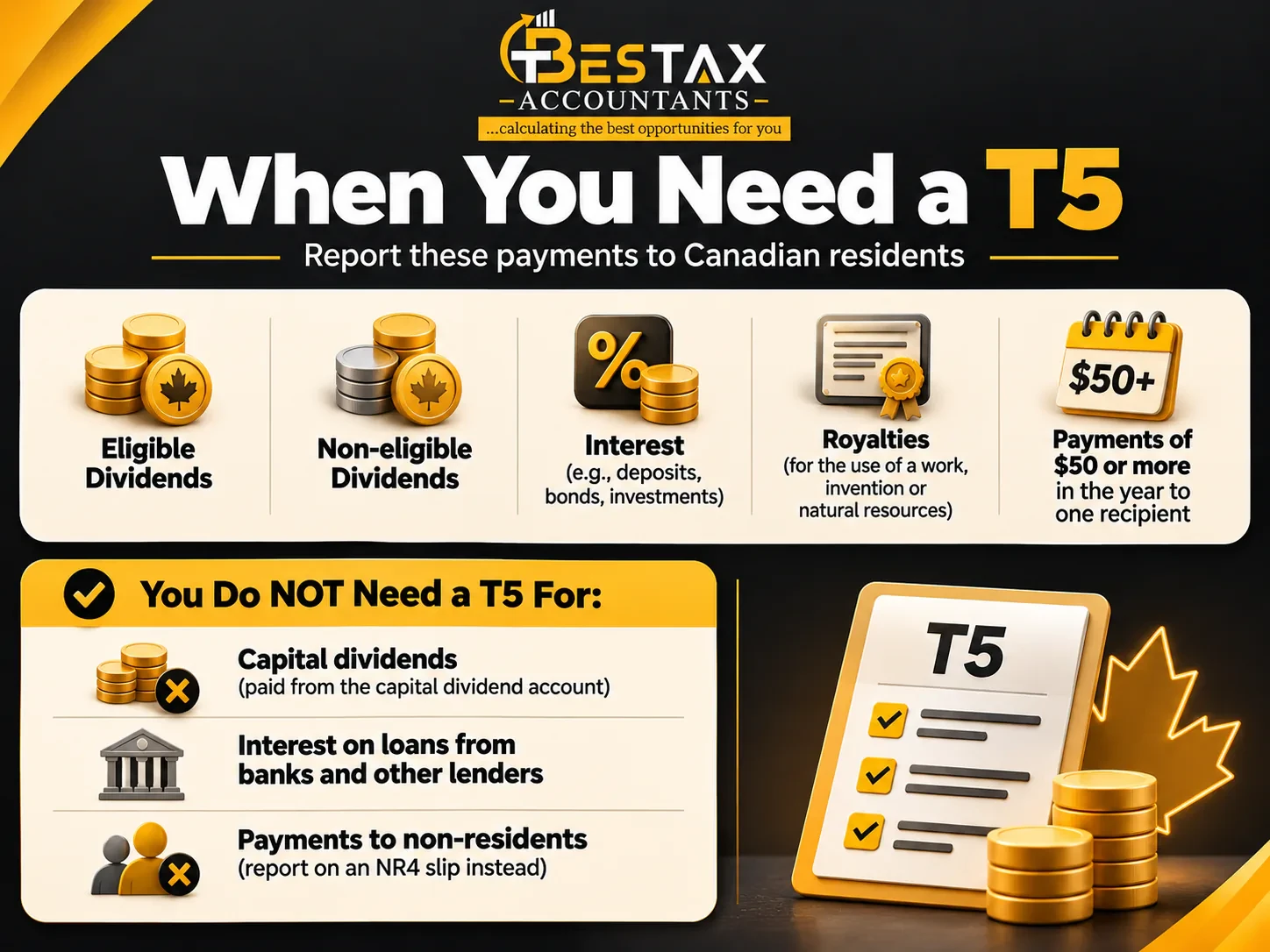
You need a T5 slip when you pay any of these to a Canadian resident:
- Eligible and non-eligible dividends, including most deemed dividends
- Interest on bonds, deposits, broker accounts and insurance or annuity contracts
- Royalties for the use of a work, an invention or natural resources
- The interest part of blended payments made by a corporation or other entity
- Accrued interest on investment contracts, reported every year for contracts acquired after 1989
For most owner-managed companies, the T5 mainly reports dividends paid to shareholders.
When you don't need a T5
You don't need a T5 for:
- Payments under $50 to one recipient for the year
- Capital dividends paid from the capital dividend account
- Interest one individual pays to another, such as on a private mortgage
- Interest on loans from banks and other lenders
- Payments to non-residents, which go on an NR4 slip instead
- A year in which you paid or credited nothing, so there's no nil return to file
Capital dividends are tax-free to the shareholder, which is why they skip the T5. They need their own election, covered in detail under the capital dividend account rules.
Payments to non-residents go on an NR4
Dividends paid to a non-resident shareholder go on an NR4 return, not a T5. You also have to withhold 25% tax, or a lower treaty rate, and remit it by the 15th of the following month. If you don't, your company owes the tax plus a 10% penalty.
Eligible vs non-eligible dividends on the T5
Every dividend on a T5 is either eligible or non-eligible. The type decides which boxes you use and how much tax your shareholder pays.
Match the dividend to its source
Non-eligible dividends usually come from profit taxed at the low small business rate. Eligible dividends come from profit taxed at the higher general rate, so the shareholder gets a bigger tax credit.
A Canadian-controlled private corporation can only pay eligible dividends up to the balance of its general rate income pool (GRIP). Designating more than that triggers a 20% tax on the excess, unless the company elects to treat the excess as a non-eligible dividend. If the CRA finds the over-designation was part of a tax avoidance plan, the tax rises to 30% of the whole dividend. The company also has to formally designate the dividend as eligible when it pays it.
The same applies to a holding company. An eligible dividend it receives doesn't flow through to its own shareholders automatically. It adds to the holding company's GRIP, and the holding company must designate any eligible dividend it pays, up to its own GRIP balance. The T4015 rule that a payment keeps its original character applies only to nominees and agents passing a payment on for someone else.
How the gross-up and dividend tax credit work
The slip doesn't just show the cash you received. It grosses the dividend up to approximate the company's pre-tax profit, then gives a credit for the corporate tax already paid.
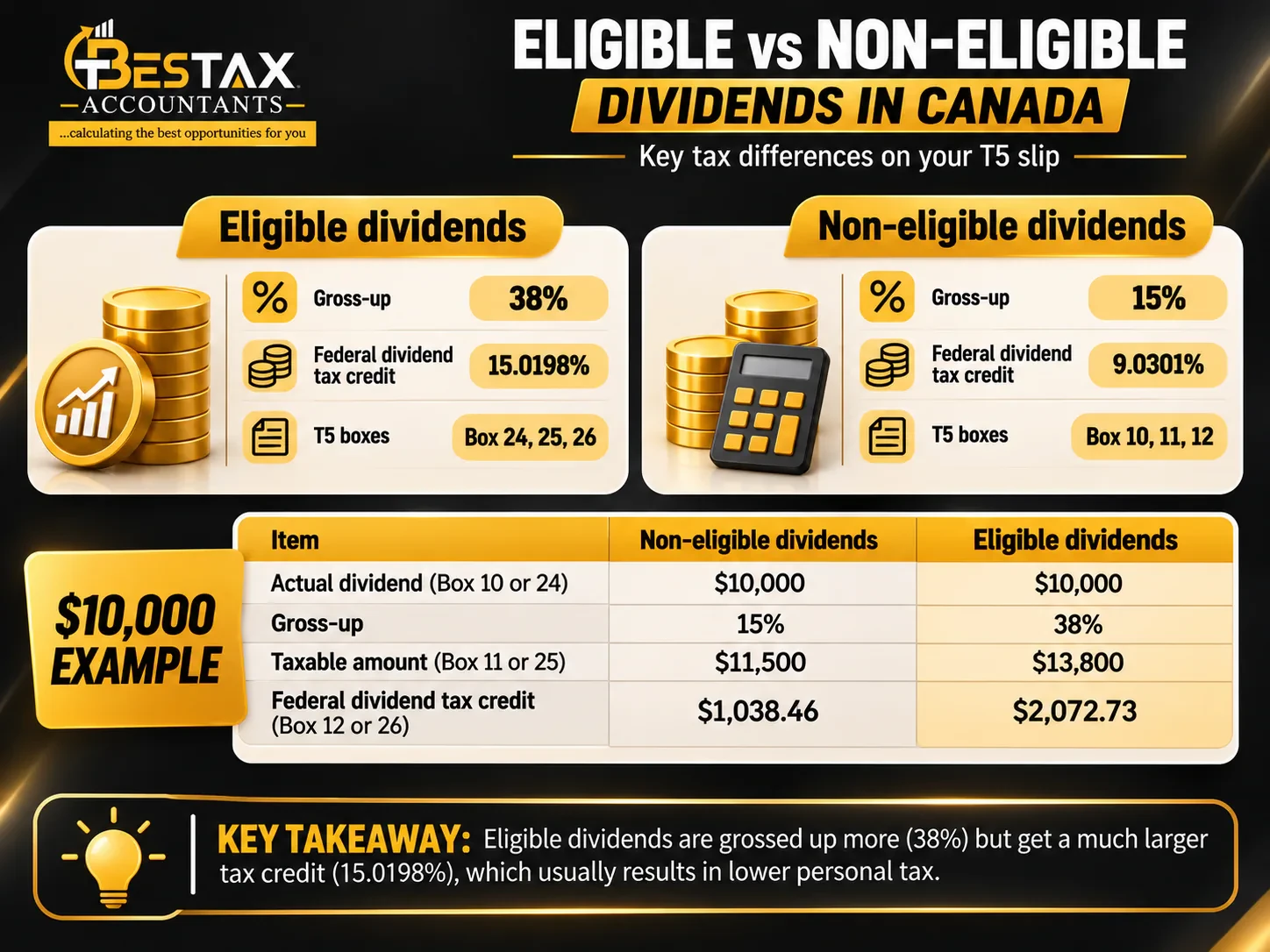
| Non-eligible dividends | Eligible dividends | |
|---|---|---|
| Actual amount | Box 10 | Box 24 |
| Gross-up | 15% | 38% |
| Taxable amount | Box 11 | Box 25 |
| Federal dividend tax credit | 9.0301% of the taxable amount (box 12) | 15.0198% of the taxable amount (box 26) |
If the shareholder is a corporation, fill in only box 10 or box 24. The gross-up and credit boxes are for individuals resident in Canada.
Example: a $10,000 dividend on the T5
Say your company pays you a $10,000 dividend. Here's how each type appears:
| Box | Non-eligible | Eligible |
|---|---|---|
| Actual amount (box 10 or 24) | $10,000 | $10,000 |
| Taxable amount (box 11 or 25) | $11,500 | $13,800 |
| Federal dividend tax credit (box 12 or 26) | $1,038.46 | $2,072.73 |
The eligible dividend shows a higher taxable amount but a much bigger credit, so it usually carries less personal tax. Deciding which type to pay, and how it compares with salary, is the core of any salary vs dividends decision.
How to complete the T5 slip box by box
After you file, the CRA runs validity and balancing checks on every slip. The identification boxes matter as much as the dollar amounts.
Recipient and payer details
- Recipient name: last name first for individuals, or the full legal name for a corporation, trust or association.
- Joint accounts: one slip with both names, the primary holder's SIN in box 22 and code 2 in box 23.
- Trusts and registered plans: the name of the trust or plan trustee, not the individual beneficiary.
- Payer: your company's full name and address on every slip.
- Year: the calendar year the income was earned.
Identification boxes
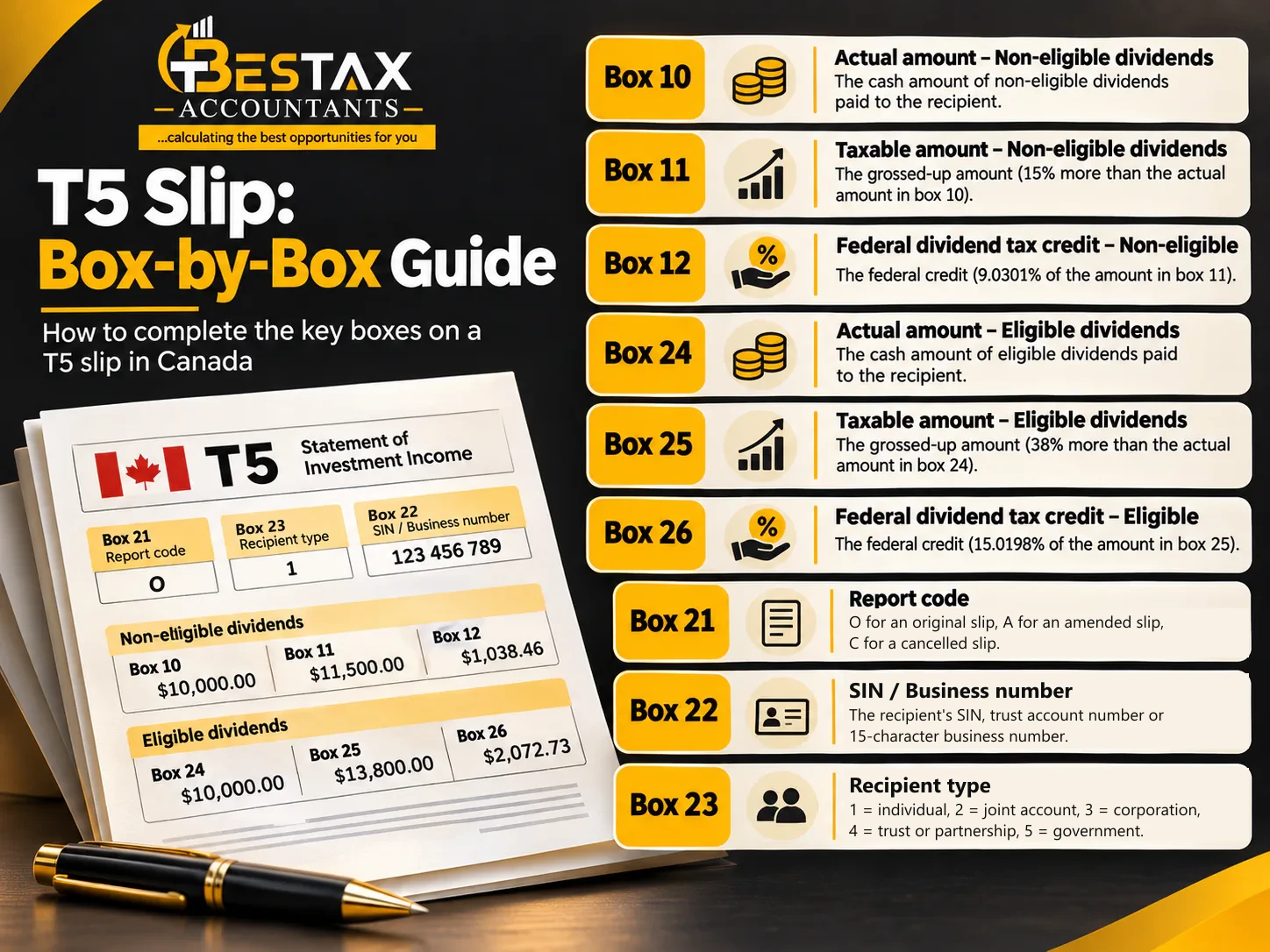
| Box | What goes in it |
|---|---|
| 21 | Report code: O for original, A for amended, C for cancelled |
| 22 | The recipient's SIN, trust account number or 15-character business program account number |
| 23 | Recipient type: 1 individual, 2 joint account, 3 corporation, 4 trust, partnership or association, 5 government |
| 28 | Transit or branch code, for financial institutions |
| 29 | Account or policy number, if you have one |
Other income boxes
| Box | What it reports |
|---|---|
| 13 | Interest from Canadian sources |
| 14 | Other Canadian income, such as dividends from a non-taxable Canadian corporation |
| 15 | Gross foreign income, before foreign tax withheld |
| 16 | Foreign tax paid |
| 17 | Royalties from Canadian sources |
| 18 | Capital gains dividends from investment or mutual fund corporations |
| 19 | Accrued annuity and life insurance income |
| 27 | Foreign currency code, if amounts aren't in Canadian dollars |
| 30 | Interest deemed to accrue on equity-linked notes |
You can only fit three codes in the "Other information" area. If more apply, use another slip. Each slip can also carry only one foreign currency.
Get every recipient's SIN right
You must make a reasonable effort to get each recipient's SIN. Ask in writing, record the date and keep a copy. If you don't, the CRA can charge $100 for each missing SIN.
A recipient who doesn't have a SIN has 15 days to apply for one. If you still don't have it at the deadline, file without it rather than file late. And you can't use a SIN for anything other than the slip without written consent.
How to file T5 slips on time
Filing means sending the slips and the T5 Summary to the CRA, and giving each recipient their copy. Both have the same deadline.
The T5 filing deadline
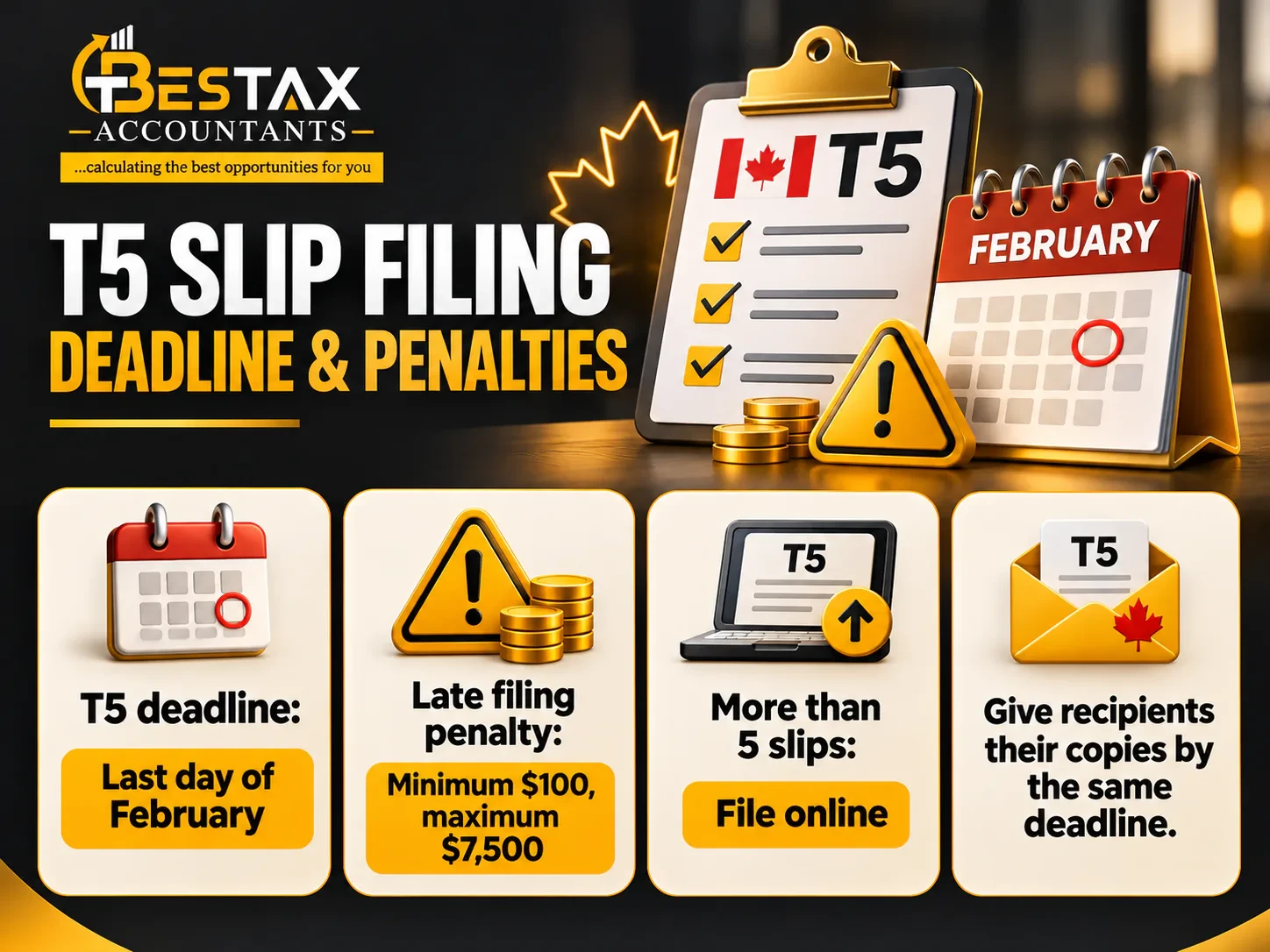
The T5 is due on the last day of February after the calendar year the income relates to. If that falls on a weekend or holiday, you have until the next business day.
For dividends paid in 2026, February 28, 2027 is a Sunday, so slips filed by March 1, 2027 are on time. The T5 sits alongside your other corporate tax filing deadlines at the start of each year.
If your business or activity ends, the slips are due within 30 days of the end date instead.
Complete the T5 Summary accurately
The T5 Summary totals every slip you file under one account. Its main parts are:
- Your 15-character program account number, which ends in RZ for T5 filers
- The total of each box across all slips, on lines 10 to 26
- The number of slips filed, on line 31
- A contact person and a signature from someone with signing authority
File one summary for each account. Don't include amounts that aren't on a slip, and don't use the summary to change your address.
Choose the right filing method
| Method | Best for | Limit |
|---|---|---|
| Web Forms | Small companies filing a few slips | Up to 100 slips per submission |
| Internet file transfer | Accounting software that exports XML | Up to 150 MB per submission |
| Paper | Only if you file 5 slips or fewer | Mailed to the Jonquière Tax Centre |
If you file more than 5 slips, you must file online. You need your business number and web access code, unless you file through My Business Account or Represent a Client. Group all slips for the same account and year under one summary.
Give recipients their T5 copies
Recipients must get their slips by the same February deadline. You can post them on a secure portal they can print from, or email them if the recipient agrees in writing. Otherwise, send two paper copies.
You don't have to keep copies of the slips, but you must keep the records you used to prepare them.
T5 penalties and how to avoid filing errors
The CRA only sends a notice of assessment for a T5 when it charges a penalty. Here's what can trigger one.
T5 penalty amounts
| Problem | Penalty |
|---|---|
| Filing the T5 late | Minimum $100, maximum $7,500 |
| Missing information, such as a SIN you made no reasonable effort to get | $100 per failure |
| Filing more than 5 slips on paper instead of online | $125 for 6 to 50 slips, rising to $2,500 for 2,501 or more |
| A recipient refusing to give their SIN | $100, charged to the recipient |
Unpaid penalties also attract interest at the CRA's prescribed rate, compounded daily. If circumstances beyond your control caused the problem, you can ask for relief on Form RC4288 for penalties from the past 10 calendar years.
Deemed dividends from share transactions
Some transactions create dividends even when no dividend is declared. Under section 84, a deemed dividend can arise when your company:
- Redeems or buys back its own shares, other than on the open market
- Reduces the paid-up capital of a class of shares
- Increases paid-up capital without a matching increase in net assets
- Winds up or reorganizes and distributes property to shareholders
These amounts go in the dividend boxes on a T5 like any other dividend. They're easy to miss because no one wrote a dividend cheque.
How to correct a T5 after filing
- Amended slip: change only the wrong details and use code A in box 21. Give the recipient two copies.
- Cancelled slip: keep the original details unchanged and use code C.
- Paper corrections: mark the slip AMENDED or CANCELLED and send it with a letter explaining why. Don't file an amended summary.
- Missed slips: file them separately, marked ADDITIONAL if on paper. Late additional slips can still attract penalties.
- Lost slips: give the recipient a copy marked DUPLICATE. Don't send it to the CRA.
Frequently asked questions
Yes. Any dividend of $50 or more paid to a Canadian resident needs a slip, even when the company and the shareholder are effectively the same person.
Yes. A T5 covers amounts paid or credited. A dividend credited to your shareholder loan account is reported the same way as one paid in cash.
Yes. Use recipient code 3 and the company's business number, and fill in only the actual amount in box 10 or box 24. Corporations don't use the gross-up or credit boxes. When the holding company later pays its own dividends, it designates them as eligible or non-eligible based on its own GRIP.
The taxable amount of all your dividends, from box 11 and box 25, goes on line 12000 of your return. The non-eligible portion is also entered on line 12010. The federal dividend tax credit is claimed on line 40425.
No. A T4 reports salary and wages, with source deductions. A T5 reports dividends and investment income, with no tax withheld for Canadian residents.
Let Bestax prepare your T5 slips
The T5 connects your company's books to your shareholders' personal returns. Bestax prepares it as part of your year-end, so the dividend type, the amounts and the deadline all line up.
What the Bestax T5 service covers
- Dividend review: every dividend declared in the year, including deemed dividends from share redemptions or reorganizations.
- Eligible or non-eligible: a GRIP check before any dividend is designated as eligible.
- Capital dividends: a separate check that any tax-free capital dividend was properly elected and stays off the T5.
- Slip preparation: each slip completed with the right boxes, gross-up, credit and recipient codes.
- Filing and distribution: the T5 and T5 Summary filed online before the deadline, with copies sent to every shareholder.
- Corrections: amended or additional slips filed if anything changes after filing.
Records to send Bestax
- Directors' resolutions for each dividend declared.
- The dates and amounts of every dividend paid.
- Each shareholder's legal name, address and SIN or business number.
- Details of any share redemptions, buybacks or reorganizations in the year.
- Your company's GRIP balance, if you've paid eligible dividends before.
We handle T5 slips alongside your corporate tax return filing. Book a call before year-end, especially if you plan to pay a dividend before December 31.
Disclaimer: The information provided in this blog is for general informational purposes only. For professional assistance and advice, please contact experts.


Fact checked by
Haseeb Hamdani
Lead Advisor · Director Accounting & Taxation
With over a decade of cross-border experience spanning Canada, the UAE, and beyond, Haseeb Hamdani leads the Bestax team of qualified professionals with one clear goal - to make sure your business is compliant, protected, and positioned to grow. His international credentials and real-world expertise across tax, compliance, and business structuring mean clients always receive precise, reliable, and commercially sound financial guidance.
Learn More About Haseeb