


To dissolve a corporation in Ontario, you file Articles of Dissolution with the Ontario Business Registry and pay a $25 fee. The Ministry of Finance must then give its consent. Before you file, you settle the company's debts, distribute its property and bring its Canada Revenue Agency (CRA) filings up to date. Below is the full process in plain language: the exact steps, the documents you need, and the tax rules that trip most owners up.
Closing a company is not as simple as locking the door and walking away. Ontario and the CRA both keep your corporation legally alive until you file the right paperwork. Miss a step and you keep getting filing demands, penalties and interest for a business that no longer trades.
This guide is written for owners with no prior knowledge, so every term is explained as we go.
What Dissolving a Corporation Actually Means
A corporation is a separate legal person. It exists on a government register until you formally end it. Dissolving a corporation is the legal act of removing it from that register so it stops existing and stops owing annual filings.
There are two ways a corporation ends in Ontario:
- Voluntary dissolution. You choose to close the company and file the paperwork yourself. This is what most owners do and what this guide covers.
- Involuntary (administrative) dissolution. The government cancels the corporation, usually for failing to file annual returns or pay amounts owed. This does not clear debts or tax obligations, and directors can still be pursued.
One more point matters before you start. Where your company was incorporated decides which government you file with:
- An Ontario corporation, set up under the provincial Business Corporations Act (OBCA), is dissolved through the Ontario Business Registry.
- A federal corporation, set up under the Canada Business Corporations Act (CBCA), is dissolved through Corporations Canada. We cover both below, and our guide to federal vs provincial incorporation explains the difference.
Are You Eligible to Dissolve a Corporation in Ontario?
A corporation can only be dissolved once its affairs are wound up. In practice, that means its property has been distributed and its debts and liabilities have been discharged. There are two paths.
Path 1: Clean Up First, Then Dissolve
If the company has no property and no liabilities, or you settle everything before filing, the shareholders authorise the dissolution and you file Articles of Dissolution. This is the simplest route and the one most small Ontario corporations use.
Path 2: Wind Up Over Time, Then Dissolve
If the company still holds property or owes money and needs time to sort it out, the route depends on where it was incorporated:
- Ontario corporations use a voluntary winding-up under the OBCA. The shareholders pass a special resolution to wind up, usually appoint a liquidator, and the liquidator collects the assets, pays the creditors and distributes what remains before the corporation is dissolved.
- Federal corporations file a Statement of Intent to Dissolve with Corporations Canada, give notice to creditors, wind up their affairs, and then file for the final certificate of dissolution.
Two Limits That Apply to Both Paths
First, the dissolution must be properly authorised. If the corporation has issued shares and carried on business, the shareholders authorise it by special resolution. If no shares were ever issued and it never traded, the incorporators authorise it.
Second, an insolvent company cannot use voluntary dissolution to walk away from its debts. Under the federal rules, a bankrupt corporation cannot request dissolution at all, because bankruptcy does not end a corporation's existence. An Ontario corporation that cannot pay its creditors cannot meet the requirement that its liabilities be discharged, so its insolvency has to be resolved first, usually through a licensed insolvency trustee.
How to Dissolve a Corporation in Ontario, Step by Step
The steps to dissolve an Ontario corporation follow the same order for every provincial company. Doing them out of order is the single most common reason a dissolution stalls.
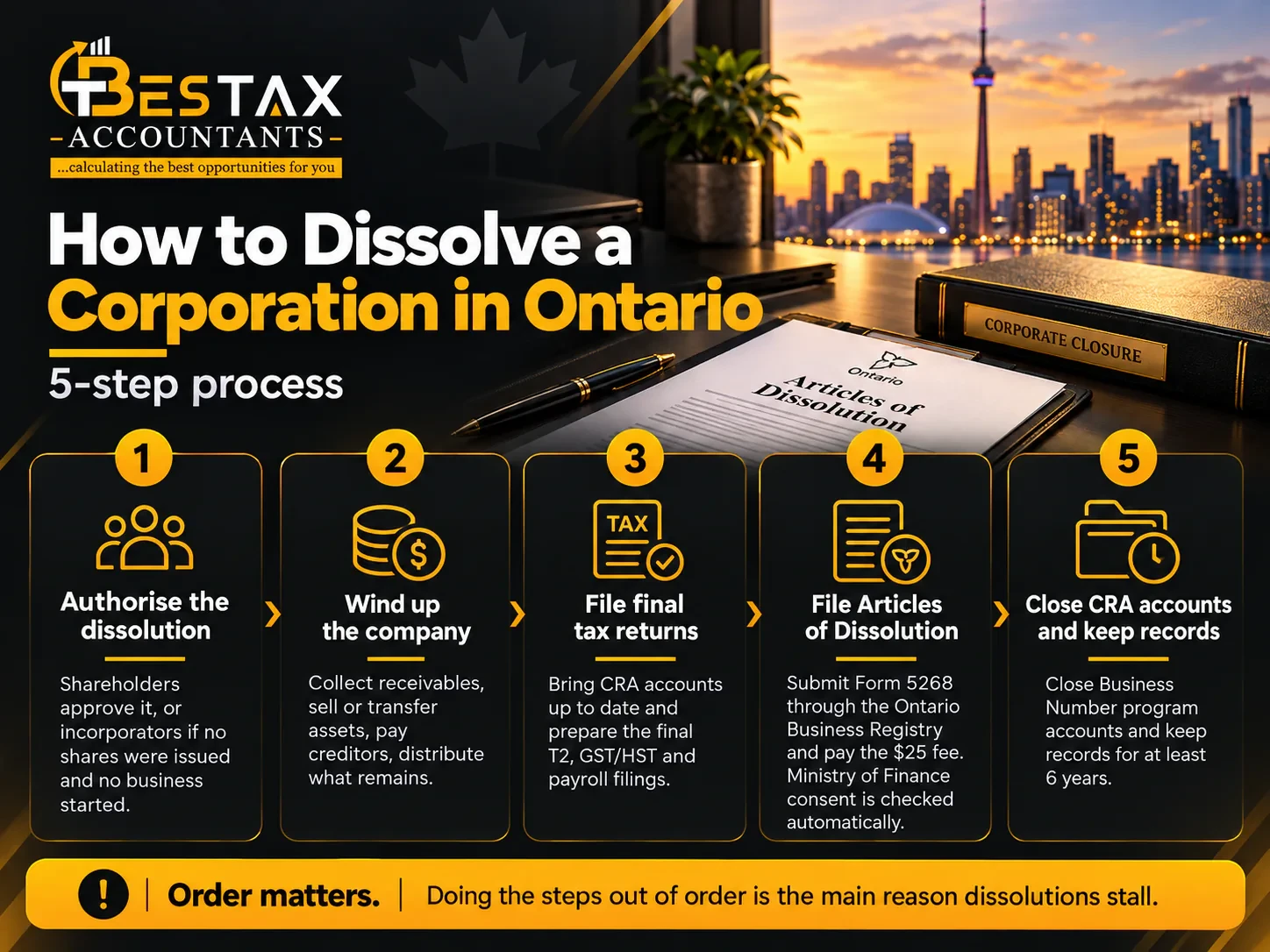
Step 1: Authorise the Dissolution
Hold the meeting or sign the written resolution that approves closing the company. For a corporation that has issued shares, the shareholders approve the dissolution by special resolution, and if there is more than one class of shares, each class must approve it. For a company that never issued shares and never started business, the incorporators sign instead. Keep this resolution in your minute book. You do not file it with your Articles of Dissolution, but the CRA will ask for a copy when you request a clearance certificate.
Step 2: Wind Up the Company
Winding up means finishing the company's business life. Collect what is owed to the company, sell or transfer its assets, pay off every creditor, and then distribute anything left over to the shareholders according to their rights. Selling assets can trigger tax, so plan this step before you move money, not after.
Step 3: Bring Your CRA Filings Up to Date
This is where dissolving an Ontario corporation gets technical. Before you file the Articles, every return for past tax years must be filed and paid: T2 corporate returns, GST/HST returns and payroll remittances. The Ministry of Finance consent in Step 4 checks this. The final T2 itself comes later, because it covers the year that ends on the dissolution date. The tax section below sets out which return is filed when.
Step 4: File the Articles of Dissolution
Once the company is wound up and its returns are current, you submit Articles of Dissolution (Form 5268) to the Ontario Business Registry. The fastest way is online at the Ontario Business Registry, where you get immediate confirmation that your application was received and can pay by debit or credit card. You can also mail the form.
To complete the filing you need:
- The corporation name and Ontario Corporation Number (OCN)
- The corporation's official email address on record
- The nine-digit company key that proves you are authorised to file
- The effective date you want
- The provincial fee of $25
As part of the filing, your application is automatically forwarded to the Ministry of Finance for consent. The Ministry checks that the corporation has met its Ontario tax obligations, such as returns and payments, before a certificate of dissolution can be issued. If there is a compliance issue, the Ministry will contact you.
You choose the effective date: either the date the Ministry of Finance consent is obtained, or a specific date up to 30 days out, subject to that consent.
Step 5: File the Final Return, Close Your CRA Accounts and Keep Your Records
After the corporation is dissolved, file the final T2 for the short year ending on the dissolution date. Then close your Business Number program accounts with the CRA so the agency stops expecting returns. If you skip this, the CRA treats the corporation as still existing and will keep asking for returns even when no tax is owed.
Finally, keep the company's books and records. The CRA requires records to be kept for two years after dissolution. We recommend keeping them longer, especially if directors could face questions about payroll or GST/HST. Our guide on how long to keep tax records in Canada covers the general rules.
Documents You Need to Dissolve an Ontario Corporation
Here is the paperwork checklist for a provincial dissolution, in one place.
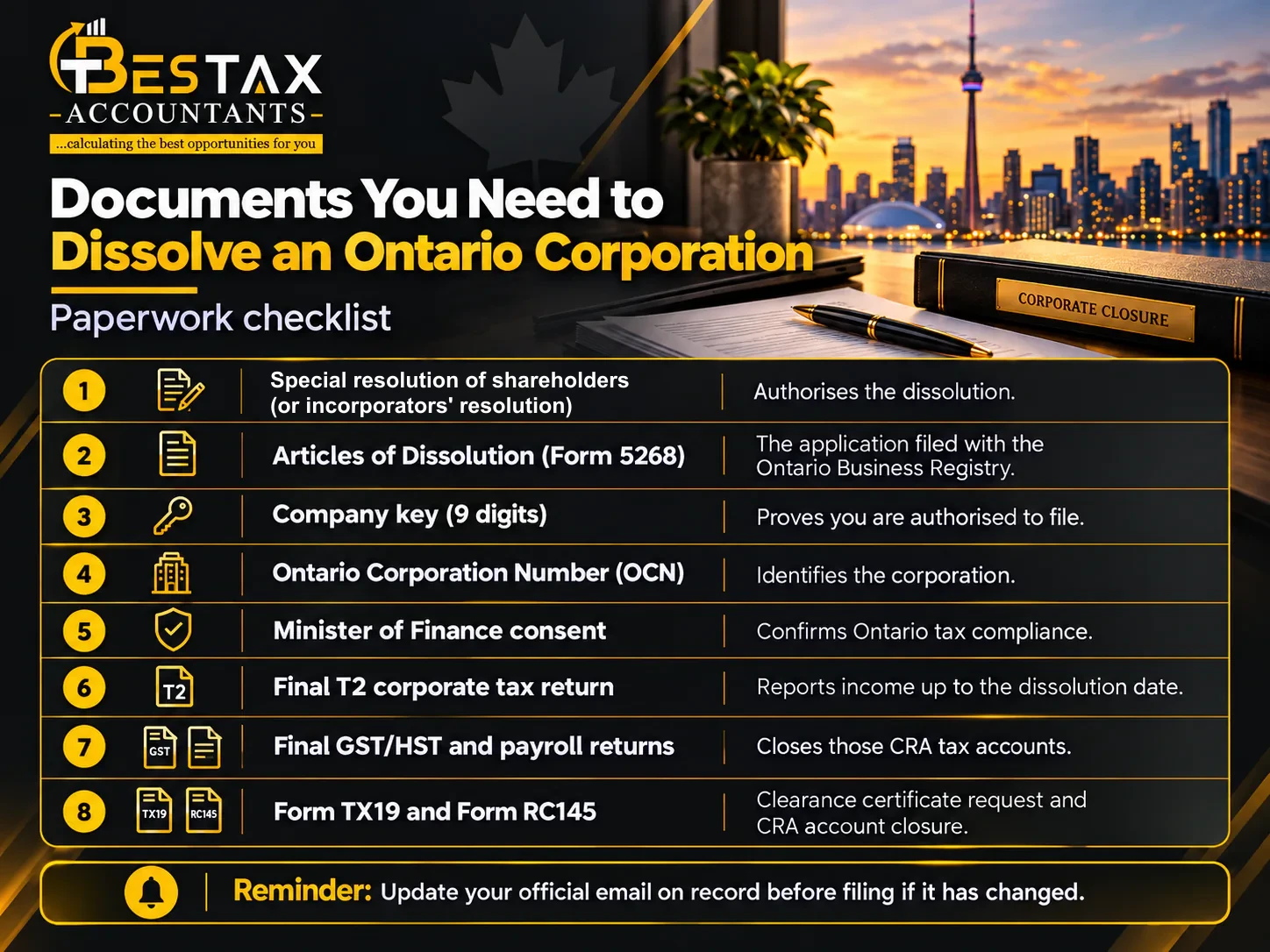
| Document | What it is for | Where it goes |
|---|---|---|
| Special resolution of shareholders (or incorporators' resolution) | Authorises the dissolution | Kept in your minute book, not filed |
| Articles of Dissolution (Form 5268) | The application that ends the corporation | Ontario Business Registry |
| Company key (9 digits) | Proves you are authorised to file | Entered in the application |
| Ontario Corporation Number (OCN) | Identifies your corporation | Entered in the application |
| Minister of Finance consent | Confirms Ontario tax compliance | Requested automatically during filing |
| Final T2 corporate tax return | Reports income up to the dissolution date | CRA |
| Final GST/HST and payroll returns | Closes those tax accounts | CRA |
| Form TX19 (and GST352 if registered) | Requests the CRA clearance certificate | CRA |
| Form RC145 | Requests closure of CRA program accounts | CRA |
If your official email address on record with the ministry has changed, update it first by filing a notice under the Corporations Information Act, because all dissolution documents are sent to that address.
The Tax Requirements for Ontario Corporation Dissolution
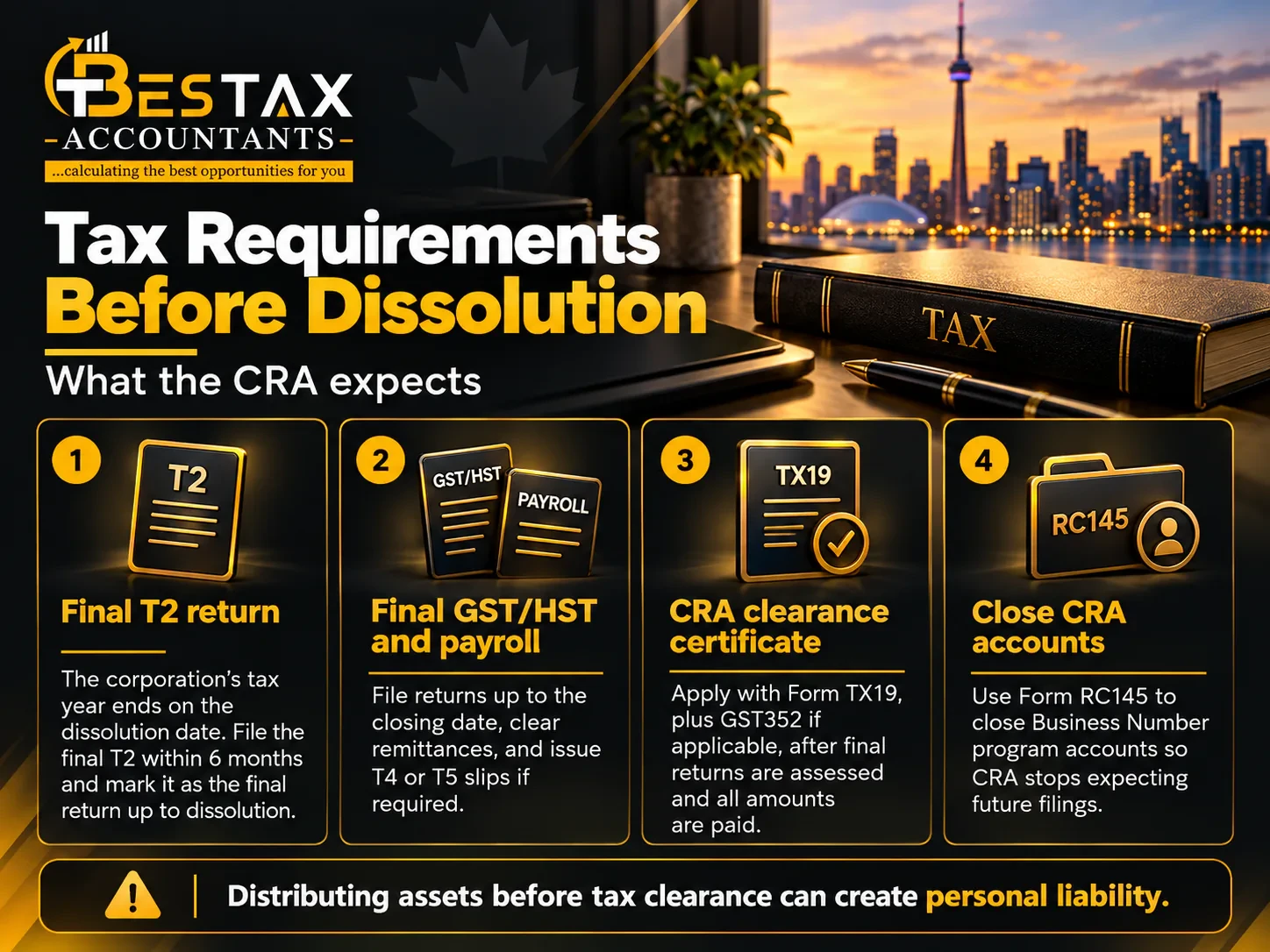
The registry side of closing a company is quick. The tax side is where most of the work and risk sits. Here is what the CRA expects, and in what order.
Which Return Is Filed When
Owners often assume every tax filing is done before the Articles are filed. It is not, and the order matters:
| When | What you file |
|---|---|
| Before the wind-up | All T2, GST/HST and payroll returns for past periods, filed and paid |
| During the wind-up, before distributing to shareholders | Final GST/HST and payroll returns, T4 and T5 slips, then the clearance certificate request (TX19) once those are assessed |
| Filing the Articles | Ministry of Finance consent is checked against your Ontario tax filings |
| After dissolution | The final T2 for the short year ending on the dissolution date, due within six months, then Form RC145 |
The exact sequence depends on whether the company still holds assets and on its year-end, so this is the step to plan with an accountant.
File a Final T2 Return
Your corporation's last tax year ends on the date of dissolution. You file a final T2 corporate income tax return for that short year, and on page 1 of the T2 you answer yes to the question asking whether this is the final return up to dissolution. That flag tells the CRA to stop expecting future returns. The final T2 is generally due within six months of the dissolution date. It also reports any tax triggered when you sold or transferred assets during the wind-up, so it is rarely a simple nil filing. Our step-by-step guide shows how to file a T2 corporate tax return.
Settle GST/HST and Payroll
File your final GST/HST return up to the closing date and account for tax on any assets kept or distributed. If you had employees, file the final payroll remittances and T4 slips, and file T5 slips for any dividends paid to shareholders. This step protects you personally. Directors can be held personally liable for unremitted GST/HST and payroll source deductions, so clear these balances before you distribute anything.
Apply for a CRA Clearance Certificate
A clearance certificate confirms that the corporation has paid all income tax, GST/HST, interest and penalties owed at the time it is issued. Without one, whoever distributes the company's property can be held personally responsible for unpaid amounts, up to the value of what was handed out.
You request it on Form TX19, plus Form GST352 if the company had a GST/HST account. Apply only after the returns have been assessed and all amounts are paid, not at the same time as filing, and before you distribute the remaining property.
The CRA sends an acknowledgement within 45 days and can take up to 120 days to assess a complete request. Supporting documents include the resolution confirming the intention to dissolve and its date, the notice of assessment for the T2 return filed, and a statement of how assets have been and will be distributed. The CRA's clearance certificate page lists the full requirements.
This is the strongest protection available when closing a company, and it is why professionals treat it as a required step rather than an optional one. Our guide to the CRA clearance certificate covers what it is and how to apply in detail.
Close Your Program Accounts
Once dissolved, use Form RC145 to close your Business Number program accounts. If the incorporating authority has already sent the CRA notice of your dissolution, your GST/HST, payroll and information return accounts may close automatically, but you must still file the corporate return up to the date of dissolution. Closing the accounts is what finally stops the filing demands.
How to Dissolve a Federal Corporation Operating in Ontario
If your company was incorporated federally rather than provincially, you dissolve it through Corporations Canada, not the Ontario registry.
- A federal corporation with no property and no liabilities can dissolve by special resolution and file Form 17, Articles of Dissolution, online.
- A federal corporation that still holds property or owes money files Form 19, Statement of Intent to Dissolve, first. It then notifies creditors, gives notice in each province where it operates, winds up its affairs, and files for the final certificate of dissolution.
- If you change your mind after filing the intent to dissolve, you can file a Statement of Revocation of Intent to Dissolve (Form 20) before the final certificate is issued. Unlike the dissolution itself, the revocation carries a filing fee, so check Corporations Canada's current fee schedule before you file.
There is no federal filing fee for either the certificate of intent to dissolve or the certificate of dissolution. The same CRA tax steps above still apply, because dissolving with the registry and clearing your taxes are two separate jobs. Corporations Canada's guide on dissolving a business corporation sets out the federal process.
Costs and Timelines for the Dissolution of a Corporation
Owners are often surprised that the government fees are small. The time and cost mostly come from the tax cleanup, not the filing.
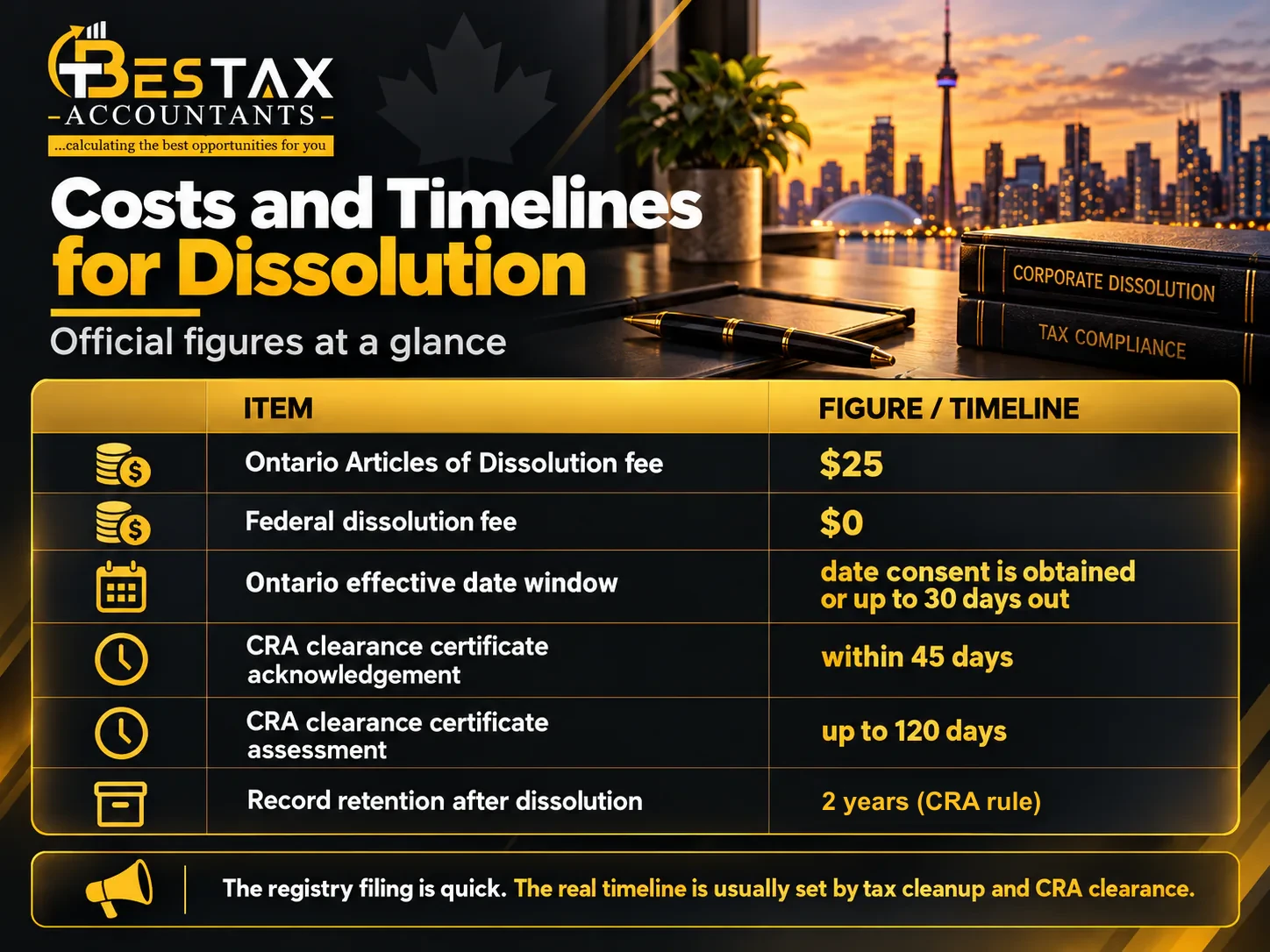
| Item | Official figure |
|---|---|
| Ontario Articles of Dissolution fee | $25 |
| Federal (Corporations Canada) dissolution fee | $0 |
| Ontario effective date window | The date consent is obtained, or up to 30 days out |
| CRA clearance certificate acknowledgement | Within 45 days |
| CRA clearance certificate assessment | Up to 120 days from a complete request |
| Record retention after dissolution (CRA) | 2 years after the date of dissolution |
The registry filing itself is fast. The real timeline is set by the CRA clearance certificate, which can take several months, and by how quickly you settle debts and file final returns. Plan for the whole process to run across a few months, not a few days.
Common Mistakes When You Dissolve a Corporation in Ontario
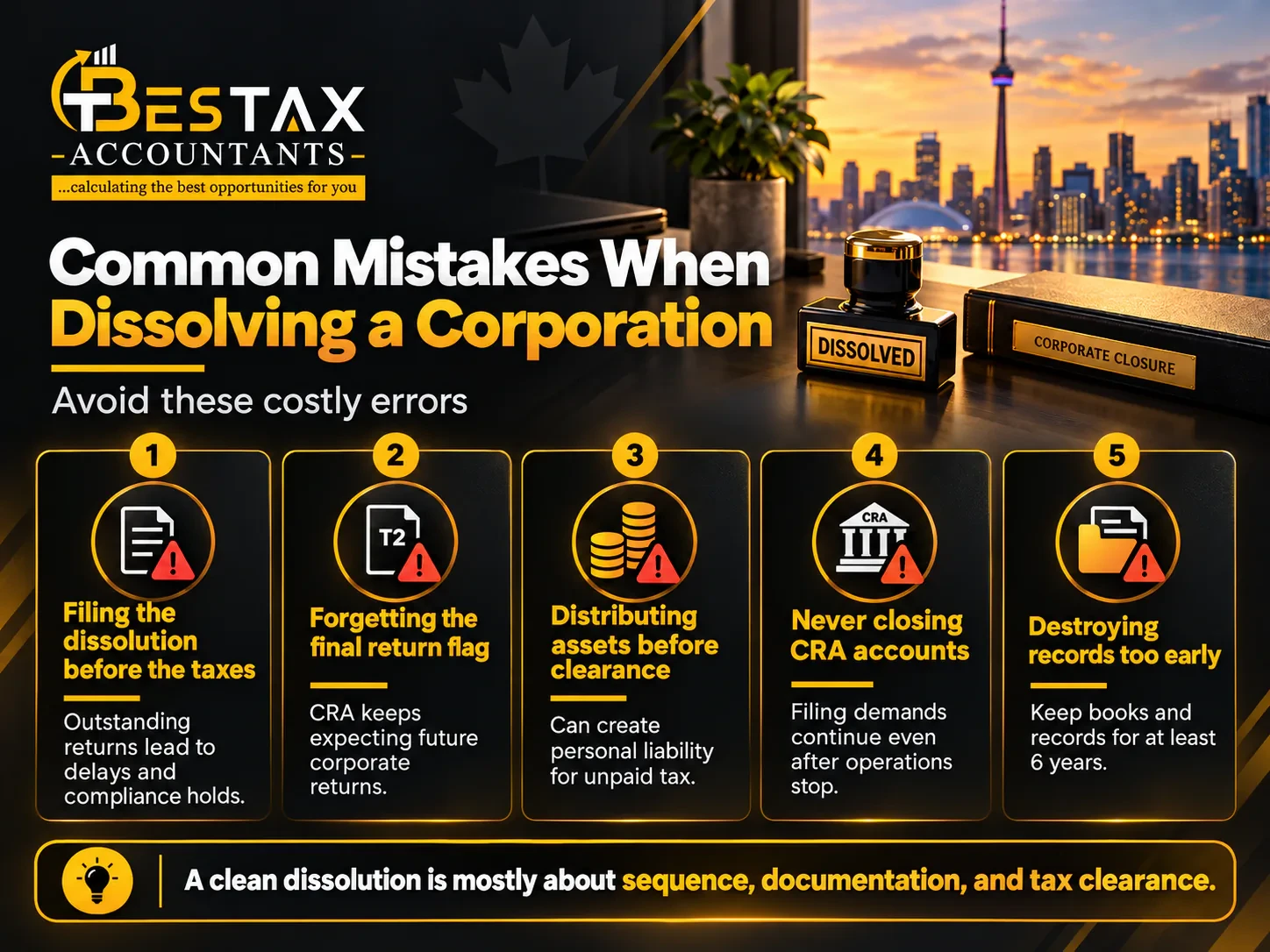
- Filing the dissolution before the taxes. Filing the Articles while returns are outstanding leads to compliance holds and delays.
- Forgetting the final return flag. If you do not mark the T2 as the final return up to dissolution, the CRA keeps expecting returns, which can lead to penalties if they are not filed.
- Distributing assets before clearance. Handing money to shareholders before you have a clearance certificate can make you personally liable for the company's unpaid tax.
- Never closing the CRA accounts. Without Form RC145 or an automatic closure, the corporation is treated as active and keeps generating filing demands.
- Destroying the records too early. The CRA requires records to be kept for two years after dissolution, and directors are safer keeping them longer.
How Bestax Handles the Dissolution of a Corporation for You
Winding up a company is one of those jobs where the order of steps matters as much as the steps themselves. Our Canadian team in Mississauga runs the whole close-down in sequence, so nothing is filed too early and nothing is missed.
We bring your returns up to date, reconcile and close your GST/HST and payroll accounts, apply for the CRA clearance certificate to protect you from personal liability, file the Articles of Dissolution once everything lines up, and then file the final T2 corporate return.
We have supported businesses for more than 10 years, with offices in Canada and the UAE and a team of 35+ professionals. One business owner told us the process was easier than expected, explained in plain language with no jargon, and filed on time. That is the standard we hold on every corporate close.
If you are ready to close your company cleanly, or you want to know the right order for your situation, talk to our team. We are available Monday to Saturday, 9am to 8pm.
Frequently Asked Questions
Authorise the closure by special resolution of the shareholders, wind up the company by paying its debts and distributing its property, bring your CRA returns up to date and obtain a clearance certificate, then file Articles of Dissolution with the Ontario Business Registry and pay the $25 fee. The application is automatically sent to the Ministry of Finance for consent before a certificate of dissolution is issued. The final T2 for the year ending on the dissolution date is filed afterwards.
The government fee to file Articles of Dissolution for an Ontario corporation is $25. For a federal corporation, Corporations Canada charges no fee to dissolve. The larger cost is usually the accounting work to file the final returns and obtain the clearance certificate, not the filing fee itself.
The registry filing is quick, and you get immediate confirmation when you file online. The overall timeline is set by the tax cleanup. The CRA acknowledges a clearance certificate request within 45 days and can take up to 120 days to assess a complete request, so most closures run across several months from start to finish.
Yes. When you file Articles of Dissolution, your application is automatically forwarded to the Ministry of Finance, which checks that the corporation has met its Ontario tax obligations. A certificate of dissolution cannot be issued until that consent is given, and the Ministry will contact you if a compliance issue exists.
Yes. The corporation's tax year ends on the dissolution date, so the final T2 corporate income tax return is filed after dissolution, generally within six months. On page 1 of the T2 you confirm that it is the final return up to dissolution, which tells the CRA to stop expecting future returns. Returns for earlier years must already be filed before you file the Articles.
A clearance certificate confirms the corporation has paid all its income tax, GST/HST, interest and penalties at the time it is issued. You request it on Form TX19, plus Form GST352 if the company had a GST/HST account. It is strongly recommended before distributing any property, because without it the person distributing the assets can be personally liable for the company's unpaid tax.
Not while the debts remain. A corporation can only be dissolved once its liabilities are discharged and its property is distributed. If an Ontario corporation needs time to settle its affairs, it can go through a voluntary winding-up under the OBCA, usually with a liquidator. A federal corporation files a Statement of Intent to Dissolve instead. An insolvent company has to resolve its insolvency first.
You need the special resolution of shareholders (or the incorporators' resolution) authorising the dissolution, the Articles of Dissolution (Form 5268), your company key, your Ontario Corporation Number, and the Minister of Finance consent that is requested automatically. On the tax side you need the final T2 and any final GST/HST and payroll returns, Form TX19 for the clearance certificate, and Form RC145 to close your CRA accounts.
After the corporation is dissolved, file the final T2 up to the date of dissolution and file Form RC145 to close your Business Number program accounts. If the incorporating authority has already notified the CRA, your GST/HST and payroll accounts may close automatically, but you must still file the corporate return. Closing these accounts is what stops the CRA from treating the company as active.
If the corporation never issued shares and never carried on business, the incorporators or their personal representatives authorise the dissolution instead of shareholders. You still file Articles of Dissolution, confirm that the company has no debts and no property to distribute, and pay the $25 fee. This is usually the simplest version of the process.
A voluntarily dissolved Ontario corporation generally cannot be revived through the registry. It requires a private Act of the Ontario Legislature, which is slow and costly. Corporations dissolved by the province for missed filings can usually be revived within 20 years. Revival is far harder than dissolution, so it is worth getting the closure right the first time.
You can file the registry paperwork yourself, but the risk sits in the tax steps. Calculating tax on asset transfers, filing an accurate final T2, distributing retained earnings efficiently and obtaining a clearance certificate all carry personal liability if handled out of order. An accountant runs these steps in the correct sequence so the closure is clean and protected.
Disclaimer: The information provided in this blog is for general informational purposes only. For professional assistance and advice, please contact experts.

