
Bussiness Setup
Start-Up Visa and C11 Work Permit: Starting a Business in Canada as a Foreign Entrepreneur (2026 Update)
Yes, the Start-Up Visa is closed to new founders. Apply for a C11 work permit with 51% ownership and proof of funds. Book your free consultation.


Foreign entrepreneurs who want to start a business in Canada in 2026 now rely mainly on the C11 work permit. The federal Start-Up Visa Program stopped taking new applications on December 31, 2025, its last window closed on June 30, 2026, and its optional open work permit closed to new applicants on December 19, 2025.
The C11 work permit is an LMIA-exempt route under the International Mobility Program. It lets you enter Canada to run your own business when that work creates a significant benefit for the country.
This guide explains both programs in plain language, shows where each one stands right now, and walks through the money, the paperwork, and the financial evidence that decide whether your application is approved.
What Is the Start-Up Visa?
The Start-Up Visa Program was Canada's flagship route for immigrant entrepreneurs with an innovative business idea. It targeted founders whose businesses could create jobs for Canadians and compete on a global scale.
The program worked by matching a founder with a designated organization, which could be a venture capital fund, an angel investor group, or a business incubator. That organization issued a commitment certificate, and the founder used it to apply for permanent residence directly.
Where the Start-Up Visa stands in 2026
IRCC stopped accepting new Start-Up Visa applications on December 31, 2025. The only exception was founders who already held a valid commitment certificate issued in 2025, and they had until June 30, 2026 to apply. The program is now paused, and IRCC has said a new, targeted pilot program for immigrant entrepreneurs will follow. Check the IRCC Start-up Visa page for its current status.
The scale of this route is also worth understanding. Under the official 2026 to 2028 Immigration Levels Plan, the entire Federal Business category, which includes both the Start-Up Visa Program and the Self-Employed Persons Program, is targeted at just 500 permanent resident admissions per year, within a range of 250 to 1,000.
So while the Start-Up Visa remains an important program on paper, it is not a route you can start today. That is why most foreign entrepreneurs are now looking at the C11 work permit.
What Is the C11 Work Permit?
The C11 work permit is an LMIA-exempt work permit for business owners who want to enter Canada to run, including establishing, their own business. It falls under paragraph 205(a) of the Immigration and Refugee Protection Regulations, the significant benefit provision, and it is administered through the International Mobility Program.
LMIA-exempt means you do not need a Labour Market Impact Assessment. A normal foreign worker usually needs a Canadian employer to prove that no Canadian or permanent resident could fill the job. As a business owner applying under C11, you are both the employer and the employee, so that labour market test does not apply. Instead, the whole application turns on one question: will your work in Canada create a significant social, cultural, or economic benefit?
The C11 work permit is for temporary residence only. It is not a permanent residence program. If your real goal is to settle in Canada permanently, the work permit is a first step that gets you on the ground and operating, and you then move toward permanent residence through a separate program.
Start-Up Visa vs C11 Work Permit: A Simple Comparison
Both routes are built for foreign entrepreneurs, but they are very different tools. This table shows how they line up in 2026.
| Feature | Start-Up Visa | C11 Work Permit |
|---|---|---|
| Status in 2026 | Paused and closed to new applicants | Open |
| What you get | Permanent residence | Temporary work permit |
| Legal basis | Start-up business class | Paragraph 205(a), significant benefit |
| LMIA required | No | No |
| Designated organization needed | Yes, a commitment certificate | No |
| Ownership needed | Varies by the business structure | You must control at least 51 percent |
| Typical length | Permanent | Up to 18 months, extensions possible |
| Best for | Founders backed by a Canadian investor or incubator | Owner-operators ready to run a viable Canadian business now |
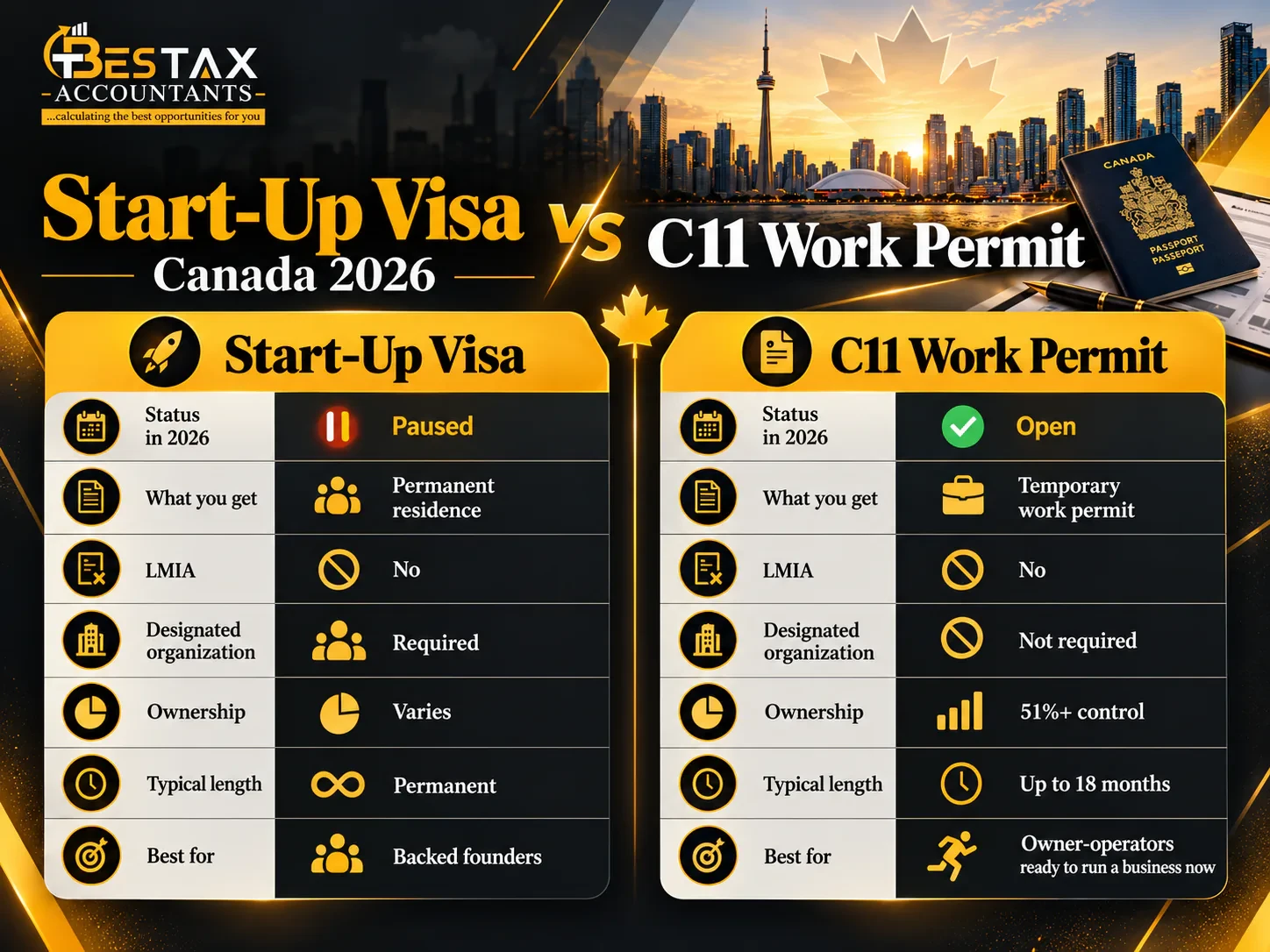
The headline is straightforward. The Start-Up Visa leads to permanent residence but is paused. The C11 work permit gets you working in Canada quickly but is temporary. For many entrepreneurs the practical answer is to enter on a C11 work permit, build a real operating business, and then apply for permanent residence through a program that rewards that experience.
Who Qualifies for the C11 Work Permit?
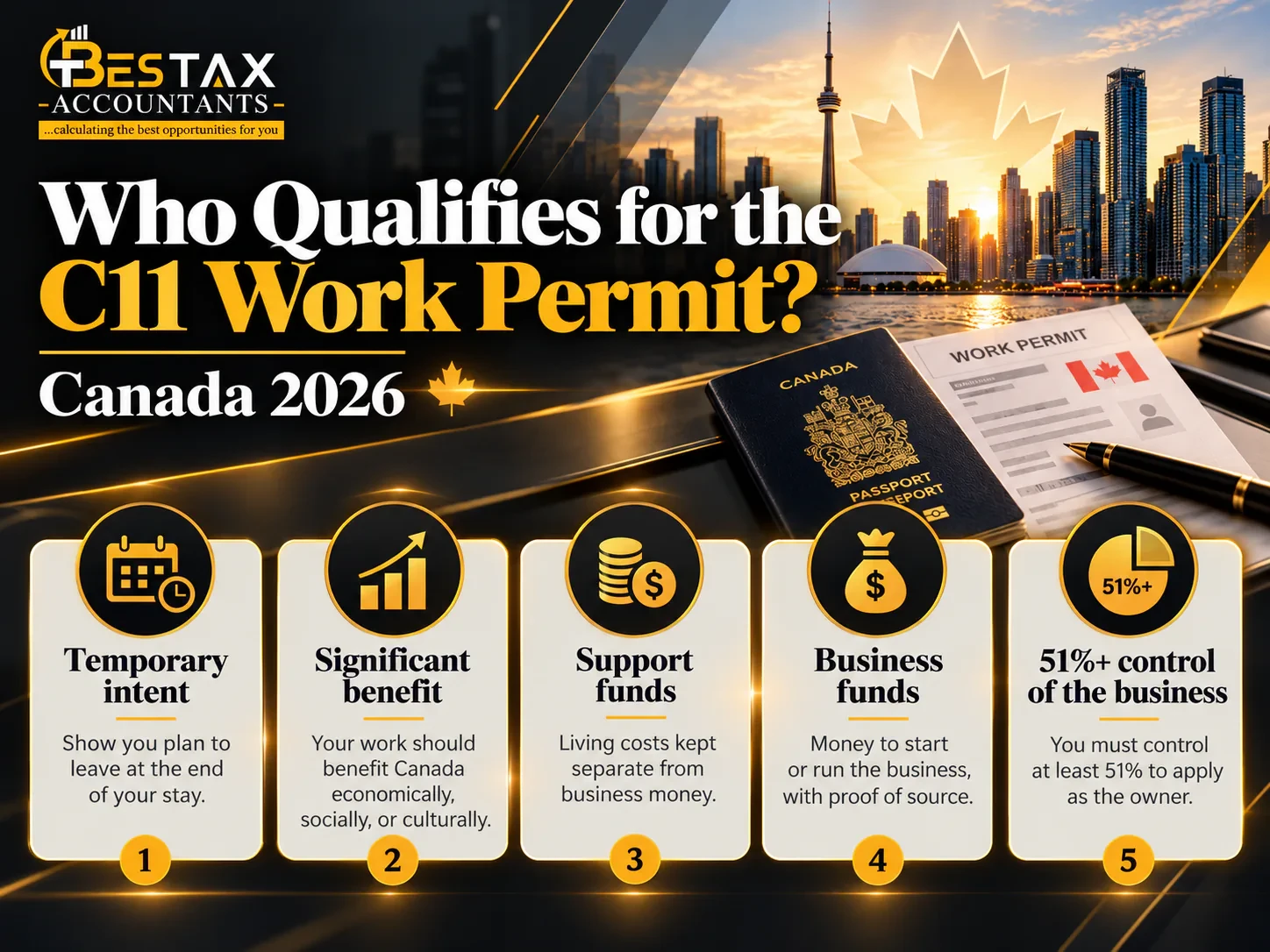
To be approved, a foreign entrepreneur must satisfy an immigration officer on four points. Miss any one of them and the application is refused.
- Temporary intent. Your work must be on a temporary or seasonal basis, and you must show a plan to leave Canada at the end of your authorized stay. Officers look closely at whether you are trying to become a resident through the back door.
- Significant benefit. Your work must generate significant economic, social, or cultural benefit for Canadian citizens or permanent residents.
- Support funds. You must have enough money to support yourself and your family, kept separate from the money the business needs.
- Business funds. You must have separate funds to actually start or run the business, and you must be able to prove where that money came from.
The 51 percent ownership rule
On top of these four tests, there is a hard ownership rule. A C11 work permit is considered only when you control at least 51 percent of the business. If you own less than 51 percent and are coming to work in the business, you are treated as an employee rather than a business owner, which usually pushes you into a different work permit category that may require an LMIA. Where a business has several owners, generally only one owner can qualify under C11.
Ownership rules for foreign nationals also shape how you set the company up. Our guide to foreign ownership in Canada covers what non-Canadians can own and how to hold it.
What "Significant Benefit" Actually Means
This is the phrase that decides most C11 applications, and it is more concrete than it sounds. IRCC officers are asking whether your business will genuinely add something to Canada, not just support you and your family.
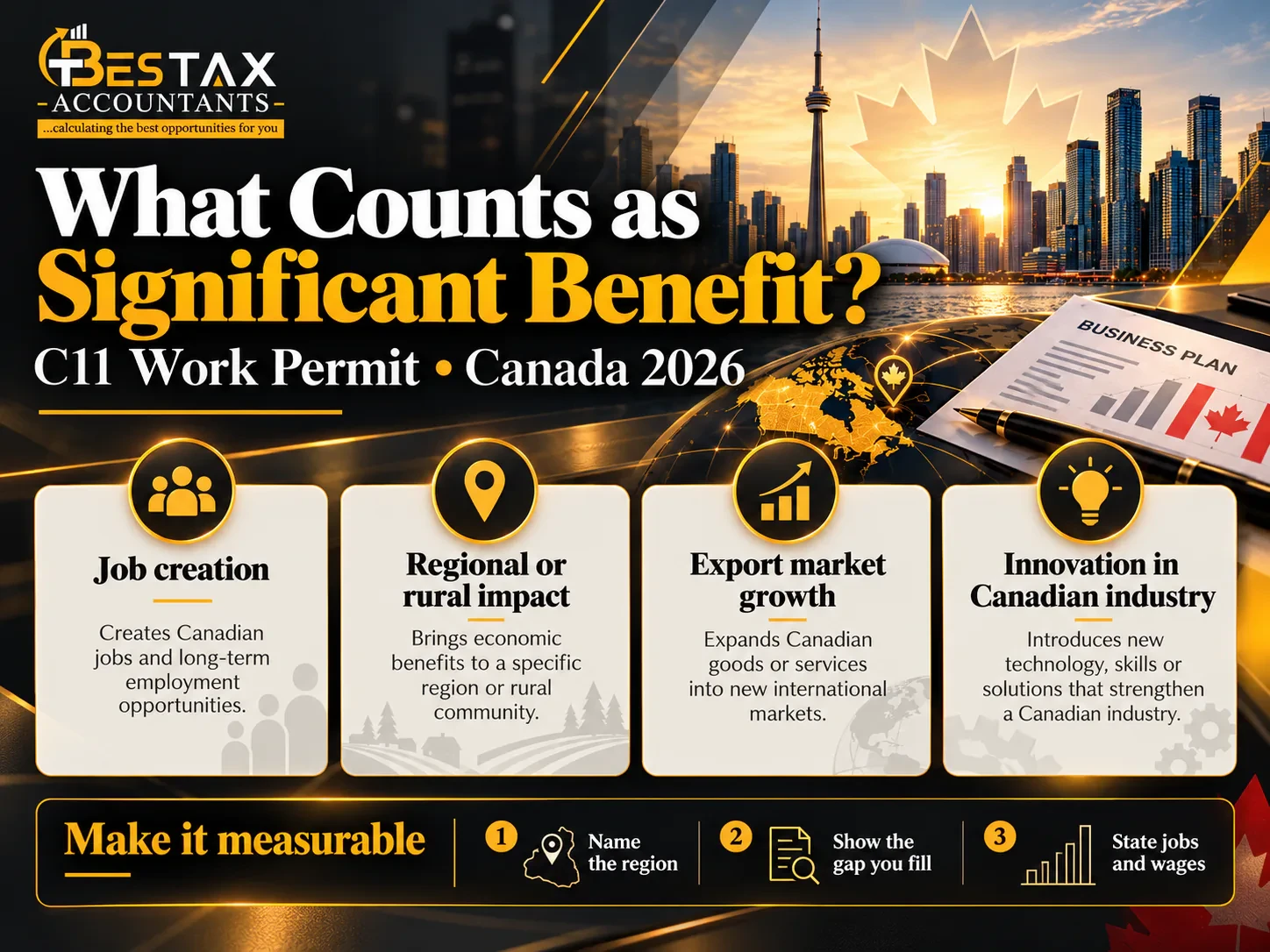
The kinds of benefit that carry weight include real job creation in the area, development in a regional or remote location that lifts the local economy, expansion of export markets for Canadian goods and services, and advancement of a Canadian industry through new technology, products, or services.
Why location changes everything
IRCC uses a clear example to show this. A small convenience store on a busy Toronto street that hires two people may not create any real economic benefit, because it simply competes with existing Canadian businesses and hires staff who could have worked elsewhere. The same store in a small rural area, where the nearest grocery store is twenty kilometres away, can be a genuine benefit, because it hires from a small local pool where jobs are scarce and it supports other businesses nearby.
What to put in your business plan
Make the benefit specific and measurable. Name the region, name the gap you fill, state how many jobs you will create and at what wages, and show the numbers behind all of it. Officers are told to review the business plan to see whether it is a concrete plan for starting a business or just a market study, so vague ambition will not carry the file.
How Much Money Do You Need?
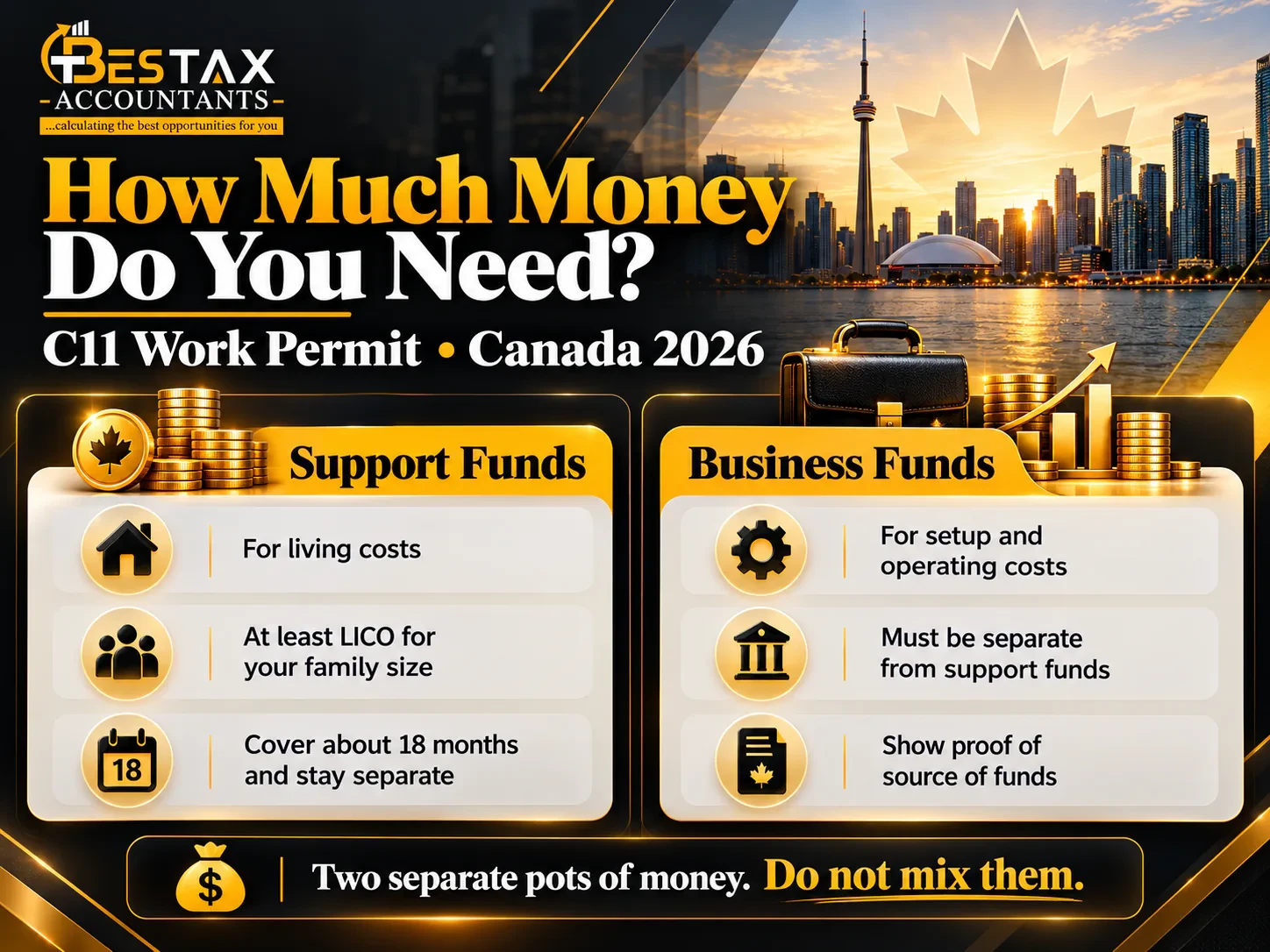
There are two separate pots of money for a C11 work permit, and they must be kept apart. This is one of the most common places applications go wrong.
Support funds
Support funds are for living costs. You need transferable and available funds, free of debts or other obligations, at least equal to the Low Income Cut-Off (LICO) for your family size, covering a minimum of 18 months, or the length of your stay if it is shorter. These funds can be cash, bank deposits, or other liquid assets such as stocks and bonds.
Business funds
Business funds are separate money to establish or run the business and to pay yourself. You must be able to show the source of these funds, which is called proof of provenance. An officer wants to see that the money is real, that it is yours, and that it is enough to get the business running without relying on sales from day one. If you plan to top up your capital in Canada, our guide on how to get funding to start a business in Canada covers the main options.
The financial evidence behind these two pots is exactly where an accountant earns their fee. A clean statement of funds, a documented money trail, and a realistic budget for setup costs, wages, and supplies make the difference between a file that reads as credible and one that reads as hopeful.
How to Apply for the C11 Work Permit
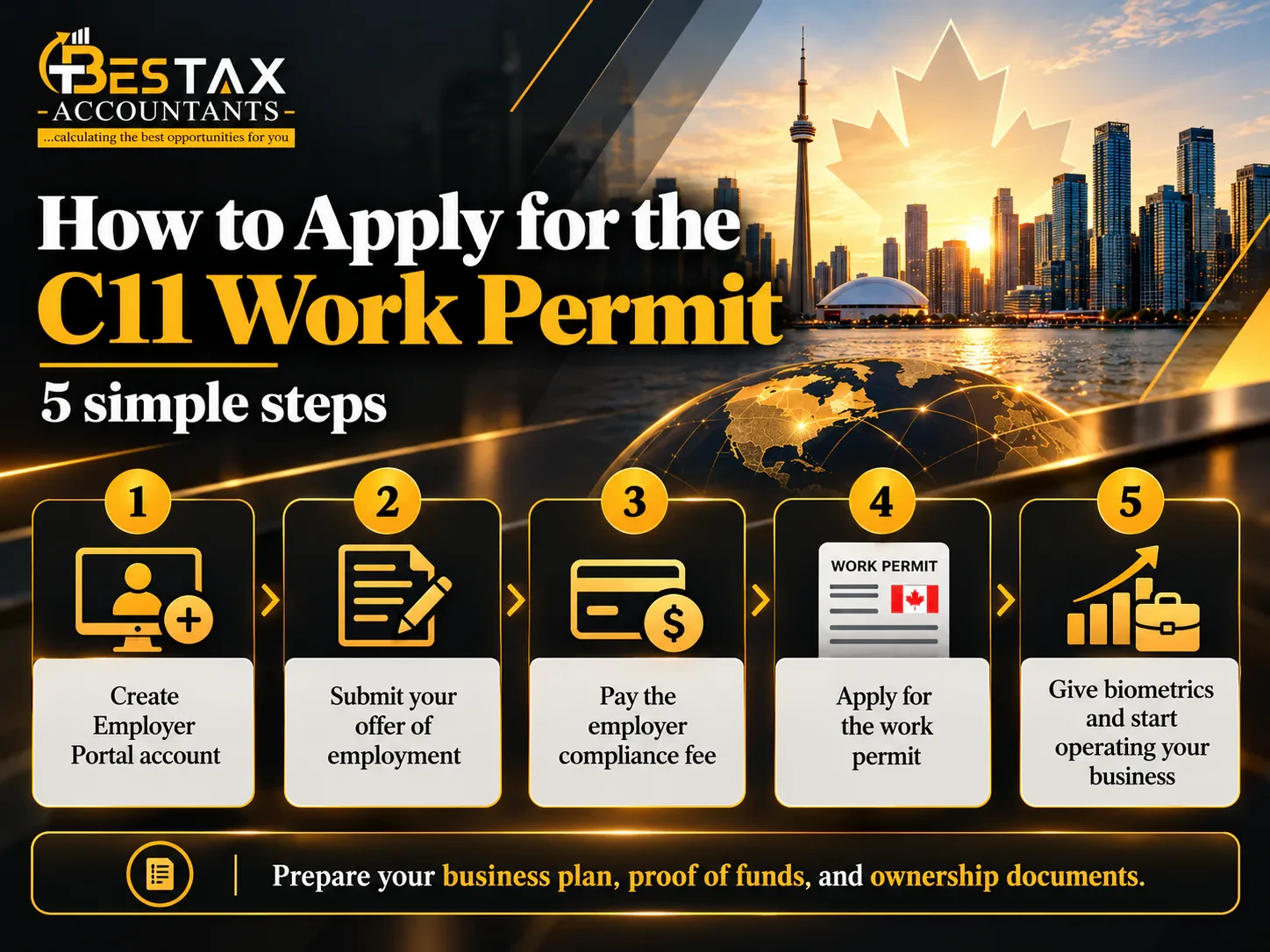
The C11 process has a step that surprises many first-time applicants. Because you are both the employer and the employee, you submit an offer of employment to yourself before you apply for the permit. Here is the order of events.
- Create an Employer Portal account and submit the offer of employment. You submit the offer for yourself, which generates an offer of employment number. In the portal you select the exemption category for a business owner on a temporary purpose.
- Pay the employer compliance fee. This is paid through the Employer Portal at the offer stage.
- Prepare your evidence. This includes proof of your ownership stake, proof of the temporary nature of your stay, your business plan, proof of support funds, and proof of business funds with their source.
- Apply for the work permit online. Applications are expected to be submitted electronically through your IRCC secure account.
- Give biometrics and wait for the decision. An officer reviews whether your work meets the significant benefit test and whether all other requirements are met.
Which job code to use
Job codes trip many people up. If you are self-employed, you use the National Occupational Classification code and job title that match the actual work you do, not a generic entrepreneur code. If you are a true entrepreneur who hires staff, the generic code 88888 with the job title Entrepreneur is used.
What Does the C11 Work Permit Cost?
The government fees are modest compared with the money the business itself needs. These are the official IRCC amounts.
| Fee | Amount | Who pays |
|---|---|---|
| Work permit processing fee | $155 | Applicant |
| Employer compliance fee | $230 | Employer, which is you as the business owner |
| Open work permit holder fee | $100 | Only where an open work permit applies, for example a spouse |
| Biometrics | Generally $85 per person, or $170 per family | Applicant |
Fees change, so confirm the current amounts on the IRCC work permit fee page before you pay, because an incorrect payment can delay or reject an application. The far larger numbers in any C11 budget are your support funds and your business funds, not these processing fees.
How Long Does the C11 Work Permit Last?
A C11 work permit is issued for a temporary purpose, and the duration normally does not exceed 18 months. IRCC instructs officers to keep the permit to 18 months or less.
Extending a C11 work permit
If your business needs more time to get established, you can apply in Canada for a further permit. For an extension, an officer must still be satisfied that your stay remains temporary and, importantly, that your work continues to provide a significant benefit. You will need to show what you achieved during the first permit and what benefit the next period will bring.
There is a caution here that matters for long-term planning. If a foreign national is issued work permits year after year with no break in stay, or spends the majority of their time in Canada, an officer may decide they no longer meet the temporary intent requirement. A C11 work permit is not a way to live in Canada permanently as a business owner. If permanence is the goal, you need a permanent residence plan running alongside it.
From C11 Work Permit to Permanent Residence
This is the question almost every foreign entrepreneur asks, and it needs an honest answer. The C11 work permit does not lead to permanent residence on its own. It is a temporary permit, and permanent residence comes through a separate program.
The most common bridge is a Provincial Nominee Program entrepreneur stream. Several provinces, including Ontario, British Columbia, Manitoba, and Saskatchewan, run their own entrepreneur streams that can lead to nomination and then permanent residence. The 2026 to 2028 Immigration Levels Plan increased Provincial Nominee Program admissions, with a target of 91,500 in 2026, so this remains a well-supported route.
One technical point saves a lot of disappointment. Time you spend as a self-employed person or as an entrepreneur does not count as qualifying work experience for the Canadian Experience Class under Express Entry. Running your own business on a C11 permit does not, by itself, build the Express Entry experience that leads to permanent residence. Your permanent residence plan has to be built on a program that actually values business ownership, which is why the provincial entrepreneur streams matter so much.
The right sequence is to design the permanent residence plan before you apply for the work permit, so the business you build and the province you choose line up with a program that can eventually give you permanent status. The province also decides where you incorporate, so compare federal and provincial incorporation before you register.
Where an Accountant Fits In, and Where a Lawyer Does
It helps to be clear about who does what. The immigration filing itself, the legal strategy, and representation before IRCC are the work of a licensed immigration professional, such as a Regulated Canadian Immigration Consultant or an immigration lawyer. We always recommend working with one for the application.
The financial side of the application is where an accountant belongs, and it is the part that quietly sinks many business immigration files. At Bestax, our Canadian team handles the money side so your immigration representative can build the strongest possible case.
- Proof of funds that holds up. We prepare a clean statement of your support funds and business funds, kept properly separate, with the documented source of funds an officer expects to see.
- The financial model in your business plan. We build realistic startup costs, wage budgets, cash flow, and job-creation numbers, so your significant benefit argument rests on figures that stand up to scrutiny.
- Company registration and structure. We set up the Canadian company correctly from the start through our company registration team, so your ownership percentage and structure match what a C11 application requires. Our guide on how to incorporate a business in Canada walks through each step, and you will need a CRA business number once the company exists.
- Bookkeeping and CRA compliance once you land. From your first month operating, our accounting and bookkeeping team keeps clean records, which is exactly the evidence you need when you apply to extend the permit or move to permanent residence.
- Corporate tax, GST/HST, and payroll. We prepare your corporate tax return, handle GST/HST registration once your sales pass the threshold, and run payroll when you start hiring the Canadians who make your significant benefit real.
Why Foreign Entrepreneurs Work With Bestax
We are a cross-border firm built for exactly this situation. Bestax has offices in Mississauga and Dubai, so an entrepreneur relocating to Canada from the Gulf or beyond gets one team working across both regions and time zones. If you still earn income abroad, our cross-border tax team handles that side too.
Every engagement is prepared by a specialist and reviewed by a senior professional. Bestax is an ACCA and ICAEW Approved Employer. For a foreign entrepreneur starting a business in Canada, that means the financial foundation of your move is built once and built right.
Ready to Start a Business in Canada?
If you are a foreign entrepreneur planning a move to Canada, the financial side of your C11 work permit is where the decision is often won or lost. We prepare the proof of funds, the business plan financials, the company registration, and the ongoing tax and bookkeeping that keep your file strong from the first application through to permanent residence.
Send us your plan and your numbers, and we will map the accounting and financial steps for you at no cost. Book a free consultation.
Frequently Asked Questions
Is the Start-Up Visa still open in 2026?
No. IRCC stopped accepting new Start-Up Visa applications on December 31, 2025. Founders with a valid 2025 commitment certificate could still apply until June 30, 2026, and that window has now closed. IRCC continues to process applications already in its inventory, but there is no way to start a new Start-Up Visa application right now.
Can I still get a Start-Up Visa work permit?
No, not as a new applicant. The Start-Up Visa optional open work permit has been closed to new applicants since December 19, 2025. If you already hold one, you may be able to extend it while your permanent residence application is being processed.
What is the C11 work permit in Canada?
The C11 work permit is an LMIA-exempt permit under the International Mobility Program that lets a foreign entrepreneur enter Canada to run or establish their own business. It is granted when an officer is satisfied that your work will create a significant economic, social, or cultural benefit for Canada.
Can a foreign entrepreneur start a business in Canada without permanent residence?
Yes. A foreign entrepreneur can start a business in Canada on a temporary basis using the C11 work permit, without first becoming a permanent resident. You must control at least 51 percent of the business and show that your stay is temporary.
Do I need an LMIA for the C11 work permit?
No. The C11 work permit is LMIA-exempt, which means you do not need a Labour Market Impact Assessment and you do not need a Canadian employer to prove a labour shortage. As the business owner, you are both the employer and the employee.
How much money do I need for a C11 work permit?
You need two separate amounts. Support funds must at least equal the Low Income Cut-Off for your family size for a minimum of 18 months, and business funds must be enough to start or run the business, kept separate and with proof of where the money came from.
How long is a C11 work permit valid?
A C11 work permit is normally issued for up to 18 months, because the work must be temporary. You can apply to extend it if the business needs more time, as long as you still show temporary intent and that your work continues to provide a significant benefit.
What percentage of a business must I own for a C11 work permit?
You must control at least 51 percent of the business to apply as a business owner under C11. If you own less than 51 percent, you are treated as an employee and usually need a different type of work permit, which may require an LMIA.
How much does the C11 work permit cost?
The main official fees are the work permit processing fee of $155, the employer compliance fee of $230 that you pay as the business owner, and a biometrics fee that is generally $85 per person or $170 per family. An open work permit holder fee of $100 applies only in certain cases, such as for an accompanying spouse.
Can my family come with me on a C11 work permit?
In many cases a spouse or common-law partner can apply for a work permit and dependent children can study in Canada. Spousal open work permit eligibility has tightened recently and depends on the occupation and the current rules, so a licensed immigration professional should confirm what applies to your family.
Can the C11 work permit lead to permanent residence?
Not on its own. The C11 work permit is temporary, so permanent residence comes through a separate program, most often a Provincial Nominee Program entrepreneur stream. Keep in mind that time spent as a self-employed person or entrepreneur does not count as experience for the Canadian Experience Class.
What counts as a significant benefit for a C11 work permit?
A significant benefit usually means real job creation, development in a rural or remote area, expansion of export markets, or advancing a Canadian industry through new technology or services. The same business can qualify in a small town where jobs are scarce and fail in a large city where it only competes with existing businesses.
This article explains general rules as of October 2026 and is not legal or immigration advice. Immigration rules change, and applications should be prepared with a licensed immigration professional. Bestax provides the accounting and financial services that support a business immigration file.
Disclaimer: The information provided in this blog is for general informational purposes only. For professional assistance and advice, please contact experts.


