


For 2026 the CPP ceiling rose to $74,600, the CPP2 ceiling to $85,000 and the EI ceiling to $68,900. The maximum an employer now pays for one employee outside Quebec is $6,218.75 across all three.
The CPP rate is unchanged and the EI rate is one basis point lower, so the increases come from the ceilings. If your payroll still runs on 2025 ceilings, it stops deducting too early for higher earners, and as the employer you are liable for the shortfall.
If you run payroll for staff in Canada, or pay yourself as a self-employed contributor, the tables below give every 2026 rate, ceiling and maximum.
2026 CPP, CPP2 and EI Rates for Employees and Employers
Three deductions come off every pay outside Quebec. Each has its own rate, its own ceiling and its own maximum, and the employer matches or exceeds every one.
CPP: 5.95 Percent to the YMPE
The Year's Maximum Pensionable Earnings, the YMPE, is $74,600 for 2026, up from $71,300. The employee contributes 5.95 percent of pensionable earnings between the $3,500 basic exemption and the YMPE, and the employer matches it. The CPP contribution limit for the year is therefore $4,230.45 each, which is 5.95 percent of $71,100.
- Rate: 5.95 percent employee, 5.95 percent employer match
- Basic exemption: $3,500, unchanged
- YMPE: $74,600
- Maximum contribution: $4,230.45 each
The exemption is applied per pay period, so an employee you pay biweekly has $134.61 of each pay exempt. Nothing is deducted on earnings above $74,600 under this first tier.
CPP2: 4 Percent on the Second Ceiling
CPP2 is the second additional contribution, fully phased in since 2025. It applies at 4 percent on pensionable earnings between the YMPE and the Year's Additional Maximum Pensionable Earnings, the YAMPE, which is $85,000 for 2026. The second ceiling is therefore a band of $10,400, and the maximum is $416.00 for the employee and $416.00 for the employer.
- Rate: 4 percent employee, 4 percent employer match
- Band: $74,600 to $85,000
- Maximum contribution: $416.00 each
- Reported separately on the T4, in its own box
An employee earning $80,000 pays CPP2 on $5,400, which is $216.00, on top of the full $4,230.45 of base CPP. An employee earning $70,000 pays no CPP2 at all. The combined CPP contribution limit for an employee who reaches both ceilings is $4,646.45, matched by the employer.
EI: 1.63 Percent to the Maximum Insurable Earnings
The EI premium rate for 2026 is 1.63 percent for employees outside Quebec, down one basis point from 2025. The maximum insurable earnings are $68,900, up $3,200, so the maximum employee premium still rose, to $1,123.07. There is no exemption. EI is deducted from the first dollar of insurable earnings.
The employer pays 1.4 times the employee premium, which is 2.282 percent, to a maximum of $1,572.30 per employee. An employer with an approved reduced rate under a qualifying wage-loss plan pays less than 1.4 times, and the reduction is set each year under the EI Premium Reduction Program, which Employment and Social Development Canada administers.
| 2026, outside Quebec | Employee | Employer | Ceiling |
|---|---|---|---|
| CPP, 5.95 percent | $4,230.45 | $4,230.45 | $74,600 YMPE, $3,500 exemption |
| CPP2, 4 percent | $416.00 | $416.00 | $74,600 to $85,000 YAMPE |
| EI, 1.63 percent and 2.282 percent | $1,123.07 | $1,572.30 | $68,900 |
| Combined maximum | $5,769.52 | $6,218.75 |
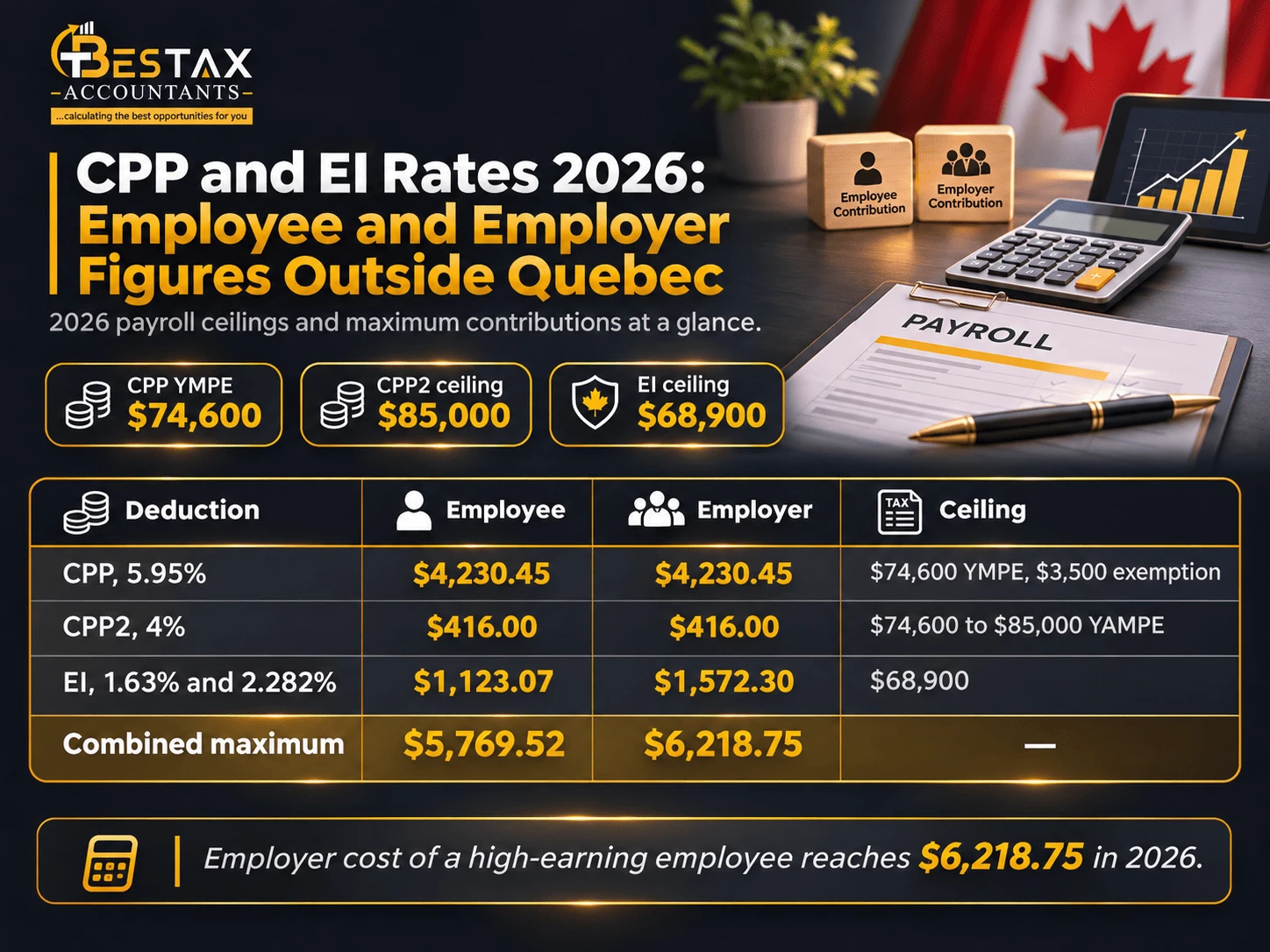
The employer maximum of $6,218.75 is the figure that belongs in your cost of every hire earning $85,000 or more, on top of salary. Our guide to calculating payroll taxes in Canada shows the same figures applied per pay period for weekly, biweekly and monthly runs.
Self-Employed CPP and Quebec Rates for 2026
A self-employed contributor pays both shares. A Quebec employee pays into different plans. Both groups reach different maximums from the table above.
Self-Employed CPP
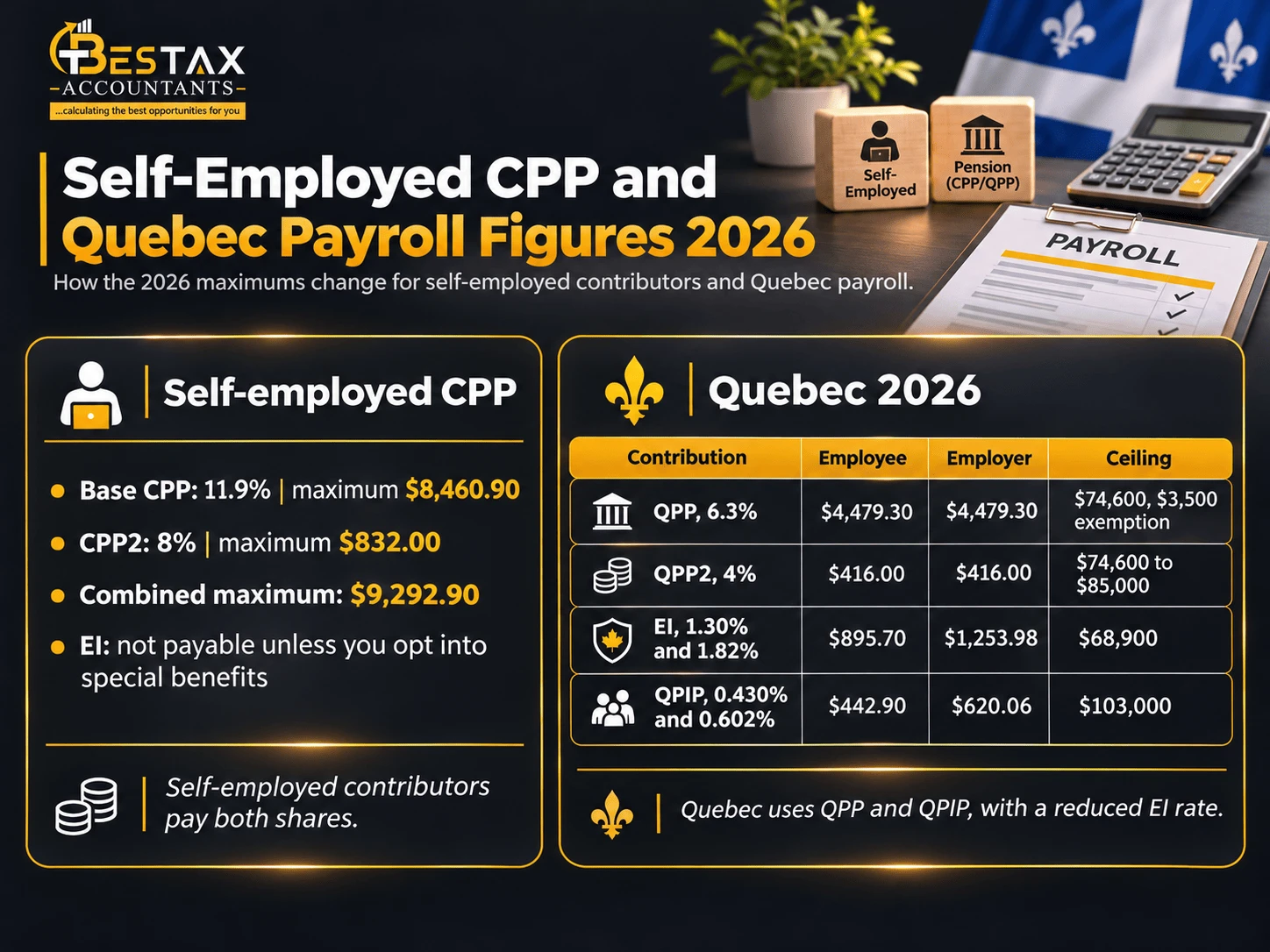
Self-employed CPP is paid at both the employee and the employer rate, because the contributor is both. The 2026 rate is 11.9 percent on pensionable earnings between $3,500 and $74,600, for a maximum of $8,460.90. CPP2 adds 8 percent on the second band, for a maximum of $832.00. The combined self-employed maximum is $9,292.90, paid with the T1 return and through instalments where the CRA requires them.
- Base CPP: 11.9 percent, maximum $8,460.90
- CPP2: 8 percent, maximum $832.00
- Combined: $9,292.90
- EI: not payable unless the contributor opts into the special benefits program
The after-tax cost is lower than the headline. The employer half of your contribution and the enhanced portions are deductible from income, and the base employee portion earns a tax credit. Our guide to self-employed taxes in Canada shows how the contribution fits into the T1 return.
Quebec QPP/QPIP and the Reduced EI Rate
Employees who report to a Quebec establishment contribute to the Quebec Pension Plan instead of CPP, at a higher rate on the same ceilings. For 2026 the QPP employee rate is 6.3 percent, down from 6.4 percent after the plan's most recent actuarial valuation lowered the base contribution rate, for a maximum of $4,479.30. QPP2 applies at the same 4 percent on the same $74,600 to $85,000 band, for $416.00.
Quebec employees pay a reduced EI rate of 1.30 percent, because the Quebec Parental Insurance Plan covers maternity and parental benefits that EI covers elsewhere. The maximum Quebec EI premium is $895.70, and the employer pays 1.4 times, to $1,253.98. QPIP is then added at 0.430 percent for the employee on insurable earnings up to $103,000, for a maximum of $442.90. The employer pays 0.602 percent on the same earnings, to a maximum of $620.06.
| 2026, Quebec | Employee | Employer | Ceiling |
|---|---|---|---|
| QPP, 6.3 percent | $4,479.30 | $4,479.30 | $74,600, $3,500 exemption |
| QPP2, 4 percent | $416.00 | $416.00 | $74,600 to $85,000 |
| EI, 1.30 percent and 1.82 percent | $895.70 | $1,253.98 | $68,900 |
| QPIP, 0.430 percent and 0.602 percent | $442.90 | $620.06 | $103,000 |
When Each Deduction Stops During the Year
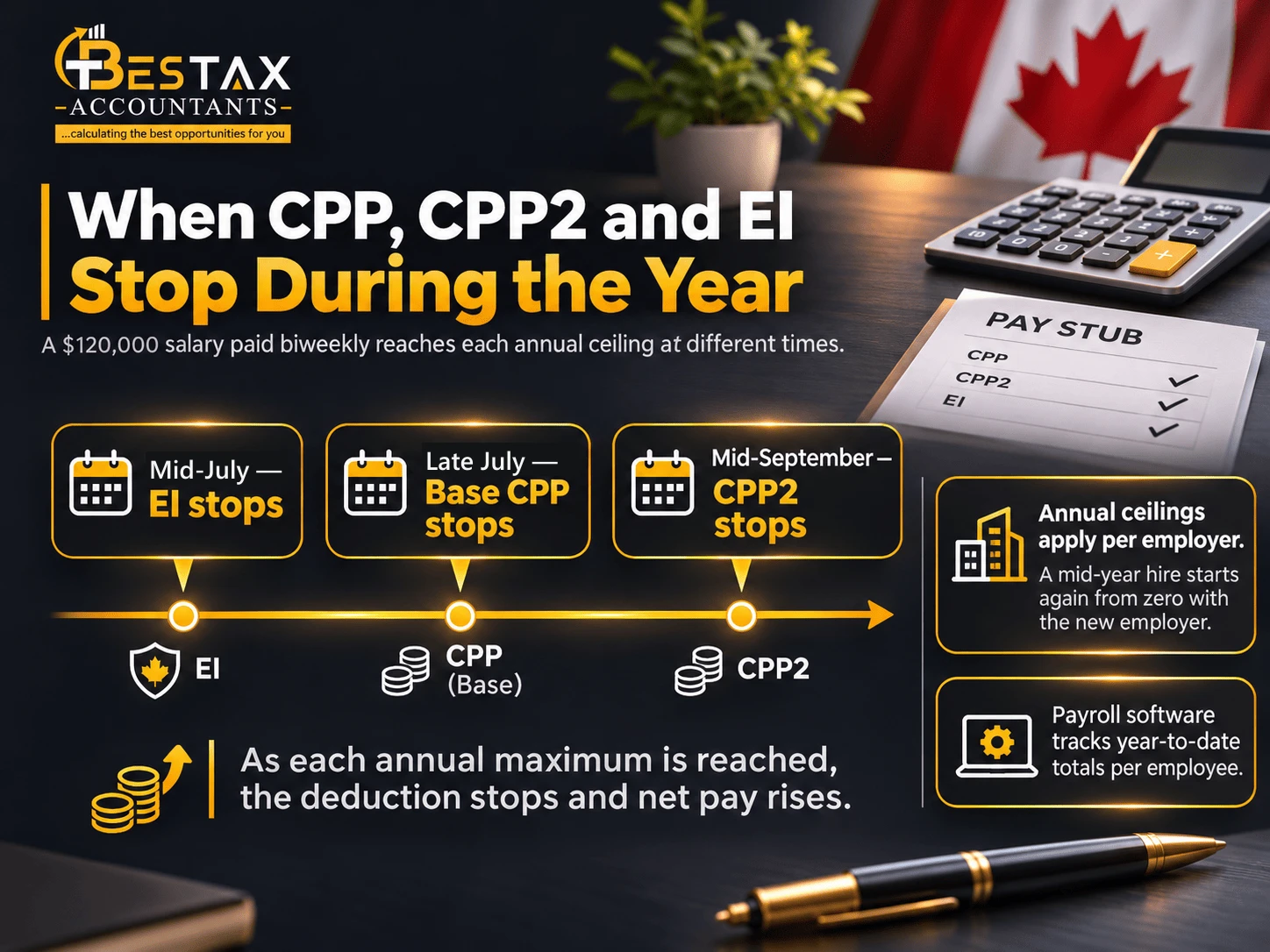
Each ceiling is annual, so a high earner reaches the maximum part way through the year and the deduction stops. On a $120,000 salary paid biweekly from early January, EI stops in mid-July, base CPP in late July and CPP2 in mid-September, and the employee's net pay rises at each point. Your payroll software tracks the year-to-date totals per employee. A mid-year hire from another employer starts again from zero, because the ceilings apply per employer.
Employer Match, Remittances and Year-End Reporting
The rates are the easy part. The employer's obligations attach to every pay run, and the penalties for missing them start on the first day late.
The Employer Match and What It Costs Per Hire
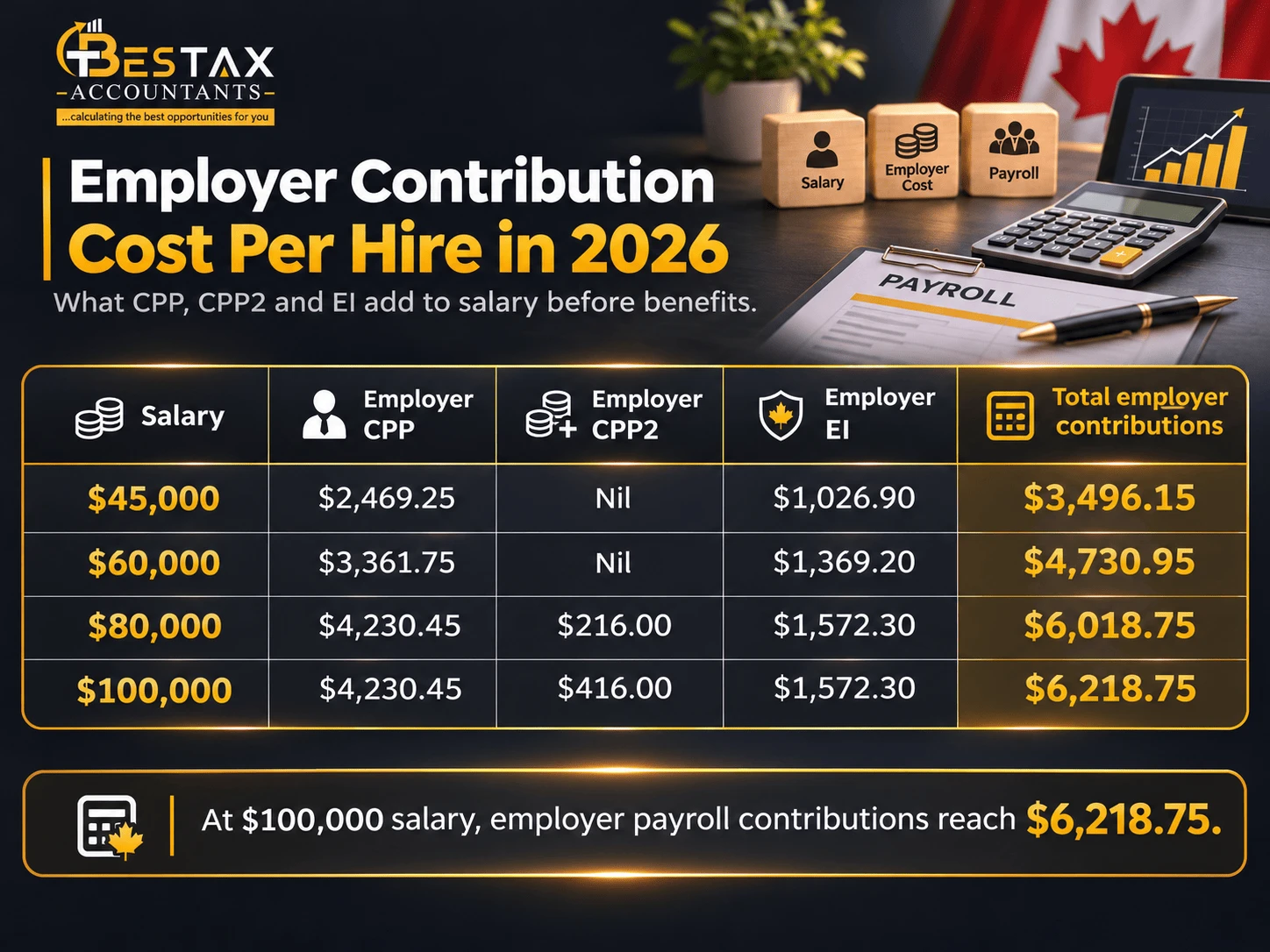
The employer match is not optional. For every dollar of CPP and CPP2 your employee contributes, you contribute the same. For every dollar of EI they pay, you pay $1.40. On a $60,000 salary, your 2026 cost is $3,361.75 of CPP, no CPP2, and $1,369.20 of EI, which adds $4,730.95 to the wage before any benefits.
| Salary | Employer CPP | Employer CPP2 | Employer EI | Total employer contributions |
|---|---|---|---|---|
| $45,000 | $2,469.25 | Nil | $1,026.90 | $3,496.15 |
| $60,000 | $3,361.75 | Nil | $1,369.20 | $4,730.95 |
| $80,000 | $4,230.45 | $216.00 | $1,572.30 | $6,018.75 |
| $100,000 | $4,230.45 | $416.00 | $1,572.30 | $6,218.75 |
Remitting on Time
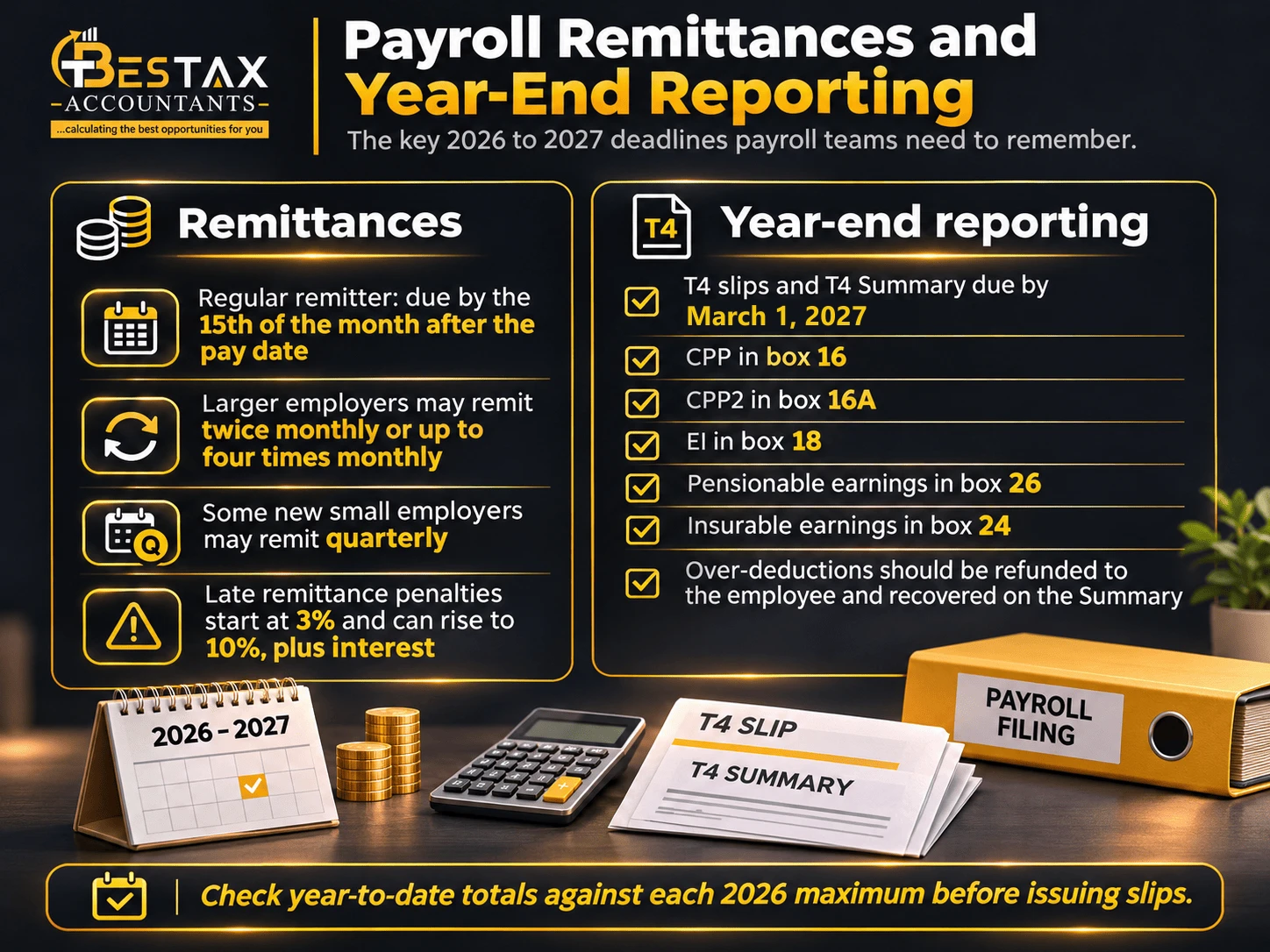
The deductions withheld and the employer's share go to the CRA together. For a regular remitter, the amount is due by the 15th of the month after the pay date. If your average monthly withholdings are higher, you remit twice a month or up to four times, and a small employer with a perfect compliance record may qualify to remit quarterly. A late remittance is penalized at 3 percent for one to three days, rising to 5, 7 and 10 percent, with interest on top.
Our guide to payroll remittances in Canada sets out the remitter thresholds and the due dates for each. The remittance is your own liability, and the withheld amounts are held in trust for the CRA from the pay date. That is why a missed remittance is treated more severely than a missed tax return.
Year-End Reporting
T4 slips report the employee's CPP, CPP2 and EI, each in its own box, and the T4 Summary reconciles the year's remittances to the slips. Both are due by the last day of February, which for the 2026 year is March 1, 2027. A slip that reports CPP2 in the base CPP box, or omits it, is a common filing error, because box 16A was only added for the 2024 slips. Our guide to preparing a T4 slip walks through every box.
- CPP in box 16, CPP2 in box 16A, EI in box 18, with pensionable and insurable earnings in boxes 26 and 24
- T4 and T4 Summary filed by March 1, 2027, since February 28 falls on a Sunday, electronically where the employer files more than five slips
- Year-to-date totals checked against each maximum before the slips are issued
- Any over-deduction refunded to the employee and recovered on the Summary
Our payroll services in Canada run every pay period on the current ceilings, remit on the date your remitter type requires, and file the slips from the same records. The 2027 tables are loaded in December, ready for the first pay run of January.
The 2026 Figures at a Glance
The 2026 rates changed little, and the ceilings changed enough to matter on every pay.
- CPP at 5.95 percent to a $74,600 YMPE, maximum $4,230.45 each
- CPP2 at 4 percent from $74,600 to $85,000, maximum $416.00 each
- EI at 1.63 percent to $68,900, maximum $1,123.07 employee and $1,572.30 employer
- Self-employed CPP at 11.9 percent and 8 percent, combined maximum $9,292.90
- Quebec on QPP at 6.3 percent, EI at 1.30 percent and QPIP at 0.430 percent
Check a recent pay stub against those figures. If an employee's year-to-date CPP stopped at last year's maximum of $4,034.10, or their EI at $1,077.48, the payroll setup was not updated and every pay since then is short. Send us the stub and we will confirm the shortfall and the correction before the next remittance.
CPP and EI FAQs
The rate fell one basis point to 1.63 percent, but the maximum insurable earnings rose $3,200 to $68,900. On any salary above $68,900 the ceiling controls, so the maximum premium rose by $45.59 despite the lower rate.
No. CPP2 starts on the first dollar above the YMPE. An employee at $74,600 pays the full base CPP of $4,230.45 and no CPP2. An employee at $74,601 pays four cents of CPP2.
Yes. The maximums apply per employer, so you deduct from the first pensionable and insurable dollar regardless of what the previous employer deducted. The employee recovers any over-contribution on their T1 return. The employer does not.
No. CPP and EI apply to employees. A genuine independent contractor pays self-employed CPP through their own return and no EI. If the CRA later finds the contractor was an employee rather than an independent contractor, the employer owes both shares of CPP and EI for the periods assessed, with penalties and interest.
The YMPE, the YAMPE and the maximum insurable earnings are indexed each year. For 2027 the CRA has announced a YMPE of $76,700, a YAMPE of $87,400 and a CPP contribution rate of 5.75 percent each for employees and employers, down from 5.95 percent. That puts the 2027 maximum at $4,209.00 each for base CPP and $428.00 each for CPP2. Retraite Québec confirms the 2027 QPP figures separately, and we update this guide once the 2027 EI and QPP figures are final.
Disclaimer: The information provided in this blog is for general informational purposes only. For professional assistance and advice, please contact experts.