


Uber driver taxes in Canada work differently from a regular job. Nobody withholds tax from your weekly payout. You report the income, claim your expenses and handle HST yourself.
Ride-share drivers must register for HST from their very first fare, even if they only drive a few hours a week. The usual $30,000 small-supplier exemption does not apply to you.
Your income goes on Form T2125, your HST goes on a separate return, and both carry the same April 30 payment date.
How Uber Driver Income Is Taxed in Canada
CRA treats Uber and Lyft drivers as self-employed. You are running a small business, and your profit is added to any other income you earn that year. Our guide to self-employed taxes in Canada covers the wider rules every sole proprietor follows.
Reporting on Form T2125
You report rideshare income on Form T2125, Statement of Business or Professional Activities. It goes in with your regular T1 return.
Start with gross fares, including tips. Then subtract your expenses. The result is your net business income, and that is the number you pay tax on.
CPP and How Much to Set Aside
As a self-employed driver, you pay both halves of CPP. In 2026, that's 11.9% of your net profit between $3,500 and $74,600. An employee pays only 5.95%.
Say your net profit is $30,000. Your CPP bill is $3,153.50, before any income tax. You do get to deduct the employer half on your return.
Higher earners pay a second layer. On net earnings between $74,600 and $85,000, you also pay CPP2 at 8%, up to $832 for 2026.
No tax comes off your weekly payout, so plan ahead. We recommend moving all the HST, plus about a quarter of your profit, into a separate account every week.
Your Uber Tax Summary
Uber posts a monthly and annual tax summary in your driver account. Quebec drivers get the annual summary only. It shows gross fares, the HST collected on your trips and the HST you paid on Uber's fees.
It also lists Uber's service fee, booking fees and the kilometres you drove online. Use it as your starting point.
The summary isn't an official tax slip, though. You don't attach it to your return. Keep it with your records in case CRA asks.
CRA also gets your numbers from Uber directly. Under CRA's digital platform reporting rules, Uber files an annual report on each driver by January 31. CRA can match that report against your T2125.
Do Uber Drivers Need an HST Number?
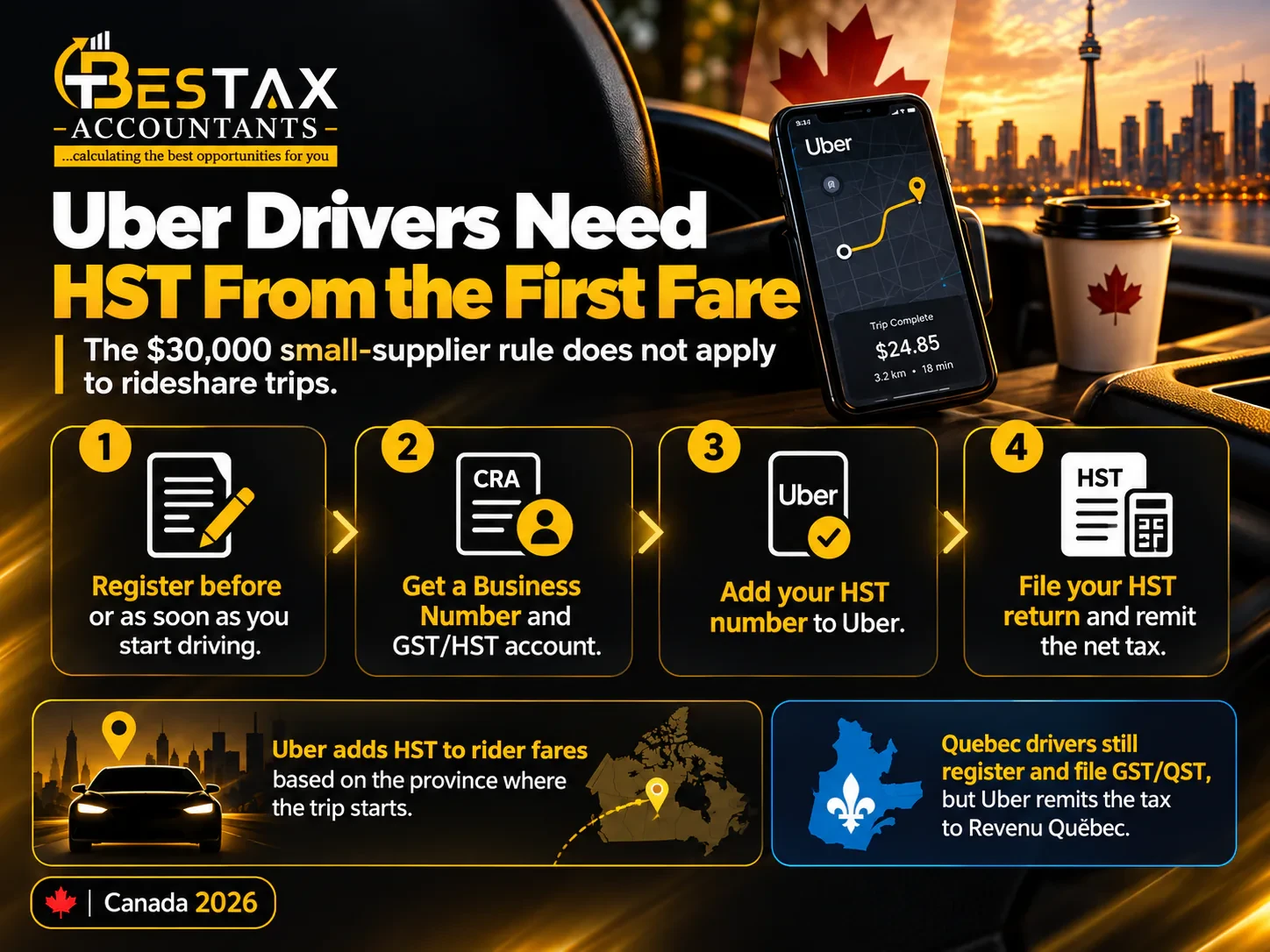
Yes. Since July 1, 2017, GST/HST applies to every commercial ride-share fare. CRA requires you to register even if you are a small supplier.
Mandatory HST Registration From the First Dollar
Most small businesses don't register until sales pass $30,000. That small-supplier threshold doesn't apply to ride-share drivers.
One trip is enough to trigger registration. It makes no difference whether you drive full time or only on weekends.
You get a business number and a GST/HST account through CRA's Business Registration Online, or by mailing Form RC1. Once you register for HST, add the number to your Uber account. Our guide on how to register for HST in Ontario walks through the application.
How Rideshare Driver HST Flows
You never charge riders HST yourself. Uber adds it to each fare on your behalf, at the rate of the province where the trip starts: 13% in Ontario, 14% in Nova Scotia, 15% in New Brunswick, Newfoundland and Labrador and PEI, and 5% GST elsewhere.
Outside Quebec, Uber pays that HST to you with your weekly earnings. It is not your money. You hold it and send the net amount to CRA when you file your HST return.
Quebec works differently. Uber collects GST and QST on your trips and remits them to Revenu Québec for you. You still register for both before your first trip and file a GST/QST return for each reporting period. Our Quebec GST and QST guide sets out the rates.
Tax Deductions Uber Drivers Can Claim
Every valid expense lowers your taxable profit. For most drivers, the car is the biggest deduction by far.
Your Vehicle Logbook
You can only deduct the business share of your car costs. To prove that share, CRA expects a vehicle logbook.
Record the date, trip purpose and kilometres for each business trip. Note your odometer reading on January 1 and December 31. Business kilometres divided by total kilometres gives your business-use percentage.
After one full year of logs, CRA lets you track a representative three-month sample in later years instead. Uber's summary shows your online kilometres, which helps, but it doesn't replace your own log.
Common Uber Driver Tax Deductions
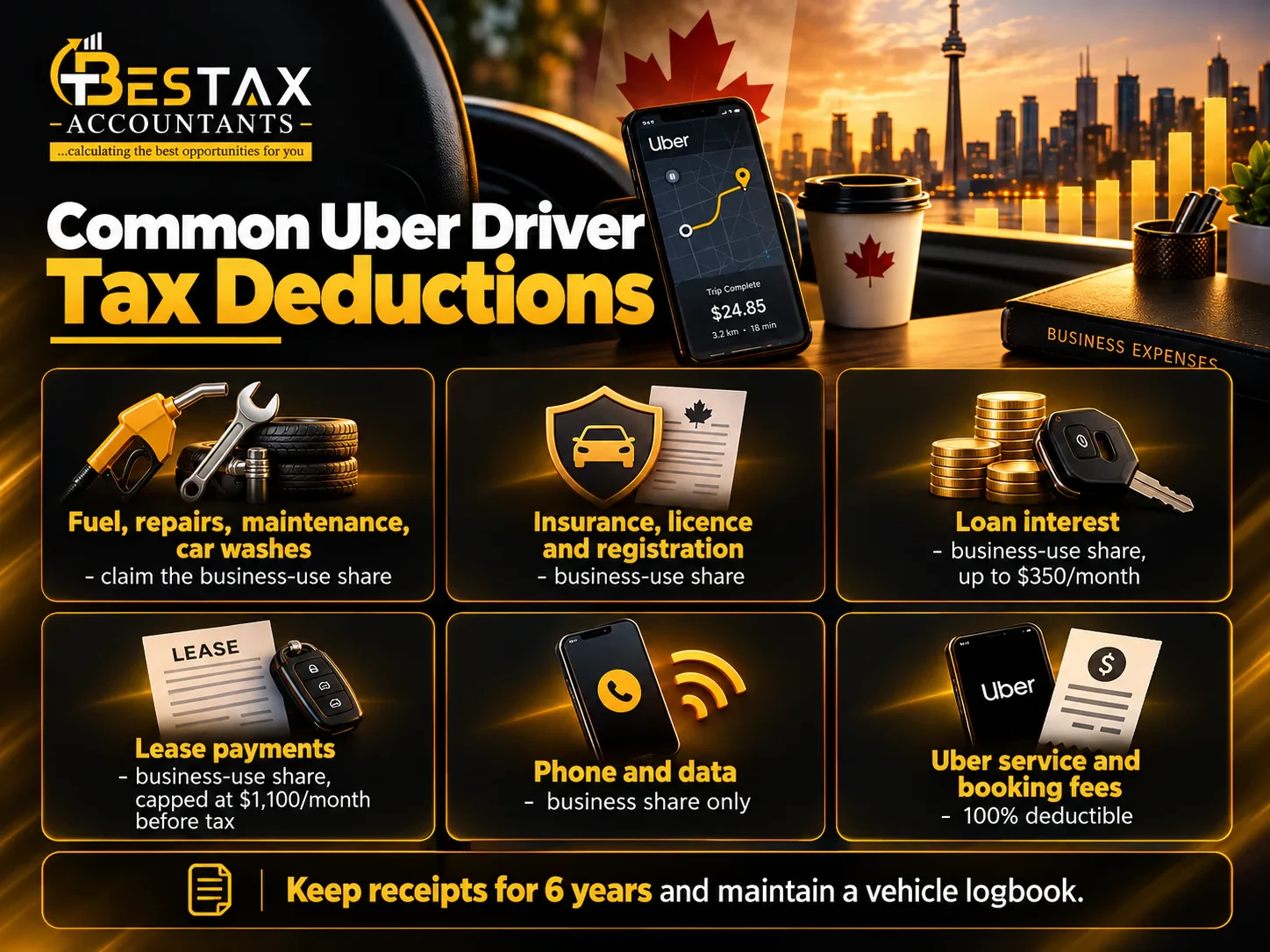
| Expense | How much you can deduct |
|---|---|
| Fuel, repairs, maintenance and car washes | Business-use percentage |
| Insurance (including rideshare coverage), licence and registration | Business-use percentage |
| Car loan interest | Business-use percentage, up to $350 a month |
| Lease payments | Business-use percentage, capped at $1,100 a month before tax for 2026 leases |
| Capital cost allowance (CCA) | Business-use percentage of the yearly CCA claim |
| Phone and data plan | Business share only |
| Uber service and booking fees | 100%, since they relate only to driving |
Keep receipts for six years. Tracking expenses every week, rather than once in April, keeps deductions from slipping through.
CCA Class 10 and Class 10.1
If you own your car, you claim its cost over time through CCA. Most cars go in Class 10, which allows 30% a year on a declining balance.
A car bought in 2026 for more than $39,000 before tax goes in Class 10.1 instead. The rate is still 30%, but CCA only applies to the first $39,000 plus tax. Zero-emission vehicles have a higher cap of $61,000.
The year you buy the car follows special first-year rules, so your first claim differs from later years. We confirm the current first-year rate when we prepare your return.
How to File Your HST Return as an Uber Driver
Your HST return tells CRA how much HST you collected and how much you owe. You can calculate it two ways.
Regular Method With Input Tax Credits
Take the HST Uber collected on your fares. Subtract input tax credits, which is the HST you paid on business expenses like fuel, repairs and Uber's fees. You remit the difference.
Apply your business-use percentage to car costs here too. If 70% of your driving is for Uber, you claim 70% of the HST on gas.
Insurance and loan interest carry no HST, so they give you no input tax credit. You still deduct them on your T2125.
The Quick Method
The Quick Method skips most of the tracking. You remit a flat rate of your HST-included fares instead.
For service businesses, the rate is 8.8% in Ontario and 3.6% if you are based in a province that only charges GST. You also get a 1% credit on the first $30,000 each year. To use it, your taxable sales must be $400,000 or less, and you file Form GST74 to elect it.
The catch is that you give up input tax credits on day-to-day expenses. You can still claim them on capital purchases, such as a car.
The HST you keep under the Quick Method is not tax-free. It counts as business income on your T2125.
Which Method Costs Less?
Here's an Ontario driver with $40,000 in fares and $1,800 of HST paid on business expenses:
| Item | Regular method | Quick Method |
|---|---|---|
| HST collected on fares | $5,200 | $5,200 |
| Calculation | $5,200 − $1,800 in input tax credits | ($45,200 × 8.8%) − $300 credit |
| HST to remit | $3,400 | $3,678 |
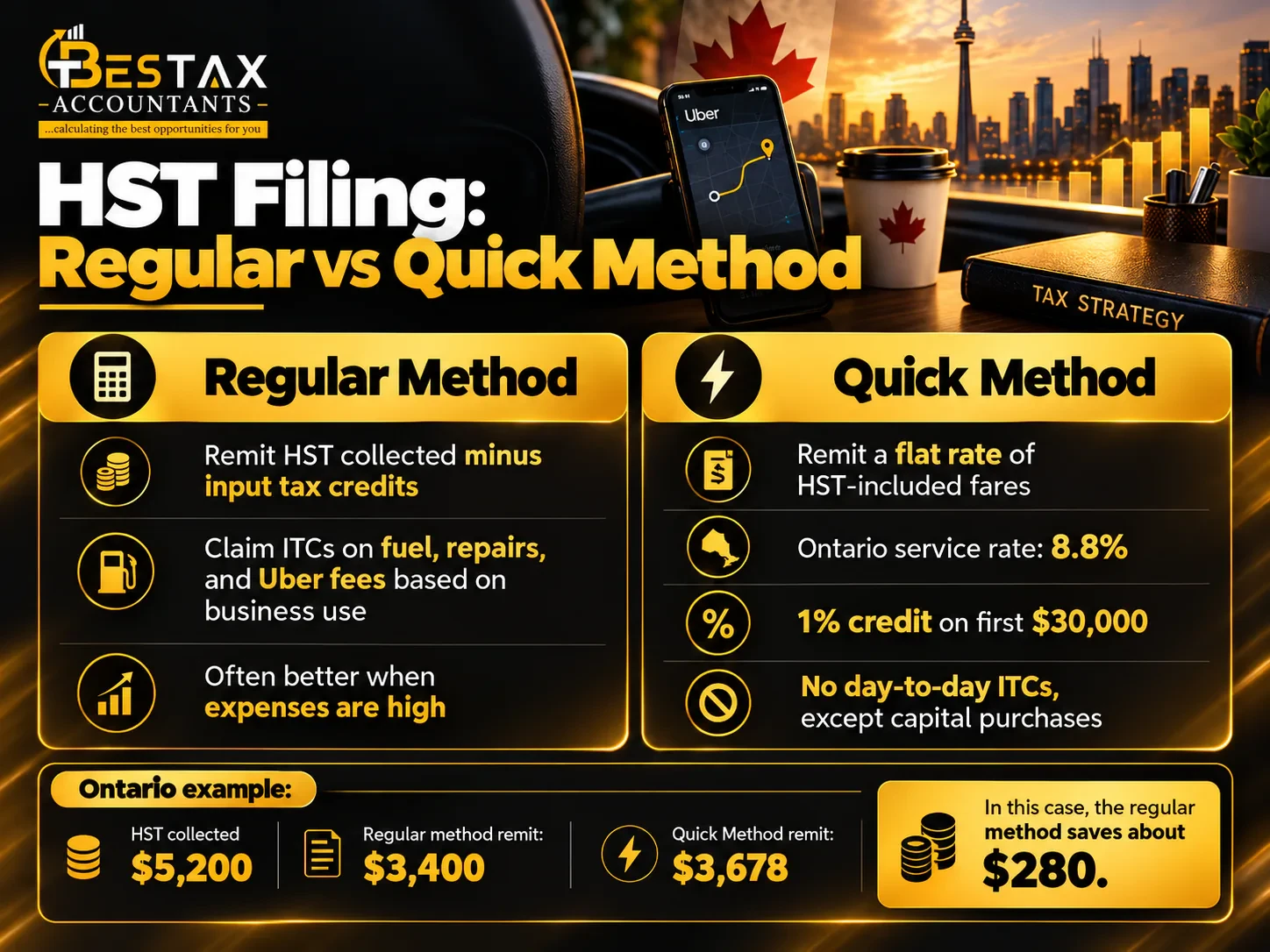
In this case, the regular method saves about $280. Drivers have high fuel and repair costs, so their input tax credits often beat the Quick Method.
Run both numbers before you elect, or have us file your GST/HST return and compare them for you.
Key Tax Deadlines for Uber Drivers
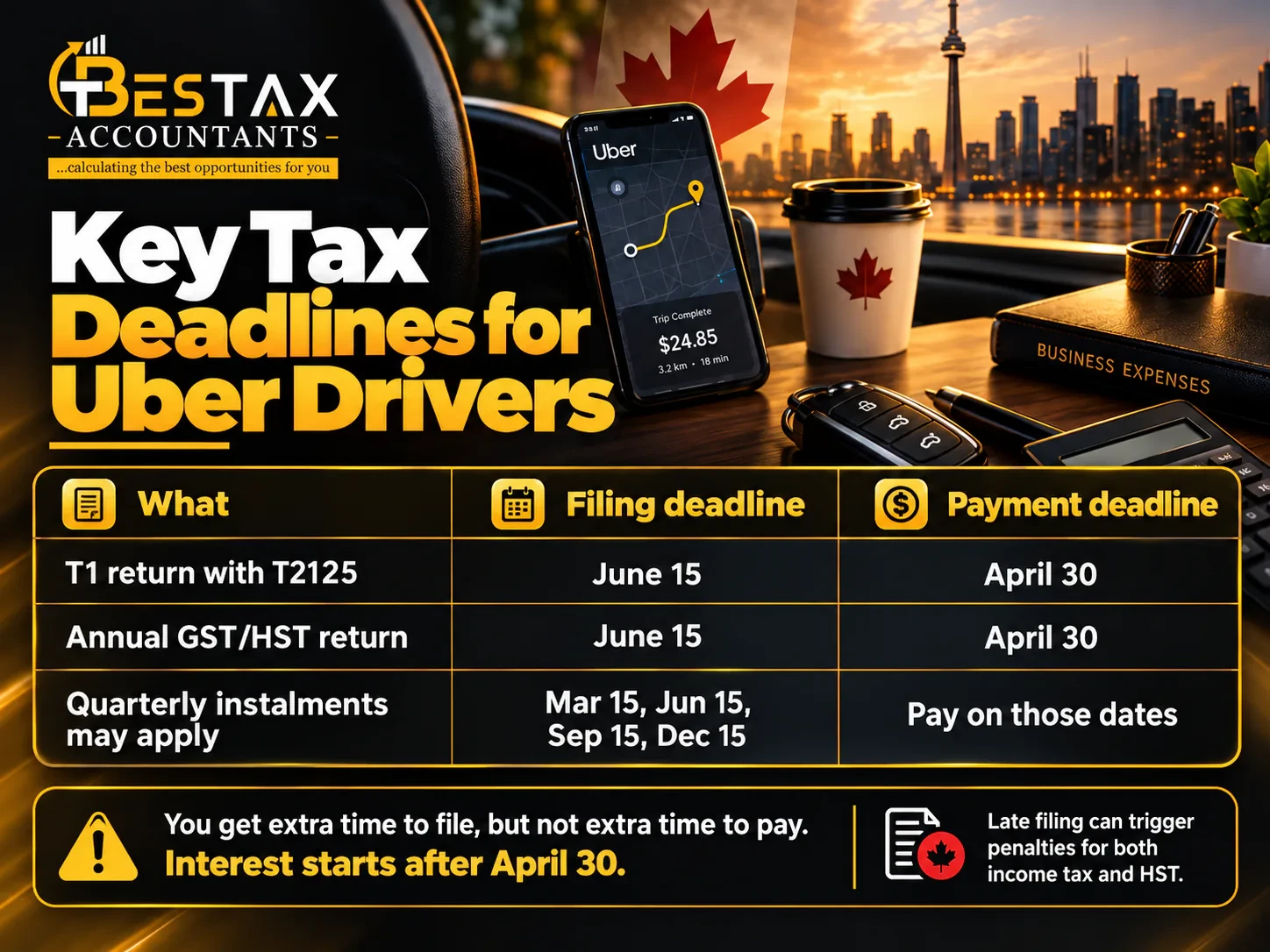
Self-employed drivers get extra time to file, but not extra time to pay. Interest starts on any balance still unpaid after April 30.
| What | Filing deadline | Payment deadline |
|---|---|---|
| Income tax return with T2125 | June 15 | April 30 |
| Annual GST/HST return | June 15 | April 30 |
These dates apply to most drivers, who use a calendar year and file HST annually. If you chose quarterly HST filing, each return is due one month after the quarter ends.
Filing late costs extra. CRA charges 5% of your income tax balance, plus 1% for each full month late, up to 12 months. A late HST return adds 1% of the amount owing, plus 0.25% for each full month late, up to 12 months. Our guide to the penalty for late tax filing in Canada covers repeat penalties and relief.
Instalments
Once you owe more than $3,000 in income tax, CRA may ask you to pay instalments. That happens when you hit this amount this year and in either of the previous two years. Quebec residents have a lower $1,800 threshold for federal tax.
Income tax instalments are due March 15, June 15, September 15 and December 15.
If you file HST annually and your net tax for the previous year was $3,000 or more, you also pay quarterly HST instalments. Set aside HST from every weekly payout, so the April bill is never a surprise.
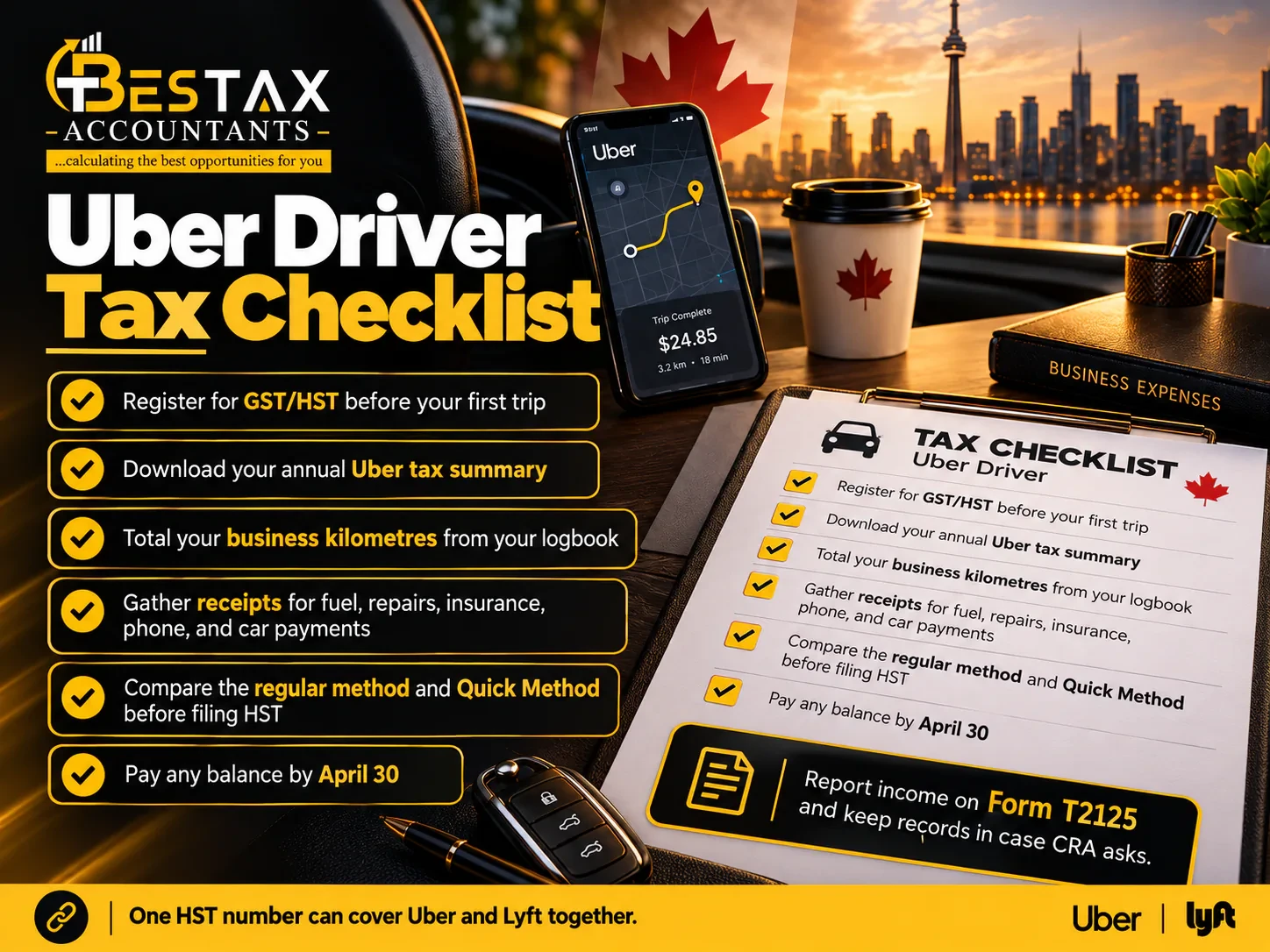
Uber Driver Tax Checklist
Run through this list before each tax season:
- Register for a GST/HST number before your first trip, and add it to your Uber account
- Download your annual Uber tax summary
- Total your kilometres from your vehicle logbook
- Gather receipts for fuel, repairs, insurance, your phone and car payments
- Compare the regular method and Quick Method before you file HST
- Pay any balance by April 30, even though you can file until June 15
Bestax works with Uber and Lyft drivers on HST registration, T2125 returns and annual HST filing. Book a call with our team and get your next filing done right.
Frequently Asked Questions
Do Uber Eats couriers need an HST number from the first dollar?
No. The first-dollar rule covers carrying passengers. Food delivery follows the usual $30,000 small-supplier threshold. If you do both rides and deliveries, you already need a number for the rides.
Are tips taxable?
Tips count as income, so include them on your T2125. Voluntary tips aren't subject to HST, though.
I drove without an HST number. What now?
Register now and file returns for the periods you missed. You still owe HST on those past fares, and CRA charges interest.
The Voluntary Disclosures Program can reduce what you pay. If you come forward on your own, CRA waives all penalties and 75% of the interest. If CRA contacted you first, you can still get up to 100% of penalties and 25% of interest waived.
I have a full-time job too. Do I still file a T2125?
Yes. Your employer's payroll deductions don't cover your Uber profit. Many part-time drivers owe tax in April for this reason.
Can I deduct driving that isn't for Uber?
No. Personal trips, like errands or driving to your day job, stay out of your claim. That's why the logbook matters.
Can I use CRA's per-kilometre rate instead of tracking expenses?
No. The per-kilometre rates are for employers paying car allowances to employees. Self-employed drivers deduct their actual costs, backed by receipts and a logbook.
I drive for Uber and Lyft. Do I need two HST numbers?
No. One business number and HST account covers every app. Add the same number to each one, and combine all your fares on one T2125 and one HST return.
Can I claim the HST I paid when I bought my car?
Yes, under the regular method. If you use the car 90% or more for business, you claim the full HST credit. Between 10% and 90%, you claim it gradually, based on the CCA you claim each year. At 10% or less, you get no credit. The Class 10.1 cost limit applies here too.
What if my expenses are higher than my fares?
You report a business loss. It can reduce your other income for the year, such as wages from a job. Losses year after year can draw CRA questions, so keep clean records.
Should I incorporate?
For most drivers, no. A corporation adds accounting costs and only saves tax when you leave profit in the company. Drivers who live on their earnings rarely benefit.
Disclaimer: The information provided in this blog is for general informational purposes only. For professional assistance and advice, please contact experts.

Written by
Olivia Chen
