


A cash flow statement is a financial report that shows how much real cash came into and went out of your business over a set period, and what that cash was used for. It turns profit on paper into the number that keeps a business alive: the money in your bank account.
It is one of the three core financial statements, alongside the income statement and the balance sheet. The income statement shows profit, the balance sheet shows what you own and owe on a given day, and the cash flow statement connects the two by tracking how cash moved between them.
For a Canadian business owner, this is the report that answers the most practical question of all: can I pay my people, my suppliers and the Canada Revenue Agency next month? This guide explains what the report contains, walks through a full example, and shows you how to prepare one, even if you have never read a financial statement before.
In Canada, a cash flow statement is a required part of a complete set of financial statements under both Accounting Standards for Private Enterprises (ASPE Section 1540) and International Financial Reporting Standards (IAS 7). If you are not sure which of the two applies to your company, our guide to ASPE vs IFRS explains the difference. Older Canadian records may call it the statement of changes in financial position, which is the historical name for the same report.
What Is on a Cash Flow Statement?
A cash flow statement is split into three sections, and each one answers a simple question about where your money moved.
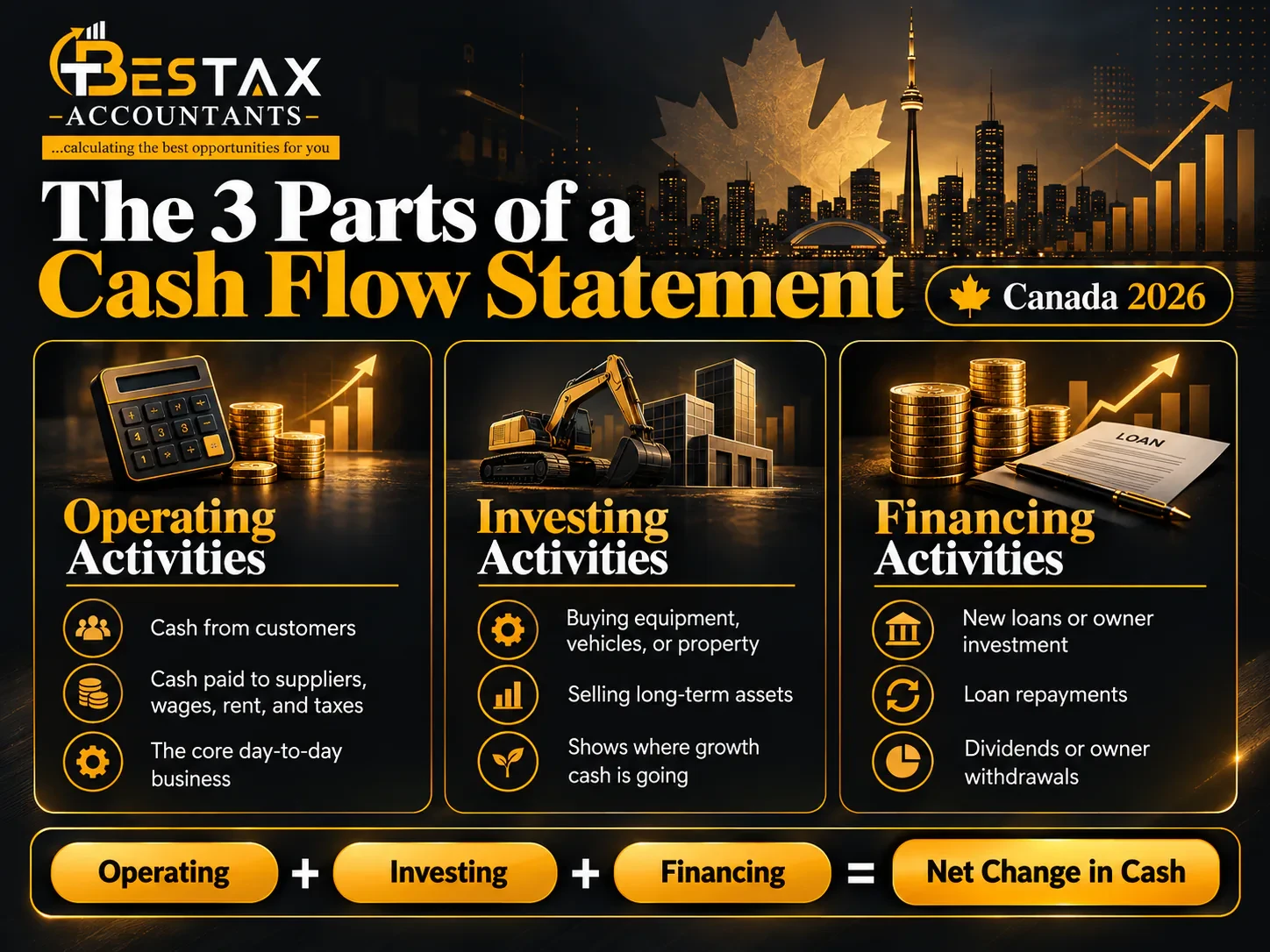
- Operating activities: cash from the day-to-day running of your business. Money from customers, minus money paid to staff, suppliers, rent and taxes. This is the engine of the business.
- Investing activities: cash used to buy or sell long-term assets. Buying equipment, a vehicle or property counts here, and so does selling them.
- Financing activities: cash exchanged with lenders and owners. New loans, loan repayments, money the owner puts in, and dividends paid out.
Below those three sections, the statement adds them together, applies the total to your opening cash balance, and shows your closing cash balance. That closing figure must match the cash line on your balance sheet.
A large public company uses the same three sections. The numbers get bigger and the notes get longer, but the structure of operating, investing and financing never changes.
The cash flow statement format
The sections always appear in the same order, so once you know the format you can read any company's statement. Here is what belongs in each one.
| Section | What it covers | Cash coming in | Cash going out |
|---|---|---|---|
| Operating activities | The core business, day to day | Payments from customers | Wages, rent, supplier bills, GST/HST, income tax |
| Investing activities | Long-term assets | Selling equipment or property | Buying equipment, vehicles, property |
| Financing activities | Lenders and owners | New loans, owner investment | Loan repayments, dividends, owner withdrawals |
The rule behind the format never changes. Operating cash plus investing cash plus financing cash equals the net change in cash for the period. Add that net change to your opening cash and you land on your closing cash. If it does not tie back to your bank statement, something is missing.
A well-built cash flow statement lets you see at a glance whether your core business is funding itself, or whether you are quietly living on loans and owner money.
Why Profit and Cash Are Not the Same
Profit and cash are different numbers, and the gap between them is the reason the cash flow statement exists. Your income statement can show a healthy profit while your bank account runs dry, because profit includes sales you have invoiced but not yet collected, and it ignores cash spent on equipment or loan repayments. The cash flow statement strips all of that away and shows only the cash that actually moved.
A quick way to picture it: the income statement is a promise of money, and the cash flow statement is the money itself. A business can look profitable and still fail if the cash arrives too late to cover the bills. That gap is one of the most common reasons healthy-looking companies get into trouble.
Our guide to the income statement explains where the profit figure comes from, and it is the natural companion to this one.
Cash Flow Statement Example
Here is a full cash flow statement example for a fictional Canadian company, Maple Lane Consulting Inc., for the year ended December 31, 2025. It uses the indirect method, which is the approach most Canadian private companies use.
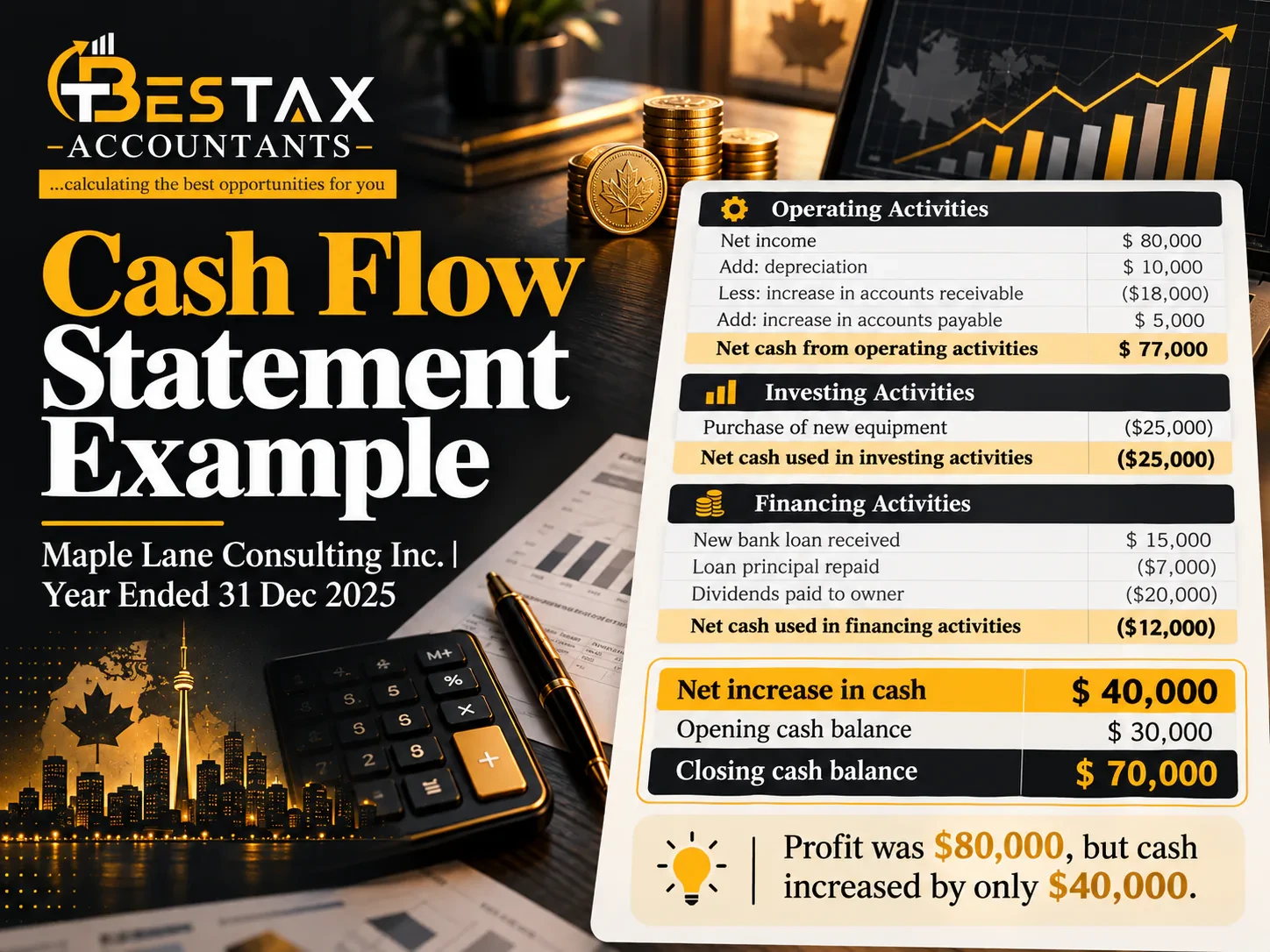
| Maple Lane Consulting Inc. | Amount (CAD) |
|---|---|
| Operating activities | |
| Net income | 80,000 |
| Add: depreciation (a non-cash expense) | 10,000 |
| Less: increase in accounts receivable | (18,000) |
| Add: increase in accounts payable | 5,000 |
| Net cash from operating activities | 77,000 |
| Investing activities | |
| Purchase of new equipment | (25,000) |
| Net cash used in investing activities | (25,000) |
| Financing activities | |
| New bank loan received | 15,000 |
| Loan principal repaid | (7,000) |
| Dividends paid to owner | (20,000) |
| Net cash used in financing activities | (12,000) |
| Net increase in cash | 40,000 |
| Opening cash balance (January 1, 2025) | 30,000 |
| Closing cash balance (December 31, 2025) | 70,000 |
What the example shows
Maple Lane earned $80,000 in profit, but its cash grew by only $40,000. Where did the other $40,000 go? Customers still owed $18,000 at year-end, $25,000 went into equipment, and $27,000 went back to the lender and the owner. Partly offsetting those outflows, $10,000 of depreciation was added back because it is an accounting expense with no cash attached, suppliers extended $5,000 of credit, and a new $15,000 loan came in.
That is the whole point of a cash flow statement. Profit tells you the business did well. Cash flow tells you what that success actually did to your bank balance.
How to Prepare a Cash Flow Statement in 6 Steps
Most Canadian businesses use the indirect method, which builds the report from figures you already have. You start with profit and adjust it back to cash.
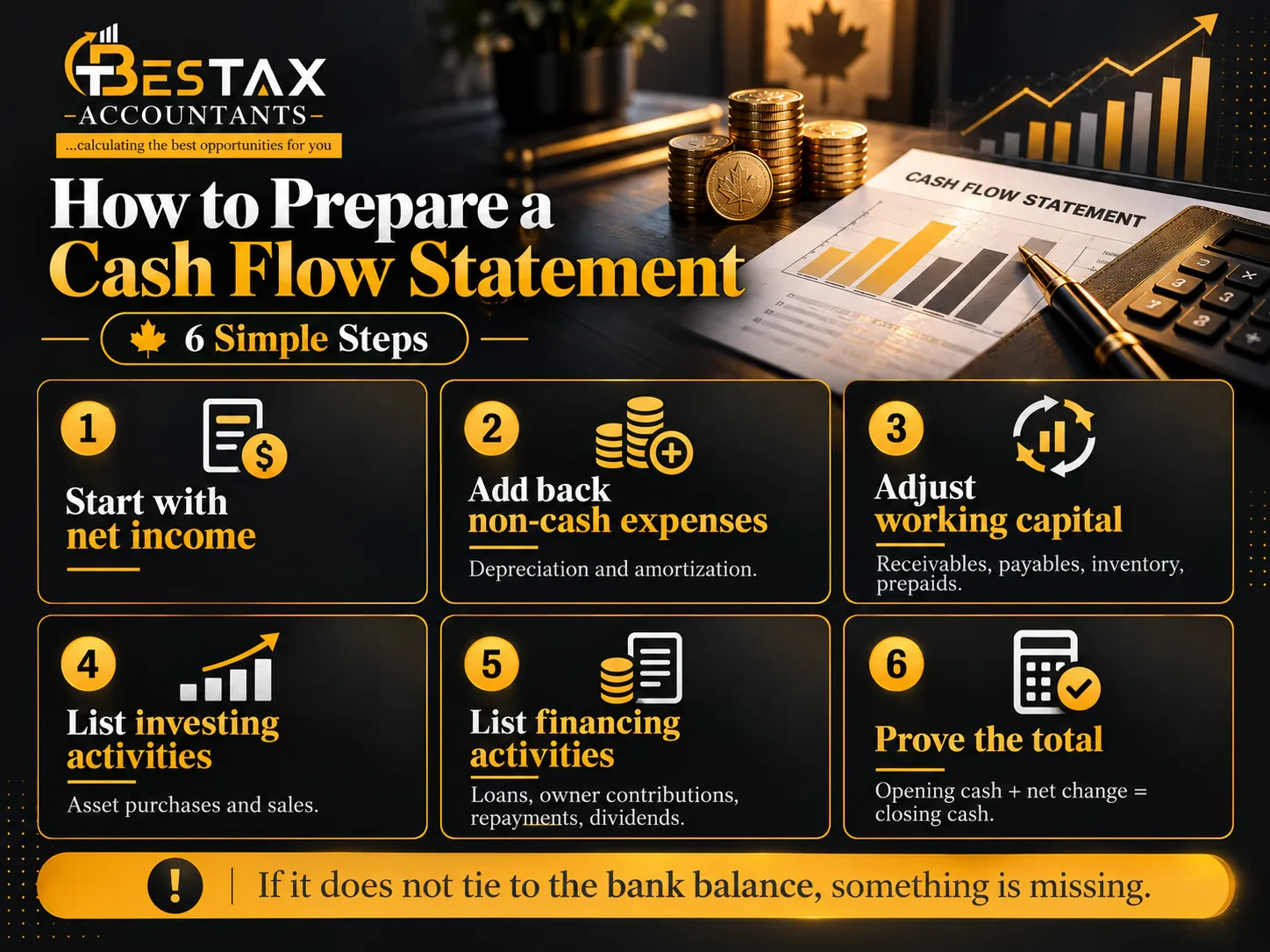
- Start with net income. Take the bottom-line profit from your income statement. Starting here links the cash flow statement directly to a report you already produce.
- Add back non-cash expenses. Depreciation and amortization reduced your profit, but no cash left the business, so add them back.
- Adjust for changes in working capital. If accounts receivable went up, customers owe you more, so subtract the increase. If accounts payable went up, you are holding on to supplier cash, so add it. Do the same for inventory and prepaid expenses.
- List your investing activities. Add any cash from selling assets and subtract cash spent buying them.
- List your financing activities. Add new loans and owner contributions, then subtract loan repayments, dividends and withdrawals.
- Prove the total. Add the three section totals to your opening cash. The result must equal your closing cash and match your bank balance. If it does not, an entry is missing or misclassified.
This method is reliable because every adjustment traces back to a specific line in your books. If your books are messy, the statement will not balance, which is why clean accounting and bookkeeping comes first. If your records have fallen behind, backlog accounting brings them up to date before the statement is prepared.
Direct vs Indirect Method
There are two accepted ways to present operating cash flows, and knowing both helps you understand what the report is doing.
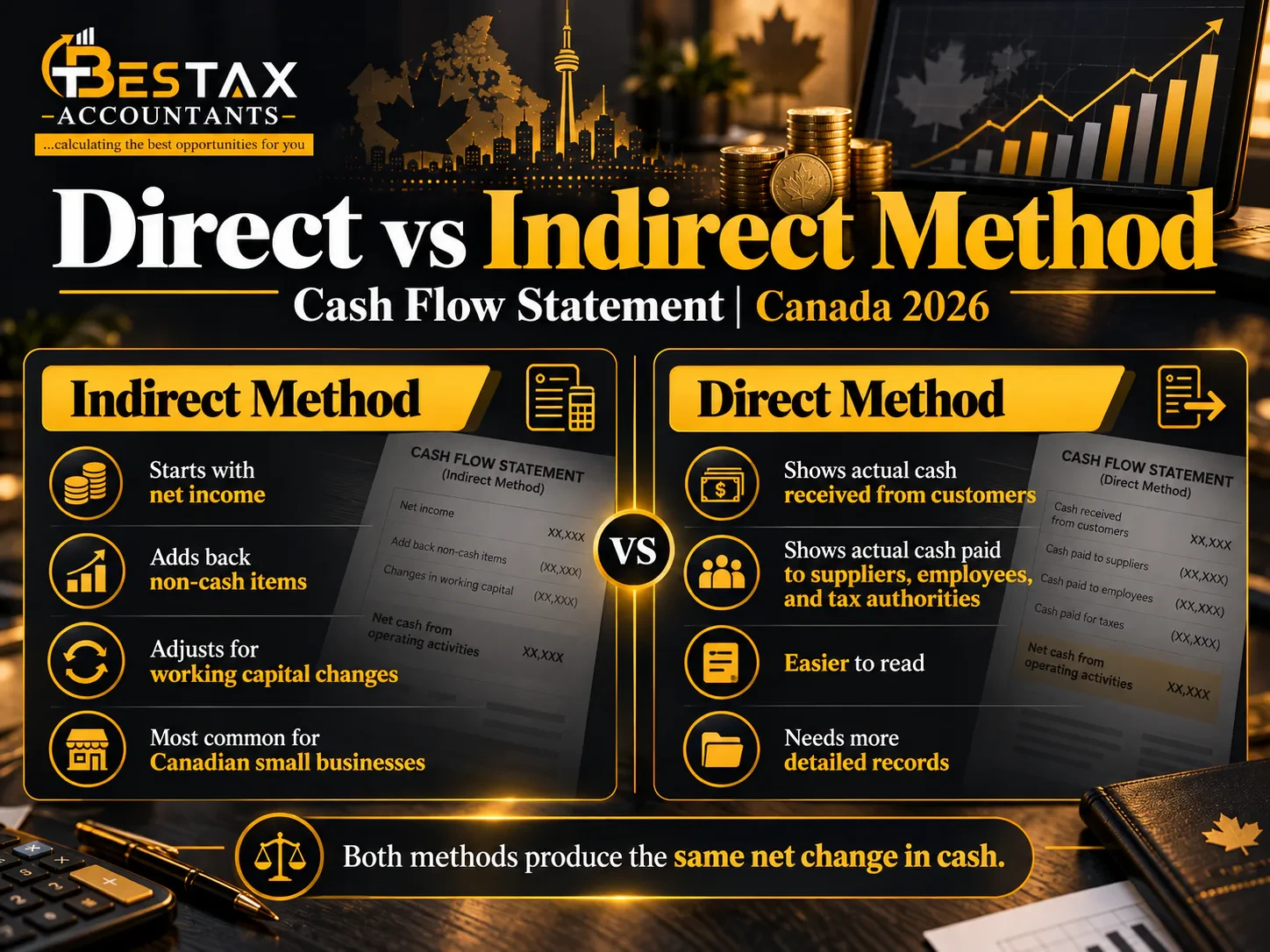
- Indirect method. Starts with net income and adjusts for non-cash items and working capital changes, as shown above. It is the most common choice for small and medium Canadian businesses because it flows naturally from the income statement.
- Direct method. Lists actual cash received from customers and actual cash paid to suppliers, employees and tax authorities. It is easier to read but takes more detailed record keeping.
Both methods produce the same net change in cash. Only the operating section looks different. Investing and financing activities are presented the same way under either approach, so once you can prepare the indirect version, the direct method is a short step away.
Behind both methods sits the logic of double-entry accounting, which is why every cash movement can be traced and proven.
Monthly and Projected Cash Flow Statements
The annual version tells you what happened. Two other versions help you stay ahead of trouble.
Monthly cash flow statement
A monthly cash flow statement breaks the same three sections down month by month. It warns you that a cash squeeze is coming before it lands, for example when a slow-paying client and a tax deadline fall in the same month. Reviewing one every month is one of the strongest habits an owner can build.
Projected cash flow statement
A projected cash flow statement, often called a cash flow forecast, does the same thing for the future. You estimate money coming in and going out over the coming weeks or months, so you can plan for shortfalls, time large purchases and decide when you can afford to hire. Lenders and investors usually ask to see a forecast, and it belongs in every business plan.
Templates to get started
You do not need special software to begin. A spreadsheet with the three standard sections is enough to track inflows and outflows, and the Business Development Bank of Canada offers a free cash flow statement template. When you want someone else to produce the numbers, our monthly and quarterly financial reporting service includes a cash flow summary in every reporting package.
Why the Cash Flow Statement Matters for Canadian Businesses
Cash, not profit, is what carries a business through its early years. According to Innovation, Science and Economic Development Canada's Key Small Business Statistics 2025, about 69.7 percent of goods-producing businesses and 67.5 percent of services-producing businesses are still operating five years after they start. By the ten-year mark, roughly 52.0 percent of goods producers and 47.2 percent of services producers remain. Staying on the right side of those numbers depends heavily on managing the cash that a cash flow statement makes visible.
Owners and lenders watch this report closely because it moves with the wider economy. The Business Development Bank of Canada's Canadian Small Business Health Index for the first quarter of 2026 found that 32 percent of small and medium businesses expected their cash flow to improve over the next twelve months, up from 26 percent the previous quarter, while the share expecting a decline fell from 20 percent to 14 percent.
Reading your own cash flow statement regularly tells you three things fast:
- Whether your core operations generate enough cash to fund themselves.
- Whether growth is quietly eating your cash through rising receivables and inventory.
- Whether you are leaning on debt or owner money to stay afloat.
Common Cash Flow Statement Mistakes
These are the errors we correct most often when we take over a new client's books.
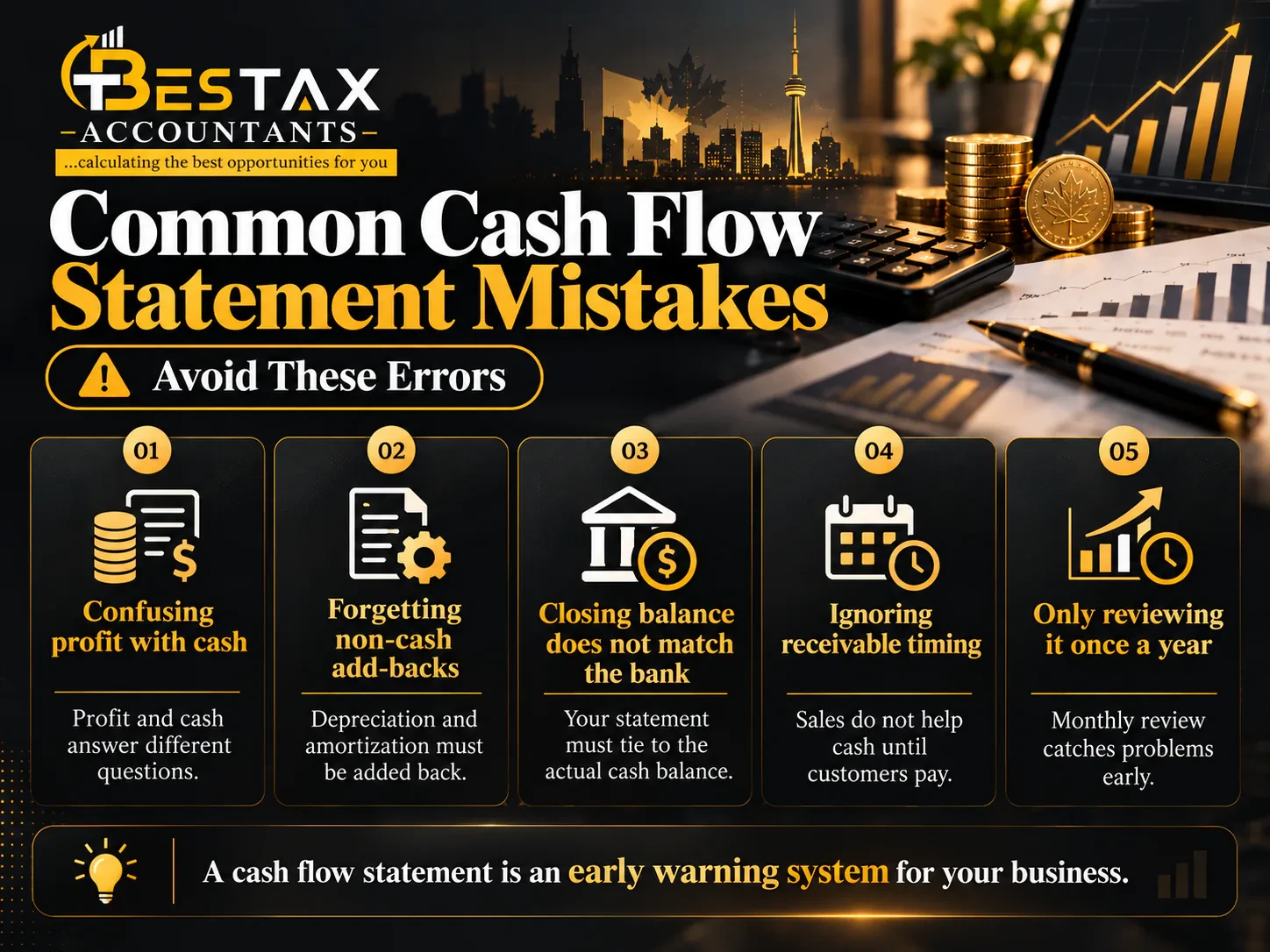
- Confusing profit with cash. A profitable business can still run out of money. The two reports answer different questions and both matter.
- Forgetting non-cash add-backs. Leaving out depreciation and amortization is one of the most common reasons an operating section is wrong.
- A closing balance that does not match the bank. If your cash flow statement does not tie back to your actual bank balance, it is not finished.
- Ignoring the timing of receivables. Booking a big sale feels great, but if the cash arrives in ninety days, the cash flow statement is what reveals the gap.
- Only doing it once a year. By the time the annual statement is ready, a cash problem is months old. A monthly review catches it early.
We check every one of these before we finalize a set of financial statements, not after a problem has already cost the owner money.
What Is Changing in 2027: IFRS 18
One change is worth flagging for businesses that report under IFRS. A new standard, IFRS 18, takes effect for annual reporting periods beginning on or after January 1, 2027. It amends IAS 7 and changes how the cash flow statement is presented in two ways.
- A new starting point. Under the indirect method, the reconciliation must start from operating profit or loss, a new IFRS 18 subtotal. Until now it started from profit or loss, which many companies presented as profit before tax.
- Fixed homes for interest and dividends. For companies without a specified main business activity, meaning companies other than banks, investment entities and similar businesses, interest and dividends received go to investing activities and interest paid goes to financing activities, removing the old policy choices. Dividends paid go to financing for all entities. For entities whose main business is investing in assets or providing financing to customers, interest received, interest paid and dividends received follow their classification in the income statement.
Most Canadian private companies use ASPE Section 1540 and are not affected by this change. If your company reports under IFRS, though, comparative figures must be restated, so preparation should begin well before 2027. We track standards like this so your reporting stays compliant without you having to follow every technical update.
How Bestax Helps You Manage Your Cash Flow
Understanding a cash flow statement is one thing. Producing an accurate one every month, on top of running your business, is another. That is where our team comes in.
Bestax serves businesses in Canada and the UAE. Our monthly and quarterly financial reports include a profit and loss statement, a balance sheet and a cash flow summary, with comparisons to prior periods and short commentary on what changed, so you always know what your bank balance is likely to do next.
Our work covers the full picture: bookkeeping that keeps your records clean, financial reports that track your cash, and tax filing and planning that keeps the CRA paid on time. You can prepare a basic cash flow statement yourself from clean books, but an accountant makes sure the classifications are correct, the statement ties back to your bank balance, and it stands up to lender and CRA scrutiny. Whether you need someone to build your first cash flow statement or to run your reporting every month, we make the numbers simple and the decisions clear.
Frequently Asked Questions
What is a cash flow statement in simple terms?
A cash flow statement is a report that shows how much cash actually moved in and out of your business over a period, and where it went. It groups every cash movement into three buckets, operating, investing and financing, then shows your opening and closing bank balance. In plain terms, it tells you whether your business made money in the bank, not just on paper.
What is the difference between a cash flow statement and an income statement?
The income statement shows profit, including sales you have invoiced but not yet collected. The cash flow statement shows only cash that actually moved. A business can post a profit on its income statement while its cash flow statement shows the bank balance falling, usually because customers are slow to pay or the company bought assets. You need both to see the full picture.
How do you prepare a cash flow statement from net income?
Start with net income, then add back depreciation and amortization, because no cash left the business for them. Adjust for working capital: if receivables rose, subtract the increase, and if payables rose, add it. Do the same for inventory and prepaid expenses. That gives your cash from operations. Add your investing and financing cash flows, then add the total to your opening cash. The result should equal your closing bank balance.
What is the difference between the direct and indirect method?
The indirect method starts with net income and adjusts it back to cash, and it is the most common choice for Canadian small businesses. The direct method lists actual cash received and paid instead. Both produce the same net change in cash, and only the operating section looks different, so you can use whichever suits your records.
Is a cash flow statement required in Canada?
Yes, for a complete set of financial statements. Under Accounting Standards for Private Enterprises, Section 1540 requires it, and under IFRS it is required by IAS 7. Even when a very small or inactive company does not prepare full financial statements, a cash flow statement is still worth having because it is the clearest early warning of a cash problem.
What is the difference between a monthly and a projected cash flow statement?
A monthly cash flow statement shows how your cash actually moved during the past month, so you can spot a squeeze before it becomes a crisis. A projected cash flow statement, also called a cash flow forecast, estimates cash coming in and going out over future weeks or months. It helps you plan for shortfalls and time large purchases, and lenders and investors usually ask to see one before they commit funds.
Where can I get a cash flow statement template?
The Business Development Bank of Canada offers a free cash flow statement template, and a simple spreadsheet works too. Whichever you use, it should separate operating, investing and financing activities and reconcile opening cash to closing cash.
Can a profitable business have negative cash flow?
Yes, and it happens often. A business can be profitable while its cash flow is negative because it is waiting on customer payments, holding too much inventory, or spending heavily on equipment and loan repayments. This is exactly why the cash flow statement exists. Profit alone can hide a real cash shortage.
Disclaimer: The information provided in this blog is for general informational purposes only. For professional assistance and advice, please contact experts.

Written by
Neha Ghauri
